Author Archives: Max van Balgooy

Unknown's avatar

About Max van Balgooy

President of Engaging Places LLC, a design and strategy firm that connects people to historic places.

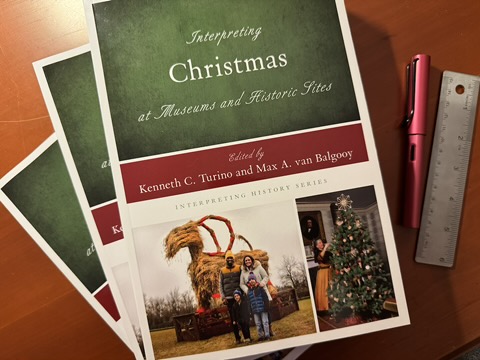
Join Today’s Museum People Call on Interpreting Christmas at Museums!

Are you ready to explore how the holiday season can transform your museum? Today at 12 pm Central Time (1 pm Eastern), the Illinois Association of Museums is hosting its monthly “Museum People Call”, and this month’s topic is Christmas at Museums and Historic Sites!

I’ll be joined by Ken Turino, my co-editor of the new AASLH book series Interpreting Christmas at Museums and Historic Sites, to discuss how your organization can leverage the holiday season to its fullest potential.

We’ll cover key topics to help you:

  • Leverage the holiday season to attract visitors and engage your community.
  • Increase financial stability through creative programming, gift shop sales, and end-of-year giving campaigns.
  • Enhance cultural sensitivity and inclusivity, ensuring your holiday interpretation is meaningful and welcoming to diverse audiences.

Whether your site has a long history of holiday programming or you’re just starting to explore the possibilities, this session will offer practical tips and inspiring ideas to align holiday traditions with your mission.

🎄 Join Us on Zoom 🎄
Click here to join the meeting
Meeting ID: 861 3328 4346

Let’s come together to make the holiday season brighter, more inclusive, and impactful for your museum and its visitors. We look forward to seeing you there!

PS. On Wednesday, December 25, the Gilded Age and Progressive Era podcast will release an interview about the Interpreting Christmas book with me, Ken, and Lenora Henson, formerly director of the Theodore Roosevelt Inaugural Historic Site in Buffalo, New York.

Discovering Inspiration: Innovative Ideas from Texas Museums

Last week, Ken Turino and I conducted two “Reimagining House Museums” workshops in Mesquite (near Dallas) and Houston. These sessions sparked meaningful conversations about the future of house museums, but the inspiration didn’t stop there. We used our free time to visit several nearby museums, each offering unique approaches that left us thinking about how museums can better serve their audiences. Here are some standout ideas we discovered:

1. Personalizing Donor Recognition and Wayfinding at the Perot Museum of Science and Nature

The Perot Museum caught our attention with its donor wall, which didn’t just list names but included statements of intent from the donors. This added a personal touch, connecting visitors with the motivations behind the support. Another smart detail: wayfinding signage that directed visitors to “more cool exhibits.” This casual yet engaging language was both clear and inviting, proving that small touches can make a big impact.

Donor wall with statements of intent at the Perot Museum in Dallas.
Continue reading

Sustainable Museums in Action: Key Takeaways from the NEMA Conference

This session on the sustainability initiatives at the Rhode Island School of Design Museum was among the first sessions at NEMA 2024.

Last week I attended the New England Museum Association 2024 Conference in Newport, Rhode Island. About 800 museum professionals attended over the three days of sessions, vendor displays, professional affiliation group meetings, and receptions. The weather was sunny and sixties, surprisingly warm for the first week of November. Without the crowds of summer, it made Newport much more pleasant.

The conference offered numerous sessions on sustainability, and I’m attending as many as possible in preparation for my upcoming course, “Creating Sustainable Museums,” at George Washington University this spring.

In the session “Climate Emergency and Sustainability Taskforce at RISD,” several staff members from the Rhode Island School of Design Museum shared insights on their in-house sustainability efforts. What began as informal conversations among a few staff members evolved into a formal task force that resulted in the “Take Care” exhibition. Staff from all areas of the museum—not only curators and educators—selected objects from the collection and created interpretive labels addressing sustainability themes. In addition to this curatorial approach, the museum implemented practical sustainable practices, including standardizing frame sizes, reusing exhibition cases, turning off cameras in virtual meetings, and eliminating admission stickers and vinyl lettering.

Continue reading

Beyond the Mill: Clarke County Historical Association’s Model for Modern Historical Programming

The Burwell-Morgan Mill in Berryville, Virginia, which hosts the Art in the Mill shows in fall and spring.

On a recent road trip through the Shenandoah Valley, we passed through the small but charming village of Millwood (south of Berryville, Virginia). With its historic church, a corner gas station turned into a post office, a hip country store, and an 18th-century stone grist mill, it feels like you’ve stepped back into mid-century America. The mill, dating back to the 1780s, ceased operations in 1943, but thankfully the Clarke County Historical Association (CCHA) stepped in to preserve this important piece of local history. They restored and reopened the mill as a museum, offering milling demonstrations that continue to connect the community with its past—a business that, while no longer economically viable, resonates deeply with those of us who value local landmarks.

Fast forward 80 years, and the CCHA not only continues to produce flour at the mill but has expanded its offerings in creative and impactful ways for a county with 15,000 residents. Today, their mission—”to help preserve the historic resources and records of Clarke County and to foster their use, understanding, and enjoyment through stewardship and education”—may sound familiar, but their approach is anything but ordinary. Their programming stands out as a model for how historical societies can evolve, attract diverse audiences, and ensure long-term sustainability. Here’s a preview of some of the exciting events and initiatives they have planned for this fall:

Continue reading

Unwrap Fresh Ideas on Interpreting Christmas at History Hour on November 26

Looking for new ideas to bring the magic of Christmas into your museum or historic site? Join us on Tuesday, November 26 at 3 p.m. Eastern for an engaging session of AASLH’s History Hour, where we’ll explore the many ways museums and historic sites are interpreting Christmas. It’s free to participate however pre-registration is required.

History Hour is a free, monthly online networking event hosted by the American Association for State and Local History that has grown from 6 participants in January to nearly 230 this month! It’s a fantastic way to connect with colleagues from around the country, share ideas, and pick up fresh tips.

I’ll be co-hosting with Ken Turino, and we’ll be diving into themes from our new book, Interpreting Christmas at Museums and Historic Sites, released in September. During the session, we’ll briefly introduce the topic and then jump into small group discussions where participants can talk through questions like:

  • How can historical and cultural traditions in your local communities be woven into your Christmas programs?
  • How have partnerships and sponsorships shaped your Christmas programming?
  • How do you ensure your Christmas interpretation aligns with your organization’s mission while staying relevant to today’s audience?
  • Given the diversity of Christmas traditions, how do you decide what to include or exclude in your interpretation?
  • What small steps have you taken to reinterpret Christmas at your site, and how have those changes influenced long-term planning?

After 30 minutes of lively group discussion, we’ll come together as a large group to share insights and takeaways. It’s a wonderful opportunity to gain new perspectives and learn from your peers.

Whether you’ve been interpreting Christmas for years or are just beginning, we’d love to have you join us for this festive and thoughtful event. Mark your calendar for November 26, and come ready to discuss your ideas and challenges!

Discover Projection Mapping: A New Way to Engage Museum Visitors

As museums continue to evolve, so do the tools we use to connect with our audiences. Projection mapping is creating new opportunities to bring stories and objects to life. Although it’s been used for decades, it is increasingly adopted by museums and historic sites. I’m excited to share my new video, now available on YouTube, where I explore some fascinating projection mapping experiences in museums that I encountered while on the road this past year.

In this video, I take you through the basics of projection mapping, explaining how it works and offering real-world examples of its use in museums and historic sites in England, Italy, and the United States. From the virtual ledger of servants at Kensington Palace to the immersive storytelling at the Capitoline Museums in Rome, projection mapping is proving to be a versatile tool for creating memorable and educational museum experiences.

Whether you’re familiar with projection mapping from iconic attractions like the Haunted Mansion at Disneyland, or this concept is new to you, the video is designed to inspire museum professionals to think creatively about how to integrate this technology into exhibitions, tours, and programs. I’ll also show how more advanced applications, like the complex presentations at the Handel Hendrix House, are pushing the boundaries of how we engage with historical spaces and objects.

Projection mapping is about more than just projecting images—it’s about creating interactive, immersive environments that deepen the visitor’s connection with museum collections.

Check out the video now and see how your museum can harness the power of projection mapping to enhance visitor engagement and interpretation. Just be aware that it’s a handcrafted video that took me two days to edit and narrate, but it’s a topic better explained in a video than in text.

Watch the full video here: https://youtu.be/c3WX7kdD0Jg

I look forward to your comments and learning how you might use projection mapping in your own work!

Reimagining Historic House Museums Workshops Coming to Texas

Reimagining workshop in St. Louis, Missouri.

I’m excited to announce that I’ll be co-teaching two Reimagining the Historic House Museum workshops in Texas this November with Ken Turino, hosted by the American Association for State and Local History in collaboration with the Texas Historical Commission. It’s a big state, so we’re offering it twice! If you’re a museum professional, volunteer, or student interested in exploring fresh strategies for engaging visitors and revitalizing historic house museums, these workshops are a great opportunity to explore new ideas and connect with colleagues.

Why Attend?

Historic house museums are at a pivotal moment, navigating changes in visitor expectations, community needs, and funding models. These workshops are designed to help you tackle these challenges, offering practical solutions for making your house museum more accessible, sustainable, and relevant. By focusing on innovative interpretation, strategic planning, and community engagement, you’ll be empowered to breathe new life into your historic house museum.

What You’ll Learn

This one-day, hands-on workshop explores the most pressing challenges and rewarding opportunities facing historic sites in America today. We’ll delve into the latest social and economic research to help you identify how these trends impact your own house museum, sparking new ideas for growth and engagement.

Throughout the day, we’ll introduce a variety of field-tested tools and techniques drawn from diverse areas like non-profit management, business strategy, and even software development. You’ll hear about innovative historic sites that are successfully adopting new models to engage their communities, offering fresh interpretation and programming, and generating income to boost financial sustainability.

A key highlight of the workshop is our facilitated brainstorming session based on Michael Porter’s Five Forces framework, where you’ll work with fellow participants to reinvent an event or program for an actual house museum. This practical exercise not only puts theory into action but also showcases the power of collaborative thinking to drive change.

Details and Registration

  • Mesquite Workshop (near Dallas): November 12, 2024 – Heritage Plaza Visitor Center
  • Houston Workshop: November 14, 2024 – Bayou Bend Collection and Gardens
  • Cost: $350 for non-members, $225 for AASLH members
  • Registration: Visit AASLH’s website for more information and to sign up. Participation is limited.

I hope to see you there as we explore how to bring new life and relevance to historic house museums. Together, let’s make these vital cultural spaces vibrant, engaging, and sustainable for generations to come!

Decolonization in London Museums: A Firsthand Look at Progress and Challenges

During my recent visit to several London museums, I was struck by the growing emphasis on decolonization. As a museum professional, I’ve been following this movement for some time, but seeing these efforts firsthand inspired me to reflect on the challenges and progress being made. Some London museums are actively re-examining their collections and narratives, working to address the complex legacies of colonialism in tangible ways, and both Royal Collections and the National Trust have staff members specifically focused on this issue. But others have a long way to go.

If you’re not familiar with decolonization, it’s the process of rethinking and revising interpretations that have historically favored the perspective of a dominant power, such as an imperial empire over a colonized nation (like Great Britain and India). However, decolonization goes beyond the empire-colony dynamic, addressing any situation where one perspective is elevated due to power imbalances. For instance, terms like “prehistory” suggest a time without history, labeling settlers as “pioneers” overlooks the people who were already living in those areas, and describing conquering armies bringing “civilization” implies they were superior to the existing cultures. Words shape our perceptions and carry significant consequences, influencing relationships across race, gender, and other social divides. Decolonization helps us recognize and correct these biases, leading to more inclusive and accurate narratives.

For an example of a museum waiting to undertake a re-examination of its exhibitions, consider Osborne House (operated by English Heritage), the country palace of Queen Victoria and Prince Albert. The displays in and around the Durbar Room discuss Britain’s relationship with India. The exhibitions include a panel about Maharaja Duleep Singh and that “his properties and treasures, including the Koh-i-Noor diamond, had to be surrendered in return for a pension from the British Government” and feature gifts sent from India to Queen Victoria to “show their loyalty to the queen.” The history is far more complex and this exhibition emphasizes only the British perspective and continues a mythology of India’s grateful subservience to the Queen.

1. Re-examining Collections

Many London museums are conducting in-depth reviews of their collections to identify items acquired during the colonial era. This process includes acknowledging the contexts in which objects were collected, often under unequal power dynamics. They are being more transparent about the provenance of key objects but contested ownership isn’t addressed publicly. Some examples:

Continue reading

Interpreting Christmas Debuts to Enthusiastic Response at AASLH Conference

While I was traveling in England over the past few weeks, Interpreting Christmas at Museums and Historic Sites was released in print. The book made its debut at the American Association for State and Local History annual meeting in Alabama, where my co-editor, Ken Turino, was on hand to sign copies. We were thrilled to see the book sell out on the first day of the conference! It’s now listed on Amazon’s Hot New Releases for the “museum industry.” We are incredibly grateful for this positive reception. This project has been years in the making, and Ken and I (and the contributors!) are delighted to finally share this resource with you. A sneak peek at the table of contents and introduction is available.

If you missed out on purchasing a copy at the annual meeting or were unable to attend, you can order it online at Rowman.com or mail this order form. Use code RLFANDF30 at checkout to save 30%. This discount is available through September 2025. The book officially releases on September 20, so it should ship immediately when you order.

For those attending the New England Museum Association annual conference in Newport, Rhode Island, we’ll be presenting a panel discussion on Christmas on Thursday, November 7, from 11:00 am to 12:30 pm. Joining us will be Laurel A. Racine, Supervisory Historian and Program Manager for the National Park Service; Patricia West, recently retired Curator of Martin Van Buren National Historic Site and author of Domesticating History: The Political Origins of America’s House Museums; and David Rau, Curator of Visitor Engagement at the Florence Griswold Museum.

If you’ve had a chance to read Interpreting Christmas, we’d greatly appreciate a review on Amazon.com. Since history museums and historic sites are such a specialized field, your feedback can help others make more informed purchasing decisions.

Amazon’s Hot New Releases for the “museum industry for September 2024.

Kew Palace: Using Tableware as Labels

A table set for dinner at Kew Place in London.

I am currently in England for the Royal Collections Studies, a prestigious 10-day course offered by the Attingham Trust for art historians and museum curators. This immersive program brought together 30 participants from over a dozen countries, including five of us from the United States. Over the past several days, we’ve explored the rich and diverse collections housed in palaces in and around London, delving into the fascinating history of the objects owned and displayed by the royal family since the reign of King Charles I (since much earlier material hasn’t survived).

The course has offered an incredible opportunity to study royal paintings, ceramics, books, sculptures, furniture, and prints. However, beyond just admiring these collections, I’ve been particularly interested in how these historic places are managed and interpreted for visitors.

One especially clever approach was found at Kew Gardens, in the palace of King George III. There, the interpretation of one of the dining rooms used a unique method: the dishes on the table featured modern ceramic plates with text transferred directly onto them. This subtle but effective technique allows visitors to learn about the room without the need for traditional labels or signage, which can sometimes detract from the historic atmosphere. I’ve also seen this idea applied using embroidered tea towels and tablecloths—another way to educate visitors while maintaining the authenticity of the space.

It’s a brilliant balance of education and preservation, and a reminder of how thoughtful interpretation can enhance our understanding of historic places without overwhelming the senses.

Places with quotations to support the interpretation of Kew Palace in London.