Category Archives: Community engagement

Making Mission and Vision Visible: Put it by the Coffee Pot

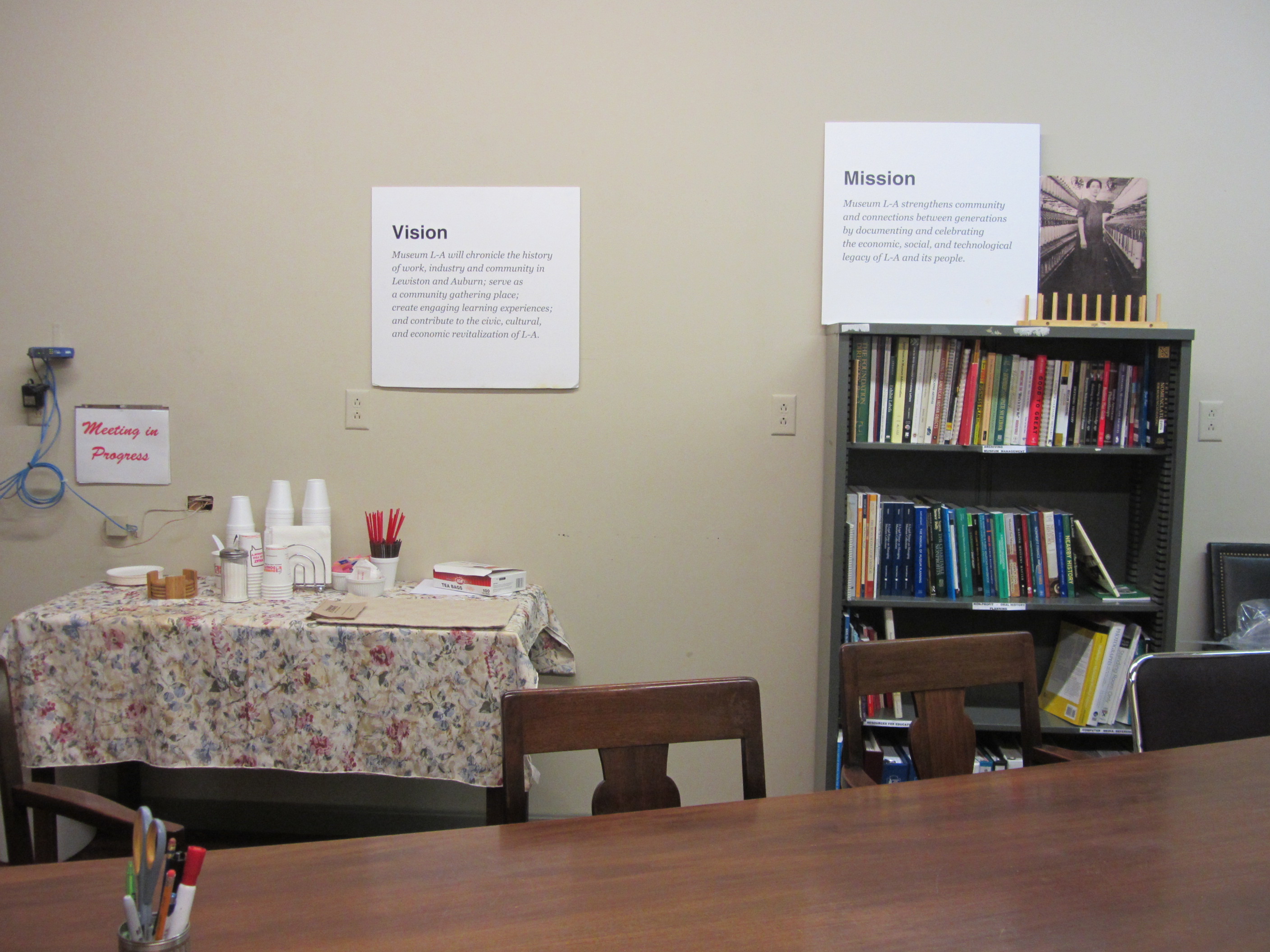
A recent visit to Museum L-A in Maine, a local history museum serving the communities of Lewiston and Auburn, revealed a clever way to keep the mission and vision visible and prominent.  They were posted on large boards in the conference room above the refreshments–whenever a group met, they couldn’t miss these reminders of the organization’s purpose and direction.

Their mission and vision were developed through a community-wide facilitated process led by E. Verner Johnson and they came up with statements that go far beyond the typical “collect, preserve, and educate”:

Mission

Museum L-A strengthens community and connections between generations by documenting and celebrating the economic, social, and technological legacy of L-A and its people.

Vision

Museum L-A chronicles the history of work, industry and community in Lewiston and Auburn; serves as a community gathering place; creates engaging learning experiences; and contributes to the civic, cultural, and economic revitalization of L-A.

For more details, see their strategic plan highlights on their website.  I was pretty impressed with this local history museum, so you’ll find a post or two about it in the future.

Put Your Organization to the Rorschach Test

This slideshow requires JavaScript.

If you’re finding that your organization is in a rut and you no longer feel as inspired about its work, it might be useful to look at it in a new way by creating a “word cloud” of key documents, such as a strategic plan, mission and vision statements, interpretive themes, or visitor evaluation.  A word cloud is a visual presentation of the most frequently used words, sized by frequency.  For example, if you use the word “history” ten times more than “preservation” in your strategic plan, “history” shows up much larger than “preservation” in the word cloud.  The word cloud allows you to look at your organization from a different perspective: words jump out at you and prompt questions about what’s being emphasized (and what’s not).

As examples, in the slide show above I’ve assembled word clouds from the first few paragraphs of the About section of the websites (which often includes the mission or vision statements) of the following historic sites:

I’ve used word clouds in strategic planning sessions to Continue reading

Google Expands its Access to Museums (but not yet Historic Sites)

Floor plan of the American Museum of National History displayed as a Google Map on a smartphone.

Google Maps recently expanded its capabilities of mapping indoor places (mostly  airports and shopping malls) by including two dozen museums in the United States (such as the Philadelphia Museum of Art, Indianapolis Museum, and the Smithsonia–the many museums that make up the Smithsonian Institution) and England (such as the British Museum, Victoria and Albert Museum, and the National Portrait Gallery).  Currently, this feature is only available on Android smartphones or tablets (that may seem limiting but nearly 2 million people have downloaded this app).  More museum maps are in the works but it doesn’t look like any historic sites are participating.  Consider how useful it would be to visitors at such places as Colonial Williamsburg, Gettysburg Battlefield, Sturbridge Village, the Huntington, and James Madison’s Montpelier.  If you’re interested in adding your site details to Google Maps, you can upload floor plans yourself or get help from Google.

In a similar vein, Google Street View just added 360-degree panoramic views of Yosemite and four other national parks in California.  And of course, these are nice complements to the Google Art Project.  It looks like Google is taking a much greater interest in museums along several paths, but historic sites currently seem to be left out of the mix.  I don’t think that’s intentional. I just think it’s a common oversight because most people don’t associate museums with historic sites.  Perhaps I’ll give them a call.

Thanks to John Durel for alerting me to this news item!

Historic Sites Garner A Dozen+ Grants from IMLS

The Institute for Museum and Library Services recently announced the awards for the latest round of Museums for America grants, which include projects at more than a dozen historic places.  It’s always a quick way to see what’s happening around the country to get ideas as well as identify what projects are attractive to funders.  Congratulations to the recipients, especially our colleagues who are working with historic sites, including:

Kodiak Historical Society – Kodiak, AK
Award Amount: $52,706; Matching Amount: $52,810
Contact: Ms. Anjuli Grantham, Curator of Collections
(907) 486-5920; anjuli@baranovmuseum.org

The Kodiak Historical Society will complete design development for 2,800 square feet of exhibits at the Baranov Museum, located within the National Historic Landmark building known as the Russian-American Magazin. The project will foster the planning and design of Continue reading

IMLS Moves Deadline in Response to Comments from Museums

In a surprising move, the Institute of Museum and Library Services will be changing the application deadline for Museums for America and National Leadership Grants from January 15, although it won’t happen until 2014 at the earliest and the new deadline hasn’t been announced.  The 2013 deadline remains January 15.  According to Claudia French, Deputy Director for Museums, “We wholeheartedly support this suggestion and will change the deadline for FY2014. The time required for final approval of new grant guidelines through the Office of Management and Budget (OMB) will not allow us to alter the date for FY2013.”

This was a result of more than 100 comments received from the field as a result of a major restructuring of their grant programs.  IMLS did not reveal what other changes are under consideration or what concerns were reflected in the comments, however, they did affirm that, “In 2013, there will be no restrictions on the number of applications a museum may submit to MFA or NLG-Museums. . . .Museums submitting applications in more than one project category will compete with other museums in each category, not with themselves.”

Thanks to everyone who submitted comments on the proposed IMLS grant guidelines.  This has been one of the most controversial topics in the museum field that I encountered this year, so I’m happy to hear that museums and historic sites had some influence and that the IMLS was willing to accept public comments and provided an initial response so quickly.  A complete statement from IMLS is available on their blog.


Slave for a Day? I’m Not Sure This is a Good Idea

Footsteps of the Enslaved, a new program at Hampton

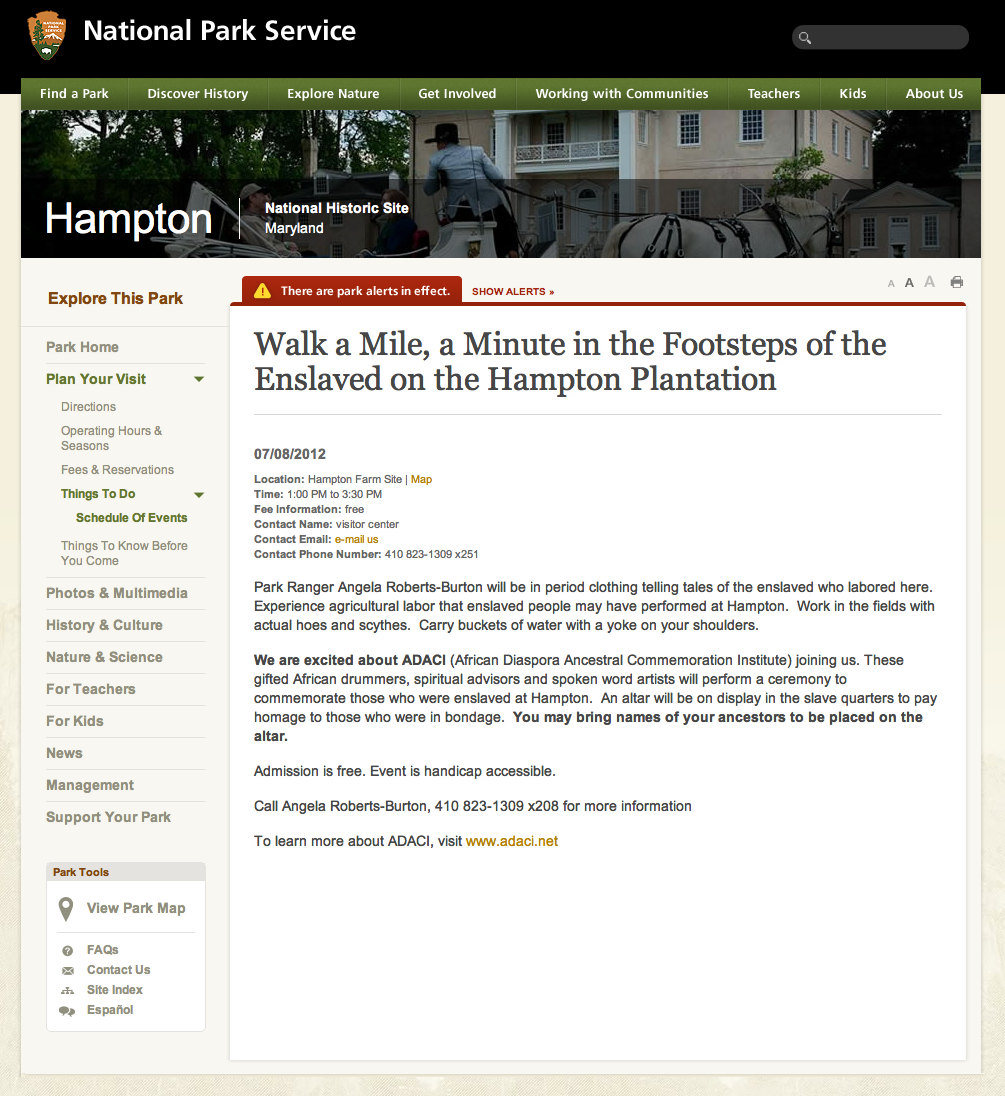
Hampton, a National Historic Site operated by the National Park Service, recently announced a “Slave for a Day” program which will allow visitors, to, “Experience agricultural labor that enslaved people may have performed at Hampton. Work in the fields with actual hoes and scythes. Carry buckets of water with a yoke on your shoulders.” After a chorus of howls went up on the Internet, the title was changed to the much more tame, “Walk a Mile, a Minute in the Footsteps of the Enslaved on the Hampton Plantation” but the program content remained the same. I certainly want to encourage the ranger who developed the program to continue to pursue her passion for African American history, but I’m not sure these activities, as described, get visitors to fully understand what life was like for enslaved people.  Antebellum farming is about hard work; Continue reading

Changes at Google+ Creates Opportunities for Museums and Sites

Okay, everyone knows about Google but Google+ and Google Places is still a mystery for many people.  It may become a bit simpler because the rumor is that Google Places is slowly being replaced by Google+ Local.  Or did that just complicate things?  Let’s start over.

Google search results for “historic sites in philadelphia”

Google has launched new search results that include the usual title, web link, and brief description, but now adds the address, phone number, shows the location on a map, a link to reviews, and a Zagat ranking on a scale of 1 to 30.  In the example to the left, you’ll see the search results for “historic sites in Philadelphia” and that the Eastern State Penitentiary (the third item) received a Zagat rating of 25 (it really is an amazing place) and has 81 Google reviews (wow! their visitors have opinions).  This new form of listing doesn’t occur for every city, just those that seem to have enough places to warrant them (right now, this list appears for Denver but not San Francisco).  Local information is being integrated across Google (including the Zagat ratings, which was acquired by Google last year), so you’ll find Continue reading

VSA: Why Teachers Visit Historic Sites

The April 2012 (15:1) issue of Visitor Studies, the semi-annual journal of the Visitor Studies Association, just arrived and it includes, “Motivating Participation in National Park Service Curriculum-Based Education Programs” by Marc Stern, Elizabeth Wright, and Robert Powell.  It’s a rare examination of the reasons why teachers visit (or don’t visit) historic sites.  For anyone that provides school programs, its findings provide some useful guidelines.

The study attempts to “understand why teachers at schools within the immediate vicinity of Great Smoky Mountains National Park attend, or don’t attend, the park’s curriculum-based programs.”  To discover the perceived benefits and disadvantages of participation, they conducted a preliminary focus group with teachers and then surveyed 400 teachers in fourteen schools and interviewed school administrators.  Although this study’s focus was on a national park’s programs for a middle and high school audience, there are some surprising findings that may cause you to question your assumptions even if you’re an historic site focusing on the elementary grade levels.  Here’s a quick summary:

  1. Administrators are most concerned about Continue reading

2012 Webby Awards Point Out Models for Historic Sites

Historic sites are always looking for good models for online activities, such as websites and mobile applications, and one of the best places to look for inspiration is the annual Webby Awards, the leading international award honoring excellence on the Internet. Established in 1996 during the Web’s infancy, the Webbys are presented by the International Academy of Digital Arts and Sciences.

The 2012 Webby Awards received nearly 10,000 entries from over 60 countries and all 50 states and awards were given in over a hundred categories for website, interactive advertising and media, online film and video, and mobile and apps. As a result, there is a lot to cull through but here are several that seem to be most related to historic sites (and hang on, this is a long list):

  • NPS’ Civil War: 150 Years features a Then and Now Timeline at the top and a Civil War Reporter sending tweets at the bottom.

    The Civil War: 150 Years has the form and content of websites that will be most familiar to historic sites, except that it commemorates “a defining event in our nation’s history and its legacy in the continuing fight for civil rights” rather than a specific place.  I like their use of Twitter to create a virtual “Civil War Reporter” whose tweets report on events from the 1860s but the major innovation is the featured Then and Now Timeline that compares similar events during the Civil War and today (although I was only able to jump months, not years).  Another way to compare the past and the present is demonstrated by Slavery Footprint, a website and mobile app that was launched on the 149th anniversary of the announcement of the Emancipation Proclamation.  It’s designed to raise awareness of modern-day slavery and can tell you approximately how many slaves have pitched in to make the goods you enjoy on a daily basis.

  • Timelines appeared in several other forms in the winning entries and along with the Then and Now version is Continue reading

HBR: To Engage Your Visitors, Keep it Simple

"To Keep Your Customers, Keep it Simple" by Patrick Spenner and Karen Freeman (Harvard Business Review, May 2012)

The May 2012 issue of Harvard Business Review arrived a little early to my mailbox, but I couldn’t stop from sharing a great article on engaging customers in business world that can easily be translated to engaging visitors and building support for historic sites and museums.  In “To Keep Your Customers, Keep It Simple,” Patrick Spenner and Karen Freeman note the paradox of today’s promotional techniques:

Companies have ramped up their messaging, expecting that the more interaction and information they provide, the better the chances of holding on to these increasingly distracted and disloyal customers.  But for many consumers, the rising volume of marketing messages isn’t empowering–it’s overwhelming.  Rather than pulling customers into the fold, marketers are pushing them away with relentless and ill-conceived efforts to engage.

This conclusion is based on multiple surveys of more than 7,000 consumers which were then compared to interviews with 200 marketing executives representing 125 brands.  Their pointed out that what consumers what and what companies think consumers want didn’t correspond to each other, or in biz speak, it’s a Continue reading