Category Archives: Governance and management

Is Planning Giving You the Creeps?

Scope CreepThis afternoon at the annual meeting of the American Alliance of Museums in Seattle, Washington, I’ll be part of “Strategic Planning Made Simple,” a panel session discussing approaches to designing and implementing strategic plans with Liz Maurer (National Women’s Museum), Laurie Baty (National Capital Radio and Television Museum), and Steve Shwarzman (Institute of Library and Museum Services).  I’ll be highlighting four ways to overcome “planning creep,” the seemingly inevitable and invisible force that pulls you away from your goals:

1.  Adopting a Meaningful Purpose and Vision.  Strategic plans have been with us for nearly a century, first for military purposes and then adopted by businesses in the 1970s.  It’s now pretty clear that planning without a purpose is a wasted effort and now you’ll find both businesses and non-profit organizations adopting “mission statements.”  While mission statements are needed, not all mission statements are helpful.  I’ll be outlining the six elements of a Continue reading
Grease the Gears of Your Next Meeting

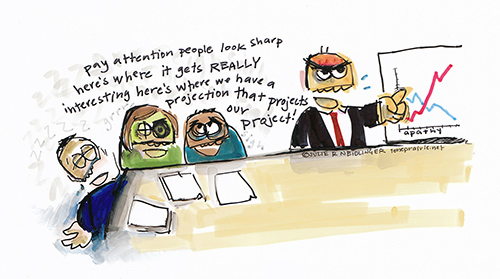
meetingsWe are in meetings regularly but how many of them are productive?  The minutes grind by slowly as the group argues over what it’s supposed to be doing and everyone is anxious to get back to their desks.  A couple weeks later, you repeat the same meeting because no one remembers what was decided or who was responsible.  I’ve been there hundreds of times but it improved about fifteen years ago when I began following the principles in How to Make Meetings Work by Michael Doyle and David Strauss (1993).  It introduced me to the value of agendas, the decision-making process, and the important role of a facilitator.  The facilitator is a neutral third party whose sole purpose is to manage the meeting process and ensure it is productive.  He or she doesn’t make decisions but helps the group discuss issues collegially to arrive at decisions thoughtfully.  The facilitator makes meetings easier, putting grease on the gears that would otherwise grind and bind.  If you’re a regular reader of this blog, you are probably serve as a facilitator from time to time.

Over the years I’ve become increasingly aware of the importance of facilitation, especially as organizations move from a top-down, command-and-control form of management to Continue reading

Webinar: Better Board Governance

Stanford Social Innovation Review, a quarterly journal devoted to informing and inspiring leaders of social change, is hosting a free hour-long webinar on improving board performance on Wednesday, May 21, 2014 at 2 pm Eastern/11 am Pacific. This webinar is for non-profit board members, executive directors, and managers/staff who work with board members—anyone who seeks to create an organization with consistently effective governance in order to radically increase impact for its community and visitors.  Thanks to the support of the Henry R. Kravis Prize in Leadership, this webinar is free but advance registration is required.

In this webinar you will learn the nine attributes of effective nonprofit board governance and be able to make significant improvements in your organization’s board. Join Kim Starkey Jonker and William F. Meehan III as they expand on their recent Stanford Social Innovation Review article, “A Better Board Will Make You Better.” They will discuss the difficulties of achieving consistently effective governance and provide actionable suggestions for overcoming these challenges. Kathy Spahn, recipient of the 2014 Henry R. Kravis Prize in Leadership, will join Jonker and Meehan to discuss Helen Keller International’s governance experiences and provide real-world examples about what works. 


The Future of Leadership: A Perspective from Business Workforce Trainers

Strategy and leadershipWhat’s the future of leadership look like? Five leaders in the field of business workforce training and development shared their perspectives at a session at the 2014 ASTD conference yesterday (and just renamed itself the Association for Talent Development).  In the conversation, Debbie Blanchard (Ken Blanchard Companies), James Kirkpatrick (Kirkpatrick Partners), Halley Bock (Fierce, Inc.) and Tacy Byham (Development Dimensions International) discussed their experiences and observations as consultants who work with companies around the world.  The session was presented in a question-and-answer format, but I’ve synthesized and distilled their responses to highlight key ideas.

1.  Leadership is not a “soft skill”; it is an intentional practice to improve organizational performance and profitability.  You cannot thrust people into leadership to see if they can swim, instead it has to be initiated, conducted, and practiced intentionally.

2.  Leadership has moved from a hierarchical, single command-and-control structure to Continue reading

Corcoran Dismantlement Offers Lessons for Museums and Sites

Corcoran 2014The recent news that the Corcoran in Washington, DC, will be mostly dissolved and its parts distributed to the National Gallery of Art (NGA) and George Washington University (GWU) is generating lots of discussion on whether this is a good thing or not, and who should take the credit or blame.  For those unfamiliar with the Corcoran, it’s an unusual museum because it’s a combination of art gallery and art college.  Students use the art collection for study and inspiration, and the art gallery exhibits student and faculty artworks along with historic American paintings and sculpture, connecting past and present.  It’s a great approach for providing a rich environment for the study and appreciation of art for both students and the public.  Other museums have followed similar paths to create deeper places of learning, including the Henry Ford Museum with its charter school, the Academy of Natural Sciences in its merger with Drexel University, and the American Museum of Natural History offering a Masters of Arts in Teaching.  Yes, museums and historic sites can offer more than just an hour-long tour or a morning field trip.

The Corcoran was created in the Gilded Age, the era of the first major public museums.  Unlike its contemporaries such as the Boston Museum of Fine Arts and the Metropolitan Museum of Art, the Corcoran seems to have gone asleep in the mid-twentieth century and like Rip Van Winkle, it couldn’t wake up.  It made attempts to move out of its slumber, including Continue reading

Museum Advocacy Day Highlights

This slideshow requires JavaScript.

Last week was Museums Advocacy Day and this week is Historic Preservation Advocacy Day, so Congress is getting lots of visits from people who care about our nation’s history and culture.

Museums Advocacy Day has improved each year.  The schedule is well organized and the training and materials are thoughtfully assembled to give everyone a clear idea of what might happen during a congressional visit and the priorities for requests (with lots of good background information so you can speak about issues confidently).  At the top of the list was a request for “robust funding” for the Office of Museum Services at IMLS, protection of the charitable deduction, and permission for museums to be eligible with schools for federal teacher training funds.  Even if you weren’t able to join us, the American Alliance of Museums provides lots of information and ideas for advocacy at home (although the handy “Issues at a Glance” from the Advocate Handbook doesn’t seem to be available online).

IMLS, NEH, NPS, NFS, and NEA talked about their needs but they didn’t seem to be aware Continue reading

Unsettling State of State Historical Societies

In preparation for my presentations at the upcoming Historic House Symposium at Gunston Hall and the National Council on Public History annual meeting, I’m analyzing financial information about history organizations in the United States.  I’m currently researching state historical societies, working my way from the most populous state (California with 37 million residents) to the least (Wyoming with about half a million residents).  So far I’m about halfway done, but I wanted to share what I’ve learned and get your reactions.

Chart Biggest State Historical Socities 2012

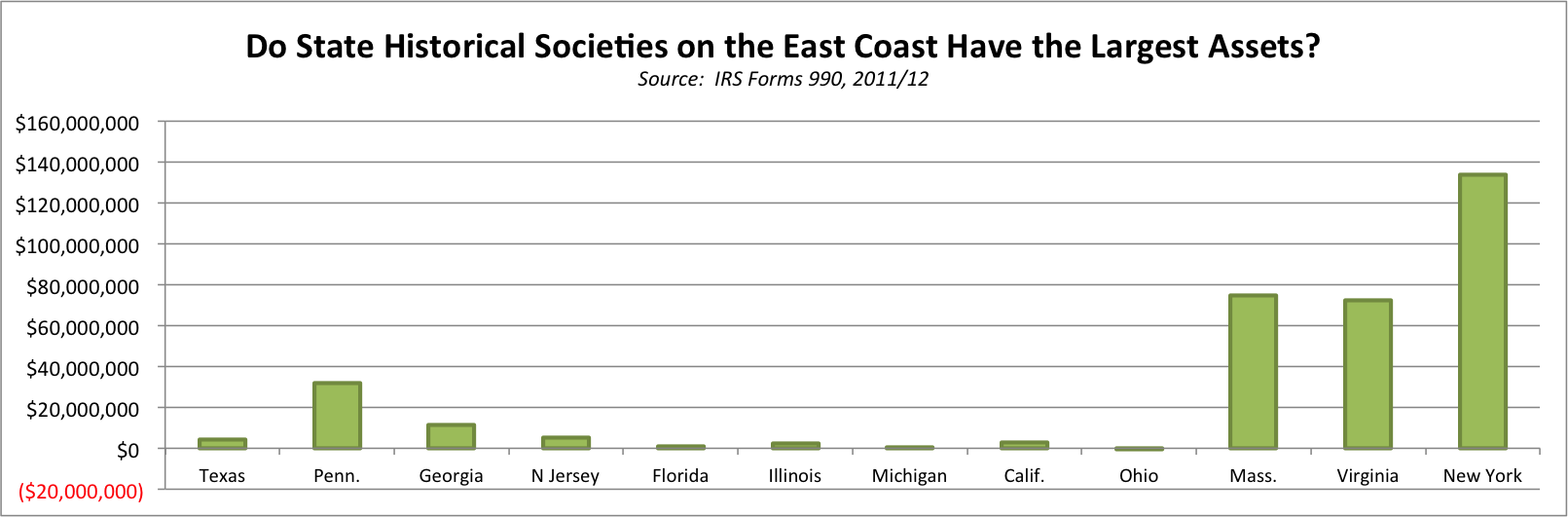
Among my preliminary discoveries is the dramatic difference among state historical societies. Some are incredibly big (the New York Historical Society has $133 million in net assets) and some states don’t seem to have a statewide historical society (anyone know what’s happening in North Carolina?).  One might assume that the biggest states have the biggest historical societies, but Continue reading

Million Dollar Salaries at America’s Biggest Museums

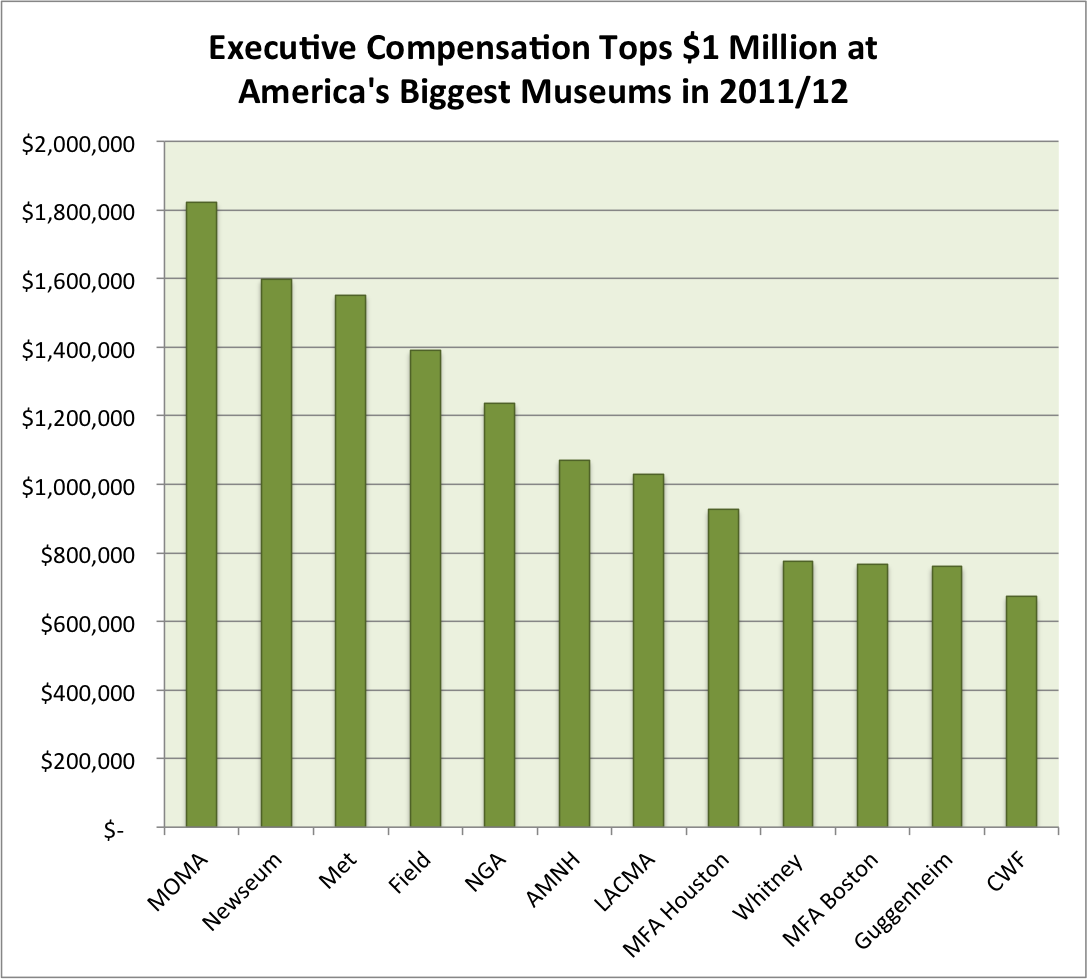
Exec Compensation 2011-12A review of the latest Forms 990 of more than two dozen of America’s biggest museums identified the most highly compensated executives in the field.  Among these museums, annual compensation ranged from $228,000 to $1,822,257 and the average was $727,000.  Seven directors earn more than one million dollars per year, as follows:

Financial Management at America’s Billion-Dollar Museums

Big 5 Museums Assets 2012

The Smithsonian Institution has more than $3 billion in assets and had more than $168 million in income for its 2012 fiscal year, making it the biggest and strongest museum in America.  It’s also the leader of the handful of American museums that have more than a billion dollars in net assets, according to the latest financial reports available through GuideStar.  At the top of the list of America’s wealthiest museums are:

  • Smithsonian Institution (Washington, DC)
  • Metropolitan Museum of Art (New York)
  • Museum of Fine Arts Houston (Texas)
  • Colonial Williamsburg Foundation (Virginia)
  • Museum of Modern Art (New York)

This is a nice trivia question for the next museum reception but what does it mean?  First of all, the size of the museum isn’t based on Continue reading

A Campaign to Make History Relevant to Americans

American flag with puzzle piece missingIn the last year I’ve become part of an group to find ways to make history more meaningful and relevant to Americans.  The History Relevance Campaign, for lack of a better name, is an informal grassroots effort made up of public historians, preservationists, educators, historic site managers, and museum leaders who are creating a national, broad-based strategy to assert the relevance of history.

Just to clarify, the History Relevance Campaign is not connected to any one history organization. From its start in early 2013, the group has strived to be as inclusive as possible.  Secondly, it is not a lobbying group.  Its main audience is the general public, not elected officials and public policy makers.  Thirdly, its intent is to show that history skills are just as important as Continue reading