Category Archives: Governance and management

Unsettling State of State Historical Societies

In preparation for my presentations at the upcoming Historic House Symposium at Gunston Hall and the National Council on Public History annual meeting, I’m analyzing financial information about history organizations in the United States.  I’m currently researching state historical societies, working my way from the most populous state (California with 37 million residents) to the least (Wyoming with about half a million residents).  So far I’m about halfway done, but I wanted to share what I’ve learned and get your reactions.

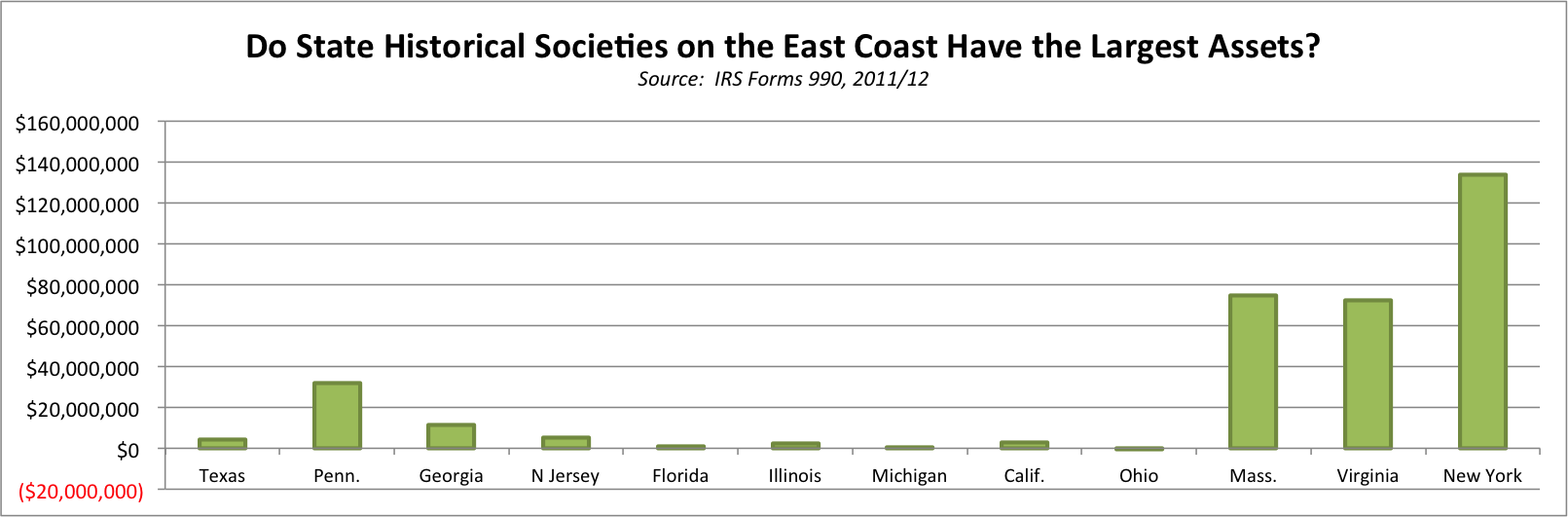
Chart Biggest State Historical Socities 2012

Among my preliminary discoveries is the dramatic difference among state historical societies. Some are incredibly big (the New York Historical Society has $133 million in net assets) and some states don’t seem to have a statewide historical society (anyone know what’s happening in North Carolina?).  One might assume that the biggest states have the biggest historical societies, but Continue reading

Million Dollar Salaries at America’s Biggest Museums

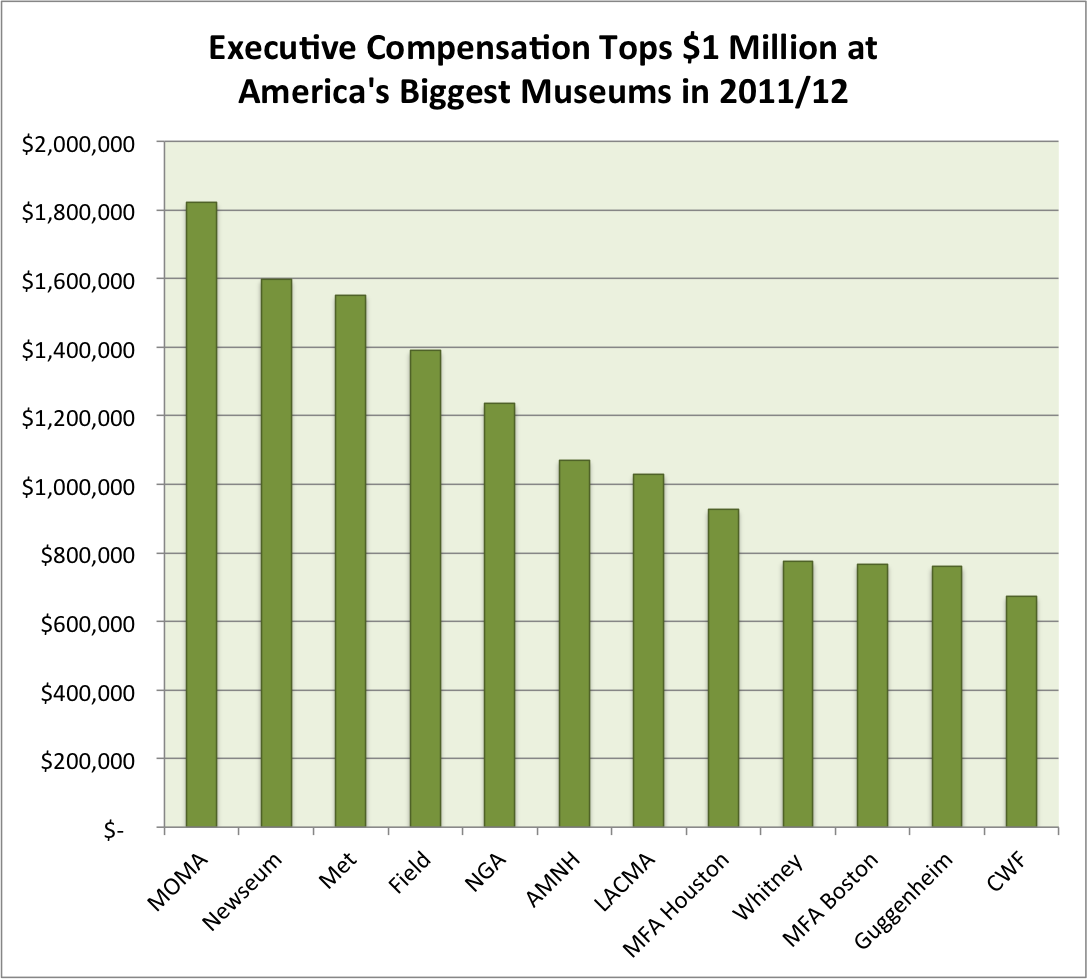
Exec Compensation 2011-12A review of the latest Forms 990 of more than two dozen of America’s biggest museums identified the most highly compensated executives in the field.  Among these museums, annual compensation ranged from $228,000 to $1,822,257 and the average was $727,000.  Seven directors earn more than one million dollars per year, as follows:

Financial Management at America’s Billion-Dollar Museums

Big 5 Museums Assets 2012

The Smithsonian Institution has more than $3 billion in assets and had more than $168 million in income for its 2012 fiscal year, making it the biggest and strongest museum in America.  It’s also the leader of the handful of American museums that have more than a billion dollars in net assets, according to the latest financial reports available through GuideStar.  At the top of the list of America’s wealthiest museums are:

  • Smithsonian Institution (Washington, DC)
  • Metropolitan Museum of Art (New York)
  • Museum of Fine Arts Houston (Texas)
  • Colonial Williamsburg Foundation (Virginia)
  • Museum of Modern Art (New York)

This is a nice trivia question for the next museum reception but what does it mean?  First of all, the size of the museum isn’t based on Continue reading

A Campaign to Make History Relevant to Americans

American flag with puzzle piece missingIn the last year I’ve become part of an group to find ways to make history more meaningful and relevant to Americans.  The History Relevance Campaign, for lack of a better name, is an informal grassroots effort made up of public historians, preservationists, educators, historic site managers, and museum leaders who are creating a national, broad-based strategy to assert the relevance of history.

Just to clarify, the History Relevance Campaign is not connected to any one history organization. From its start in early 2013, the group has strived to be as inclusive as possible.  Secondly, it is not a lobbying group.  Its main audience is the general public, not elected officials and public policy makers.  Thirdly, its intent is to show that history skills are just as important as Continue reading

Washington Post Investigates Financial Fraud at Nonprofits

Form 990 diversionDuring the last couple months the Washington Post has been running a series of articles on financial fraud at non-profit organizations using the annual Form 990 report.  According to their research, more than a thousand organizations have disclosed “a significant diversion” of assets (such as embezzlement) since 2008.  “Significant” means it exceeds $250,000 or five percent of the organization’s assets or receipts, so minor occurrences of fraud are not revealed.  Charitable organizations (such as museums and historic sites) were by far the most common victims, representing about 65 percent of the total.  Educational institutions were the second most common victims, but fell far behind at about 15 percent.

The three most common forms of financial fraud are: Continue reading

Historic House Museum Sustainability at MAAM

This slideshow requires JavaScript.


It’s unclear if most historic house museums will be able to move beyond traditional approaches based upon the discussion at yesterday’s, “There is Power In a Union: Collaboration and Sustainability in Historic House Museums.” At the Mid-Atlantic Association of Museums annual meeting, Frank Vagnone of the New York Historic House Trust moderated the session with a panel of five representatives of the National Trust’s Historic Artists’ Home and Studios program and about 35 people in attendance.  Although Vagnone encouraged the group to focus on collaborations that earned significant income to sustain the museum, examples from the audience kept falling short.  Anything that provided some revenue (such as school groups or small grants) or increased attendance (even if it was shortlived or unrelated) were held up as acceptable partnerships.  The audience discussed the value of serving school groups, the need to use social media, the declining relevance of museums, and the challenge of obtaining grants from local banks, but no one was Continue reading

Responses to Government Shutdown Vary at Historic Sites and Museums

This slideshow requires JavaScript.

Washington, DC is one of the nation’s museum meccas with nearly 19 million annual visitors so with the partial shutdown of the federal government, tourists are frustrated and confused.  Closed are the most popular destinations such as the Smithsonian Institution, National Gallery of Art, Lincoln Memorial, US Holocaust Memorial Museum, National Archives, and Capitol Visitor Center (tours of the White House ended in March 2013 due to sequestration).  Although it is a federal city, many of its museums and historic sites are privately operated so places such as the Phillips Collection, Corcoran Gallery of Art, President Lincoln’s Cottage, Tudor Place, Woodrow Wilson House, and International Spy Museum, are open as usual.  “National” may be in its name, it doesn’t mean it’s affected by the shutdown, so the National Building Museum, National Geographic Museum, National Museum of Women in the Arts, National Museum of Health and Medicine, and National Museum of American Jewish Military History are open (as is the National Aquarium in Baltimore).  Adding to the confusion are parts of the federal government that remain open (hence its more precise definition as a “partial shutdown”), so historic sites such as the US Supreme Court and Arlington National Cemetery (but not Arlington House), continue to be open to tourists.

Washington DC is definitely a confusing places for tourists at the moment, but it’s also confusing at the Continue reading

HBR: The Truth About the Customer Experience

Harvard Business Review, September 2013

Harvard Business Review, September 2013

The September 2013 issue of Harvard Business Review features four articles on women in leadership, which will be of interest to many people who work at historic sites and museums.  The first is on the subtle gender bias that obstructs women’s access to leadership in even the most well-meaning organizations (and how to correct the problem), the second article describes companies who have successfully incorporated inclusivity, and the third reveals the way women make buying decisions differently in a business-to-business (B2B) setting from men.  The fourth article is a roundup of recent research on women in the workplace, such as women receive less criticism but also less challenging assignments.  Of course, the museum and historic site field is dominated by women, so I wonder what these statistics would look like for us.

There’s also a good article on “customer journey mapping.”  It’s a relatively new method of studying a customer’s buying experience by identifying all the places that a company interacts with a customer and evaluating each of these “touchpoints.”   By mapping the customer’s journey to buy a product from their initial search for information to its delivery and installation, a company can better understand the Continue reading

Early Bird Registration Discount on AASLH Meeting Ends this Week

The American Association for State and Local History just released its program for its annual meeting on September 18-21, 2013 in Birmingham, Alabama this year and it’s full of educational sessions, workshops, and field trips for people who work, volunteer, and love historic sites, including:

  • A tours of historic sites in Birmingham, Montgomery, and Florence
  • A visit to the Sixteenth Street Baptist Church on the week of the 50th anniversary of the bombing that killed four girls.
  • A workshop on interpreting slavery at historic sites and museums
  • A breakfast for professionals working  in historic house museums with the provocateurs who wrote The Anarchist Guide to Historic House Museums.
  • Sessions on interpreting women at historic sites, incorporating the arts, integrating African American voices into historic plantation tours, strategic planning through scenarios, and the creation of heritage trails.

Lots of events happen at the same time so it’s always hard choosing, but this year’s meeting is being held in partnership with the International Coalition of Sites of Conscience, so along with the sessions that focus around historic sites, there are also many sessions on community engagement, organizational leadership, interpretation of controversial topics, and the incorporation of new perspectives.   It’ll be a good meeting and I plan to be there, so I’m taking advantage of the early bird discount that ends this Friday, July 26. Registration is $325 for members, but this week it’s only $235 (staff of institutional partners get this same low price until August 16, so you have a few more weeks).  For more information, visit AASLH.org.

Pursuing an Aspirational Vision

1488056History organizations choose the impact they want to make.  Sometimes the choice is intentional and brought in by a visionary leader or strategic plan, but it can also come about through organizational confidence and maturity.  These transitions can occur quickly or over many years, and unlike puberty, there’s no guarantee that an organization won’t return to its previous condition.  In my work with dozens of history organizations over the past thirty years, I’ve witnessed three typical turning points that resulted in extraordinary activities and programs.  Two turning points–doing history with passion and making history meaningful–were discussed previously.

The third turning point for history organizations occurs when they adopt an aspirational vision for improving society.   Imagining a better America, museums, historic sites, and historical societies can follow examples set by such visionaries as Ann Pamela Cunningham.  She believed that George Washington’s exemplary service during the nation’s formation would urge a “bond of Union and political regeneration” during a period of increasing conflict in the 1850s and that the preservation of Mt. Vernon would Continue reading