
I recently had an opportunity to visit the Occoquan Workhouse Prison, an early 20th century federal prison in northern Virginia, which was transformed by Fairfax County in 2008 into the Workhouse Arts Center, a collection of 100 artist studios and galleries. Once regarded as a model for reform-minded incarceration with open dormitory-style residences accompanied by honest work on the surrounding country farm, its image was soon tarnished by the imprisonment and force-feeding of the women who were picketing the White House for suffrage–which helped turn public opinion against the Wilson Administration. I had long known about this infamous event and wanted to get a better sense of the conditions. At the small museum on site, I learned much about the prison’s history and the struggle for woman’s suffrage, however, I also learned that Continue reading
Category Archives: Historic preservation
Los Angeles to Host International Conference on Care and Interpretation of Collections in Historic Houses
Los Angeles is hosting a four-day international conference on the care and interpretation of collections in historic house museums on November 6-9, 2012 called, The Artifact, its Context, and their Narrative: Multidisciplinary Conservation in Historic House Museums. A half dozen organizations are sponsoring and hosting the conference, including ICOM-DEMHIST (the international committee for historic house museums), three ICOM conservation working groups, the Getty Conservation Institute, Getty Research Institute, the University of Southern California’s School of Architecture/Heritage Conservation Program, and the Gamble House. Historic sites encounter some of the most challenging preservation issues in the museum field because it is often impossible to maintain environmental conditions that are ideal for the collections, building, and visitors. Indeed, some leaders in the field have wondered whether historic sites should be even considered museums because it establishes such an impossible standard.
The four-day conference consists of two days of site visits (such as the Gamble House, Huntington Library, Eames House, and Will Rogers Ranch) and two days of presentations and lectures. Sarah Staniforth (National Trust UK) and Linda Young (Deakin University) will be providing broad overview presentations on the challenges and opportunities facing collections in historic sites, but most of the presentations are Continue reading
Frank Lloyd Wright’s Archives Transferred from his Homes to NYC

Taliesen, Spring Green, Wisconsin, 1932. Drawing by Frank Lloyd Wright.
The Frank Lloyd Wright Foundation, which owns and operates Taliesen and Taliesen West–the homes and studios last used by Frank Lloyd Wright–has transferred its architectural archives of papers, drawings, and models to the Avery Architectural & Fine Arts Library at Columbia University and the Museum of Modern Art in New York City. The collection includes more than 23,000 architectural drawings, about 40 large-scale, architectural models, some 44,000 photographs, 600 manuscripts and more than 300,000 pieces of office and personal correspondence. “The Frank Lloyd Wright Foundation takes seriously its responsibility to serve the public good by ensuring the best possible conservation, accessibility, and impact of one of the most important and meaningful archives in the world,” said Sean Malone, CEO of the Frank Lloyd Wright Foundation. “Given the individual strengths, resources and abilities of the Foundation, MoMA and Columbia, it became clear that this collaborative stewardship is far and away the best way to guarantee the deepest impact, the highest level of conservation and the best public access.”
The decision to transfer the collections couldn’t have been easy for the Foundation–it’s a significant part of their identity with tremendous historical and cultural value. Admitting you can’t care for a collection is difficult–but organizations should regularly ask themselves if they’re the only ones to do this work and if someone else can do it better. It’s especially tough at historic sites and house museums–they typically have the most complex collections management issues of any museum. Not only are they caring for Continue reading
HBO CEO named Mt. Vernon CEO; A Step Backwards IMHO

George Washington’s Mount Vernon
Today, Curtis G. Viebranz becomes the president and chief executive officer of George Washington’s Mount Vernon. Unfortunately, this decision by the Mount Vernon Ladies’ Association is a step backward for its mission, history, education, preservation, and ironically, women, too. Viebranz succeeds James C. Rees III, who retired in June. Here’s an excerpt from the official announcement:
Viebranz brings to Mount Vernon more than twenty years of experience at major multinational Internet and cable enterprises, including a successful tenure as president of HBO International, the global arm of Time Warner’s Home Box Office unit. Prior to that, as Time Warner turned its attention to digital distribution strategies, Viebranz was tapped to serve as the first president of Time Inc. Multimedia. During his seventeen-year career at Time Warner and its predecessor company, Time Inc., Viebranz built an impressive resume, also serving as president of Time Inc. Europe and HBO Video.
After departing Time Warner, Viebranz helped to launch Continue reading
Detour Ahead for National Trust’s Main Street Program?

Preservationists in Frederick, Maryland, which received a Great American Main Street Award in 2011.
In a move that will surprise many who work in historic preservation, the National Trust for Historic Preservation has decided to move its Main Street program to a separate non-profit subsidiary and three of its senior staff members–Doug Loescher, Lauren Adkins, and Andrea Dono–have decided to leave the organization. Main Street was created more than thirty years ago to help revitalize historic downtowns and commercial districts and its work was so highly regarded that the National Trust presented its own Honor Award to its founders–Mary Means, Scott Gerloff, Tom Moriarity, and Clark Schoettle–in 2004. In a email message on June 18, Executive Vice President David Brown wrote:
As most of you are aware, since the launch of the Preservation10X framework last September, we have been engaged in a focused and inclusive process to assess the current status of the National Trust Main Street program and the Main Street Center, in order to arrive at the best path forward for Main Street. Thank you for the excellent input many of you have provided during this process.
Main Street is one of the most valued programs of the National Trust. It has achieved unprecedented stature nationwide as a highly successful preservation-based economic development program and enjoys great popularity among a wide constituent base. In many ways it has far surpassed Continue reading
IMLS’ Revised Grant Guidelines Need Revision
 In May, the Institute of Museum and Library Services (IMLS)–the national agency devoted to museums and libraries–released a new set of proposed guidelines that would significantly revise their grant programs for museums (and that includes historic sites, historical societies, house museums, and preservation organizations). Initially, these changes were proposed to go into effect without comment from the field, but fortunately enough museums spoke up that director Susan Hildreth changed her mind and announced she would welcome comments–but the comment period ends on Friday, July 6, 2012.
According to IMLS, the guidelines affect the Museums for America and National Leadership Grants for Museums programs, however, the impact is much larger because these programs are proposed to consume two other grant programs: Conservation Project Support and 21st Century Museum Professionals. Claudia French, deputy director for museums, proposed the changes so that the grant programs would align better with the IMLS strategic plan and make it easier for grantees and IMLS staff.
Here are the major changes that caught my eye:
1. One deadline to rule them all: January 15. Currently, the deadlines for Continue reading
Earthquake in Northern Italy destroys Historic Sites
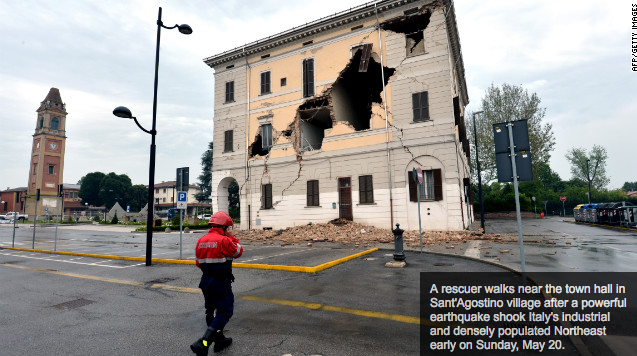
The Town Hall in Sant’Agostino, Italy, damaged by Sunday’s earthquake.
On Sunday morning, the area near Bologna in northern Italy was struck by a major earthquake with aftershocks occurring today. Damage to historic buildings is significant and about seven people have died. Information is still coming in but the latest on CNN (with many photos) is:
Northern Italy was shaken by an aftershock Monday morning, a day after a magnitude-6.0 quake killed at least seven people and left thousands of survivors huddling in tents or cars overnight. Continue reading
Sold! Frank Lloyd Wright Home and Studio in Oak Park

Frank Lloyd Wright Home and Studio, Oak Park, Illinois
On Monday, the National Trust for Historic Preservation sold Frank Lloyd Wright’s Home and Studio in Oak Park, Illinois but don’t worry, it’ll still be preserved and open to the public. It was acquired by the Frank Lloyd Wright Preservation Trust, who has been operating and managing the site for nearly four decades and I suspect will be there for many more. In the 1970s, the FLWPT was a fledging organization that was attempting to save the Prairie-style home and studio of Frank Lloyd Wright, which had become badly deteriorated and cut up into a half dozen apartments by a private owner. It didn’t have the ability to purchase the property when it came up for sale, so they partnered with the National Trust to buy the property. The FLWPT would eventually repay the National Trust for its half of the $260,000 purchase price but in the meantime, the National Trust would hold the title and lease it to the FLWPT at a nominal price. The success of this venture prompted these two organizations to partner on the preservation of the Robie House, a Frank Lloyd Wright masterpiece which is owned by the University of Chicago but was badly maintained (another example of a university mistreating historic places!). With the sale of the Home and Studio, the Robie House partnership is also concluded and the FLWPT will work directly with the University.
I’m not sure what the change in relationship means, but just a few days ago, the Robie House and Frank Lloyd Wright Home and Studio were National Trust Historic Sites, two of 29 historic places sprinkled across the United States. It’s a ragtag collection that by itself makes no interpretive sense, doesn’t adequately represent American history or culture, isn’t connected by ownership (some NTHS are owned by others) or management (most NTHS are operated by other non-profits), and wasn’t formed to achieve a specific strategy or vision (they were mostly added as opportunities arose, donors made offers, or presidents were seduced). But with this transition, I hope it sparks some discussion around two important national issues for historic sites: Continue reading
Haas-Lilienthal House completes Sustainability Management Plan

Haas-Lilienthal House
The Haas-Lilienthal House in San Francisco has just completed a Sustainability Management Plan, which will help them meet energy and sustainability goals while preserving its character-defining and historically significant features. Through this plan, they’ve established a goal of reaching LEED Gold, however, there’s a “stretch goal” to reach “net zero.” Many people think that historic house museums are unable to meet any “green ratings” without compromising their preservation goals, however, recent achievements by President Lincoln’s Cottage and others show it’s possible. The Haas-Lilienthal House is owned and operated by San Francisco Archiectural Heritage, a city-wide preservation organization, so plans like this not only provide a road map for greening the maintenance procedures and capital building improvements to save money and energy, but advance their position that historic preservation is relevant and historic buildings can perform as well as modern ones.
The plan was developed by Barbara Campagna, FAIA, LEEP AP, a former colleague of mine at the National Trust for Historic Preservation, where she was actively involved Continue reading
Lodging in Historic Canal Houses Garners State Award

C & O Canal National Historical Park in Maryland
The Maryland Historical Trust, the state agency that preserves and interprets Maryland’s history, recently presented an Outstanding Stewardship award to the National Park Service and the C & O Canal Trust for its Canal Quarters Program, which allows the public to stay overnight in many of the historic lock houses adjacent to the towpath. NPS acquired the 184-mile long Chesapeake and Ohio Canal with 1,300 historic structures, and figuring out what to do with all of them has been a challenge for decades. Partnering with the nonprofit C & O Canal Trust, NPS developed a new model for adaptive reuse that allows visitors to stay overnight while traveling along the canal. Although the buildings are among the park’s primary historic “artifacts”, many were vacant and only served as “scene setters” for the park’s four million annual visitors. The resulting program not only preserves the buildings, but also allows them to be used in a way that creates a memorable experience for visitors (and probably earns some new revenue!). Congratulations on a fine idea and getting it implemented despite the bureaucracy of the federal government!
Learn more at “Maryland Historical Trust honors program offering lodging in C&O Canal lock houses” in the Washington Post (February 27, 2012).
 Engaging Places