Category Archives: Resources

AASLH Annual Meeting in September Offers Lots for Historic Sites

Alexander Ramsey House in St. Paul, an historic site of the Minnesota Historical Society.

Alexander Ramsey House in St. Paul, an historic site of the Minnesota Historical Society.

Historic sites and house museums will find lots of educational sessions and workshops just for them at the upcoming annual meeting of the American Association for State and Local History on September 17-20 in St. Paul, Minnesota (the right half of the Twin Cities).  There are more than 70 sessions and workshops offered this year, so I’m only highlighting a few to show the diversity of topics on or about historic sites:

  • Putting the Native American Voice into Historic Sites
  • Saving the Charnley Norwood House
  • Interpreting Religion at Historic House Museums
  • Two Very Different Historic Houses Ask:  We Got the Money–Now What?
  • Telling a Whole History:  Methods of Interpreting Domestic Servants
  • Welcoming All Visitors:  Accessible Programs at History Museums and Sites
  • Diversity and Inclusion:  What Does that Really Mean for Museums and Historic Sites?
  • Diversity in Education:  Teaching About Slavery, Innovative Strategies, and Best Practices
  • Making the Invisible Visible:  Using Mobile Technology to Reach New Audiences, Improve Accessibility, and Breathe New Life into a Virginia Historic Site
  • Redefining Success:  Tips and Techniques for Training Interpreters to Talk About Slavery
  • They Can’t All be Museums
  • Pocket Change:  Moving a House Museum into the 21st Century on a Budget

Of course, there are many more sessions that address related topics, such as boards, fundraising, Continue reading

IMLS’ Count of Museums in the US May Be Exaggerated

LIMLS Museum Distribution by Type 2014q3ooking for museums in your county or state?  Want to know how you compare to other museums across the nation? You’ll find them in the Museum Universe Data File recently produced by the Institute of Museum and Library Services (IMLS).  It’s a free database of museums in the US that includes names, addresses, contact information, total revenue and expenses, and GIS data.

IMLS held a webinar today to explain the datafile and answer questions.  They constructed the list from several sources, including the Internal Revenue Service and Foundation Center,  which were then reconciled to remove duplicates. Data will be updated every six months based on continuing research and community feedback. IMLS will be using the datafile to conduct sampling surveys for future research projects, such as collections care, to inform their programs and share results with the field and Congress, however, you are encouraged to use it as well.

The big news is that of the 35,144 total museums in the US, most are related to Continue reading

Is Planning Giving You the Creeps?

Scope CreepThis afternoon at the annual meeting of the American Alliance of Museums in Seattle, Washington, I’ll be part of “Strategic Planning Made Simple,” a panel session discussing approaches to designing and implementing strategic plans with Liz Maurer (National Women’s Museum), Laurie Baty (National Capital Radio and Television Museum), and Steve Shwarzman (Institute of Library and Museum Services).  I’ll be highlighting four ways to overcome “planning creep,” the seemingly inevitable and invisible force that pulls you away from your goals:

1.  Adopting a Meaningful Purpose and Vision.  Strategic plans have been with us for nearly a century, first for military purposes and then adopted by businesses in the 1970s.  It’s now pretty clear that planning without a purpose is a wasted effort and now you’ll find both businesses and non-profit organizations adopting “mission statements.”  While mission statements are needed, not all mission statements are helpful.  I’ll be outlining the six elements of a Continue reading

Museum Advocacy Day Highlights

This slideshow requires JavaScript.

Last week was Museums Advocacy Day and this week is Historic Preservation Advocacy Day, so Congress is getting lots of visits from people who care about our nation’s history and culture.

Museums Advocacy Day has improved each year.  The schedule is well organized and the training and materials are thoughtfully assembled to give everyone a clear idea of what might happen during a congressional visit and the priorities for requests (with lots of good background information so you can speak about issues confidently).  At the top of the list was a request for “robust funding” for the Office of Museum Services at IMLS, protection of the charitable deduction, and permission for museums to be eligible with schools for federal teacher training funds.  Even if you weren’t able to join us, the American Alliance of Museums provides lots of information and ideas for advocacy at home (although the handy “Issues at a Glance” from the Advocate Handbook doesn’t seem to be available online).

IMLS, NEH, NPS, NFS, and NEA talked about their needs but they didn’t seem to be aware Continue reading

Nancy Duarte’s “Resonate” Free on iPad

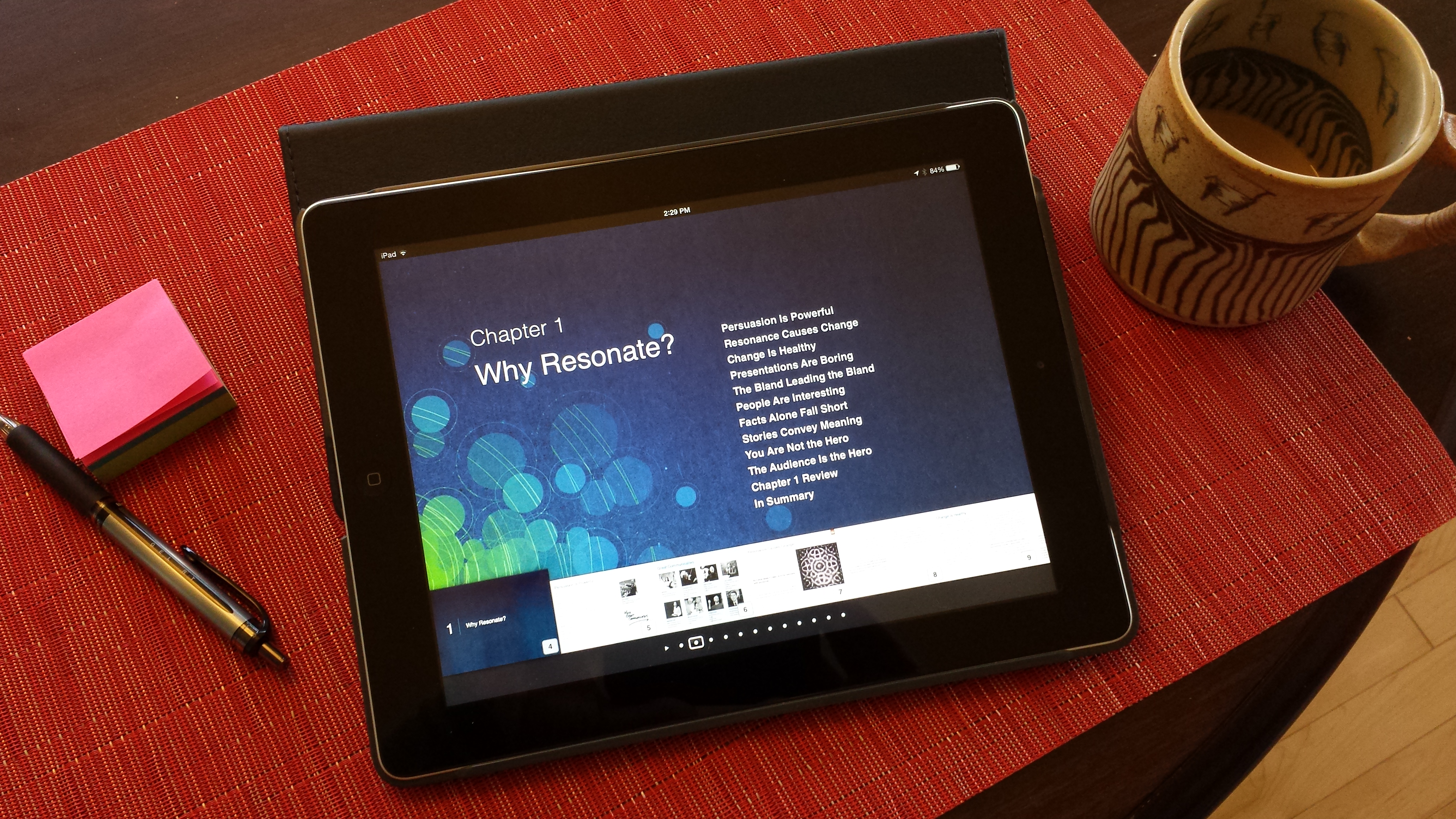
A multi-touch version of Resonate is available free on iPad.

A multi-touch version of Resonate is available free on iPad.

Nancy Duarte is one of the leading producers of presentations, including the Academy Award-winning film, “An Inconvenient Truth” with Al Gore.  There may not be agreement on climate change, but everyone was impressed by the quality of that documentary.  Duarte has shared her expertise through Slide:ology and Resonate, and these books have not only helped me improve and enhance my Powerpoint presentations but also my interpretation skills.  Her approach is firmly grounded in the techniques of effective communication, which can be applied to many situations at museums and historic sites.  If you’re not familiar with Nancy Duarte, she explains her ideas in an 18-minute presentation at TEDxEast in 2011.

The good news for iPad owners is a “multi-touch” version of Resonate is available free through iBooks.  All of the content from the book is supplemented with videos, quizzes, backstories, and other interactive experiences to better engage you.  You’ll not only learn about building better presentations and communicating more effectively, but you’ll also experience an example of one of the most effective eBooks available.  If you’re not sure how to do this, open the iBooks application and search the Store for “Resonate by Nancy Duarte”.

AASLH Refreshes its Website

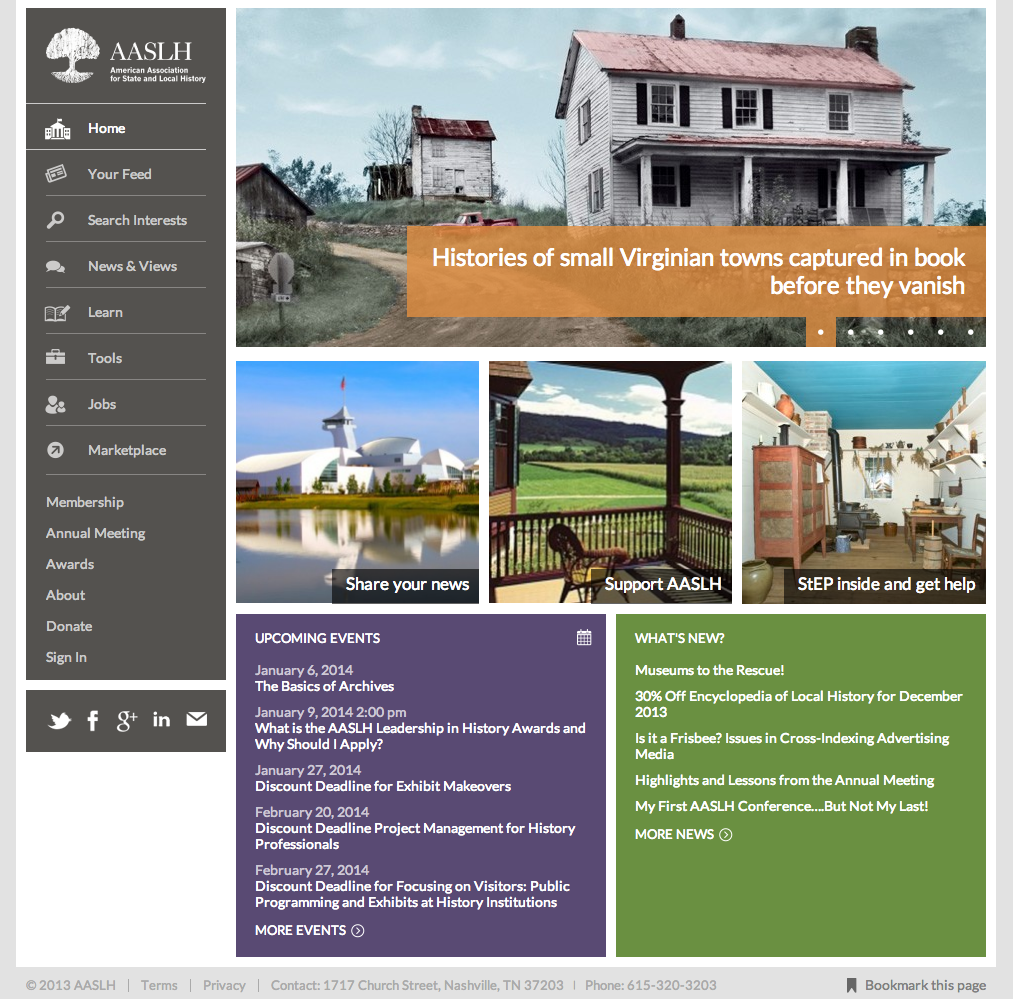
AASLH website 2013The American Association for State and Local History refreshed its website at aaslh.org, launching a significantly improved and enhanced version that’s rich with color and photos, along with continually updated news, blog posts, and tweets laid out in a magazine format.    You’ll need to explore the various pages to discover the new features and content, but I especially like News and Views to quickly soak up what’s happening and the Learn and Search Interests pages, where you can browse popular topics with just a click of a mouse, such as “administration” or “funding.”  There’s also a Your Feed page that allows you choose from a menu of topics that interest you, such as “best practices” or “historic houses” and viola! you get a special page created just for you.

As a member of the AASLH Council, I officially receive the credit for the new website, but it actually belongs to the AASLH staff, particularly Rebecca Price, Bob Beatty, and Terry Jackson.  This new website has been a longtime in coming, but it was worth the wait.

PS.  If the new website comes up broken, as it did for me at first, just refresh your browser to clear its memory of the old website.

A Clever Model of Engagement for Your Desk or Office

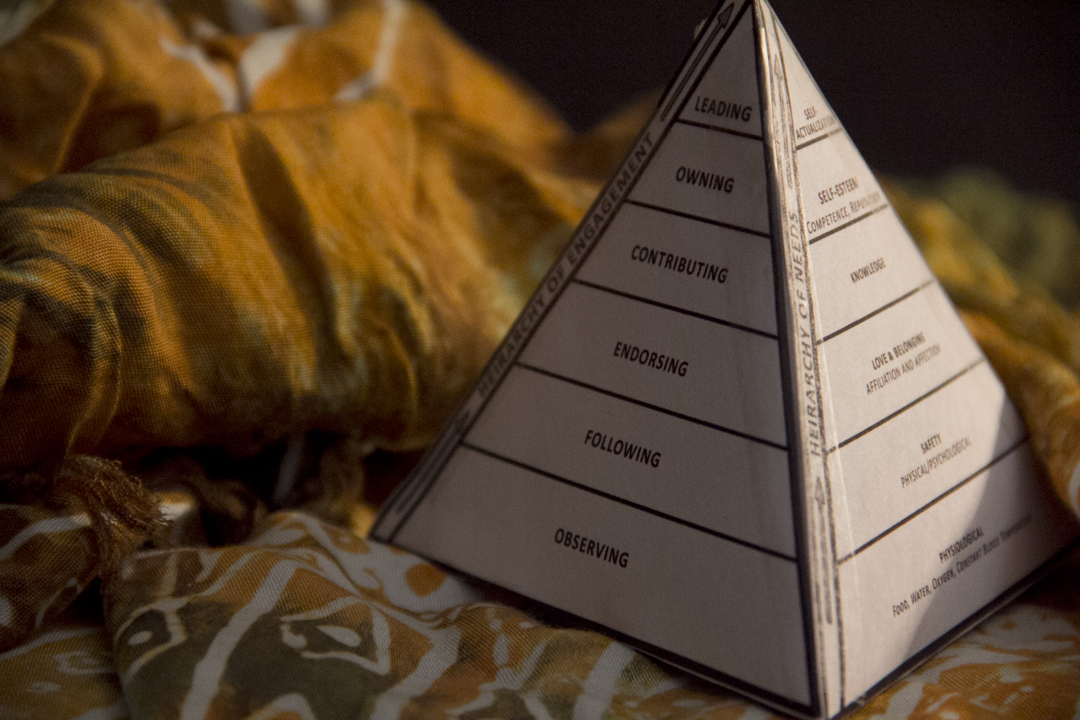
Travis Kirspel's Engagement PyramidI’ve been working on a strategic plan for the Division of Historical and Cultural Affairs for the State of Delaware for the past few months and after a recent meeting, I stopped by the office of Travis Kirspel, one of the planning team members and the Curator of Digital Assets.  A set of geometric solids in his bookcase caught my eye–I associate them with early science and cabinets of curiosity–and it turns out he created them.  He’s interested in community engagement, so he used his skills as a graduate of the Savannah College of Art and Design to develop a clever model that pulls together various theories into one object.  He graciously provided more details, as well as the blueprints so you can create a pyramid for your desk or office.

The Pyramid of Engagement:  A Psychological Model for Building Community Relationships by Travis Kirspel

It is said (albeit on Wikipedia) that the Egyptian pyramids were, well, pyramid-shaped as a nod to the “primordial mound” from which the earth was created. They have also been described as more like “resurrection machines” than “tombs” by design. Essentially, the deceased pharaohs’ souls became superhuman cannonballs launched through Continue reading

Early Bird Registration Discount on AASLH Meeting Ends this Week

The American Association for State and Local History just released its program for its annual meeting on September 18-21, 2013 in Birmingham, Alabama this year and it’s full of educational sessions, workshops, and field trips for people who work, volunteer, and love historic sites, including:

  • A tours of historic sites in Birmingham, Montgomery, and Florence
  • A visit to the Sixteenth Street Baptist Church on the week of the 50th anniversary of the bombing that killed four girls.
  • A workshop on interpreting slavery at historic sites and museums
  • A breakfast for professionals working  in historic house museums with the provocateurs who wrote The Anarchist Guide to Historic House Museums.
  • Sessions on interpreting women at historic sites, incorporating the arts, integrating African American voices into historic plantation tours, strategic planning through scenarios, and the creation of heritage trails.

Lots of events happen at the same time so it’s always hard choosing, but this year’s meeting is being held in partnership with the International Coalition of Sites of Conscience, so along with the sessions that focus around historic sites, there are also many sessions on community engagement, organizational leadership, interpretation of controversial topics, and the incorporation of new perspectives.   It’ll be a good meeting and I plan to be there, so I’m taking advantage of the early bird discount that ends this Friday, July 26. Registration is $325 for members, but this week it’s only $235 (staff of institutional partners get this same low price until August 16, so you have a few more weeks).  For more information, visit AASLH.org.

Top Ten Ideas to Build Effective Museum Experiences

This slideshow requires JavaScript.

A couple weeks ago, I was part of a workshop on building effective museum experiences on June 3, 2013 at Historic London Town and Gardens in Edgewater, Maryland.  Thanks to a National Leadership Grant from the Institute of Museum and Library Services, they’ve partnered with the Maryland Historical Trust to present a series of workshops for museums and historic sites in the region.

For this workshop, they assembled an outstanding team of speakers:

In the afternoon, we broke into several groups.   I led a discussion with Tom Mayes on creating tours using techniques from narrative non-fiction, giving participants a chance to try Continue reading

AAM Annual Meeting: Report to the Field

Last week’s annual meeting of the American Alliance of Museums was held just 30 miles from my house but I wasn’t able to attend due to other commitments.  I missed seeing so many of my friends!  Fortunately, Terri Anderson, a colleague working at the Corcoran Gallery of Art, shared her experiences:

Terri Anderson

Terri Anderson

I had a great time attending the American Alliance of Museums annual conference this week, held in Baltimore, Maryland. AAM put on an excellent conference, full of interesting sessions. To be completely honest, I haven’t said that about an AAM conference in a while. I was pleasantly surprised by how interesting and informative each session was. Also a first for me was being completely blocked from a session. “How We Did It: The Move of the Barnes Collection” was so full, the AAM volunteer had to close the doors and wouldn’t let in any more people even to stand in the back. All the sessions I attended (in the collections management track) were full or over-full—I hope AAM can get arrange for bigger rooms for its collections sessions next time.

A great feature of this year’s conference is that Continue reading