Category Archives: Technology

Latest National Research on Technology in the K-12 Education (with Tips for Historic Sites)

"From Pixel to Print," the 2015 report on the use of technology in K-12 education.

“From Pixel to Print,” the 2015 report on the use of technology in K-12 education.

Project Tomorrow, a nonprofit organization focused on education, just released a national study on the use of technology by teachers and students called, “From Print to Pixel: The Role of Videos, Games, Animations, and Simulations within K-12 Education.”  For the past thirteen years, Project Tomorrow has provided these annual “Speak Up” research reports to help schools and elected officials (and I’m including museums and historic sites) better understand the trends in technology in the K-12 education field. This year’s report incorporates responses from 415,686 K-12 students, 38,613 teachers and librarians, 4,536 administrators, 40,218 parents and 6,623 community members representing over 7,600 schools and 2,600 districts in the United States and around the world.


From “Print to Pixel” highlighted these major findings: Continue reading

Video: Detour’s High-Tech Audio Tours Come to Museums

Groupon founder Andrew Mason guides Casey Newton of Verge through the San Francisco Museum of Modern Art using the latest version of Detour, a location-based outdoor audio tour app that now works indoors as well.  Through your smartphone, Detour knows your location in the museum and presents the artworks in that specific gallery along with the associated audio recordings so you can wander (giving you the right information in the right place), as well as 15-30 minute “walks”.  Parts of this Verge video are silly and the background music too loud, but it looks like smartphone technology now has the capability to be used at historic sites for self-guided tours of the buildings, landscape, and neighborhood in a way that’s more flexible and responsive to visitor interests.

The video below is a better explanation of Detour’s ability to “automatically guide you as you walk, almost like you’re there with a real person”.  It debuted last year with ten Detours of San Francisco (including architecture) at $4.99.

Looking for Exhibit Ideas? Check Out These Online Files

Exhibit Files 2016Looking for an idea for an upcoming exhibit? Need some alternatives for an interactive activity? Want to know if anyone else has installed an outdoor exhibit at a bus station? You’ll want to explore “Exhibit Files,” a free online collection of exhibition records and reviews for exhibit designers and interpretive planners.  The Association of Science-Technology Centers launched this website in 2007 with funding from the National Science Foundation, but despite those affiliations, you’ll find plenty of files related to history, including a case study of Lewis & Clark (the national Bicentennial exhibition); a review of Terror House in Budapest by Daniel Spock of the Minnesota Historical Society; and a case study of a low-tech document-based interactive exhibit at the Missouri State Archives. Because most exhibit techniques can be used with any subject, you can adapt many ideas for your specific needs. The files can be searched by title, date, tag, or topic (such as history or architecture).   And if you have an exhibit experience to share or you’re looking to solve a problem, you can join for free and become one of the nearly 3,000 members.

Video: Online Event Sales and Promotion via EventBrite

In this 8:55 video, Steve Dotto at DottoTech explains Eventbrite, a tool that allows you to setup, manage, and promote an event online.  Eventbrite can handle paid or free events, allows for discounts, and can accept donations, plus it can create ads for email, Facebook, an event page, or a countdown widget for your website.  Eventbrite is free but collects a service fee for each ticket sold for paid events (2.5% + 99¢ per ticket; for nonprofits it is 2.0% + 99¢ per ticket; if the event is free, there’s no charge!).  Fees can be passed on to the customer or can be absorbed into the ticket price (a $10 ticket for a museum would incur $1.49 in service fees).  You can use PayPal to process payments or use Eventbrite’s payment processing service for 3% of the ticket price.

If your museum or historic site has experience working with Eventbrite, please share what’s worked or not in the comments below.

An App That Easily Merges Oral History and Images

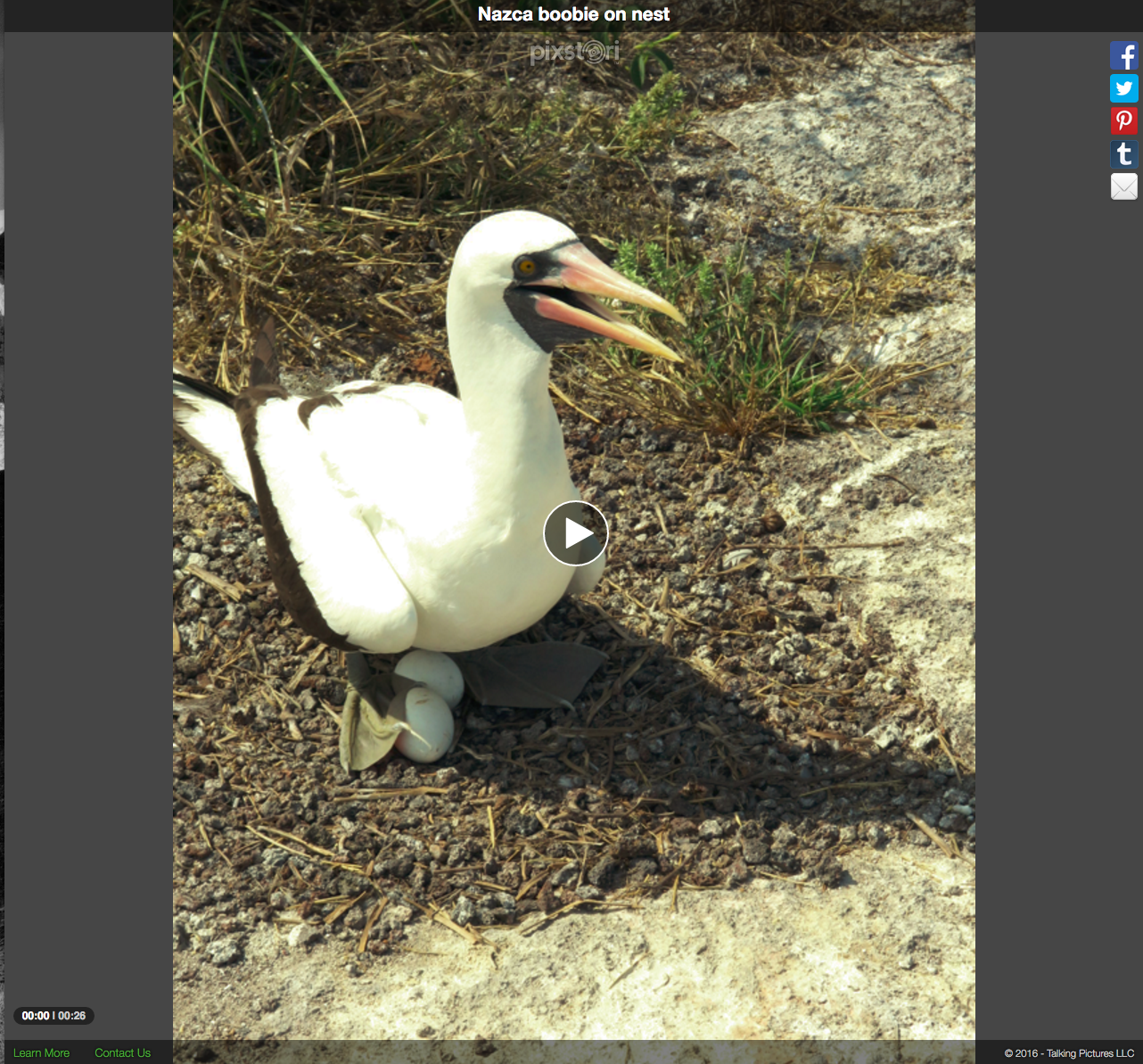
My recording about a bird nest on the Galapagos Islands using PixStori.

My recording about a bird nest on the Galapagos Islands using PixStori.

At the National Council on Public History conference last week in Baltimore, Michael Frisch of the University of Buffalo introduced PixStori, a iOS app that he helped develop that easily shares photographs with audio recordings.  Frisch is a leader among oral history practitioners and he developed the app as a way for people to record short oral histories to accompany photographs.

Users pull up a photo from their iPhone or iPad and then record a short message (up to 20 minutes), which can then be shared via email, Twitter, or Facebook.  I experimented with a photo of a bird and it’s remarkably easy to use.  It’s definitely fun for sharing photos, but I can easily see museums and archives using it to share historic images or documents with a comment by an historian or help promote an upcoming event.  But I can also see how it might be used in-house to record visitor reaction to proposed exhibit or to send a message to your staff about a site emergency. It appears that the recordings are stored at PixStori, so recipients don’t need to have the app installed but do need an internet connection to see and hear the file. The app is available free for iOS devices and an Android version is underway.

Interactive Station Using a Tablet and Stanchion

This slideshow requires JavaScript.

The equipment for interactive displays is becoming increasingly easier, thanks to powerful computer tablets that can show documents, images, and videos.  There’s no need to mount a monitor to the wall with a fat cable snaking to a computer unit tucked into a cabinet.  I recently saw a nice example of an interactive tablet system at the George Washington University Museum in Washington, DC.  The tablet (such as an Apple iPad or Samsung Galaxy Tab) is mounted on a stanchion with a special head from the Exhibit Stanchions Group.  That’s it. None of the tablet’s ports are blocked so it can be charged or updated even when it’s held in place.  The tablet is securely fastened and the stanchion is heavy enough to withstand a casual bump, but if you need to remove the stanchion for an event or use it elsewhere, it can be easily picked up (yes, a thief could steal the whole thing but if they’re walking out the door with a stanchion, you’ve got bigger problems).

Free DIY Assessment for Your Collections

Rembrant's personal museum at Rembrant Huis, Amsterdam.

Rembrant’s personal study collection at Rembrant Huis, Amsterdam.

Historic sites have incredibly complex collections that range from furniture and photos to buildings and landscapes. Figuring out priorities for collections care can be daunting but thankfully, the University of Illinois Libraries with the help of IMLS funding, recently created a Preservation Self-Assessment Program (PSAP). It’s a free online tool that helps collection managers evaluate the condition of materials, storage and exhibit environments, and institutional policies for books, paper documents, photographs, recordings, films, and architectural prints in historic sites, museums, archives, and libraries. In addition, there’s a Format ID Guide, which includes identification cheatsheets in case you can’t tell a blue print from a Diazo print.

Staff and volunteers at any level of experience can use the PSAP. The program asks questions about your the materials in your collection, storage and exhibition environments, and collections policies to develop a unique profile for your organization and potential priorities for collections care. It includes additional help to explain concepts and principles, showing examples along the way. The application runs in your web browser; no software installation is necessary. No limit is placed on the amount of items or collections you assess; all data is securely stored on University of Illinois servers. The Illinois Heritage Association has a lengthy overview with more details.

Even though PSAP doesn’t cover everything you’ll encounter in your collections, it’ll help you with a significant part. Now someone needs to get to work on a Museum Self-Preservation Program in Illinois.

Unconference in DC Poised to Transform Museums


Openlab is convening an unconference, talks, and a planning workshop in Washington, DC on December 1-2 to “to accelerate the speed and impact of transformational change in the GLAM (gallery, library, archive, and museum) sector” in order to “to increase and disseminate knowledge; to encourage civic dialogue and engagement; and to support individuals in their right to access and participate in culture.”  The brain child of Michael Peter Edson of the Smithsonian, much of OpenLab’s work seems to be focused on using digital technologies to solve age-old questions, such as “what needs to change in galleries, libraries, archives, and museums?” and “what is missing in the current funding and support landscape for GLAMs and the humanities?”  It’s all a bit nebulous and unclear, but that’s the core nature of an unconference. Nevertheless, it’s one of many concurrent efforts to increase the impact of museums in society (and yes, we’re still in the fragmented stage).

The first day on December 1 (today) is the unconference and a series of Ignite talks from 2-7 pm in Arlington, Virginia that’s free and open to the public.  The second day, however, Continue reading

Using Windows for Interpretation

Every historic site (well, perhaps 98% of them) have windows but they are rarely used in the interpretation.  Here are several ways to use windows to set the stage, enhance the experience, or provoke thinking.

1.  Windows can set the stage for interpretation

Dayton Aviation Heritage National Historical Park in Dayton, Ohio.

Dayton Aviation Heritage National Historical Park in Dayton, Ohio.

The easiest way is to use windows is as an introduction to the site by using a bold image or intriguing message that prepares the visitor for what’s inside.  Perforated vinyl is ideal for this situation because it can display graphics while allowing light to flow inside and permitting views outside.  At the Dayton Aviation Heritage National Historical Park, perforated vinyl signs on the two-story windows of the visitor center feature enormous Continue reading

Video: Smithsonian’s Museum Goes High Tech

In this 3:35 video, The Verge interviews Aaron Cope, the head of engineering, about the new high tech exhibits at the Cooper Hewitt Museum, which is in the former home of Andrew Carnegie and part of the Smithsonian Institution.  The Cooper Hewitt closed for the last three years for an extensive renovation to imagine a museum that was part of the Internet and served as a bridge to their huge 130-million-object collection.