Nancy Duarte’s “Resonate” Free on iPad

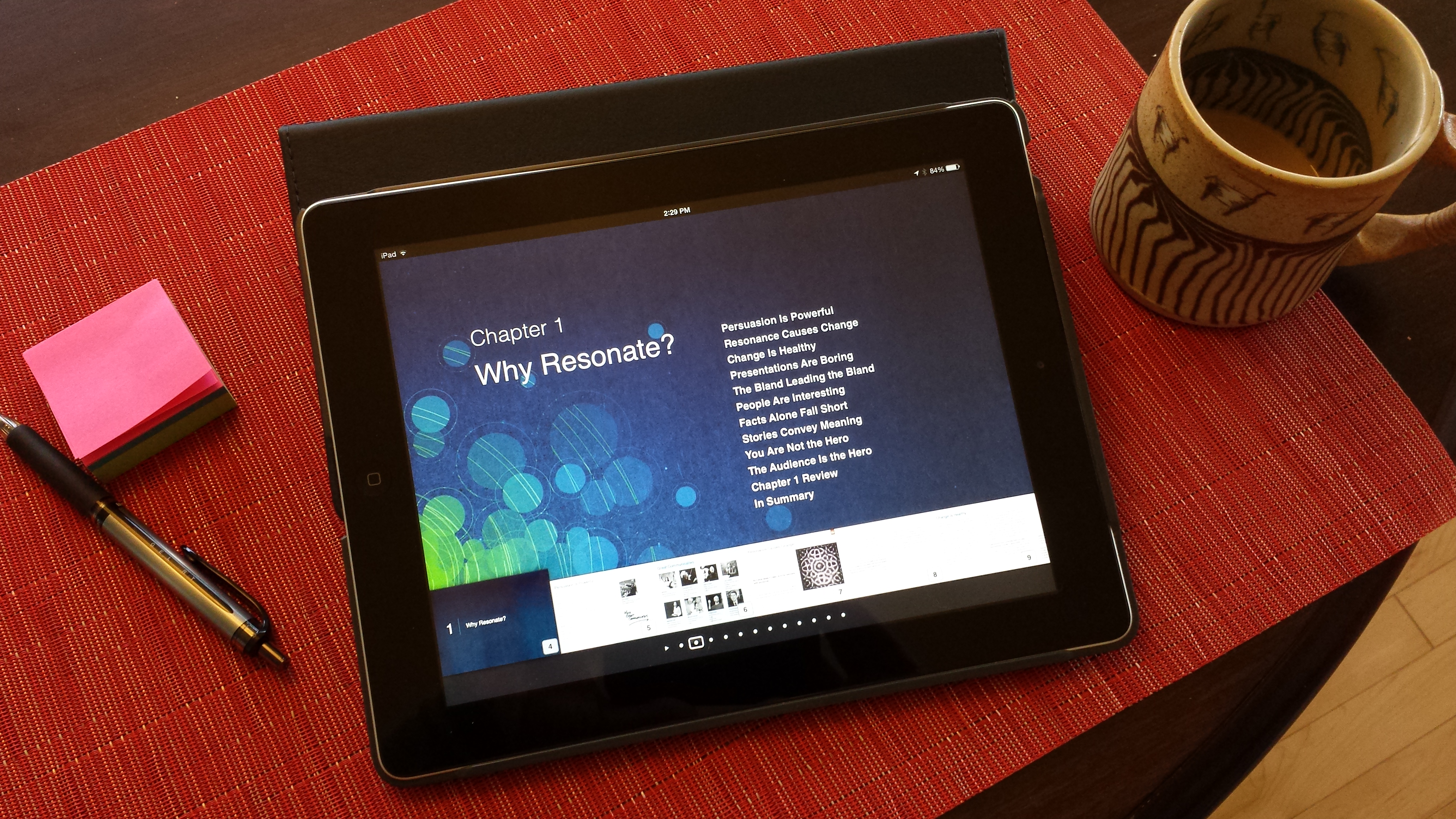
A multi-touch version of Resonate is available free on iPad.

A multi-touch version of Resonate is available free on iPad.

Nancy Duarte is one of the leading producers of presentations, including the Academy Award-winning film, “An Inconvenient Truth” with Al Gore.  There may not be agreement on climate change, but everyone was impressed by the quality of that documentary.  Duarte has shared her expertise through Slide:ology and Resonate, and these books have not only helped me improve and enhance my Powerpoint presentations but also my interpretation skills.  Her approach is firmly grounded in the techniques of effective communication, which can be applied to many situations at museums and historic sites.  If you’re not familiar with Nancy Duarte, she explains her ideas in an 18-minute presentation at TEDxEast in 2011.

The good news for iPad owners is a “multi-touch” version of Resonate is available free through iBooks.  All of the content from the book is supplemented with videos, quizzes, backstories, and other interactive experiences to better engage you.  You’ll not only learn about building better presentations and communicating more effectively, but you’ll also experience an example of one of the most effective eBooks available.  If you’re not sure how to do this, open the iBooks application and search the Store for “Resonate by Nancy Duarte”.

Are Historic House Museums Adapting for the Future?

Gunston Hall, Lorton, Virginia.

Gunston Hall, Lorton, Virginia.

In March, the Historic House Museum Consortium of Washington, DC will be examining how historic house museums are adapting to the future at its annual Historic House Museum Symposium.  Presented alongside the 2014 Virginia Association of Museums conference, the symposium will feature three speakers, a boxed lunch, and a special tour of Gunston Hall on Saturday, March 15, 2014 from 9 am to 3 pm at George Mason’s Gunston Hall in Lorton, Virginia.  Registration is limited and is $15 per person.

Speakers include Continue reading

Million Dollar Salaries at America’s Biggest Museums

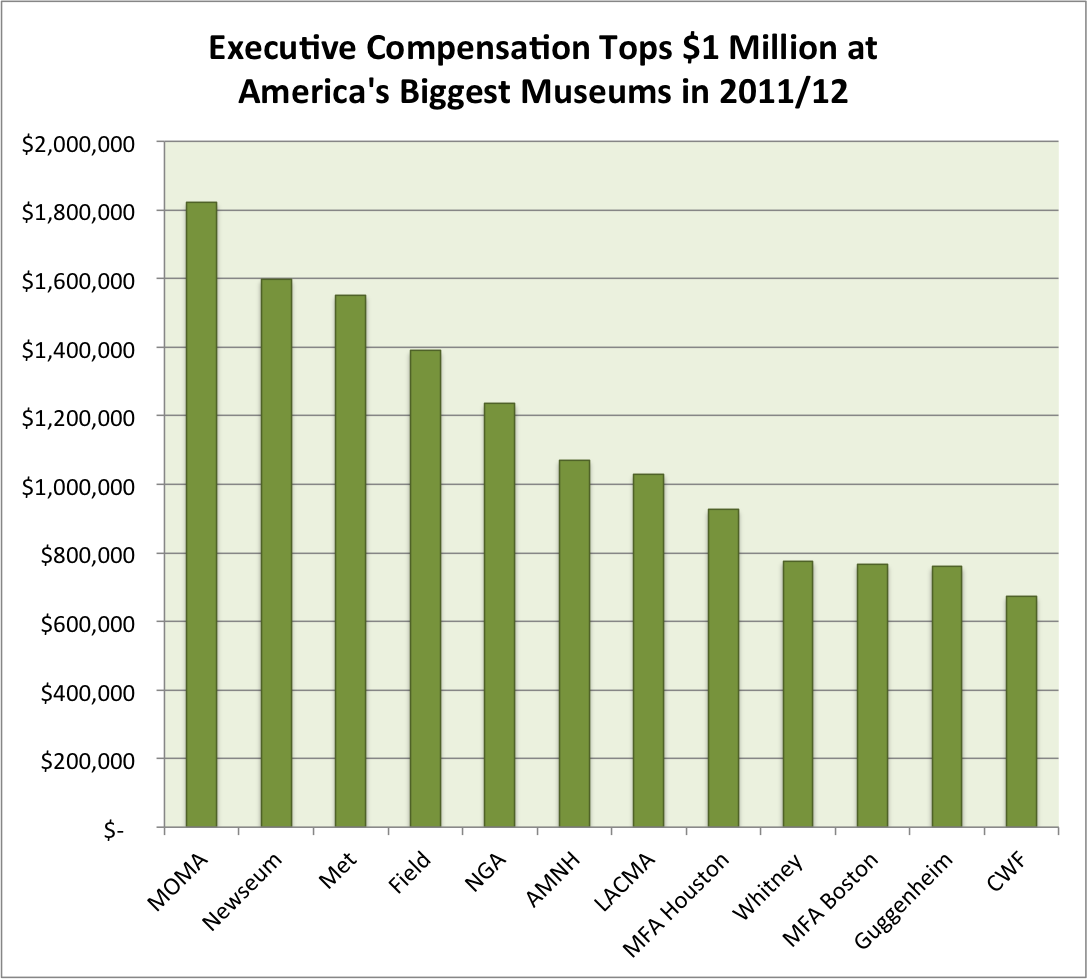
Exec Compensation 2011-12A review of the latest Forms 990 of more than two dozen of America’s biggest museums identified the most highly compensated executives in the field.  Among these museums, annual compensation ranged from $228,000 to $1,822,257 and the average was $727,000.  Seven directors earn more than one million dollars per year, as follows:

Mary van Balgooy Appointed Executive Director of SWG

Mary van Balgooy at the headquarters of the Society of Woman Geographers.

Mary van Balgooy at the headquarters of the Society of Woman Geographers.

Today Mary van Balgooy, vice president of Engaging Places, LLC, becomes the first executive director of the Society of Woman Geographers (SWG), an international membership association based in Washington, DC.

SWG was founded in 1925 in New York by four women who were recognized explorers but ineligible for membership in similar male-only organizations. Over the decades, its members have included aviatrix Amelia Earhart, anthropologist Margaret Mead, author Pearl Buck, archaeologist Mary Douglas Leakey, and primatologist Jane Goodall. It has grown from Continue reading

Financial Management at America’s Billion-Dollar Museums

Big 5 Museums Assets 2012

The Smithsonian Institution has more than $3 billion in assets and had more than $168 million in income for its 2012 fiscal year, making it the biggest and strongest museum in America.  It’s also the leader of the handful of American museums that have more than a billion dollars in net assets, according to the latest financial reports available through GuideStar.  At the top of the list of America’s wealthiest museums are:

  • Smithsonian Institution (Washington, DC)
  • Metropolitan Museum of Art (New York)
  • Museum of Fine Arts Houston (Texas)
  • Colonial Williamsburg Foundation (Virginia)
  • Museum of Modern Art (New York)

This is a nice trivia question for the next museum reception but what does it mean?  First of all, the size of the museum isn’t based on Continue reading

Relevance of History Discussed at AHA Session

This slideshow requires JavaScript.

Last Friday, January 3, about 65 people braved the winter cold of Washington, DC (okay, compared to Midwest right now, it’s balmy) to participate in a discussion on the relevance of history to Americans.  Leading the discussion with me were Tim Grove of the Smithsonian Institution and Cathy Gorn and Kim Fortney of National History Day.

It was an exciting mix of participants.  The room was not only filled with historians who were attending the American Historical Association conference, but also people who work at history organizations in the DC region.  These various perspectives sparked a Continue reading

The Most Popular Blog Posts for 2013 at EngagingPlaces.net

Your 2013 year in bloggingAs the Engaging Places blog enters its third year, it’s a chance to take a look back to see what’s attracted and intrigued our readers.  The busiest day for 2013 was June 25 when the post on Rethinking the “Do Not Touch” Sign went up and attracted nearly 550 views.  Of the 34,000 views for the year, the most popular posts were (starting with the highest):

  1. IMHO: Seismic Shifts Predicted in Historic Preservation (update: the National Trust moved to the Watergate after selling their HQ building; Preservation Action has moved from the National Building Museum to the Heurich House Museum; and the Advisory Council on Historic Preservation is moving to the National Building Museum–it’s musical chairs in DC!)
  2. HBO CEO named Mt. Vernon CEO; A Step Backwards IMHO (still popular even though it was posted in 2012)
  3. Sequestration to Hit Smithsonian Collections
  4. Let’s Give SWOT a REST (and another popular post from 2012)
  5. NEA Survey Reveals Patterns in Historic Site Visitation
  6. Rethinking the Mission Statement

Most readers came from the United States, although Canada and the United Kingdom were close behind (with a total of 122 countries!).  It seems that readers are most interested in

Continue reading

Cleaning Out My Cabinet of Curious Stories

Like all good museologists, I have a small cabinet of curiosities where I collect things of wonder, inspiration, and imagination.  Mine is virtual and sits in Evernote.  It’s time for a year-end clean-up, so here are a few that didn’t develop into full blog posts but even in their unrefined state, seem sufficiently interesting to share:

Google Maps Historical Society 2013

Google is continually looking for ways to get information to us as quickly and easily as possible. The last couple years it’s been creating quick descriptions of places using five keywords–but I’m not sure how they’re derived. A recent search for “historical society near Maryland” in Google Maps associated the American Historical Association with “symbol” and the Historical Society of Washington DC with “celebrities.” Who doesn’t like attention like that? The most surprising, though, is the description of the DAR National Headquarters with Continue reading

A Campaign to Make History Relevant to Americans

American flag with puzzle piece missingIn the last year I’ve become part of an group to find ways to make history more meaningful and relevant to Americans.  The History Relevance Campaign, for lack of a better name, is an informal grassroots effort made up of public historians, preservationists, educators, historic site managers, and museum leaders who are creating a national, broad-based strategy to assert the relevance of history.

Just to clarify, the History Relevance Campaign is not connected to any one history organization. From its start in early 2013, the group has strived to be as inclusive as possible.  Secondly, it is not a lobbying group.  Its main audience is the general public, not elected officials and public policy makers.  Thirdly, its intent is to show that history skills are just as important as Continue reading

Washington Post Investigates Financial Fraud at Nonprofits

Form 990 diversionDuring the last couple months the Washington Post has been running a series of articles on financial fraud at non-profit organizations using the annual Form 990 report.  According to their research, more than a thousand organizations have disclosed “a significant diversion” of assets (such as embezzlement) since 2008.  “Significant” means it exceeds $250,000 or five percent of the organization’s assets or receipts, so minor occurrences of fraud are not revealed.  Charitable organizations (such as museums and historic sites) were by far the most common victims, representing about 65 percent of the total.  Educational institutions were the second most common victims, but fell far behind at about 15 percent.

The three most common forms of financial fraud are: Continue reading