IMLS Moves Deadline in Response to Comments from Museums

In a surprising move, the Institute of Museum and Library Services will be changing the application deadline for Museums for America and National Leadership Grants from January 15, although it won’t happen until 2014 at the earliest and the new deadline hasn’t been announced.  The 2013 deadline remains January 15.  According to Claudia French, Deputy Director for Museums, “We wholeheartedly support this suggestion and will change the deadline for FY2014. The time required for final approval of new grant guidelines through the Office of Management and Budget (OMB) will not allow us to alter the date for FY2013.”

This was a result of more than 100 comments received from the field as a result of a major restructuring of their grant programs.  IMLS did not reveal what other changes are under consideration or what concerns were reflected in the comments, however, they did affirm that, “In 2013, there will be no restrictions on the number of applications a museum may submit to MFA or NLG-Museums. . . .Museums submitting applications in more than one project category will compete with other museums in each category, not with themselves.”

Thanks to everyone who submitted comments on the proposed IMLS grant guidelines.  This has been one of the most controversial topics in the museum field that I encountered this year, so I’m happy to hear that museums and historic sites had some influence and that the IMLS was willing to accept public comments and provided an initial response so quickly.  A complete statement from IMLS is available on their blog.


Contemporary Visitor Center opens at French Historic Site

MuséoParc Alésia in Burgundy, France. The new orientation center is on the right and reconstructed sections of Roman fortifications are on the left.

On the site in Burgundy, France where Julius Caesar laid siege to Gallic leader Vercingetorix, architect Bernard Tschumi of New York created a circular concrete orientation center wrapped in a wood lattice on the site occupied by the Roman army.  (Although Napoleon II erected a 22 foot tall statue of Vercingetorix in 1865, he doesn’t seem to have caught on as a celebrity and no one names their kids after him.)  Called MuseoParc Alesia, the design of the interpretation center echoes the ringed fortifications built by Julius Caesar in 52 BC.  The building not only interprets the site through the exhibits inside but emphasizes views out onto the historic landscape via the windows and balconies that circle the building.  After watching a film about the battle, visitors exit the auditorium onto the tree-shaded roof terrace to enjoy a panoramic view so that, “vous vivez une expérience au cours de laquelle vous allez comprendre l’histoire de ce site, apprendre à regarder les signes dans le paysage mais aussi partager un lieu, un moment, un récit.”  And it includes an innovation for French museums:  a “toy library” for children ages 3 to 8 where they can learn while having fun (I think we call this a discovery room in the U. S.).  Strangely, the architect wanted the lobby to be empty.  I wonder if visitors will find this a confusing and sterile experience after encountering this dramatic building outside?  Seems to me to be a bit jarring, but I guess I’ll have to go to Burgundy to find out for myself.  A second circular museum built in the brick Gaul style will be located about a half mile away.

You’ll find a slide show of images at Architectural Record and initial reviews on Trip Advisor look promising.  Thanks to Barbara Campagna for alerting me to this new building!

Flexible Lobby Thanks to Furniture on Wheels

This slideshow requires JavaScript.

During a recent visit to the Abbe Museum in Bar Harbor, Maine, I spotted a clever way that allows them to easily remodel their lobby from a visitor reception area to an event space.  You don’t notice it at first because the furniture is so well designed and complements the appearance of the building.  The reception desk is busy selling tickets and greeting visitors, and next to it are panels explaining what to see and do.  But look below or behind, and you discover it’s not a panel but a moveable storage wall.  Clever!

AASLH Conference Offering Lots for Historic Sites

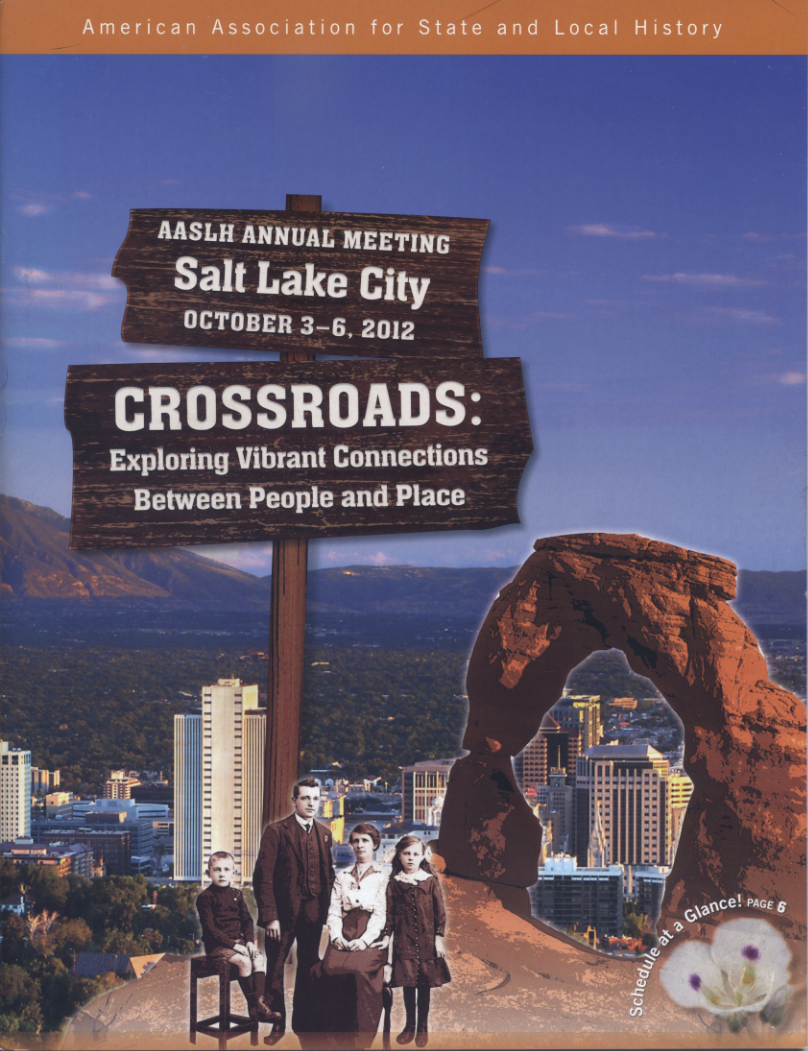
Preliminary program for the 2012 AASLH Annual Meeting in Salt Lake City.

The program for the annual meeting (aka conference) of the American Association for State and Local History just arrived in my mailbox.  Flipping through its pages, there are more than 70 educational sessions, many that focus specifically on historic sites and house museums including:

  • Twilight at Conner Prairie: The Creation, Betrayal, and Rescue of a Museum
  • Too Important to Fail: Historic House Museums Meet Communities’ Needs
  • Business Models and Earned Income for Historic Houses
  • Visitors to Religious Sites: The Whos and Whys
  • Historic Places as Museums: Crossroads of Expectations
  • Re-imagining Historic Sites: Three Roads to the Same Destination
  • Paranormal Policies (if your site hasn’t been contacted by paranormal researchers in pursuit of ghosts, your time will come)

In addition, most of the other sessions are helpful, depending on your needs and interests.  There are sessions on fixing poorly functioning Continue reading

Amelia Wong Joins Museum Studies Faculty at GWU

Amelia Wong, currently the US Holocaust Memorial Museum’s senior social media strategist, will be joining the fulltime faculty of the Museum Studies Program at George Washington University this fall as an assistant professor. Amelia holds a BA from UCLA in history and a PhD in American Studies from the University of Maryland, College Park. Amelia’s scholarship focuses on how museums, especially those concerned with democratization, can engage critically with technology for their goals. Her dissertation, “Museums, Social Media, and the Fog of Community,” reflects her research interests and
is the first book-length project about social media in American museums.

At the Holocaust Museum, the Twitter community has grown from 2000 to over 100,000 people under her direction. Amelia also developed and produced an ongoing Web series, “Curators’ Corner,” which gives the public, donors and others an inside look at the
museum’s collections via short multimedia presentations narrated by museum staff. During her first year at the museum, Amelia proposed, Continue reading

Comments on IMLS Revised Grant Guidelines Due Today

A crew from Alabama repairing downed power lines in Maryland near my office.

Electrical power was out in my part of the world for a couple days earlier this week due to the fierce thunderstorm that struck the Midwest and Mid-Atlantic on Friday.  Some parts are still without power and although I haven’t conducted a survey to see how the nearby historic sites fared, I have heard that one historic house museum in Virginia is facing about $30,000 of clean-up costs due to fallen trees and branches.

But power and Internet have been restored to my office, just in time to submit my comments to IMLS on their revised guidelines to their grant program.  Comments are due today to comments@imls.gov.  Here’s what I submitted:

Please accept these comments for the public record regarding the draft guidelines for the FY 2013 Museums for America and National Leadership Grants for Museums programs of the Institute of Museum and Library Services.

I appreciate the federal Continue reading

AASLH Council Meets in Maine

This slideshow requires JavaScript.

This past Saturday, the Council (aka board) of the American Association for State and Local History met in Maine for one of their three regular meetings each year.  It’s been a tough few months due to the discovery of embezzlement and fraud within the organization, so this meeting had been preceded by nearly a dozen additional meetings of the Council and several committees by conference call to deal with various aspects related to the situation, potential threats to the organization, and improvements to our current financial management by reviewing and revising various policies, procedures, and practices.  This meeting adopted revised financial policies and procedures; adopted revised codes of ethics for board, staff, and organization; adopted a revised conflict of interest policy for board and staff; and discussed how the by-laws may need to revise the finance and audit committee responsibilities as well reconsider how Council members are elected to ensure we have sufficient people on board with financial skills.  We also began working more strategically, looking longterm to identify priorities so we can preserve those programs that matter most to members and most effectively fulfill the mission.  History News and the annual meeting/conference rose to the top as expected, but Continue reading

Detour Ahead for National Trust’s Main Street Program?

Preservationists in Frederick, Maryland, which received a Great American Main Street Award in 2011.

In a move that will surprise many who work in historic preservation, the National Trust for Historic Preservation has decided to move its Main Street program to a separate non-profit subsidiary and three of its senior staff members–Doug Loescher, Lauren Adkins, and Andrea Dono–have decided to leave the organization.  Main Street was created more than thirty years ago to help revitalize historic downtowns and commercial districts and its work was so highly regarded that the National Trust presented its own Honor Award to its founders–Mary Means, Scott Gerloff, Tom Moriarity, and Clark Schoettle–in 2004.  In a  email message on June 18, Executive Vice President David Brown wrote:

As most of you are aware, since the launch of the Preservation10X framework last September, we have been engaged in a focused and inclusive process to assess the current status of the National Trust Main Street program and the Main Street Center, in order to arrive at the best path forward for Main Street. Thank you for the excellent input many of you have provided during this process.

Main Street is one of the most valued programs of the National Trust. It has achieved unprecedented stature nationwide as a highly successful preservation-based economic development program and enjoys great popularity among a wide constituent base. In many ways it has far surpassed Continue reading

Slave for a Day? I’m Not Sure This is a Good Idea

Footsteps of the Enslaved, a new program at Hampton

Hampton, a National Historic Site operated by the National Park Service, recently announced a “Slave for a Day” program which will allow visitors, to, “Experience agricultural labor that enslaved people may have performed at Hampton. Work in the fields with actual hoes and scythes. Carry buckets of water with a yoke on your shoulders.” After a chorus of howls went up on the Internet, the title was changed to the much more tame, “Walk a Mile, a Minute in the Footsteps of the Enslaved on the Hampton Plantation” but the program content remained the same. I certainly want to encourage the ranger who developed the program to continue to pursue her passion for African American history, but I’m not sure these activities, as described, get visitors to fully understand what life was like for enslaved people.  Antebellum farming is about hard work; Continue reading

Changes at Google+ Creates Opportunities for Museums and Sites

Okay, everyone knows about Google but Google+ and Google Places is still a mystery for many people.  It may become a bit simpler because the rumor is that Google Places is slowly being replaced by Google+ Local.  Or did that just complicate things?  Let’s start over.

Google search results for “historic sites in philadelphia”

Google has launched new search results that include the usual title, web link, and brief description, but now adds the address, phone number, shows the location on a map, a link to reviews, and a Zagat ranking on a scale of 1 to 30.  In the example to the left, you’ll see the search results for “historic sites in Philadelphia” and that the Eastern State Penitentiary (the third item) received a Zagat rating of 25 (it really is an amazing place) and has 81 Google reviews (wow! their visitors have opinions).  This new form of listing doesn’t occur for every city, just those that seem to have enough places to warrant them (right now, this list appears for Denver but not San Francisco).  Local information is being integrated across Google (including the Zagat ratings, which was acquired by Google last year), so you’ll find Continue reading