
HBR: To Engage Your Visitors, Keep it Simple

"To Keep Your Customers, Keep it Simple" by Patrick Spenner and Karen Freeman (Harvard Business Review, May 2012)

The May 2012 issue of Harvard Business Review arrived a little early to my mailbox, but I couldn’t stop from sharing a great article on engaging customers in business world that can easily be translated to engaging visitors and building support for historic sites and museums.  In “To Keep Your Customers, Keep It Simple,” Patrick Spenner and Karen Freeman note the paradox of today’s promotional techniques:

Companies have ramped up their messaging, expecting that the more interaction and information they provide, the better the chances of holding on to these increasingly distracted and disloyal customers.  But for many consumers, the rising volume of marketing messages isn’t empowering–it’s overwhelming.  Rather than pulling customers into the fold, marketers are pushing them away with relentless and ill-conceived efforts to engage.

This conclusion is based on multiple surveys of more than 7,000 consumers which were then compared to interviews with 200 marketing executives representing 125 brands.  Their pointed out that what consumers what and what companies think consumers want didn’t correspond to each other, or in biz speak, it’s a Continue reading
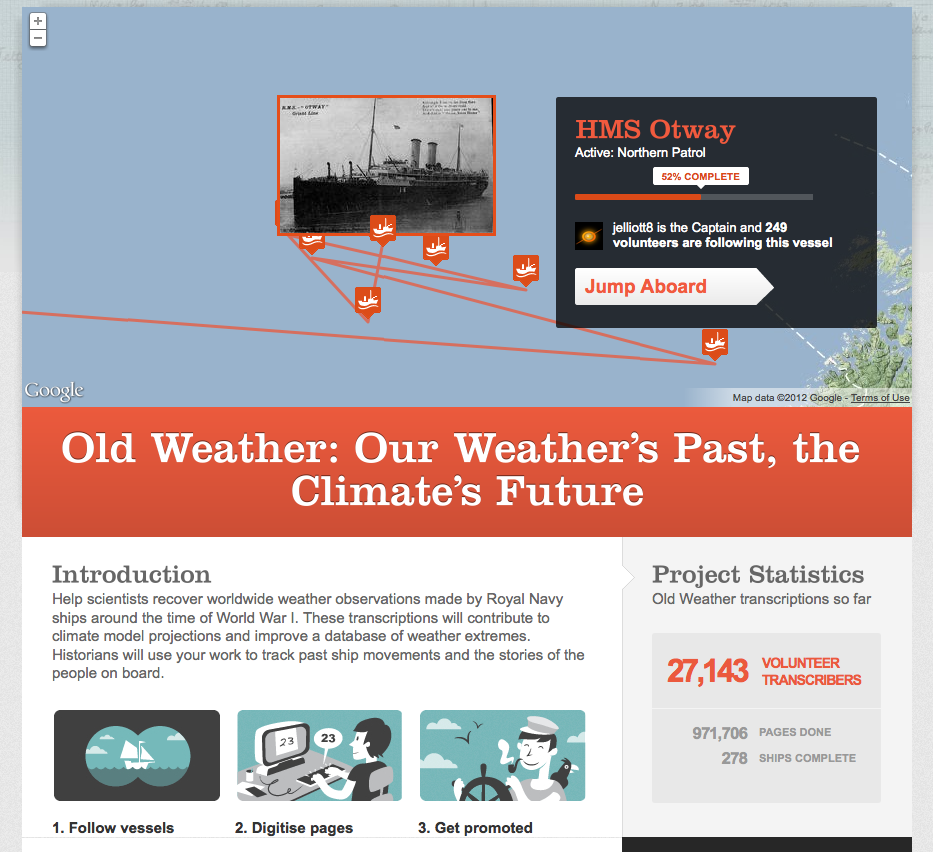
WebWise 2012: Using Volunteers Online

Much of the work at historic sites and history museums wouldn’t be possible without volunteers (and we just passed National Volunteer Week) but very few organizations have recruited volunteers for work online.  Is it possible? What would they do? A session at WebWise 2012 explored these ideas in a panel called, “Sharing Public History Work: Crowdsourcing Data and Sources.”

OldWeather.org, a project of the Citizen Science Alliance

Ben Brumfield of FromThePage Open-Source Transcription Software shared his experiences from small crowdsourcing projects.  He noted that many organizations often object to public participation in scholarly projects because they don’t have the skills or expertise, but he’s found that those people participating are self-selecting and highly focused.  Participation is not equally distributed but mostly done by a small number of people, thus it’s not really crowdsourcing but nerdsourcing.  He provided some examples of “well informed enthusiasts” conducting exemplary work, such as Continue reading

Attractive Outdoor Interpretive Panels are Possible at a Bargain Price

This slideshow requires JavaScript.


James Madison’s Montpelier in Virginia sports some very attractive interpretive signs that looked so good, I had to figure out how they were made. With a bit of prodding and poking, I discovered they were printed plastic attached with Velcro to a sturdy wooden frame.  Very clever!  The signs are great looking even after a couple years outside.

Peggy Vaughan, Vice President of Communications and Visitor Services, generously shared that the three signs cost about $900 total:  $90 for each 30″x 40″ PVC sign and $210 for each base. The content, design, and bases were created in-house (yes, Montpelier is fortunate to have a graphic designer and master carpenters on staff) and the signs were printed by FedEx Office (formerly Kinkos). This sign was created using Adobe Indesign, saved as a pdf, and printed directly on PVC–the image isn’t as sharp but they last longer outdoors than the alternative method of laminating a printed image onto PVC. Peggy said that, “The big advantage to these signs for us was that they are relatively cheap, and because everything around here is always changing, we did not want to spend $2,000 on a proper museum sign, as we had in the past, that would be out of date before it wore out. And, frankly, even if things don’t change at your museum, your messaging should change from time-to-time to keep up, don’t you think?”

If you’re looking for more ideas for signs at historic sites, I’ve collected dozens of images from places around the world—good, bad, and ugly—on several web albums.  Please note that one sign may serve several purposes (e.g., directional AND identification), so look in other categories, too.

Identification Signs

Directional and Wayfinding Signs

Informational Signs

Are Your Metrics Just Skin-Deep?

I’ve long been a fan of developing clear measures of success or metrics in planning.  Too often, though, boards and staff at historic sites only use total attendance or the financial bottom line to judge their success.  Certainly, having no visitors is not a good sign, but is a large number of visitors a mark of success?  Not necessarily, because high attendance may be due many factors, including some that may have nothing to do with advancing your mission in a significant manner, such as weddings rentals or dog walkers or corporate retreats.  I’m not knocking those activities and they may be an essential part of your programming, however, what I’ve most often heard at board meetings are conversations like this:

Board chair:  I heard we did well last month.  What was our attendance?

Director:  We had 2,500 visitors in March, double what we had in February.

Boardmembers (in unison):  Wow, that’s great! 

Director:  And looking at the guestbook, we had people from 14 different states and 3 foreign countries, including Latvia.

Board chair:  This must be a record for us.  Okay, let’s have the financial report–looks like the bottom line is positive.  Is there a motion to accept?

Don’t assume this only happens at the local historic house museum–it happens at the big ones as well.  As I’ve often said, Continue reading

Cooking Gene Project Raising Funds Online

Michael Twitty at the Sandy Spring Museum in Maryland.

A couple weeks ago I attended a lecture on the “world of a slave” at the Sandy Spring Museum in Maryland.  Kym Rice spoke about her recently published two-volume work, The World of a Slave: Encyclopedia of the Material Life of Slaves in the United States, which she co-edited with Martha Katz-Hyman of Colonial Williamsburg.  Many of you know Kym as the director of the museum studies program at George Washington University, but you may not know she is also working towards her Ph.D. in American Studies, focusing on African American history and culture.

Joining her was Michael Twitty, one of the contributors to the encyclopedia.  He gave a fascinating lecture on African American foodways but also discussed an upcoming research trip as part of his Cooking Gene Project:

From May to September, Michael will be going with a team of friends on several expeditions into the Old South searching for his own connections to his ancestors through food and cooking. The Southern Discomfort Tour–May to July–will form the bulk of these explorations and will incorporate diverse Continue reading

WebWise 2012: Learning and Participation on the Move

WebWise 2012 in Baltimore.

It’s been a couple weeks since the WebWise conference in Baltimore, but the information hasn’t gone stale yet.  It’s still cutting edge and thought-provoking because most of the projects discussed are still underdevelopment and it’s unclear if they’ll succeed or not.  However, they do provide a glimpse of current and potentially future practices in the use of technology for historic sites. The webcast videos are now available except for LeVar Burton’s presentation, which is waiting for broadcast permission. Heritage Preservation will be using portions of the webcasts to create webinars that will be available later this summer including, “Crowdsourcing in Public History” and “Oral History in the Digital Age.”

The first panel session, History Places and Spaces:  Learning and Participation on the Move, was moderated by Nancy Proctor and looked at the ways that mobile technologies (that is, technologies that are aware of your location) can provide new and better experiences for visitors.

Rob Stein at the Indianapolis Museum of Art opened the session by stating that the field already recognizes that location should be a required element in basic content but the challenge is the proliferation of software and hardware platforms.  Every digital device (website, cellphone, tablet) seems to be in a unique format and requires special treatment.  To overcome this, Stein suggested we rethink Continue reading

NEH Announces Recent Awards

The National Endowment for the Humanities recently announced the awards for the applications submitted in August 2011 (yes, 2011) for the “America’s Historical and Cultural Organizations” grant program.  Out of the 25 major grants awards (I’m not including the small NEH on the Road grants), about a third are related to historic places including:

El Presidio de Santa Barbara State Historic Park Visitor Center Plan

  • Santa Barbara Trust for Historic Preservation, Santa Barbara, CA
  • Award: Outright; $40,000
  • Planning for interpretive exhibitions and programs in a newly constructed visitor center about the history of Santa Barbara.

Impressions of a Lost World

  • Pocumtuck Valley Memorial Association, Deerfield, MA
  • Award: Outright; $40,000
  • Planning for a website, mobile applications, hand-held digital and print tours, public programs, and educational materials about the early nineteenth-century discovery of dinosaur tracks in the Connecticut River Valley and the impact of this discovery on American thought and culture.

Continue reading

Interpreting African American History if You’re NOT African American

Session on Interpreting African American history and culture, AASLH annual meeting, 2012

Last September, I had the privilege of moderating a session on interpreting African American history at historic sites in a room filled with some of the smartest people in the field during the annual meeting of the American Association for State and Local History.  The panelists–George McDaniel, Pam Green, David Young, and Tanya Bowers–gave outstanding opening remarks but even more engaging was the discussion that followed with the audience.  Because African American history can be a sensitive topic and to demonstrate a way to confront these issues among a group of strangers, I used a technique drawn from Great Tours (page 117).  Each person in the audience was given a 3×5 card and was asked to anonymously complete the sentence, “I would feel more comfortable talking about African American culture and history if…”  Among the responses I received were: Continue reading

EngagingPlaces.net Celebrates Six Monthiversary

EngagingPlaces.net is entering its sixth month of operation and it’s doing well, thanks to all of you readers.  Each month has shown growth in the number of views and this past week saw a record of number of views in one day (432!).  Even more important measures are the number of subscribers/followers and quality of comments so this blog is providing a useful service to those who are working to preserve and interpret historic houses, sites, and places.  For those of you like data, most people are referred to this blog via search engines (such as Google, Bing, and Yahoo), Facebook, Twitter, and LinkedIn.  Most people come to the blog searching for specific people (e.g. Anthea Hartig, Barbara Carson, Laurie Ossman) or trends (e.g., 2012 Mobile Computing Trends).

I’ve also noticed that about the same number of people subscribe to the blog as follow me on Twitter, so I’ll experimenting with the type and frequency of posts in each media.  I’ve recently shifted to 2-3 posts weekly on the blog and 2-3 tweets daily on Twitter, taking Friday-Sunday off (views drop off significantly on those days–are you all taking three-day weekends or facing information overload by the end of the week?).  The blog posts will be mostly original or extended content whereas in the tweets, I will share stories produced by others and on occasion, breaking news.

The advantage of the two different media is that you can control how much and how frequently you wish to be engaged with EngagingPlaces.net: Continue reading

Nonprofit Benchmarks for Online Communications

Email Messaging Benchmark infographic

Online communications–electronic newsletters, Facebook, e-fundraising, Twitter–have become a standard for non-profit organizations but often we’re unsure if they’re effective.  We can track the number of Facebook Fans or times an email has been opened, but those numbers mean little by themselves.  Benchmarking is one way to measure effectiveness and progress, and one of the easiest ways to do this is by comparing your results consistently over time (for example, number of Facebook Fans on December 31, 2012 compared to December 31, 2011).

But to really see how you’re doing, you need to compare yourself to similar organizations.  The American Association of Museums has developed an online benchmarking tool for comparisons across the museum field, however, it doesn’t include e-communications at this time (they’re collecting lots of data in other areas, though, so please participate).  M+R Strategic Services and the Nonprofit Technology Network just released its 2012 eNonprofit Benchmarks Study as an infographic to show the highlights.   These results are based on a study of 44 leading nonprofits in 2011 and among the many benchmarks are:

  • 12-15% of email messages are opened, with a response rate for advocacy around 4% and for fundraising at less than 1%.
  • The average one-time online gift is $62.
  • For every 1,000 email subscribers, nonprofits have an average of 103 Facebook Fans and 29 Twitter Followers.

The full study will be released on April 5 at the Nonprofit Technology Conference (although you can attend in-person free in Washington DC) and will be presented as a webinar on April 18.