Take Advantage of the Ten Cultural Trends for 2012

JWT Intelligence has just released its Ten Trends for 2012 based on surveys of Americans and Britons and interviews with experts and influencers.  If you can’t afford to buy copy of their full report for $250, here’s a summary plus some suggestions for taking advantage of them:

  1. Navigating the New Normal:  The economy won’t be back to the way it was for some time, so consumers are now becoming price conscious by habit.  Consider stripped down offerings (such as smaller sizes of products in your museum store) or some access at lower cost (such as a “grounds only” admission fee).
  2. Live a Little:  Although they don’t want to pay a lot, visitors are becoming anxious to splurge on a few good things responsibly.  Adjust your programs so they promote both the fun experience and extraordinary aspects of your site (and be sure you can deliver it–just saying your tours are fun and extraordinary doesn’t make it so).
  3. Generation Go:  20-somethings are struggling Continue reading

El Morro National Monument Damaged by Vandalism

In October, two international students from the University of New Mexico went behind a split rail fence and carved their nicknames on the sandstone walls of El Morro National Monument.  They knew enough English to write “Super Duper Dana” and “Gabriel” but claimed they didn’t know enough English to read the sign posted just a few feet away that said, “It is unlawful to mark or deface El Morro Rock.”  Now their graffiti joins “Pedro Romero 1758” and two thousand other signatures, dates, messages, and petroglyphs that have been left over hundreds of years by Puebloans, Spaniards, and Americans.  They were recently charged with damaging an archaeological resource on public land and face fines, prison, and repair costs of nearly $30,000.   For more details, see the Albuquerque Journal and Cibola Beacon. Continue reading

What do You do with Collections in a 21st Century House Museum?

Museums and the Disposals Debate, 2011

One of the findings of the 2007 Kykuit Conference was that “undefined collecting coupled with a lack of professional standards and inconsistent practices regarding deaccessioning are an impediment to change and sustainability” and recommended that “selected sites should develop a pilot process to streamline deaccessioning and share their results with the field.”

Some of this work may have just been accomplished with the publication of Museums and the Disposal Debate, an anthology of essays edited by Peter Davies.  At a hefty 600 pages, it includes two dozen contributions from museums from around the English-speaking world but for those working at historic house museums, you’ll be most interested in “Too Much of a Good Thing: Lessons from Deaccessioning at National Trust Historic Sites” by Terri Anderson, the John and Neville Bryan Director of Museum Collections at the National Trust for Historic Preservation (she moderated the standing-room only session on deaccessioning for AAM a couple years ago).  I read an early version of her essay and it’s the best I’ve seen written on the particular challenges facing deaccessioning at historic sites, which are distinctly different from other museums.

The talk of becoming “21st century museums” is often coded language for Continue reading

Latest Trends in Mobile Computing

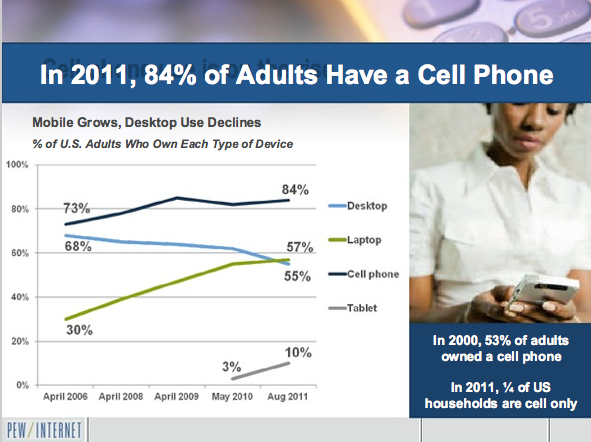
According to a recent survey by the Pew Internet and American Life Project, 84% of American adults have a cell phone and laptop and desktop use are about the same.

Aaron Smith, senior research specialist at the Pew Internet and American Life Project, recently released the key trends on Americans and mobile computing based on a nationwide telephone survey.  You can find the entire presentation online but some highlights for historic sites and historic house museums are:

  1. The use of mobile devices (cell phones, laptop computers, and tablets) is growing and desktop computer use is falling.  About 2/3rds of Americans connect to the internet wirelessly using a laptop or handheld device.  One quarter of US households only use cell phones.  [Soon everyone will be carrying an internet-connected computer with them–what will that mean for your organization?  How will that change your communications strategy, your programs and activities?]
  2. Smartphones (cell phones with internet access) are most popular with people ages 18-29, college graduates, households with an annual income $75,000 or more, and African Americans and Latinos.  [If you are trying to reach one of these audiences, Continue reading

Grants Awarded for Experimental Interpretive Research

Congratulations to Jebney Lewis, Sandy Lloyd, Philip Seitz, and Randall Mason on their 2011 HPP Awards for Interpretive Inquiry and Investigation from the Heritage Philadelphia Program (HPP) of The Pew Center for Arts & Heritage. Formerly known as the HPP Scholars in the Interpretation of History, this professional development opportunity supports individual practitioners in the investigation of imaginative projects in public history by connecting the present to the past in engaging, imaginative, and meaningful ways; responding to audience/community interests or needs; and
demonstrating a complex understanding and presentation of history.  There are four recipients this year, an unprecedented number:

  • Jebney Lewis for We Make the City.  Lewis will develop and construct a small exhibit with a focus on the intersection of Broad and Market Streets between the years 1900–10. It will examine “how the aspirations of the industrializing city were embodied in the creation of grand expressions of pride and ostentation,” as illustrated through Continue reading

Mark Twain House Embezzlement Case Featured by IRS

The million-dollar embezzlement case that hit the Mark Twain House has been memorialized as a featured fraud case for Fiscal Year 2012 by the Internal Revenue Service:

On November 21, 2011, in Bridgeport, Conn., Donna Gregor, of East Hartford, was sentenced to 42 months in prison and three years of supervised release, for embezzling more than $1 million from the Mark Twain House & Museum. On August 5, 2011, Gregor waived her right to indictment and pleaded guilty to one count of wire fraud and one count of filing a false tax return.  According to court documents and statements made in court, between 2002 and 2010, Gregor employed two different schemes to defraud the Mark Twain House.  In the first scheme, Gregor submitted false information via the Internet to the Mark Twain House’s payroll management vendor in order to receive, as a direct deposit in her personal bank account, an additional amount of pay to which she was not entitled.  Gregor then adjusted Continue reading

History Places

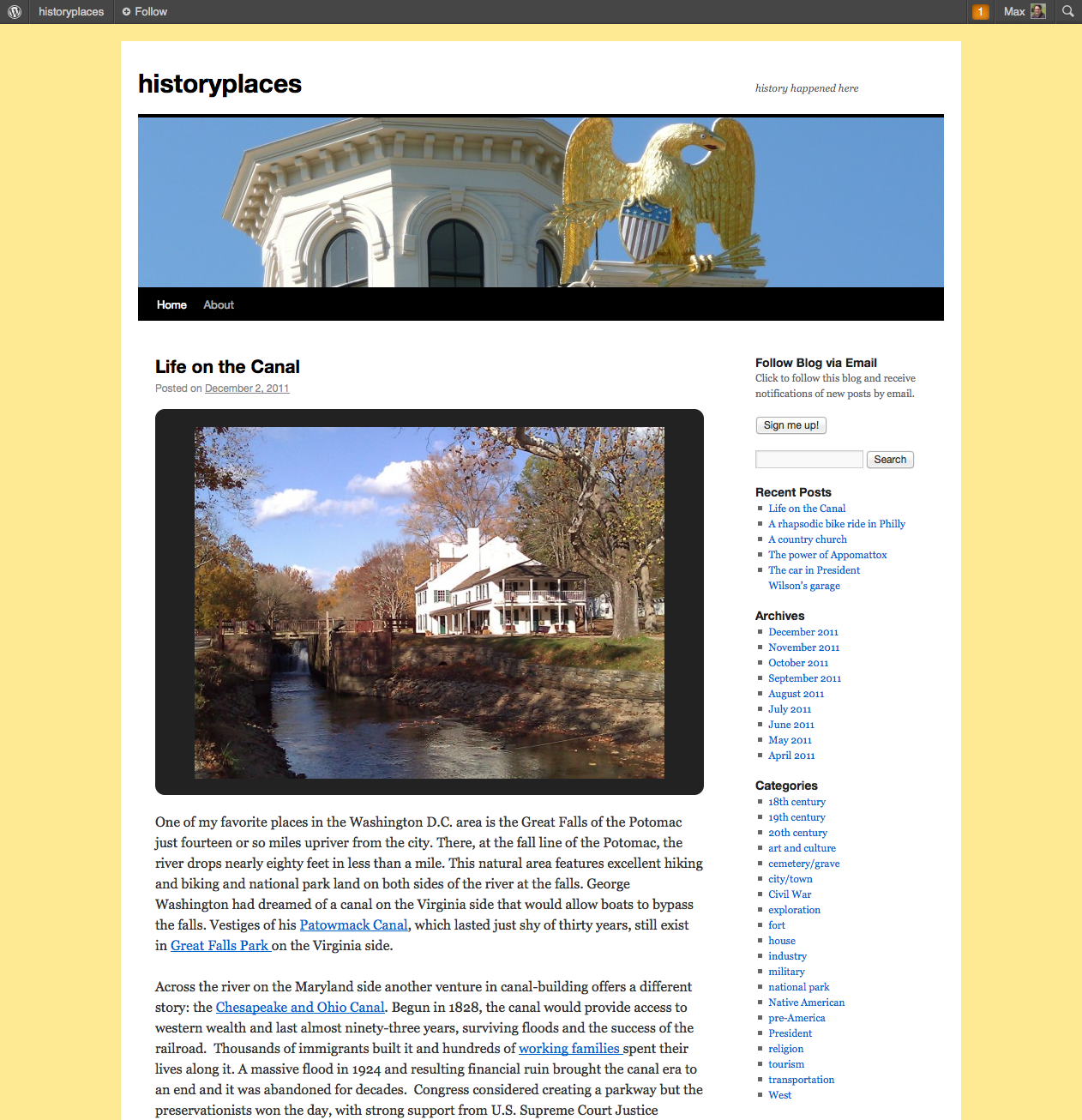
HistoryPlaces.WordPress.com by Tim Grove

Some of you may know Tim Grove as the Chief of Education at the National Air and Space Museum or as the History Bytes columnist in History News, but you may not know he started a weekly blog about historic places in April.  Through a wide variety of sites, he posts ideas and opinions about interpretation, visitor experience, and historical significance.  It’s part travelogue, part museum studies.  Most recently he’s discussed the C & O Canal near DC, the Forbidden Drive in Philadelphia, Appomattox Court House, and Fort Mantanzas in Florida.  If you’re enthusiastic about historic sites, check out his blog at HistoryPlaces.WordPress.com.

Montpelier Adopts New and Improved Mission Statement

Mission statements are required part of non-profit organizations, but I’ve often found that they’re treated like death and taxes–inevitable but you don’t want to think about it. In museums and historic sites, you can tell when they’re particularly useless when you can swap the name of the organization with another and it still makes sense.  Good mission statements are distinctive, memorable, and passionate.  They have to help you make decisions–is this project, activity, donor, or partnership right for us?  They have to go beyond “collect, preserve, and interpret” and describe what you want your audience to “think, feel, and do“.  Creating a good mission statement isn’t easy and examples are hard to come by, so when I find them, I collect them like golden eggs.
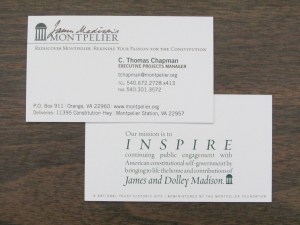
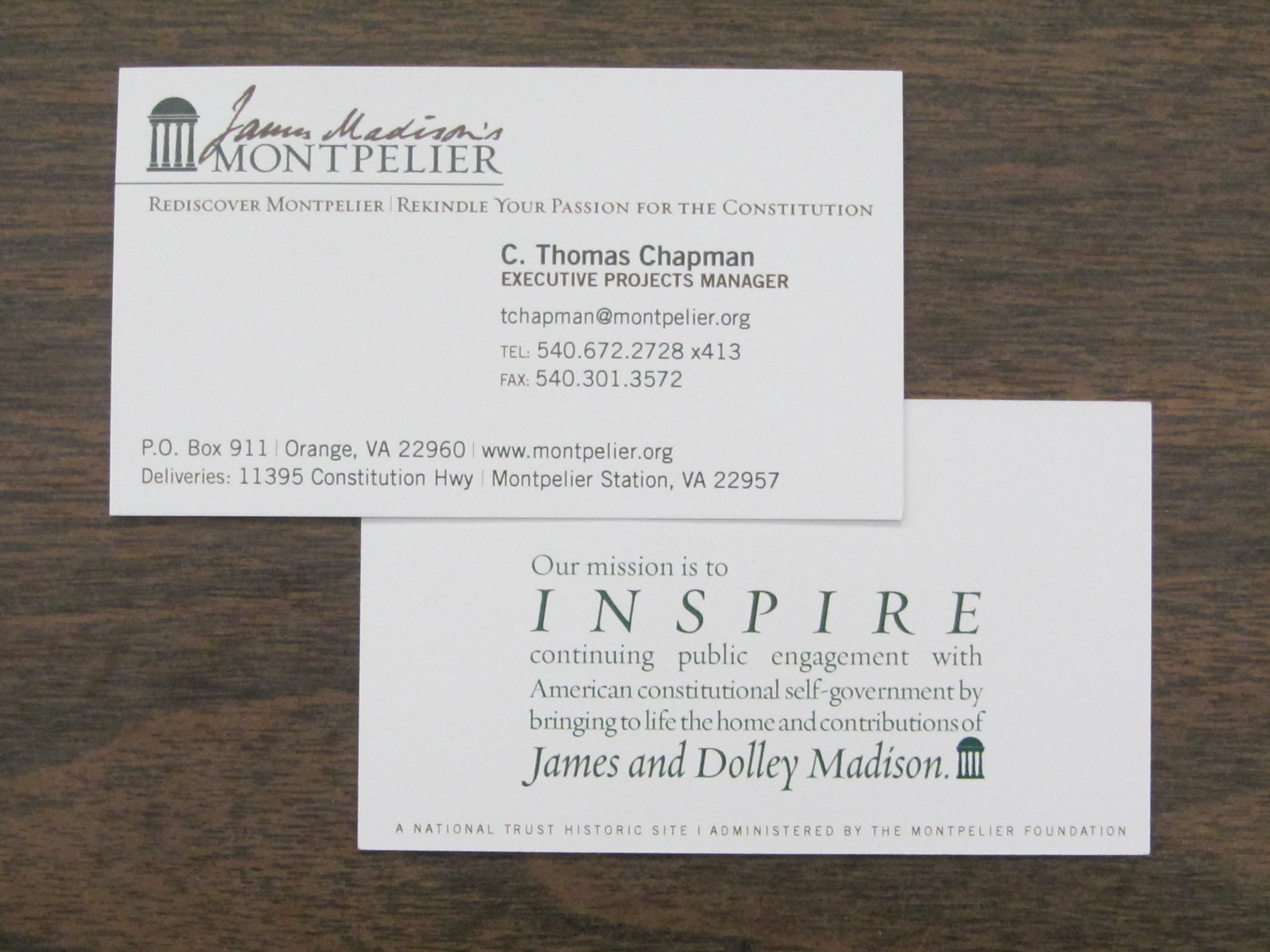
Montpelier's new mission statement on the back of a business card.

When I visited James Madison’s Montpelier last week, I learned they adopted a new mission statement.   Developed as part of their strategic planning process by a small team of trustees and staff, it was then shared with the entire board and staff for comment and revision before it was adopted by the board of trustees.  I thought it was so good I wanted to share it as an exemplar:

Our mission is to inspire continuing public engagement with American constitutional self-government by bringing to life the home and contributions of James and Dolley Madison.

Yes, there’s a bit of jargon that requires some explanation but it’s so much better than the previous one:

The Montpelier Foundation preserves the legacy of James Madison, his family, and
Montpelier’s plantation community, and seeks to inspire an understanding and
commitment to the ideals of the Constitution as the first successful form of self
governance to secure liberty for its citizens. The Foundation’s mission is founded on
the fact that the Constitution is a landmark in the history of mankind’s quest to achieve
freedom. James Madison, the individual most responsible for the Constitution,
provided both the innovative ideas central to its success and the leadership that
brought about its creation and ratification.

Yikes.  Try to fit that on the back of a business card.
Want Buy-In? Build Trust

John Kotter is a prolific author of books about “change” in organizations.  Getting people, organizations, and communities to move in new directions or to end old habits is difficult, but he’s developed lots of practical strategies and outlined a step-by-step process to succeed based on his studies of dozens of companies.  Fundamental is a relationship of trust among the participants (e.g., managers and employees, city council and residents, historic sites and neighbors), which is a result of transparency and openness, and a willingness to listen and discuss tough issues.  It sounds obvious but I’ve seen national organizations create an atmosphere of suspicion, hostility, and fear simply because they hold too many closed door meetings, only communicate bland or stale news when the environment is clearly unsettled, and won’t answer simple questions about what’s happening.  The result is change has to be forced (and enforced and reinforced) and buy-in, participation, and support is low.  It’s the worst way to implement change, except for war.

If you’re dealing with change at your historic site or house museum (either leading or experiencing it), John Kotter introduces this idea in, “Levering Trust to Achieve Buy-In,”  a short video at Forbes posted last week.  If you want to explore his ideas further, I’ve found his books Leading Change (a classic) and Buy-In:  Saving Your Good Idea from Getting Shot Down (really a handbook, great for advocacy and fundraising) to be helpful.

Engaging Exhibits: An Experimental Approach at the Smithsonian Institution

Andrew Pekarik discussing a new theory of visitor typologies to the education staff at the National Air and Space Museum.

Yesterday I had lunch with Tim Grove, the Chief of Interpretation at the National Air and Space Museum and author of the History Bytes column in History News, to catch up on various things.  We were discussing my current puzzling out of methodologies for my book on interpretive planning for historic sites and discussing Howard Gardner’s “multiple intelligences,” when he mentioned that I might be interested in joining his staff meeting that afternoon.  Andrew Pekarik in the Office of Policy and Analysis at the Smithsonian was giving a presentation on a new theory for visitor engagement–would I like to come?   Absolutely!

Andy’s presentation was a short 30 minutes but was incredibly intriguing.  It’s based on dozens of evaluations on various exhibits at several different Smithsonian exhibits and is currently being independently verified, but the framework is public and was published with Barbara Mogel in the October 2010 issue of Curator as “Ideas, Objects, or People?  A Smithsonian Exhibition Team Views Visitors Anew.”  Here’s the new framework in a nutshell: Continue reading