
Tag Archives: African American history

At the press: Interpreting African American History and Culture

Cover Interpreting Af Am History smallMy book, Interpreting African American History and Culture at Museums and Historic Sites is now at the press and will be available in December from Rowman and Littlefield.  I’ve been assembling it for the past two years and just completed the index, so now it’s firmly in the hands of the publisher.  This book is part of a new “interpreting” series launched by Rowman and Littlefield and the American Association for State and Local History.  Also released this year are books on topics that include slavery, Native American history and culture, LGBT history, and the prohibition era.  If you’d like to order a copy of any of these books at a nice 25 percent discount, use the code 4F14MSTD by December 31, 2014.

Interpreting African American History and Culture at Museums and Historic Sites is another step in a path being laid by many people for nearly 150 years. Although much has been accomplished at museums and historic sites to enhance and improve the interpretation of African American history and culture, we’ve also learned Continue reading
A Bibliography on Interpreting African American History and Culture

As many of you know, I’m assembling an anthology on the interpretation of African American history and culture at historic sites and in history museums, expected to be published by Rowman and Littlefield later this year as part of the AASLH book series.  To provide an overview of the field during the past twenty years, I’ve developed an eleven-page bibliography of published articles and books.  Although not comprehensive nor definitive, it provides a gateway to the breadth and width of the work underway in the United States for inspiration and best practices, and suggests needs and opportunities in the field.  Due to limited space, this bibliography will be reduced in the book so I wanted to provide it here for those who are interested in the expanded version.

This bibliography primarily focuses on theories and methods (the “how”) of interpreting African American history and culture at museums and historic sites, such as tours, exhibits, events, programs, videos, and websites.  Related, but not part of this bibliography, are Continue reading

Can the Exploratorium Help Us Explore History?

Last week I visited the Exploratorium in its new home on Pier 15 in San Francisco. If you haven’t veen there, it’ll seem like a science center but you’ll quickly discover it’s really a place about learning, especially through direct experiences with art, tinkering, and phenomena (yep, that’s how they describe it).  It’s an incredibly active place (almost to the point of overwhelming) that seems to effectively engage its visitors, so I continually watch to see if any of their exhibits or ideas can be applied to historic sites or history museums.  During my latest visit, I found two exhibits that with a mild tweak could be really be innovative for interpreting history.

This slideshow requires JavaScript.

1.  Question Bridge:  Black Males.  This temporary exhibit is, “comprised of many individuals asking and answering questions about the experience of black men in modern America.”  Inside the small dark room are Continue reading

Interpreting African American History at Your Site or Museum?

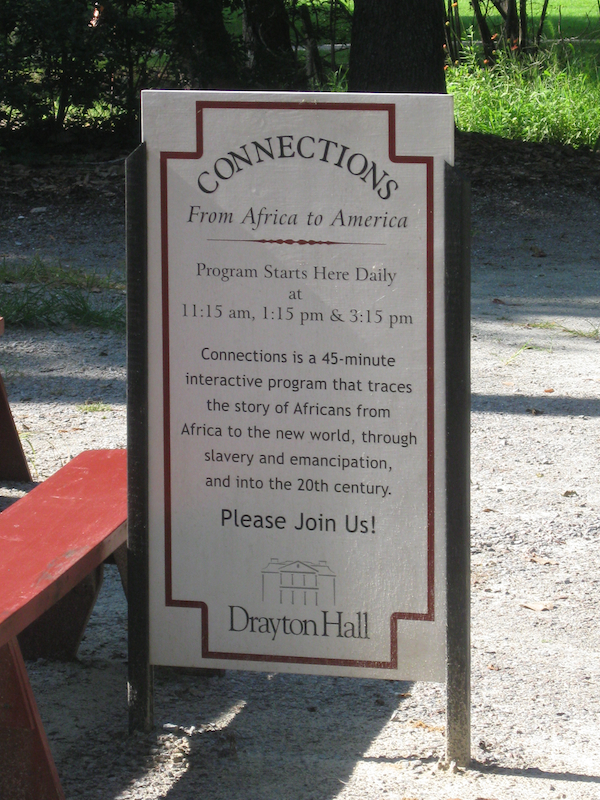
Every day Drayton Hall offers "Connections," a 45-minute program that traces the story of Africans from Africa to the new world and into the 20th century.

Every day Drayton Hall offers “Connections,” a 45-minute program that traces the story of Africans from Africa to the new world and into the 20th century.

If you’ve been involved with the planning, development, presentation, or evaluation of an outstanding exhibit, program, or project interpretation of African American history and culture at a museum or historic site in the last five years, consider sharing it as a case study for a book I’m editing for Rowman and Littlefield Publishers.  This book will be part of a series on the interpretation of various topics published by the American Association for State and Local History that are slated for release later this year.  The first part of the book will be a wide-ranging anthology of articles written by experts and scholars from a variety of perspectives, including Bernard Powers, Matthew Pinsker, Kristin Gallas, James DeWolf Perry, George McDaniel, Amanda Seymour, Donna Graves, Julia Rose, and Lila Teresa Church with a foreword written by Lonnie Bunch.  If you know any of these people, you know it’ll be an interesting and thought-provoking book.

I need help with the second half of the book: a set of 12-16 case studies of exemplary programs that can be adapted by others.  Are you aware of any Continue reading

Interpreting Bondage and Freedom in the Chesapeake

This slideshow requires JavaScript.

Visiting Annapolis a few weeks ago, I had a chance to see the nearly completed installation of Freedom Bound: Runaways of the Chesapeake, a year-long exhibit about the resistance to servitude and slavery in the Chesapeake Bay region from the colonial period to the Civil War.  Heather Ersts and Ariane Hofstedt of the Historic Annapolis Foundation graciously provided a personal tour of the exhibit, which is installed in several museums and historic sites around the city.  It’s an exhibit worth seeing not only for the content, but also the design, and several items jumped out at me:

1.  The exhibit looks at the varied experiences of people through nine persons.  Seven of these persons were enslaved Africans, but two are white–a convict servant and an indentured servant–which will surprise most visitors.  It complicates the usual narrative that only Africans were held in bondage (of course, being owned as a slave is very different from being incarcerated as a convict) and it’s by encountering the unexpected that people are more likely to learn.  The typical exhibit about slavery trots out the same 1850 drawing of the slave ship Brooks, a pair of iron shackles, and perhaps a tag from Charleston.  Yes, those are all authentic and true, but the constant repeat of these items renders them Continue reading

Slave for a Day? I’m Not Sure This is a Good Idea

Footsteps of the Enslaved, a new program at Hampton

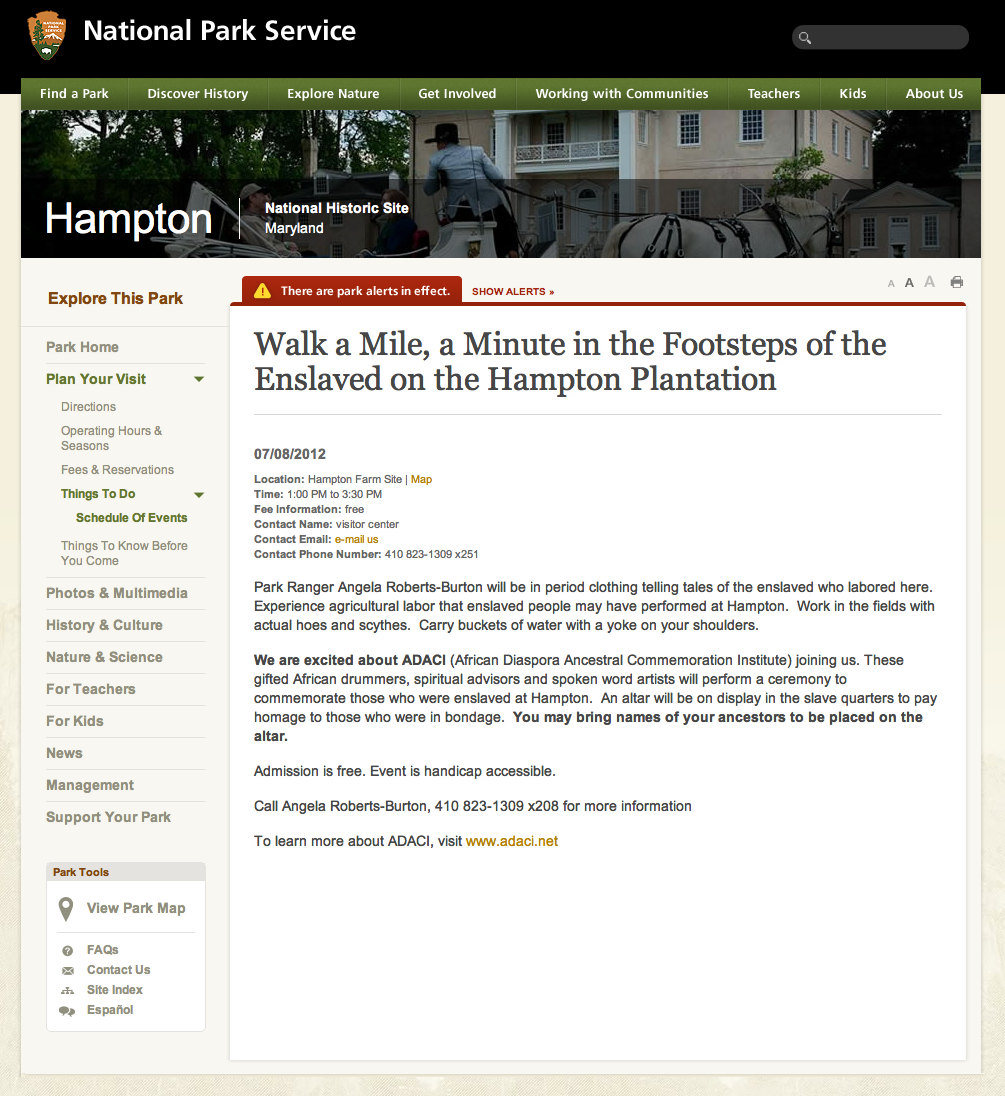
Hampton, a National Historic Site operated by the National Park Service, recently announced a “Slave for a Day” program which will allow visitors, to, “Experience agricultural labor that enslaved people may have performed at Hampton. Work in the fields with actual hoes and scythes. Carry buckets of water with a yoke on your shoulders.” After a chorus of howls went up on the Internet, the title was changed to the much more tame, “Walk a Mile, a Minute in the Footsteps of the Enslaved on the Hampton Plantation” but the program content remained the same. I certainly want to encourage the ranger who developed the program to continue to pursue her passion for African American history, but I’m not sure these activities, as described, get visitors to fully understand what life was like for enslaved people.  Antebellum farming is about hard work; Continue reading

Interpreting African American History if You’re NOT African American

Session on Interpreting African American history and culture, AASLH annual meeting, 2012

Last September, I had the privilege of moderating a session on interpreting African American history at historic sites in a room filled with some of the smartest people in the field during the annual meeting of the American Association for State and Local History.  The panelists–George McDaniel, Pam Green, David Young, and Tanya Bowers–gave outstanding opening remarks but even more engaging was the discussion that followed with the audience.  Because African American history can be a sensitive topic and to demonstrate a way to confront these issues among a group of strangers, I used a technique drawn from Great Tours (page 117).  Each person in the audience was given a 3×5 card and was asked to anonymously complete the sentence, “I would feel more comfortable talking about African American culture and history if…”  Among the responses I received were: Continue reading

African American Historic Place Demolished in Virginia, Despite Protests

The Masonic Lodge in Hobson, recently destroyed by the City of Suffolk, Virginia. In this 2002 photo, then-Suffolk Councilman E. Dana Dickens III is seen with Hobson resident Mary Ellen Hill, who was one of the two women arrested Monday on misdemeanor charges during an unsuccessful attempt to save the former Masonic Lodge building, seen behind them. Virginian-Pilot file photo.

A Masonic Lodge that was the centerpiece of Hobson, an early 20th century African American waterman’s community in Virginia, was recently demolished by the City of Suffolk, despite protests from the local community and standing in front of the bulldozers.  The 1950 Masonic Lodge served as a community meeting place, general store, school, philanthropic organization, and rallying point for political activism in the village of Hobson, which was recently placed on the Virginia Landmarks Register.  Only portions of downtown Suffolk are locally protected as historic districts.

According to the October 25, 2011 edition of the Virginian-Pilot:

In a last-ditch effort to save a historic building from the bulldozer Monday morning, two community activists placed themselves inside a circa-1912 former Masonic Lodge in the rural village of Hobson and pleaded with police to send a city wrecking crew away.  Instead, police arrested Continue reading