Tag Archives: American Association for State and Local History

Webinar: How can Historic Sites Make History More Relevant?

History Relevance CampaignOn Monday, March 21 at 3:00 pm Eastern/12 pm Pacific, Tim Grove and I will be discussing the History Relevance Campaign during AASLH’s monthly Historic House Call.  For the past few years, a dozen people from various history organizations have studied the challenges and opportunities for changing the common attitude that history is nice, but not essential.  We won’t have overnight solutions and there’s lots of work to do, but we’ll share what we’ve learned, discuss how it impacts historic house museums, and provide a tool that organizations have found very helpful.  The webinar is free but preregistration is required.

If you’re not familiar with the Historic House Call, they are webinars offered through out the year by the Historic House Museum Community of the American Association for State and Local History (AASLH).  Upcoming webinars include religion and historic house interpretation and using futures thinking to navigate ongoing change, and a recording of an earlier webinar, “creating engaging and memorable tours” is available.  They also have a very active listserv on Yahoo Groups, a growing blog called “Views from the Porch,” and free resources, such as the Technical Leaflet, “How Sustainable is Your Historic House Museum?

Historic House Workshops for the New Year

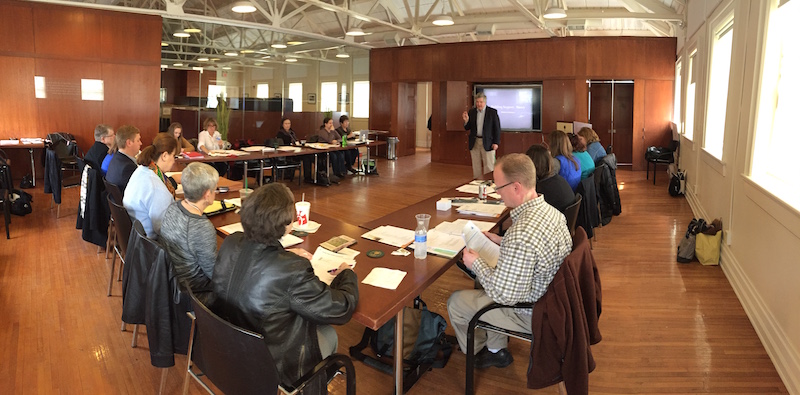
Historic House Museum Workshop, Charleston, South Carolina, 2015

Historic House Museum Workshop, Charleston, South Carolina, 2015

If want some time to plan and evaluate what’s happening at your historic site or house museum, one of the best ways is through a workshop. Of course, a long weekend of reflection in the Rockies or Virgin Islands might be more relaxing, but a workshop with colleagues discussing the potential solutions to the challenges facing historic sites will be more effective.

AASLH is offering two workshops this year just for house museums and historic sites, and I’ll be part of both of them:

April 4: Reinventing the Historic House Museum at the Campbell House in St. Louis, Missouri

This one-day symposium is designed to offer current thinking, practical information, and solutions to the challenges facing historic sites. The historic house museum in America is not dead nor are most of them dying. The field, however, needs to take time to reflect and renew as the world around our historic sites continues to change. The symposium will include presentations, discussion, a boxed lunch, historic site visit, and a brainstorming workshop at the historic house museum to try out the new ideas proposed during the symposium. Workshop led by Ken Turino (Historic New England) and Max van Balgooy (Engaging Places). (There may be a second Reinventing workshop offered this year.)

April 28: Historic House Museum Issues and Operations at Brucemore in Cedar Rapids, Iowa

Why are historic houses necessary to their communities? How are historic house museums unique? This workshop focuses on the special needs, management, and interpretation of historic houses. With a focus on historic house museums, topics covered include collections care, types of research appropriate for historic house museums, exhibition development, interpretive tours, volunteers, and building and landscape maintenance. Workshop led by George McDaniel (Drayton Hall) and Max van Balgooy (Engaging Places).

Can’t attend these workshops but are still looking for a shot in the arm? Join one of the quarterly Historic House Calls. Every call explores a different topic with an expert, and they’ve previously discussed deaccessioning, tours, interpreting race, and environmental sustainability.

AASLH has nearly two dozens way to sharpen your skills with some of your smartest colleagues in the history field and you’ll find a continually updated list on their calendar of events.
Reinventing Historic Houses in National Parks

This slideshow requires JavaScript.

Earlier this week I led a workshop on reinventing historic house museums at two great National Parks—Marsh-Billings-Rockefeller in Vermont and Saint-Gaudens in New Hampshire—with Ken Turino of Historic New England. The National Park Service and the American Association for State and Local History co-sponsored this workshop to help their staff rethink the tours of the historic houses at these two sites, especially for visitors under 35 years of age. Using such tools as the Five Forces and a Double-Bottom Line Matrix along with a smorgasbord of ideas from other sites, we explored possible processes and projects that could improve and enhance their tours.  Our goal wasn’t to provide solutions but to raise many useful questions, including: Continue reading

AASLH Annual Meeting Provokes Historical Thinking

Tim Grove facilitating a lively conversation about historical thinking at the AASLH Annual Meeting in 2015.

Tim Grove facilitating a lively conversation about historical thinking at the AASLH Annual Meeting in 2015.

The annual meeting of the American Association for State and Local History always offers a good mix of educational sessions, social events, and opportunities to visit museums and historic sites around the country.  This year, Sam Wineburg, a Stanford University professor and author of Historical Thinking and Other Unnatural Acts (2001), prompted an ongoing discussion with his plenary address on the first day of the annual meeting.  Through his research on students and scholars, he showed that the analysis of historical documents is a sophisticated skill that isn’t apparent to most people (and I can confidently say this also applies to objects, buildings, and landscapes).  He went on to argue that teaching people to think historically isn’t about teaching history but making them better citizens.  John Dichtl, president of AASLH, discusses this further on the AASLH blog.

These ideas were pursued the next day at a packed session facilitated by Tim Grove of the National Air and Space Museum.  Using excerpts from Wineburg’s book, Tim encouraged a lively dialogue that allowed me to report out 15 Tweets, including:

  • Historical thinking: multiple perspectives; analysis of sources; context; and based on evidence.
  • Are we underestimating visitors if we don’t give them oppty to debate ideas & issues at museums/historic sites?
  • Debates always happen, but history gets flattened over time. Build multiple perspectives, uncertainty, & questions into exhibits.
  • Asking good provocative questions is a skill. Learn more at the Right Question Institute.
  • Challenge for marketing & communications staff about handling provocative topics in social media era.
  • Are museums & sites imposing their ideology on visitors? Have we become arrogant? Do we need to learn about visitor interests?

which resulted in 31 favorites and 20 retweets.  Just to be clear, these ideas didn’t come from me but from the persons gathered in the room.  I could have tweeted out many more but I couldn’t listen and type them out quickly at the same time.

If you weren’t able to attend, there’s next year in Detroit.  In the meantime, enjoy these snaps from the recent meeting in Louisville (and thanks to everyone at the Kentucky Historical Society for being such gracious hosts).

This slideshow requires JavaScript.

Interpretive Planning Workshop coming to Tennessee

AASLH Historic House Museum workshop at the Oaklands Museum, 2013.

AASLH Historic House Museum workshop at the Oaklands Museum, 2013.

On Monday, August 17, I’ll be leading a one-day workshop on interpretive planning for history museums and historic sites in Murfreesboro, Tennessee.  Sponsored by the American Association for State and Local History, Humanities Tennessee, and the Tennessee Association of Museums, the workshop will layout effective strategies for interpreting history and the humanities at museums and historic sites, explain how to use StEPs as a model for standards and best practices, and show how to conduct a self-evaluation of interpretation in order to prioritize activities.  It’ll be hot in Middle Tennessee but the workshop will be held in the comfortable and cool visitor center at the Oaklands Museum.  Registration is $75 and $15 for members (you read that correctly–$15!) and includes lunch.  To register or for more details, visit AASLH.org.

So Many Possibilities for Historic Sites at AASLH Annual Meeting

AASLH Louisville 2015The American Association for State and Local History (AASLH) just delivered the preliminary program for its annual meeting, which will be held in Louisville, Kentucky from September 16-19, 2015.  Obviously, the conference is centered around history but there are several sessions, workshops, and field trips that focus on historic sites and house museums, including:

  • Heritage Tourism in the 21st Century with James Stevens of ConsultEcon Inc., who recently studied the heritage tourism sector in Philadelphia
  • Restoration and Reconstruction: Fulfilling the Possibilities of a 21st Century Museum, a discussion about the reinterpretation of the Woodrow Wilson Family Home in South Carolina (also reviewed in the recent issue of the Public Historian and the Journal of American History; not to be confused with the Woodrow Wilson Boyhood Home in Georgia)
  • Old House, New Diverse Stories, a brainstorming session led by Ken Turino of Historic New England
  • An Untapped Resource: How to Locate and Use Legal Cases at Historic Sites, a session to learn how to mine legal case files to find compelling narratives for exhibits and programs
  • Interpreting Religion at Historic Sites, a discussion on leveraging “historical truth when interpreting religion” led by the historian of the Navigators.
  • An afternoon tour of the exuberant Second Empire Culbertson Mansion and Farmington, the Federal-style home of Lucy and John Speed.
  • There may be bourbon at the breakfast for historic house museums when Dennis Walsh from Buffalo Trace Distillery discusses the preservation of this historic sites (and it’s pretty cool website, too)
  • An evening at Locust Grove, a National Historic Landmark, with costumed interpreters, live music, and a three-course buffet.
Sam Winburg

Sam Wineburg

With 65 sessions, there is much, much more happening and you’ll be torn about what to do.  There’s certainly enough to appeal to directors, curators, historians, educators, and preservationists.  I’m particularly eager to hear Sam Wineburg, professor of education and history at Stanford University and author of Historical Thinking and Other Unnatural Acts: Charting the Future of Teaching the Past (see “A History of Flawed Teaching“), and the follow-up discussion led by Tim Grove, chief of museum learning at the Smithsonian National Air and Space Museum.  Wineburg is currently developing new forms of assessment to measure historical understanding and undertaking a longitudinal study on the development of historical consciousness among adolescents in three communities.  But I don’t want to neglect the three other outstanding plenary speakers: Wendell Berry, James Klotter, Renee Shaw, and Carol Kammen.

I rarely ever skip the AASLH annual meeting and I plan to be there this year.  Registration is $250 if you jump in before July 24 and there’s the alternative online conference featuring six sessions.


Reinventing the House Museum in Portsmouth

This slideshow requires JavaScript.

A sold-out crowd of history enthusiasts packed the auditorium at the Strawbery Banke Museum in Portsmouth, New Hampshire on April 21 to discuss ways to reinvent the house museum.  Sponsored by the American Association for State and Local History and the New England Museum Association, the one-day workshop explored ways that historic house museums can more successfully engage their community and improve their financial sustainability.

The morning featured several presentations and the afternoon was a hands-on workshop at a nearby historic house.  I opened the day with a process for developing a plan and then focused on Michael Porter’s Five Forces, a diagnostic tool that’s superior to SWOT for assessing a house museum’s strategic position.   Ken Turino of Historic New England provided a smorgasbord of ideas from house museums around the county to rethink existing conceptions.  Larry Yerdon, CEO of the Strawbery Banke Museum, discussed ways they are introducing new programs and activities to be both more engaging and financially sustainable.

After lunch, we gathered at the Governor John Langdon House, a property of Historic New England, where Joanne Flaherty and Linda Marshall led us on a quick inspection of the property and described its operations and recent efforts to use it for temporary exhibits.  Then the audience became temporary consultants using the Five Forces, analyzing existing and potential competition for exhibits, interests from visitors, and collaborating with exhibit providers.  The consensus seemed to be that an exhibit program could have a competitive advantage if it focused on the collections of Historic New England and may be better suited for rooms other than the parlor or dining room, which are architecturally significant.

This workshop will travel next to Atlanta, Georgia on June 12, where we’ll be using the Margaret Mitchell House as the case study.  To register and for more information, visit AASLH.org.


Historic House Museums Gather for AASLH Workshop in Charleston

This slideshow requires JavaScript.

For the past fifteen years, George McDaniel and I have taught a two-day workshop on the management of historic house museums for the American Association for State and Local History.  We cover a wide range of topics from fundraising to interpretation to disaster response to collections management–we really need a week, especially if there’s a lot of discussion.  That was certainly our experience last week in Charleston, South Carolina (and thanks to our hosts, the Historic Charleston Foundation!), where our discussions were so rich that I wasn’t able to complete most of my presentations.  That’s okay because the workshop is for the participants and as long as they find a topic that’s worth exploring, I’ll stay with them.  Indeed, George and I often find that we’re not instructors but facilitators, raising ideas and questions to provoke thoughtful discussions to help participants improve the management of their historic sites.

At the core of workshop is each participant’s “burning question.” They share their biggest concern or issue at the start of the class and at the end, they describe how they might address it when they return to their site.  It’s not only a way to make the workshop more relevant to the participants, but it also gives us a glimpse into the issues facing historic house museums around the country.  This year the questions included: Continue reading

History Relevance Campaign Convenes at Mt. Vernon

This slideshow requires JavaScript.

Thanks to the support of The Fred W. Smith National Library for the Study of George Washington at Mount Vernon, the steering committee of the History Relevance Campaign held a retreat this past week to plan its next steps.  Randi Korn facilitated the retreat to clarify our impact and distinctiveness as well as begin to draft outcomes for our work.  It was a long day and a half but we made tremendous progress.  Although we won’t be ready to share the results for another month or so (our draft ideas are still being discussed), we are making progress in several other areas:

1.  “The Value of History:  Seven Ways It Is Essential” is available and we encourage history organizations of all sizes to integrate it into their activities and programs.  Add the name of your organization to Continue reading

Want to Sharpen Your Historic Site Management Skills?

If you manage an historic site or house museum, there are several ways to sharpen your skills in the next few months.

Historic House Museum workshop at the Haas-Lilienthal House in San Francisco, 2014.

Historic House Museum workshop at the Haas-Lilienthal House in San Francisco, 2014.

For nearly fifteen years, the American Association for State and Local History has offered a two-day workshop on historic house museum issues and operations and next month it will be in Charleston, South Carolina on February 26-27, 2015.  Held in partnership with the Historic Charleston Foundation (one of the oldest historic preservation organizations in the US) and co-taught by me and Dr. George McDaniel of Drayton Hall, we’ll examine a wide range of topics from the unique perspective of house museums and historic sites, including leadership, interpretation, disaster preparedness, membership, and audience, through interactive presentations, group discussions, and site-specific exercises.  You’ll leave with a better sense of how your organization can better fulfill its mission and be more financially sustainable.  Registration is $345, $270 for AASLH members, plus there’s a $40 discount if you register by January 22.  Be sure to add a day to explore the historic sites in Charleston–it’s one of the best places to see a wide variety of visitor experiences in one place.

New this year is “Re-inventing the Historic House Museum,” a one-day workshop offering current thinking, practical information, and solutions to the challenges facing historic sites. The historic house museum in America is not dead nor are most of them dying. The field, however, needs to reflect and renew as the world around our historic sites continues to change.  This workshop was inspired by a sold-out symposium presented by the Historic House Museum Consortium of Washington, DC at Gunston Hall in March 2014, and now has been taken nationally to various regions by the American Association for State and Local History.  Ken Turino of Historic New England and I will be giving the core presentations and the others will vary to take advantage of the workshop location.  We’ll be at Strawbery Banke in New Hampshire on April 21, 2015 and the Margaret Mitchell House in Georgia on June 12, 2015.  Registration is $170; $95 for members of AASLH and NEMA (for April 21).