
Back in 2014, I shared a classic business matrix as a tool to help museums and historic sites think more strategically about their programs and activities. It plotted mission alignment on one axis and financial sustainability on the other, providing a quick visual way to categorize whether something was worth continuing, needed revision, or should be reconsidered altogether, using metaphors of stars, hearts, cash cows, and bunnies.
The response was strong—many found it useful for internal discussions, staff retreats, and board meetings. But since then, my thinking has evolved.
Over the last decade, I’ve come to see that we need a broader lens. It’s not enough to think about money and mission alone. Sustainability today must account for more than just dollars, and impact is shaped not only by mission statements, but also by vision and values.
A Matrix for Today
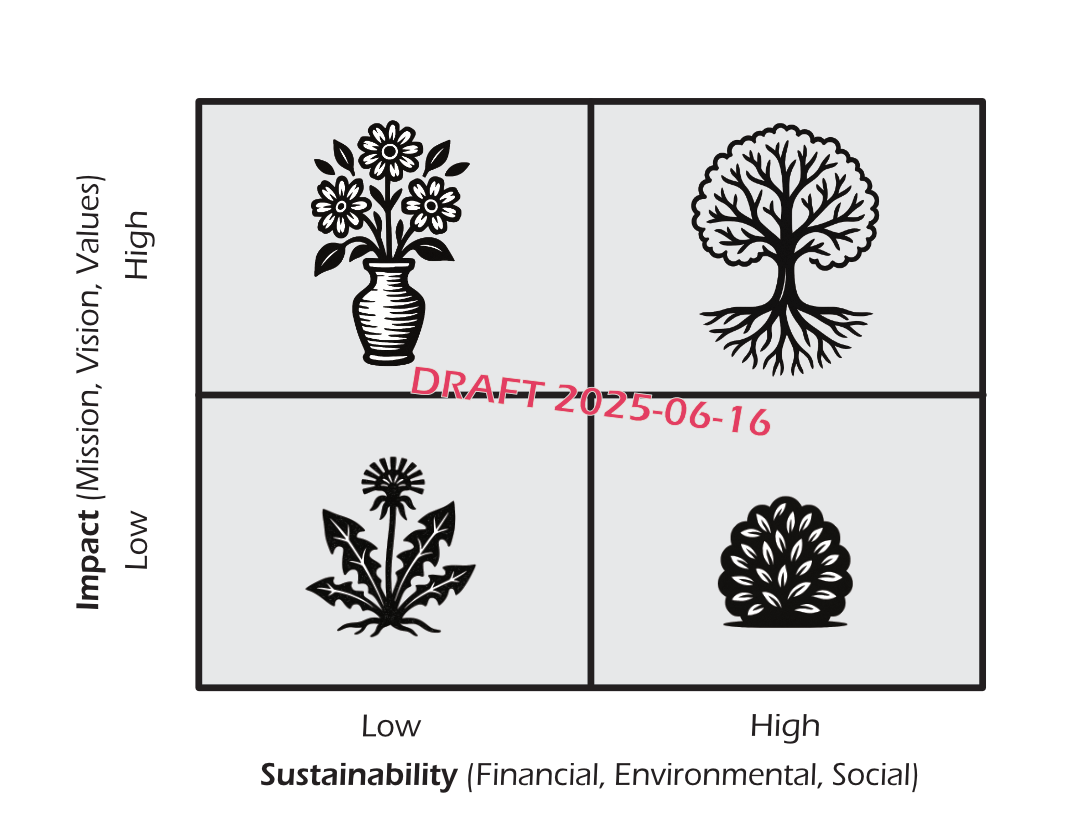
Here’s the updated version:
- The vertical axis is now Impact, encompassing not just your mission but also your vision and values—your full organizational purpose.
- The horizontal axis is now Sustainability, which considers financial, social, and environmental dimensions.
This updated Impact-Sustainability Matrix helps museum professionals assess whether a program or initiative is aligned with what matters most and whether it can endure in a resource-constrained world.
A Living Metaphor: From Bloom to Root
To make the matrix easier to understand and more memorable, I’m using a botanical metaphor. Every program or initiative can be thought of as a kind of plant—some deeply rooted and thriving, others beautiful but short-lived, and a few that are sadly distractions. I’m not sure if the metaphor is as clear and apt as my previous star/heart/cash cow/bunny matrix, so I’d love your thoughts and suggestions in the comments below.
Below are descriptions of each quadrant using this metaphor:
Continue reading
 Engaging Places