
Back in 2014, I shared a classic business matrix as a tool to help museums and historic sites think more strategically about their programs and activities. It plotted mission alignment on one axis and financial sustainability on the other, providing a quick visual way to categorize whether something was worth continuing, needed revision, or should be reconsidered altogether, using metaphors of stars, hearts, cash cows, and bunnies.
The response was strong—many found it useful for internal discussions, staff retreats, and board meetings. But since then, my thinking has evolved.
Over the last decade, I’ve come to see that we need a broader lens. It’s not enough to think about money and mission alone. Sustainability today must account for more than just dollars, and impact is shaped not only by mission statements, but also by vision and values.
A Matrix for Today
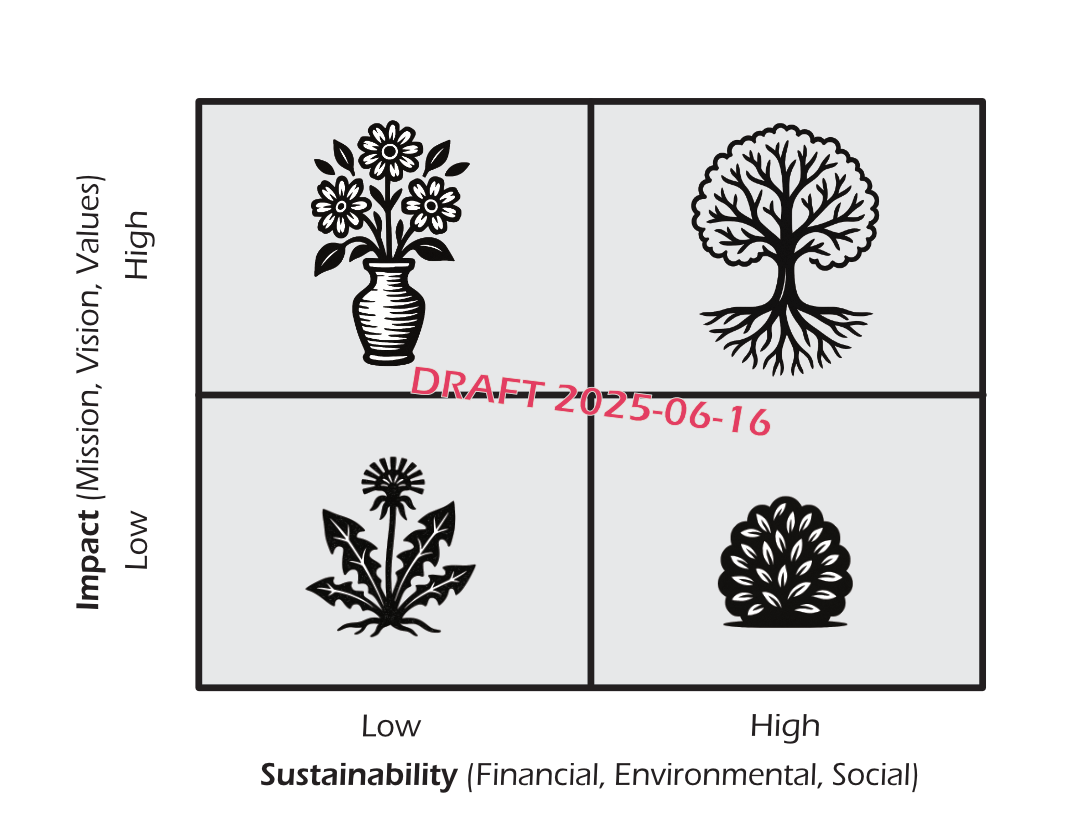
Here’s the updated version:
- The vertical axis is now Impact, encompassing not just your mission but also your vision and values—your full organizational purpose.
- The horizontal axis is now Sustainability, which considers financial, social, and environmental dimensions.
This updated Impact-Sustainability Matrix helps museum professionals assess whether a program or initiative is aligned with what matters most and whether it can endure in a resource-constrained world.
A Living Metaphor: From Bloom to Root
To make the matrix easier to understand and more memorable, I’m using a botanical metaphor. Every program or initiative can be thought of as a kind of plant—some deeply rooted and thriving, others beautiful but short-lived, and a few that are sadly distractions. I’m not sure if the metaphor is as clear and apt as my previous star/heart/cash cow/bunny matrix, so I’d love your thoughts and suggestions in the comments below.
Below are descriptions of each quadrant using this metaphor:
Sturdy Tree: High Impact, High Sustainability
These are your strongest programs—mission-aligned, deeply rooted, and flourishing. Like a well-established tree, they provide long-term value, withstand change, and offer shade and fruit to the community. These initiatives advance your mission and are supported by robust financial, social, and environmental practices. They deserve continued investment, thoughtful stewardship, and public celebration. These are your anchors—the programs others aspire to be.
Ask: How do we nurture and replicate more of these?
A Flower Arrangement: High Impact, Low Sustainability
These programs are beautiful and powerful. They embody your mission, inspire staff and audiences, and often represent the heart of your work. But like flowers in a vase, they lack roots. They require constant attention and external support—financial subsidies, staff energy, or community goodwill—to stay alive. Eventually, without change, they fade. These are emotionally hard to let go of, but they also represent opportunities: can you replant these blooms to grow roots?
Ask: Can we find ways to increase their sustainability—financially, socially, or environmentally—so they thrive long-term?
Foundational Plants: Low Impact, High Sustainability
These are the steady, low-effort programs that keep things going. They don’t demand much, and they’re not in danger—but they don’t do much to advance your mission either. Like a tidy shrub in a garden bed, they fill space and provide stability. Often inherited from previous leadership or introduced to meet a short-term need, they may now be running on autopilot. They can be useful for building capacity or engaging a niche audience—but only if their purpose is more meaningful.
Ask: Is this program still relevant? Can we refresh it or replace it with something more impactful?
Weeds: Low Impact, Low Sustainability
These are the programs that may once have had a purpose—or at least a place—but over time have become distractions or burdens. Like weeds in a garden, they take up space, consume resources, and can crowd out more impactful or sustainable efforts. Of course, “weed” is a subjective term: what’s a nuisance in one context may be valued in another. But in this quadrant, these programs neither align with your mission nor contribute meaningfully to financial, social, or environmental sustainability. It may be time to prune, repurpose, or remove them entirely—not as a failure, but as a thoughtful act of stewardship that clears the way for new growth.
Ask: What would we gain by letting this go? Is it time to rethink or remove it to make room for something better aligned with our purpose?
Using the Matrix
This matrix isn’t a scorecard—it’s a conversation starter. Use it to:
- Evaluate your current programs
- Prioritize new initiatives
- Encourage honest reflection among staff and board members
- Focus your limited resources on what truly matters
It does require that your organization have a thoughtful mission statement—something more meaningful than simply “collect, preserve, and interpret.” You’ll also need a clearly articulated vision (your long-term goal) and a defined set of values (often codified as a code of ethics). On the sustainability side, the matrix calls for useful and reliable measures of success. That means going beyond a single bottom-line figure to embrace the triple bottom line: financial, social, and environmental sustainability—an area where many museums still have room to grow. Indeed, these basic elements are the foundation for an excellent strategic plan (more on that later!).
Nevertheless, the matrix remains a practical tool. It helps leaders and managers evaluate every program, event, and activity against the factors that matter most. And when used well, it makes it easier to identify opportunities for growth, reinvestment, or reinvigoration.
For more details
- Anderson, Gail. Mission Matters: Relevance and Museums in the 21st Century. Rowman and Littlefield, 2019.
- Caradonna, Jeremy L. Sustainability: A History, Revised and Updated Edition. Oxford University Press, 2022.
- Collins, Jim. Good to Great and the Social Sectors. Jim Collins, 2005.
- Hubbard, Douglas. How to Measure Anything: Finding the Value of Intangibles in Business, Third Edition. John Wiley & Sons, 2014.
- Korn, Randi. Intentional Practice for Museums. Rowman and Littlefield, 2019.
- Willard, Bob. The Sustainability Champion’s Guidebook: How to Transform Your Company. New Society Publishers, 2009.
- Zimmerman, Steve and Jeanne Bell. The Sustainability Mindset. Jossey-Bass, 2015.
 Engaging Places
Metaphors often aren’t perfect, yet they can often inspire “right-thinking” when attempting to use them. I have used horticulture metaphors – even the Bible does – so this makes for a good start. When I think about any program, and using your matrix, I ask these questions: What is limiting the impact of a program? If we addressed these, would it increase its impact? Think resources: Water, Gardeners. Do I need to “prune” the entire program or just portions of it? Does what needs to be pruned need to be replaced with something else to increase its impact – “graft” in something new? Similarly, what is affecting the sustainability of a program? What can be done to strengthen it? Does it need “fertilizer” on a regular basis? So, I feel your horticulture metaphor has a better chance of creating a question-rich strategy session within a museum without forgetting that it’s the mission that needs to be accomplished – a beautiful and flourishing garden -which makes me think about the “soil” that the plants are living in.
LikeLike
Thanks very much for your comment. I really appreciate your observation about a horticultural metaphor and how it might help us better think about the work that we do. Your thoughts about pruning, grafting, and feeding are incredibly useful ways that we can continue to extend the metaphor to help us improve our work.
LikeLike