Are you ready to explore how the holiday season can transform your museum? Today at 12 pm Central Time (1 pm Eastern), the Illinois Association of Museums is hosting its monthly “Museum People Call”, and this month’s topic is Christmas at Museums and Historic Sites!
I’ll be joined by Ken Turino, my co-editor of the new AASLH book series Interpreting Christmas at Museums and Historic Sites, to discuss how your organization can leverage the holiday season to its fullest potential.
We’ll cover key topics to help you:
Leverage the holiday season to attract visitors and engage your community.
Increase financial stability through creative programming, gift shop sales, and end-of-year giving campaigns.
Enhance cultural sensitivity and inclusivity, ensuring your holiday interpretation is meaningful and welcoming to diverse audiences.
Whether your site has a long history of holiday programming or you’re just starting to explore the possibilities, this session will offer practical tips and inspiring ideas to align holiday traditions with your mission.
Let’s come together to make the holiday season brighter, more inclusive, and impactful for your museum and its visitors. We look forward to seeing you there!
I’m excited to announce that I’ll be co-teaching two Reimagining the Historic House Museum workshops in Texas this November with Ken Turino, hosted by the American Association for State and Local History in collaboration with the Texas Historical Commission. It’s a big state, so we’re offering it twice! If you’re a museum professional, volunteer, or student interested in exploring fresh strategies for engaging visitors and revitalizing historic house museums, these workshops are a great opportunity to explore new ideas and connect with colleagues.
Why Attend?
Historic house museums are at a pivotal moment, navigating changes in visitor expectations, community needs, and funding models. These workshops are designed to help you tackle these challenges, offering practical solutions for making your house museum more accessible, sustainable, and relevant. By focusing on innovative interpretation, strategic planning, and community engagement, you’ll be empowered to breathe new life into your historic house museum.
What You’ll Learn
This one-day, hands-on workshop explores the most pressing challenges and rewarding opportunities facing historic sites in America today. We’ll delve into the latest social and economic research to help you identify how these trends impact your own house museum, sparking new ideas for growth and engagement.
Throughout the day, we’ll introduce a variety of field-tested tools and techniques drawn from diverse areas like non-profit management, business strategy, and even software development. You’ll hear about innovative historic sites that are successfully adopting new models to engage their communities, offering fresh interpretation and programming, and generating income to boost financial sustainability.
A key highlight of the workshop is our facilitated brainstorming session based on Michael Porter’s Five Forces framework, where you’ll work with fellow participants to reinvent an event or program for an actual house museum. This practical exercise not only puts theory into action but also showcases the power of collaborative thinking to drive change.
Details and Registration
Mesquite Workshop (near Dallas): November 12, 2024 – Heritage Plaza Visitor Center
Houston Workshop: November 14, 2024 – Bayou Bend Collection and Gardens
Cost: $350 for non-members, $225 for AASLH members
Registration: Visit AASLH’s website for more information and to sign up. Participation is limited.
I hope to see you there as we explore how to bring new life and relevance to historic house museums. Together, let’s make these vital cultural spaces vibrant, engaging, and sustainable for generations to come!
If you missed out on purchasing a copy at the annual meeting or were unable to attend, you can order it online at Rowman.com or mail this order form. Use code RLFANDF30 at checkout to save 30%. This discount is available through September 2025. The book officially releases on September 20, so it should ship immediately when you order.
If you’ve had a chance to read Interpreting Christmas, we’d greatly appreciate a review on Amazon.com. Since history museums and historic sites are such a specialized field, your feedback can help others make more informed purchasing decisions.
In an earlier post, I shared a sneak peek of our book, Interpreting Christmas at Museums and Historic Sites. Next week, Ken and I will provide a comprehensive overview during the upcoming AASLH webinar, “Jingle All the Way: Maximizing Your Museum’s Holiday Potential.” This webinar draws from the book but is not an hour-long sales pitch. Instead, we’ll share key advice and ideas on leveraging holiday celebrations, researching the local history of Christmas, planning and hosting holiday events, expanding traditional programs, and enhancing cultural sensitivity and inclusivity. With so much to cover, we’ll be hitting the highlights. If you’re seeking inspiration for Christmas during these hot summer days, join us on July 23, 2024 at 3:00 pm Eastern. For more details and to register, visit here. Plus, you’ll receive a 30% discount code for the book upon registration.
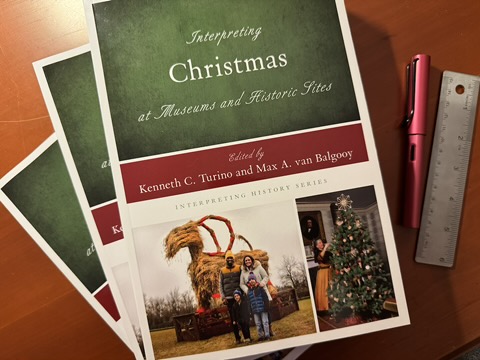
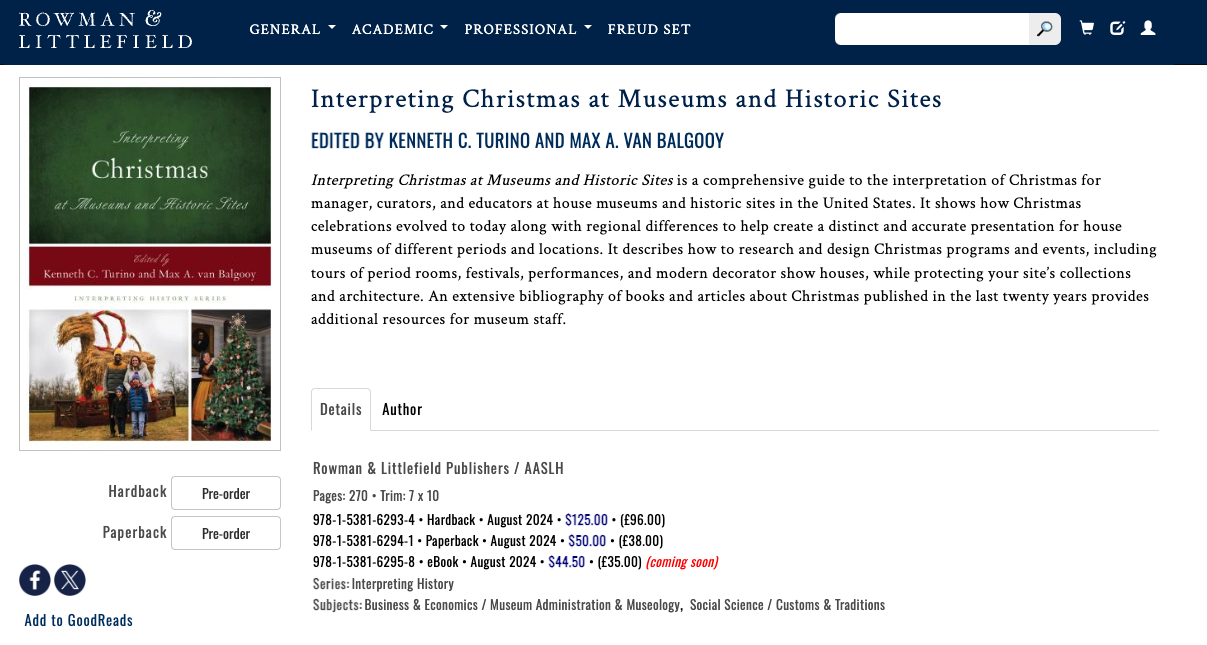
With proofs in hand, the book is moving closer to reality with a publishing date in fall, but more likely later than earlier. It has 21 chapters, 40 images, and an extensive bibliography of nearly 175 books and articles packed into 270 pages, which is about 25% longer than my Interpreting African American History and Culture at Museums and Historic Sites that Rowman & Littlefield published ten years ago (btw, Rowman was recently acquired by Bloomsbury Publishing). It’s now available for pre-order at Rowman.com for $50 for paperback and a jaw-dropping $125 for hardcover (I don’t set the prices but a 30% discount code is available for webinar attendees).
Behind the Scenes of Indexing
Ken Turino, Sara Bhatia, and I spent nearly two months creating he index, despite the publisher allocating just two weeks. The delay was partly due to other commitments (I was closing out the semester and attending the Newport Summer School), but also because the scope of the book made it significantly more complex. As anticipated, there’s an abundance of content on gifts, trees, lights, ornaments, decorating, and a variety of Santas. Rather than list two dozen pages that mention “lights,” we added subheadings for candles and electric lights, as well as safety considerations, and included “see also” references to help readers find specific information more quickly. But geez, that was slow going.
My chapter, “I’m Dreaming of a Warm Christmas: Researching California (and Other Local Places)” was initially indexed by GPT-3.5, then corrected manually as seen in this example. GPT-4o is more accurate when trained for indexing, but every entry still needs to be confirmed.
We experimented with GPT to produce the index, and the results were mixed. While GPT can generate an initial index with proper nouns and some concepts correctly formatted with page numbers, about half of the entries are usually either missing or incorrect (see example above). Thus, manual review of the proofs is still necessary, but at least GPT provides a head start. If you are interested in learning more in using GPT for indexing, I’m happy to share what I learned.
The index eventually grew to 22 pages, which is longer than most chapters! Indexing required a meticulous review of every page, during which we discovered errors that had slipped past four proofreaders. Ugh. Should we consider these flaws a characteristic of an artisanal, handcrafted gift to the field?
Ken Turino, Sara Bhatia, and I are currently compiling the index for our book Interpreting Christmas at Museums and Historic Sites, while the other authors are meticulously reviewing the proofs for any final corrections. But we are much more excited to announce that we have a colorful cover featuring images from Old World Wisconsin and Strawbery Banke, and that Rowman and Littlefield have made the 270-page book available for pre-orders at this link.
To get a start on the holidays, join us in July when we’ll be hosting a live AASLH webinar, “Jingle All the Way: Maximizing Your Museum’s Holiday Potential.” Drawing from some of the insights in the book, we’ll discuss how your historic house or history museum can leverage December’s holiday season to enhance community engagement. Mark your calendar for July 23 at 3 p.m. Eastern and secure your spot by registering here for $45 ($25 for AASLH members).
For a preliminary glimpse inside Interpreting Christmas, I’m sharing the proofs for the table of contents and introduction. Just remember, they’re publisher’s proofs so they are subject to change!
Ken Turino and I started on Interpreting Christmas at Museums and Historic Sites three years ago and I’m delighted that it is now in production at Rowman and Littlefield. Our goal is to have the book available for the AASLH annual conference in September 2024, but that’s a very tight deadline, so no promises.
As part of the publication process, two colleagues reviewed the manuscript anonymously (thank you, whoever you are!) and provided lots of helpful suggestions along with the overall evaluation that, “With a superstar group of contributors, the editors have assembled a handy and engaging collection that offers abundant practical advice and interpretive guidance for public historians who are developing and running holiday programs. Museum educators, curators, interpreters, and managers will be thrilled to have such a helpful collection as a reference and guide.”
With the hope for publication in fall 2024, Ken is proposing a session for the NEMA annual meeting in Newport, Rhode Island, and for an AASLH webinar. If the book is out in time for the AASLH annual conference in September, the publisher will host a book signing. We also have a standing invitation for an interview on the NPS blog. If you have other suggestions for regional conferences or other presentations, please let Ken or me know. We are happy to consider any potential sessions or presentations about the book as a whole or a focused topic around research, diverse traditions, planning, and public programming.
Figure 1. History-Focused Organizations command large portions of the museum field’s revenue and institutions. Source: Internal Revenue Services and National Center for Charitable Statistics.
Over the past year, Engaging Places has been looking over individual segments of the museum field. While these segments are unique in specific ways, as demonstrated by the data, several of them do share a common theme and mission: an overall goal to promote history. These four segments are History Museums (A54), History Organizations (A80), Historical Societies & Historic Preservation (A82), as well as the broad Museums (A50) category. By combining these segments we can focus on the history-centric portion of the museum field that makes up close to half of its revenue and consists of a whopping 89% of its institutions (see Figure 1). This block of museums is incredibly dominant within the field and a major focus of Engaging Places’ work. For ease of reference, we will be referring to them as History-Focused Organizations.
It is important to remember that as an aggregate these History-Focused Organizations still trend small. Over 90% operate on less than $1 million in revenue annually, with contributions and grants bringing in over half of that vital revenue. For these smaller museums, financial security is a constant and essential priority. While many of these History-Focused Organizations are unable to achieve large pools of investment to stabilize operations, unlike some of their larger counterparts, they can develop practices to move them in this direction.
Readers of History News will have caught a preview of her new book in a Technical Leaflet that accompanied the Winter 2021 issue. In this Leaflet, Kristin lays out a compelling need to change our approach:
Presenting the history of slavery inclusive and conscientious school programs is difficult and necessitates challenging the prevailing, and incomplete, narrative. It requires diligence and compassion—for the history itself, for those telling the story, and for those hearing the stories. It is a necessary part of the collective narrative about our past, present, and future.
We must talk with young people about slavery and race, as it is not enough to just talk to them or about the subject. By engaging students in dialogue about slavery and race, they bring their prior knowledge, scaffold new knowledge, and create their own relevance—all while adults hear them and show respect for what they have to say. We cannot fail future generations of learners the way many of us were failed by the sites we visited as children.
Her new book will provide more advice, examples, and replicable practices for the comprehensive development and implementation of slavery-related school and family programs at museums and historic sites.
If you haven’t met Kristin, she’s worked in museums for nearly 30 years. She holds a master’s degree in museum education from George Washington University (where I now teach in the museum studies program) and has led the education departments at the Montana Historical Society and the USS Constitution Museum and is currently the project manager for education development at the Tsongas Industrial History Center. She facilitates workshops for museums and historic sites on developing comprehensive and conscientious interpretation of slavery and speaks regularly at public history and museum conferences.
It’s a webinar bonanza at Engaging Places this month! We’ll be participating in two different back-to-back webinars in March for house museums and historic sites, one on interpreting women’s history and the other on management and strategy.
On Thursday, March 25, 2021 at 10:00 am Central, the Wisconsin Historical Society is hosting a free panel discussion on “Sharing Women’s History: Exploring New Stories and Formats for Engaging Audiences“. Panelists include Mary van Balgooy, Vice President of Engaging Places, LLC and Executive Director of the Society of Woman Geographers; Meredith S. Horsford, Executive Director, Dyckman Farmhouse Museum; and Brooke Steinhauser, Program Director, The Emily Dickinson Museum. House museums, historic sites, and other cultural organizations can share women’s history through special programs, tours, and other storytelling formats. From a broad view of new directions for interpretation to strategies for virtual engagement, panelists will share examples of innovative programming and best practices for interpreting complex stories that engage new audiences. For more details, visit https://www.wisconsinhistory.org/Records/Event/EV8032
On Friday, March 26 at 3:30 pm Eastern, Stenton, The National Society of The Colonial Dames of American, and Historic Germantown are hosting, “Historic House Museum in the 21st Century: Reimaginings and New Solutions“. Stenton Curator Laura Keim will moderate a discussion with Donna Ann Harris (author of the recently updated New Solutions for House Museums) and Kenneth C. Turino and Max A. van Balgooy of Engaging Places (editors of Reimagining Historic House Museums), who will provide overviews of their recently released publications, share lessons they’ve learned from the field and their researches, and explore the nature and future of historic house museums. Cost is “Pay What You Can” and register in advance at www.stenton.org/programs. Visit http://www.rowman.com to purchase both books and use code 4S21MUS30 for a 30% discount.
This afternoon Ken Turino and I will share the common factors that create a sustainable path forward for our country’s historic places. We’ll be drawing from the dozens of innovative sites described in our newly-published anthology, Reimagining Historic House Museums: New Approaches and Proven Solutions. Topics will include assessing whether an organization’s purpose is meaningful to the public, challenging institutions to think holistically, and ensuring that leadership supports risk and experimentation. We’ll be joined in conversation by Kathy Dwyer Southern, Immediate Past Co-Chair of the International Council of Museums United States. If you’re in the area, we welcome you to join us at 5:30 pm at the George Washington University Museum, 701 21st Street NW (at G Street) in Washington, DC. Several of the contributors to the book will be attending and I suspect we’ll have a rousing discussion over drinks at the nearby Tonic.
Ken and I continue to offer our one-day workshop on reimagining historic house museums around the country through the American Association for State and Local History and we’ve now added this shorter “Observations from the Field” presentation to highlight the big ideas from the book. We first presented it with Lisa Ackerman, Interim CEO of the World Monuments Fund, in New York City in October at the request of the Historic House Trust (video below). It was so well received that we’re bringing it to DC today and to Los Angeles in March (as part of the California Association of Museums meeting). We’ve also presented portions of this talk for the National Society of The Colonial Dames in America and Historic New England. If the workshop or presentation could benefit your organization, contact Ken or me for more details (we can only accommodate a couple of these each year, so we may have to plan far ahead).
“Observations from the Field”, Historic House Trust, October 2019







 Engaging Places