Category Archives: Books and articles

Nancy Duarte’s “Resonate” Free on iPad

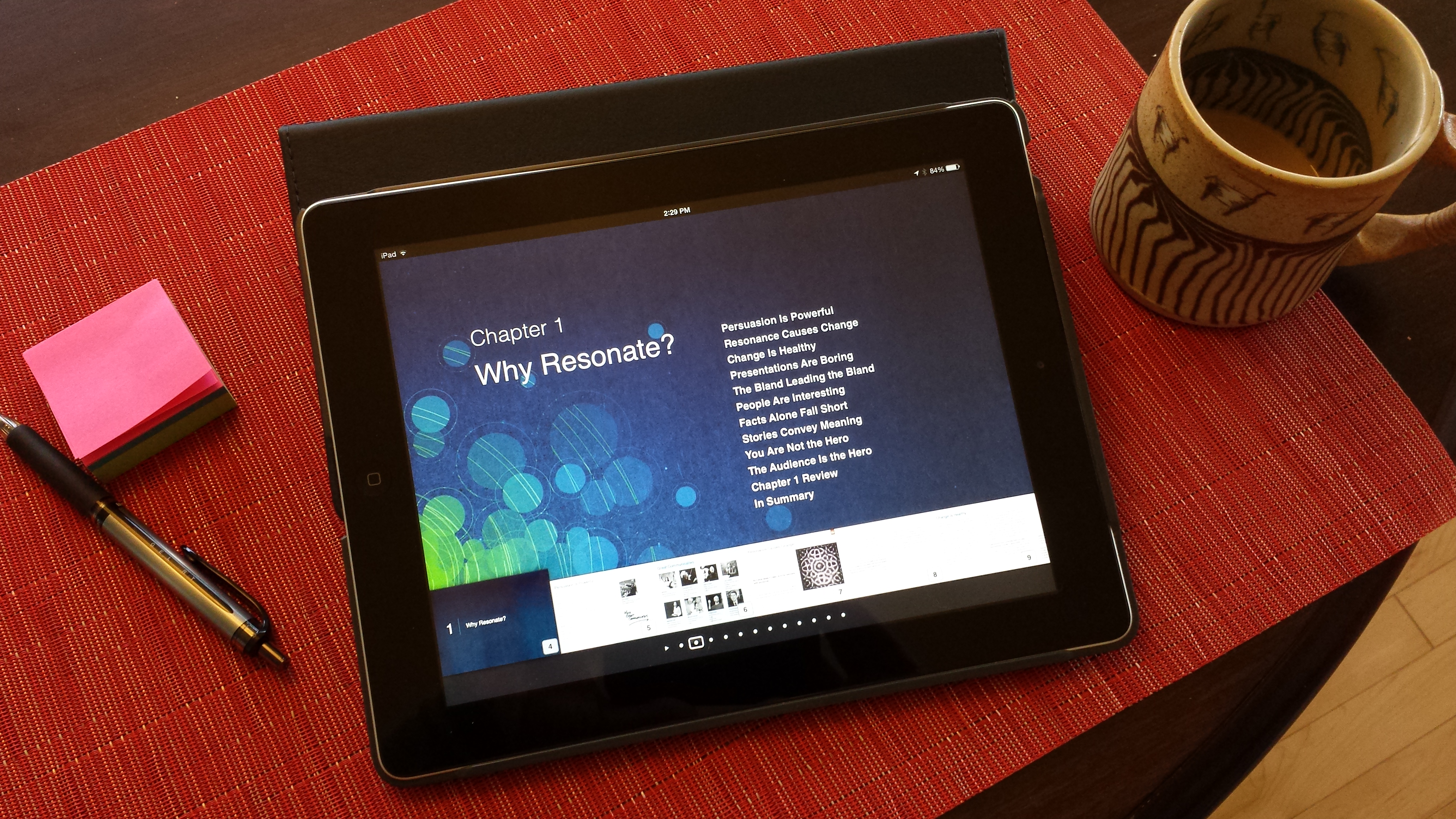
A multi-touch version of Resonate is available free on iPad.

A multi-touch version of Resonate is available free on iPad.

Nancy Duarte is one of the leading producers of presentations, including the Academy Award-winning film, “An Inconvenient Truth” with Al Gore.  There may not be agreement on climate change, but everyone was impressed by the quality of that documentary.  Duarte has shared her expertise through Slide:ology and Resonate, and these books have not only helped me improve and enhance my Powerpoint presentations but also my interpretation skills.  Her approach is firmly grounded in the techniques of effective communication, which can be applied to many situations at museums and historic sites.  If you’re not familiar with Nancy Duarte, she explains her ideas in an 18-minute presentation at TEDxEast in 2011.

The good news for iPad owners is a “multi-touch” version of Resonate is available free through iBooks.  All of the content from the book is supplemented with videos, quizzes, backstories, and other interactive experiences to better engage you.  You’ll not only learn about building better presentations and communicating more effectively, but you’ll also experience an example of one of the most effective eBooks available.  If you’re not sure how to do this, open the iBooks application and search the Store for “Resonate by Nancy Duarte”.

AASLH Award Winners

Lee Wright at the History List created a Slideshare presentation of the 87 history projects that will be receiving awards today from the American Association for State and Local History at their annual meeting in Birmingham, Alabama.   You’ll see exhibits, books, websites, preservation projects, outdoor multimedia tours, and much, much more.  It’s an easy way to get ideas for your museum and historic site (perhaps your staff can watch it over lunch together?).

Lee also mentioned that he’ll be offering the “Make this Holiday Historic” at the History List again in December to promote events, gifts, and membership at historic sites and house museums but may include some tweaks to make it more engaging.  If you are interested in participating (I especially encourage sites that are in a city or region that’s a tourist destination), contact Lee@TheHistoryList.com.

Interpreting Historic Sites: a GWU version

This fall I’m teaching a graduate-level class on interpreting historic sites and house museums at George Washington University, which has one of the best museum studies programs in the nation (I can’t say THE best, because I attended the University of Delaware’s museum studies program).   Historic site interpretation is so popular at GWU that there are two classes:  one taught by me in the museum studies program and the other by Carol Stapp in the museum education program.  My class is focusing its work on Carlyle House, a mid-18th century house in historic Alexandria, Virginia.  Director Susan Hellman has graciously allowed my class examine its interpretation for the next few months and I’ll be sharing a few of those experience on this blog.

This slideshow requires JavaScript.

I’ve significantly revised the syllabus for this fall, and because the readings form a core library on historic site interpretation, it might be useful as a bibliography of sorts to readers who are interested in this topic.  Three books are required for the course, including Interpreting Historic House Museums, edited by Jessica Foy Donnelly (Altamira, 2002).  It’s more than a dozen years old but Continue reading

History News for Spring 2013 Arrives

History News, Spring 2013

History News, Spring 2013

It’s mid-June and the spring 2013 issue of History News just arrived.  If you’re wondering why it’s late, it’s my fault.

Katherine Kane and Bob Beatty invited me to write an article that would highlight this year’s annual meeting theme: “Turning Points:  Ordinary People, Extraordinary Change.”  I was honored—and challenged.  Heroic stories of ordinary Americans changing history would be inspirational but too easy.  So I focused on us —the ordinary people who work in history organizations—to explore how we can provoke extraordinary change in our communities and audiences.  Nice idea, but it went through a dozen revisions that trampled deadlines in the process.  I hope it’s worth the wait.  I’ll be posting excerpts from it along with the entire article starting next week (have to give the AASLH members first opportunity!).

But if you don’t find my article satisfying, there are plenty of alternatives in this issue: Continue reading

Managing Timelines for Research and Interpretation

Aeon Timeline by Scribblecode.

Aeon Timeline by Scribblecode.

If you’ve ever been involved in researching or interpreting an historic site, you’ve no doubt assembled a timeline to keep track of events and understand connections between the site, region, and nation.  After you assemble a lot of data, managing those relationships becomes incredibly complex and you’re continually updating charts and reshuffling cards.  Help may be on the way through Aeon Timeline by Scribblecode, a timeline tool for fiction writers which can be easily adapted for historical research and interpretation.  It’s currently only available for the Mac for $40, but next year they will introduce a version for PC.

Like any timeline, you can plot dates of events, put them into categories (e.g., local or national), and display them neatly and chronologically.  Even better, it can zoom in or out so you can examine the details or see the big picture.  That’s nice, and you might be able to figure out how to manipulate a document, spreadsheet, or database to do this for you. But Aeon Timeline goes further by allowing you to tag events and add notes to provide depth, and you can add layers for people or places to visually keep track of what happens to whom or where.  If you’re exploring narrative non-fiction or using storytelling techniques in historical interpretation, it will help you construct arcs and identify turning points.  Watching the introductory video can explain the features better than I can, but if you’re creating a tour, exhibit, or article, this might help you organize ideas much better than the traditional outline or stack of cards.  You can download a 20-day demo version for free but if you want to buy it, Aeon Timeline is available for a 20 percent discount until June 14 at http://www.scribblecode.com/summerfest.html.

History News reprises Salt Lake City meeting and more

History News, Winter 2013

History News, Winter 2013

The Winter 2013 issue of History News, the quarterly magazine of the American Association for State and Local History, just hit my desk and focuses on the annual meeting held last fall in Salt Lake City.  Featured are the speeches of out-going president Stephen Elliott, award-winner Robert Archibald, and keynote speaker Laurel Thatcher Ulrich, which include such memorable quotes about history and museums, such as:

  • Ulrich:  “It is a truism that without sources there is no history, but we also need to understand those sources.  Most people who had looked at Martha Ballard’s diary said it was filled with mundane detail of little interest, filled with trivia.  The same has been said of Patty Sessions.  What I want to emphasize is that there is, if not drama in these humdrum records, a powerful story.  It is a history that pushes back against conventional sources.”
  • Elliott:  “To appreciate who others are and where they’re coming from, it’s important to Continue reading

History News looks at Historical Interpretation

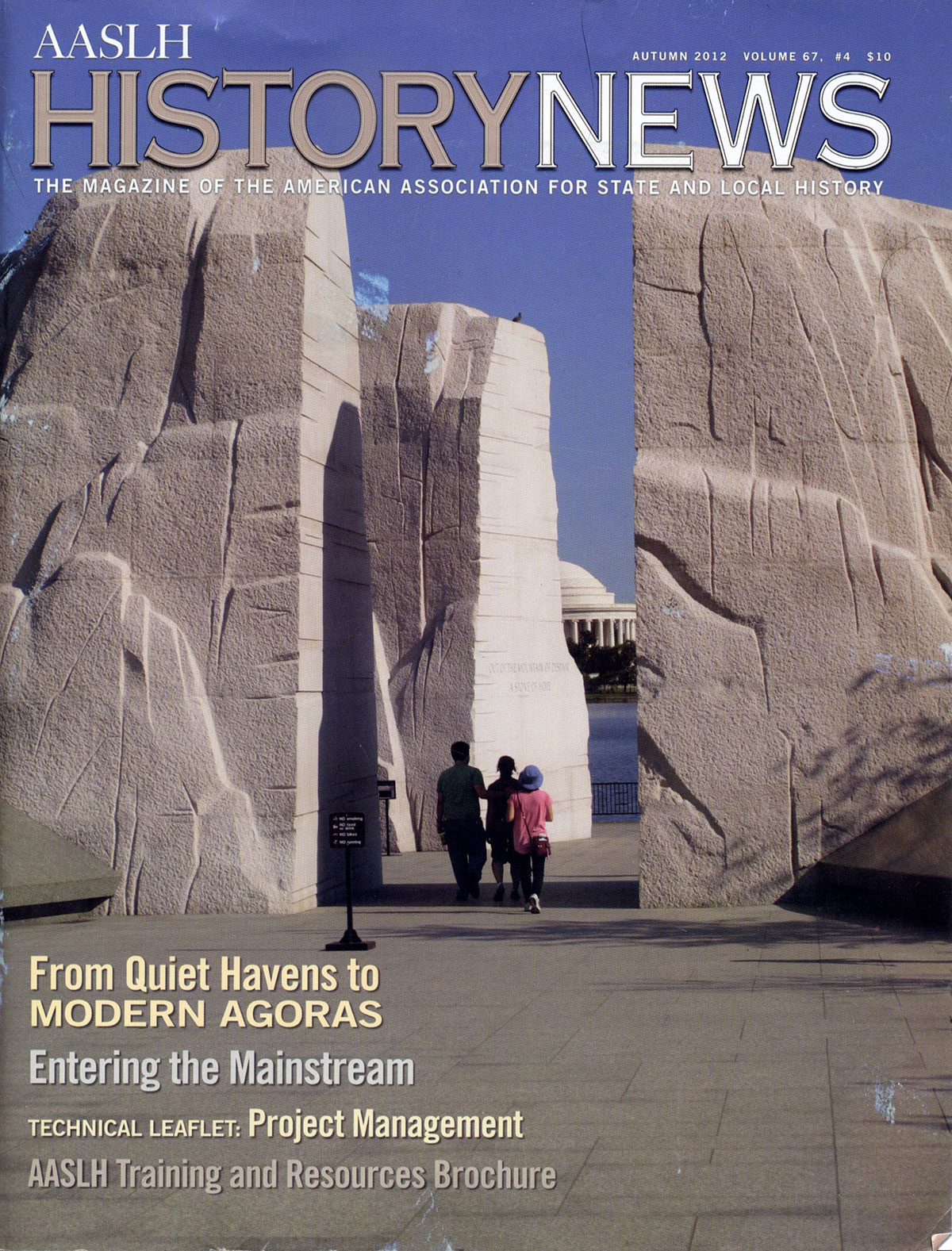
History News, Autumn 2012

History News, Autumn 2012

The autumn 2012 issue of History News arrived in my mailbox a couple weeks ago and its four feature articles on interpretation that will be of interest to historic sites:

  • “From Quiet Havens to Modern Agoras:  Libraries and Museums in an Era of Participatory Culture” by Nancy Rogers, Susanna Seidl-Fox, and Deborah Mack is a report, including the key overarching messages, from an international seminar held in Salzburg, Austria in October 2011.
  • “‘No More Wiggle-Tail Water’: Interpreting the History of Morgantown’s Water Supply at the West Virginia Botanic Garden” by Barbara Howe is a case study on integrating history in a place that focuses on horticulture and nature.
  • “When Histories Horrify: Supporting Visitors’ Responses through Responsible Interpretation” by Linda Norris, Danny Cohen, and Stacey Mann is a continuation of a session at the American Alliance of Museum’s annual meeting on the roles and responsibilities of museums in preserving and mediating horrific histories of crimes, violence, terrorism, and oppression, with references to the Kilmainham Gaol, Majdanek, Robben Island, and the Greensboro Woolworth.
  • “Entering the Mainstream:  Interpreting GLBT History” by Ken Turino and Susan Ferentinos addresses four common challenges (institutional policies on discussing sex, lack of documentary evidence, applying modern labels to historical figures, pressure to avoid controversial topics) using examples from Pendarvis, Walt Whitman House, Beauport, Sarah Orne Jewett House, Alice Austen House, and Charles Gibson House.

Also included are Continue reading

A Second Helping of Local History from A to Z

Local history lovers, rejoice–the second edition of the Encyclopedia of Local History has just been published by AltaMira Press.  Under revision for the past few years by editors Carol Kammen and Amy H. Wilson, it’s a significant update from the 2000 edition and comes in at 655 pages as a result of 200 contributors and a gazillion entries (okay, I’m exaggerating a bit).  Encyclopedias are for quick reference, not reading from A to Z , however, if you’re a local history buff, you would enjoy dipping in at random and learning about a topic (copyright or culinary history), organization (Cambridge Group or History News Network), or source (maps or inventories) from some of the best minds in the field including Stuart Blumin, John Bodnar, Simon Bronner, Michael Kammen, David Kyvig, Brown Morton, Mary Beth Norton, Sandra Oliver, Philip Scarpino, and Carol Shull.  This encyclopedia also includes entries on every state of the union and Canada (and some other English-speaking nations), providing a Continue reading

Highlights from the Latest Journal of Travel Research

I doubt many people read the Journal of Travel Research (yes, there are such things!) but I’ve been referring to it in preparation for a presentation at the Historic House Museum Consortium of Washington, DC.  Looking at the September 2012 issue of the Journal of Travel Research, I thought I’d share some of the highlights from articles that might interest historic sites and house museums:

  • In “GPS as a Method for Assessing Spatial and Temporal Use Distributions of Nature-Based Tourists,” Jeffery Hallo et al examine the use of GPS devices to study visitor behavior in national parks (an idea that can be easily be applied to large historic sites).  This research typically has to be done either by asking visitors to recall their experiences in a survey or by asking visitors to record their own behavior in diaries–both cumbersome and highly subjective methods.  GPS provides a better way to study human behavior, but so far the inaccuracy and cost has been major hurdles.  A test of three of the newest GPS devices, however, shows that these hurdles have been overcome by Continue reading

Challenges and Opportunities Facing Historic Sites and House Museums

This fall I’ll be teaching the historic site and house museum interpretation class in the Museum Studies Program at George Washington University.  Department Chair Kym Rice graciously offered me this opportunity earlier this summer and I couldn’t resist.  I’ve been impressed by the caliber of GW students and I count many of their graduates among my friends and colleagues.  Today is the first class and participating are fifteen graduate students, mostly in museum studies with a handful from history and anthropology.  We will  have some fun discussions!

During the next few months, I’ll share my experiences with you and I thought I’d start by laying out the initial readings for the course, which focus on the opportunities and challenges in interpreting historic sites.  It was hard to pick and choose among Continue reading