Category Archives: History

Interpreting African American History if You’re NOT African American

Session on Interpreting African American history and culture, AASLH annual meeting, 2012

Last September, I had the privilege of moderating a session on interpreting African American history at historic sites in a room filled with some of the smartest people in the field during the annual meeting of the American Association for State and Local History.  The panelists–George McDaniel, Pam Green, David Young, and Tanya Bowers–gave outstanding opening remarks but even more engaging was the discussion that followed with the audience.  Because African American history can be a sensitive topic and to demonstrate a way to confront these issues among a group of strangers, I used a technique drawn from Great Tours (page 117).  Each person in the audience was given a 3×5 card and was asked to anonymously complete the sentence, “I would feel more comfortable talking about African American culture and history if…”  Among the responses I received were: Continue reading

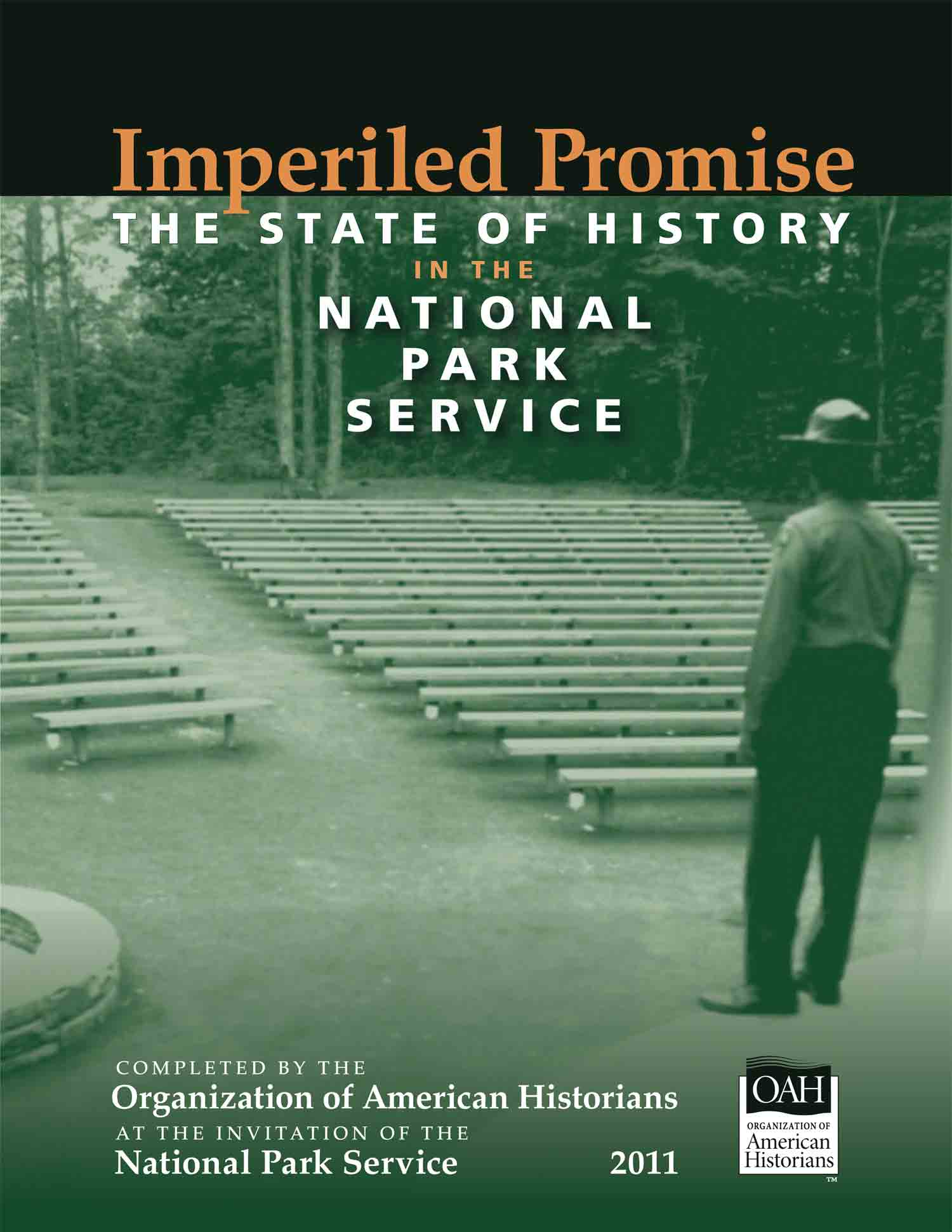
OAH Report Claims History is Imperiled at National Parks

The Organization of American Historians recently completed an evaluation of the “state of history” at the National Park Service.  Four prominent historians–Anne Mitchell Whisnant, Marla Miller, Gary Nash, and David Thelen–led the study, which was based on more than 500 staff responses to an online survey, interviews with current and former staff, site visits, discussions at national meetings, and a review of past studies and reports.

Their analysis revealed that much good work is going on in such areas as reinterpreting slavery and the Civil War, negotiating civic engagement, sharing authority, developing interdisciplinary partnerships, encouraging conversations about history through new media, and collaborating with historians in colleges and universities.  These are presented through a dozen profiles of projects at such National Parks as Manzanar, the Olmsted Center for Landscape Preservation, San Antonio Missions, Harpers Ferry, and the Martin Van Buren National Historic Site.

Although they discovered that good work is being done in a few places, it is not “flowering on the whole” due to several intertwined issues.  Most significant is the report’s contention that, “the agency as a whole needs to recommit to history as one of its core purposes, and to configure a top-flight program of historical research, preservation, education, and interpretation so as to foster effective and integrated stewardship of historic and cultural resources and places and to encourage robust, place-based visitor engagement with history.”  These concerns are presented as a dozen findings, and from my observations, many also reflect what’s happening at historic sites outside of the National Parks.  For example:

  1. The History/Interpretation Divide.  The intellectually artificial, yet bureaucratically real, divide between history and interpretation constrains NPS historians, compromises history practice in the agency, and hobbles effective history interpretation. The NPS should find and take every opportunity to reintegrate professional history practice and interpretation. [In museums, this is comparable to the tensions found between curators and educators, where those who conduct research are often separated from those who teach.]
  2. The Importance of Leadership for History.  Without visionary, visible, and respected leadership at the top, and Continue reading

Teaching History Without Textbooks? Stanford Proves It’s Possible.

In 2008, Stanford University introduced “Reading Like a Historian,” a non-traditional history curriculum to five schools in the San Francisco Unified School District.  According to Sam Wineburg, who directs the Stanford History Education Group and has been a longtime proponent of revising the teaching of history, “We need to break the stranglehold of the textbook by introducing students to the variety of voices they encounter in the past through primary sources.”  It seems this new curriculum is doing that and more, as recently reported in Futurity:

There are no orderly rows of desks in Valerie Ziegler’s 11th-grade history class—students sit in groups of three or four at small tables around the room. There also is no lectern because there are no lectures. And perhaps most striking, there are no textbooks.

These students at Abraham Lincoln High School in San Francisco learn about the Vietnam War, women’s suffrage, civil rights, the Great Depression, and other major events in U.S. history by analyzing journal writings, memoirs, speeches, songs, photographs, illustrations, and other documents of the era.

“I always tell my students they’re historians-in-training, so the work we do in here is that of a historian,” Ziegler says.

That sounds like fun, but does it have any impact? Continue reading

STEM needs a Bloom (and that’s the Arts and Humanities)

John Lithgow giving the keynote address for the National Arts and Humanities dinner in 2012.

Actor John Lithgow recently discussed the work of the Commission of the Humanities and Social Sciences (of which he is a member) and gave some thoughtful remarks about the value of the humanities as part of his keynote address at this year’s dinner honoring the fifteen recipients of the National Medal of Arts and the National Humanities Medal.  Among his observations were that,

civil discourse, self-knowledge, empathy, the habit of learning, and yes, the capacity for joy, are indeed learned skills and that they can be most effectively taught to young people through the arts and humanities, and I believe most fervently that the health of a democracy absolutely depends on these qualities.

He also criticized STEM–“the very word gives me Continue reading

College History Degree is Getting A Tune Up; Historic Sites Get a Flat Tire IMHO

The American Historical Association recently announced that it is initiating a nationwide, faculty-led project to articulate the disciplinary core of historical study and to define what a student should know and be able to do at the completion of a history degree program. Professors Anne Hyde (Colorado College) and Patricia Limerick (University of Colorado Boulder) will lead faculty from more than sixty colleges and universities across the country to frame common goals and reference points for post-secondary history education. According to the AHA, “these faculty participants will work together to develop common language that communicates to a broad audience the significance and value of a history degree.”

Hmm, just the degree?  What about the significance and value of history?  My sense is that this project is being prompted by the funder, Continue reading

For Lovers of New England: A Week on the Road in June

Discover the rich history of the region with Historic New England’s Program in New England Studies, an intensive week-long exploration of New England from Monday, June 18 to Saturday, June 23, 2012.  The Program in New England Studies includes lectures by noted curators and architectural historians, hands-on workshops, behind-the-scenes tours, and special access to historic house museums and museum collections. The program examines New England history and material culture from the seventeenth century through the Colonial Revival. Curators lecture on furniture, textiles, ceramics, art, and wallpaper and cover their history, craftsmanship, and changing methods of production. Architectural historians explore a timeline of regional architecture starting with the Massachusetts Bay styles of the seventeenth century through the Federal and Georgian eras, to Gothic Revival and the Colonial Revival. Participants visit historic sites and museums with curators and enjoy special receptions.

Expert lecturers include:

  • Richard Candee, professor emeritus, Boston University
  • Cary Carson, retired vice president of the research division at Colonial Williamsburg
  • Abbott Lowell Cummings, former director, Historic New England Continue reading

Mike Quinn named CEO of American Revolution Center in Philadelphia

Michael Quinn

H.F. (Gerry) Lenfest, chairman of the American Revolution Center today announced that Michael C. Quinn will join the organization as president and CEO effective April 1, 2012. Quinn will oversee all aspects of the development of The Museum of the American Revolution, to be built in the historic area of Philadelphia.

Since 1999, Quinn has served as president and CEO of The Montpelier Foundation, the private non-profit organization that operates James Madison’s Montpelier, a National Trust Historic Site in Virginia. Under his leadership, the home of James Madison and its surrounding environment were transformed from a 1900s mansion into a vibrant interpretive and educational center focusing on James Madison and the U.S. Constitution. He oversaw the $25 million restoration of James Madison’s home, and the planning and construction of a 15,000 square foot visitor center. He conceived and oversaw the establishment of the Center for the Constitution, which annually provides advanced intellectual seminars on constitutional theory for more than 700 teachers, police officers, and legislators.

Previously, Quinn served as Continue reading

KCET Launches Online Neighborhood Field Guides

The Highland Park Field Guide by KCET.

KCET, a public television station based in Los Angeles, has been working for the last few years on Departures, a project designed to engage “community residents, non-profit organizations, schools and students, in the creation and procurement of relevant and relatable content.”  Included in this work are a series of online interactive field guides to various neighborhoods in their region, and most recently launched is one on the historic community of Highland Park (which features the Lummis House, Heritage Square, and the Southwest Museum).  Given that KCET is one of the major public tv stations in the nation, the field guides are beautifully produced and include lots of video.

According to Kelly Simpson, associate producer of the KCET Departures, “The Highland Park Field Guide was produced in partnership with the Highland Park Heritage Trust and the North Figueroa Association. In six categories (with two more coming soon) we feature fun, informative and adventurous activities for Continue reading

Field Trip: Homestead Museum in California

This slideshow requires JavaScript.

Last week I had a chance to visit with my colleagues at the Workman and Temple Family Homestead Museum in the City of Industry, California.  I was the assistant director there a decade ago and it continues to be a special place to me (if you haven’t visited, it has great architecture and a great story).  After a generous lunch with the staff, director Karen Graham Wade and some of her staff took me to see the Workman House, the earliest house on the site.  It’s undergoing extensive interior rehabilitation to make it more suitable and attractive as an exhibit gallery.  It’s part of a major effort to respond to the changing interests of their visitors by increasing the self-guided experiences.  They are also reducing the number of days per week the Homestead Museum will be open for walk-in public tours and  increasing the number of days they’ll be open for tours by appointment and for other activities.  At La Casa Nueva, the second house on site, they are Continue reading

A Great Conference for Historic Sites Coming Up in April

The Organization of American Historians and the National Council on Public History are combining their annual meetings this year and this double-header is creating a really interesting conference for people who are working to preserve and interpret historic places.  Here are just a few sessions that caught my eye (and just a few–there are more than 200 sessions offered over five days):

  • Museum and Makers:  Intersections of Public History and Technology Buffs from Steam Trains to Steampunk
  • Museums, Historic Sites, and the University:  Public History Projects and Partnerships in the American Indian Great Lakes
  • The Witness Tree Project:  Using Historic Landscapes to Explore History and Memory
  • Toward a Reinterpretation of the Indian Wars at National Historic Sites and Parks
  • Closing Up Shop:  Strategies for Partners and Communities When Historic Sites Close Continue reading