Category Archives: Leaders in the field

Brown University and National Trust Provide Recommendations for Historic House Museums

The financial sustainability and social relevance of historic house museums continue to intrigue scholars, preservationists, organizations, and even pundits on National Public Radio (I was recently interviewed by them about this topic) and adding to the conversation are two recent publications by the John Nicholas Brown Center at Brown University and the National Trust for Historic Preservation.

Bedroom at Liberty Hall Museum, Kean University, New Jersey.

Bedroom at Liberty Hall Museum, Kean University, New Jersey.

If historic house museums are historic sites that primarily educational (not commercial) in purpose, how would they be different if they were managed by educational institutions? “University-Affiliated Historic House Museums,” a report by the John Nicholas Brown Center at Brown University may provide some answers. Prepared for the 1772 Foundation by Hillary Brady, Steven Lubar, and Rebecca Soules, the report examines the issues facing historic house museums that are owned or operated by colleges and universities based on a survey of existing practices at ten sites.  Offering recommendations for “new ways to make these museums more useful to the university community,” it concludes with a half dozen alternatives for the Liberty Hall Museum at Kean University, which might be applicable to sites that are not affiliated with universities (swap “campus” and “students” with “community” and “residents”).  By the way, the Center is hosting an intriguing colloquium in May 2015 on “lost museums“.

Future of Historic Sites Forum Journal 2014In 1949, Congress created the National Trust for Historic Preservation to Continue reading

Changing Attitudes About History one Grizzly at a Time

This slideshow requires JavaScript.

Politics and Prose, the famous independent bookstore in Washington DC, hosted a booksigning for Tim Grove, chief of museum learning at the Smithsonian Air and Space Museum, that attracted seventy-five listeners this past Saturday.  It’s not often that museum folks share a stage that recently included Patrick Buchanan, Timothy Geithner, Lynn Sherr, and Michelle Obama.  His talk will be aired on C-Span.

A self-professed history geek, Tim shares his love for history in A Grizzly in the Mail and Other Adventures in American History (University of Nebraska Press, 2014), a collection of stories from his years working at Colonial Williamsburg, Missouri Historical Society, National Portrait Gallery, and the National Museum of American History.   Tim wants to improve the public image of history by demonstrating the fun of history and “help history haters change their minds.” To do this requires provoking a deeper thinking about historical programs and activities to better link past and present  As he states in his book,

The staff at [Colonial] Williamsburg and other history sites wants visitors to “experience” history.  What does this mean?  One can visit Yosemite National Park and experience the beauty and grandeur of nature.  One can go whitewater rafting and experience the rush of the river and the cold wetness of the water as it splashes the face.  But experiencing history?  Do you experience history when you walk the hallowed ground of a battlefield or visit a historical house?  Experience in verb form implies action.  What action is actually taking place?

Tim demonstrates that “action” through a wide assortment of stories, from conquering a high wheel bicycle and questioning the significance of Eli Whitney’s cotton gin to navigating the legacy of Lewis and Clark, and yes, unpacking a grizzly bear Continue reading

Are Bloggers Mostly Educators?

Museum bloggers converse over morning coffee at AAM 2014.

Museum bloggers converse over morning coffee at AAM 2014.

Blogging is a new form of communication, often falling somewhere between professional journalism and personal journaling.  There are lots of people who love museums and historic sites, and they’ve spawned lots of blogs devoted exclusively to them (including this one).  To give you a sense of this specialized blogosphere, Jamie Glavic at Museum Minute has conducted more than seventy (70!) interviews with museum bloggers.

Last month at the American Alliance of Museums annual meeting in Seattle, Jamie convened an informal gathering of a dozen museum bloggers to meet and chat about their work over morning coffee.  I wasn’t able to catch everyone’s name, but the conversation included Rowanne Henry of Museum Stories, Chris O’Connor of the Royal BC Museum, Ed Rodley of Thinking About Museums, Jennifer Foley of Runs with Visitors, Scott Tennent at Unframed, Annelisa Stephan at the Getty Museum, and Kellian Adams at Green Door Labs.

I noticed that most of them were educators, not curators, conservators, collections managers, or administrators, which launched a discussion about the circumstances that seem to be creating this social media distinction in the museum field, including:

  • curators and conservators don’t consider blogging as scholarship; it’s not regarded equal to an article or exhibit catalog for measuring job performance or professional development.
  • blogs provide a place where educators can be heard and voice their opinions; curators dominate conversations in museums
  • blogs require a different type of writing; curators use a language couched in academia, which usually isn’t suitable for blogs
  • blogging isn’t a priority for the organization
  • blogging doesn’t work well in the institutional culture of museums; blogging requires some comfort with risk and letting go

What do you think? Does the cultural divide between educators and curators continue online? Are the distinctions around museum blogging accurate and true? Share your thoughts in the comments below.


The Future of Leadership: A Perspective from Business Workforce Trainers

Strategy and leadershipWhat’s the future of leadership look like? Five leaders in the field of business workforce training and development shared their perspectives at a session at the 2014 ASTD conference yesterday (and just renamed itself the Association for Talent Development).  In the conversation, Debbie Blanchard (Ken Blanchard Companies), James Kirkpatrick (Kirkpatrick Partners), Halley Bock (Fierce, Inc.) and Tacy Byham (Development Dimensions International) discussed their experiences and observations as consultants who work with companies around the world.  The session was presented in a question-and-answer format, but I’ve synthesized and distilled their responses to highlight key ideas.

1.  Leadership is not a “soft skill”; it is an intentional practice to improve organizational performance and profitability.  You cannot thrust people into leadership to see if they can swim, instead it has to be initiated, conducted, and practiced intentionally.

2.  Leadership has moved from a hierarchical, single command-and-control structure to Continue reading

Million Dollar Salaries at America’s Biggest Museums

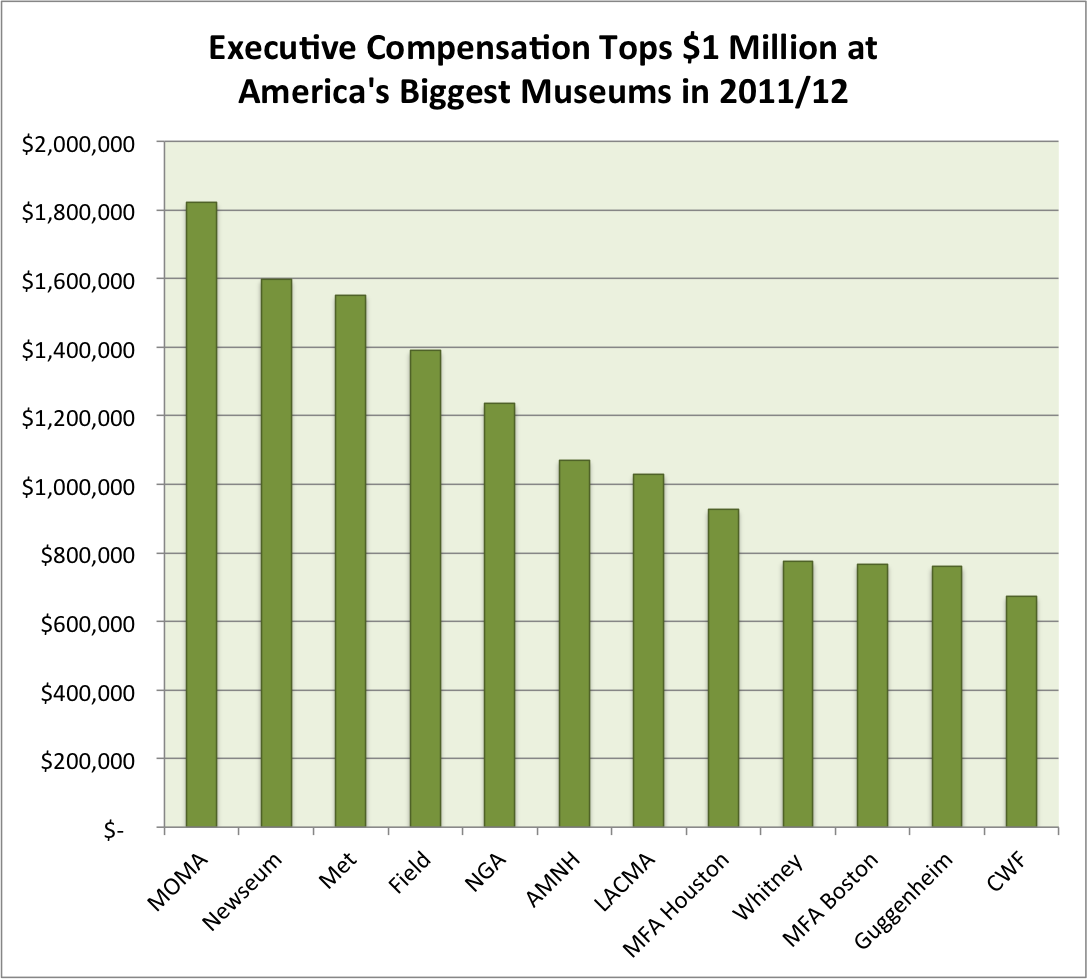
Exec Compensation 2011-12A review of the latest Forms 990 of more than two dozen of America’s biggest museums identified the most highly compensated executives in the field.  Among these museums, annual compensation ranged from $228,000 to $1,822,257 and the average was $727,000.  Seven directors earn more than one million dollars per year, as follows:

Mary van Balgooy Appointed Executive Director of SWG

Mary van Balgooy at the headquarters of the Society of Woman Geographers.

Mary van Balgooy at the headquarters of the Society of Woman Geographers.

Today Mary van Balgooy, vice president of Engaging Places, LLC, becomes the first executive director of the Society of Woman Geographers (SWG), an international membership association based in Washington, DC.

SWG was founded in 1925 in New York by four women who were recognized explorers but ineligible for membership in similar male-only organizations. Over the decades, its members have included aviatrix Amelia Earhart, anthropologist Margaret Mead, author Pearl Buck, archaeologist Mary Douglas Leakey, and primatologist Jane Goodall. It has grown from Continue reading

A Campaign to Make History Relevant to Americans

American flag with puzzle piece missingIn the last year I’ve become part of an group to find ways to make history more meaningful and relevant to Americans.  The History Relevance Campaign, for lack of a better name, is an informal grassroots effort made up of public historians, preservationists, educators, historic site managers, and museum leaders who are creating a national, broad-based strategy to assert the relevance of history.

Just to clarify, the History Relevance Campaign is not connected to any one history organization. From its start in early 2013, the group has strived to be as inclusive as possible.  Secondly, it is not a lobbying group.  Its main audience is the general public, not elected officials and public policy makers.  Thirdly, its intent is to show that history skills are just as important as Continue reading

AAM and NAI Announce Awards, but Few are Historic Sites

Walking Cinema of Gloucester HarborWalk

Walking Cinema of Gloucester HarborWalk

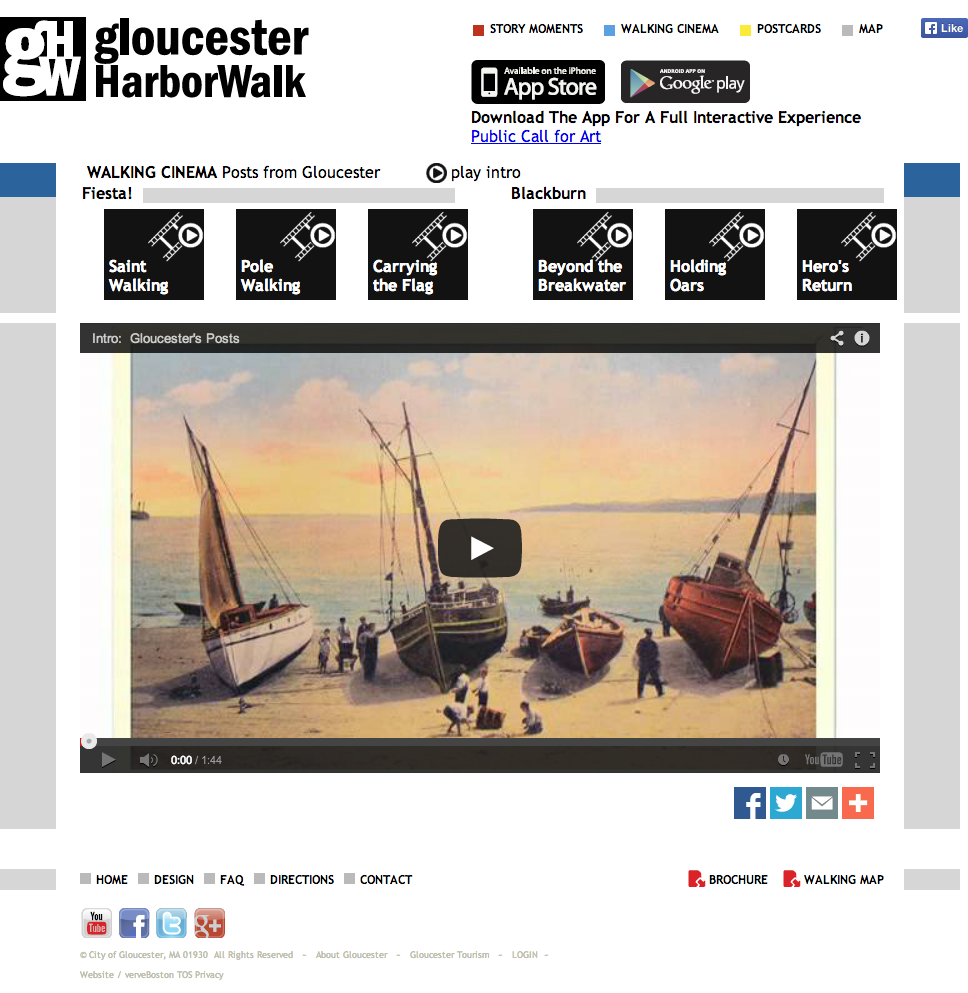
The American Alliance of Museums and the National Association for Interpretation announced their annual winners in various categories, from label writing to exhibits to publications to programs.  You’ll want to look at the entire list for inspiration, but I especially want to congratulate those people and organizations whose worked focused on historic sites, houses, and places (that’s the point of this blog).

The Media and Technology Professional Network of AAM presented Muse Awards for digital media to: Continue reading

Snapshots of AASLH in Birmingham

This slideshow requires JavaScript.

I’ve just returned from three days in Birmingham, Alabama, where I attended the annual meeting of the American Association for State and Local History.  Lots of great sessions and I was often caught struggling to decide which one to attend.  Of course, it’s always great to meet colleagues from around the country but I was struck by how many graduate students attended.  Melissa Bingmann, who directs the public history program at West Virginia University, brought a dozen students because she believes it’s a more effective use of her limited funds–students hear more “guest” speakers, visit more museums and historic places, and learn more about the field than if they had stayed on campus all year.

This slideshow requires JavaScript.

Birmingham isn’t high on my list of tourist destinations, but the AASLH meeting gave me a chance to see Continue reading

AASLH Award Winners

Lee Wright at the History List created a Slideshare presentation of the 87 history projects that will be receiving awards today from the American Association for State and Local History at their annual meeting in Birmingham, Alabama.   You’ll see exhibits, books, websites, preservation projects, outdoor multimedia tours, and much, much more.  It’s an easy way to get ideas for your museum and historic site (perhaps your staff can watch it over lunch together?).

Lee also mentioned that he’ll be offering the “Make this Holiday Historic” at the History List again in December to promote events, gifts, and membership at historic sites and house museums but may include some tweaks to make it more engaging.  If you are interested in participating (I especially encourage sites that are in a city or region that’s a tourist destination), contact Lee@TheHistoryList.com.