Plenty for Historic Sites at 2015 NCPH Meeting

National Council on Public History annual meeting 2015The National Council on Public History will be holding its 2015 conference in Nashville from April 15-18 and there are lots of sessions that will interest house museums and historic sites, including:

  • Best Practices for Interpreting Slavery at Historic Sites and Museums
  • Re-imagining Historic House Museums for the 21st Century with President Lincoln’s Cottage, Roger Brown Study Collection, and others
  • On the Cutting Edge of American Historic Preservation:  The Role of the Mount Vernon Ladies’ Association
  • Religion, Historic Sites, and Museums with Gettysburg Seminary Ridge Museum, Ephrata Cloister, and others
  • Historic Sites, Racialized Geographies, and the Responsibilities of Public Historians with the Lower East Side Tenement Museum and Weeksville Heritage Center
  • The Woodrow Wilson Family Home: Our Story of a Radical Makeover
  • Pulling Back the Curtain: Displaying the History-Making Process in Museums and Sites
  • Hidden Histories:  Cultural Amnesia, Interpretive Challenges, and Educational Opportunities
  • Haunted Histories: Ghost Lore Interpretation at Historical Sites

Nashville also has many historic sites and NCPH will be offering walking tours and field trips on musical heritage, the state capitol, crime, Civil War, civil rights, and Fisk University.  Nearby are several notable historic house museums, including the Hermitage, Belle Meade Plantation, and Belmont Mansion.

Registration is $240 and for members it’s $192.  Sign up before March 4 as a member, and it’s only $167.  For a copy of the preliminary program, visit http://bit.ly/NCPH2015prog.

At the press: Interpreting African American History and Culture

Cover Interpreting Af Am History smallMy book, Interpreting African American History and Culture at Museums and Historic Sites is now at the press and will be available in December from Rowman and Littlefield.  I’ve been assembling it for the past two years and just completed the index, so now it’s firmly in the hands of the publisher.  This book is part of a new “interpreting” series launched by Rowman and Littlefield and the American Association for State and Local History.  Also released this year are books on topics that include slavery, Native American history and culture, LGBT history, and the prohibition era.  If you’d like to order a copy of any of these books at a nice 25 percent discount, use the code 4F14MSTD by December 31, 2014.

Interpreting African American History and Culture at Museums and Historic Sites is another step in a path being laid by many people for nearly 150 years. Although much has been accomplished at museums and historic sites to enhance and improve the interpretation of African American history and culture, we’ve also learned Continue reading

Is it Time for a Membership Program Tune-up?

Museum Membership Pyramid QuestionOne of the basic ways to raise funds for museums and historic sites is through membership. It’s particularly valuable because those funds are unrestricted and pay for utilities, insurance, office supplies, maintenance, and yes, even salaries–those essential expenses that usually don’t excite donors.  We hope that most members will renew, thus increasing revenue while maintaining expenses, and a few will become more engaged and eventually become donors who contribute the funds that really make a difference.

On the other hand, membership programs are a continual management challenge for non-profit organizations.  The expense of maintaining a basic membership rarely covers the cost of administration (the printing and mailing of member newsletters, membership cards, and renewal notices).   Complicating matters is that it doesn’t seem that people want to be “joiners” any longer–membership  in all types of organizations, including unions, service clubs, professional associations, political parties, churches, and even bowling leagues has fallen.  If the membership piece of the pyramid is getting smaller, that means the number of donors will fall as well.

Museums and museum associations are rethinking membership to overcome these challenges by exploring some new directions and possibilities, including:

1.  Enlarging the pool of potential members (and other supporters).  Begin with a preliminary step of gathering contact information for as many potential supporters as possible.  Some may become members who pay annual dues, others will pay admission to attend events, and some will support a cause with money, time, or talent.  The Dallas Museum of Art went so far as to Continue reading

Video: Mapping Historic Sites Through Internships

[vimeo http://vimeo.com/107080371]

This 6:38 video describes a partnership between the Etowah Valley Historical Society and the Kennesaw State University to map historic sites throughout Etowah Valley in Georgia using GIS with the aid of college interns.  Jennifer Leifheit-Little directed the project.  You can find some of the results of this project in the interactive historical maps on the historical society’s website, with such topics as African Americans, Native Americans, mining, cemeteries, and Civil War (note: these maps take time to load and most didn’t seem to show any data in my Chrome browser).

AAM’s Education Committee revives its Web Page

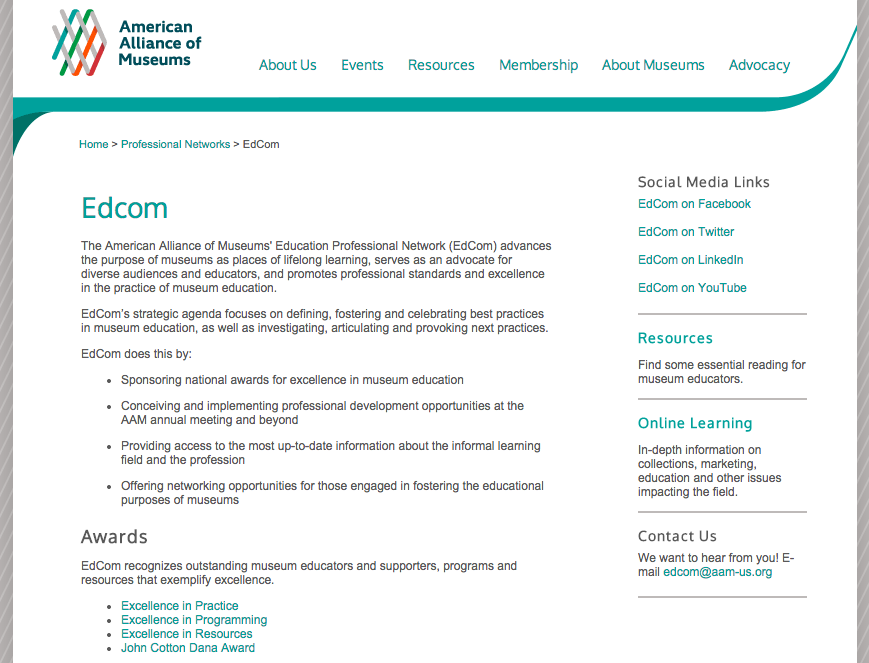
AAM EdCom web pageEdCom, the Education Professional Network of the American Alliance of Museums, recently revived its web page after a few months on hiatus.  You’ll not only find basic information about EdCom, the group that’s focused on education and interpretation in all types of museums (including historic sites), but resources, such as “Excellence in Practice: Museum Education Principles and Standards,” and a suggested bibliography.  If you want to keep on news, you’ll want to join them on Facebook, Twitter, or LinkedIn.

With the recent restructuring of membership at AAM, you can join any one of the 22 professional networks (there’s even one for Historic House Museums) for free if you’re an individual professional member.

Is Historic Preservation Ready to Preserve Culture as well as Architecture?

Sustaining San Francisco's Living History by San Francisco Heritage

Sustaining San Francisco’s Living History by San Francisco Heritage

The fundamental boundaries of historic preservation have been significantly expanded by San Francisco Heritage, one of the country’s leading historic preservation organizations. In Sustaining San Francisco’s Living History: Strategies for Conserving Cultural Heritage Assets, they state that, “Despite their effectiveness in conserving architectural resources, traditional historic preservation protections are often ill-suited to address the challenges facing cultural heritage assets. . . Historic designation is not always feasible or appropriate, nor does it protect against rent increases, evictions, challenges with leadership succession, and other factors that threaten longtime institutions.”   In an effort to conserve San Francisco’s non-architectural heritage, historic preservation must consider “both tangible and intangible [elements] that help define the beliefs, customs, and practices of a particular community.” Did you notice the expanded definition?  Here it is again:  “Tangible elements may include a community’s land, buildings, public spaces, or artwork [the traditional domain of historic preservation], while intangible elements may include organizations and institutions, businesses, cultural activities and events, and even people [the unexplored territory].”

With many historic preservation organizations, it’s all about the architecture so protecting landscapes, public spaces, and artwork is already a stretch.  They’re often not aware that Continue reading

Video: Long Beach Historical Society Cemetery Tour

[vimeo http://vimeo.com/107648495]

City TV produced this 4:10 video documenting the Historical Society of Long Beach cemetery tour (“where every plot has a story”). Started in 1995, the Historical Society conducts its annual living history tour at the city’s two oldest cemeteries on the Saturday before Halloween.  It attracts about 600 people each fall and according to one visitor, “It’s not weird at all. . . .It’s a cool place to spend an afternoon.”  Admission is $25, $15 for members, $8 for students.

Video: Cahokia Mounds, A Visitor’s Perspective

[vimeo http://vimeo.com/107530568]

In this 1:28 video, Sarah Barnard shares her visit to Cahokia Mounds State Historic Site in Illinois, a World Heritage Site and once one of the largest cities in North America.  If you interpret historic sites, it demonstrates that many visitors see the tour as just one of many activities during their visit and shows that what they find interesting and significant may be different from the site’s.  What I found most interesting is that the huge visitor center with exhibits and store was excluded from the video.  No doubt she explored the visitor center (it’s at the entrance) but I suspect it wasn’t as important as seeing the authentic historic site.

Video: Memory Series–The Warehouse

In the 2:34 video, Tianwei Studio documents “The Warehouse,” a three-channel video installation installed in an old warehouse in downtown Lubbock, Texas. It’s part of “The Memory Series is a series of site-specific video installations exams personal and collective experiences of memory. Through the over used public imagery, brings historic awareness and collective memory to the obsolete industrial architectural space, where memory is not based on an illusion of static and eternal time, but derives from the awareness of temporal change.”  It’s much more aesthetic than interpretive, but you might find some new ideas for interpretive methods (such as filling an entire doorway with a projected image) for your historic site.