Smith College, a liberal arts college in Massachusetts, recently highlighted the internships of two students at Old Sturbridge Village in a well-produced online video. Yup, they had these nice college students wearing 19th century clothes in 19th century buildings (with 21st century flies) cooking on an open fire, making cheese, and working in the dye pit to learn about life in the 19th century–and about museums. Smith College provides the funding for the internships through their Praxis program, allowing students to explore careers they may not have considered otherwise. Thanks to Sandy Lloyd for sharing this!
Highlights from the Latest Journal of Travel Research
I doubt many people read the Journal of Travel Research (yes, there are such things!) but I’ve been referring to it in preparation for a presentation at the Historic House Museum Consortium of Washington, DC. Looking at the September 2012 issue of the Journal of Travel Research, I thought I’d share some of the highlights from articles that might interest historic sites and house museums:
- In “GPS as a Method for Assessing Spatial and Temporal Use Distributions of Nature-Based Tourists,” Jeffery Hallo et al examine the use of GPS devices to study visitor behavior in national parks (an idea that can be easily be applied to large historic sites). This research typically has to be done either by asking visitors to recall their experiences in a survey or by asking visitors to record their own behavior in diaries–both cumbersome and highly subjective methods. GPS provides a better way to study human behavior, but so far the inaccuracy and cost has been major hurdles. A test of three of the newest GPS devices, however, shows that these hurdles have been overcome by Continue reading
HBO CEO named Mt. Vernon CEO; A Step Backwards IMHO
Today, Curtis G. Viebranz becomes the president and chief executive officer of George Washington’s Mount Vernon. Unfortunately, this decision by the Mount Vernon Ladies’ Association is a step backward for its mission, history, education, preservation, and ironically, women, too. Viebranz succeeds James C. Rees III, who retired in June. Here’s an excerpt from the official announcement:
Viebranz brings to Mount Vernon more than twenty years of experience at major multinational Internet and cable enterprises, including a successful tenure as president of HBO International, the global arm of Time Warner’s Home Box Office unit. Prior to that, as Time Warner turned its attention to digital distribution strategies, Viebranz was tapped to serve as the first president of Time Inc. Multimedia. During his seventeen-year career at Time Warner and its predecessor company, Time Inc., Viebranz built an impressive resume, also serving as president of Time Inc. Europe and HBO Video.
After departing Time Warner, Viebranz helped to launch Continue reading
Lincoln’s Cottage Breaks Ground on Gay Weddings for Military

Travis Hollenbeck and Daniel Vukelich at their ground-breaking wedding at President Lincoln’s Cottage
Travis Hollenbeck and Daniel Vukelich not only started a new life together by getting married on April 28, 2012, but they also broke new ground at President Lincoln’s Cottage, a National Trust Historic Site at the Soldiers’ Home in Washington, DC–it was the first wedding held at the site and perhaps the first same-sex wedding at a U. S. military base. Over 150 friends and family attended.
Hollenbeck and Vukelich chose Lincoln’s Cottage because of its personal Continue reading
AASLH Workshops for Historic Sites
The American Association for State and Local History offers a wide range of educational workshops and professional training that is particularly helpful for staff and volunteers for work at historic sites and house museums–if you know where to look. I’ve previously mentioned the sessions during its annual meeting but people often forget that it also has half-day and day-long workshops before and after the annual meeting to explore topics in depth. What most people don’t know is that you can register for just these workshops; you don’t have to attend the annual meeting–a great advantage for local folks!
This year, AASLH is offering 14 workshops, including:
- Best Practices for Slavery Interpretation led by Kristin Gallas of the Tracing Center on Histories and Legacies of Slavery with Patricia Brooks, Colonial Williamsburg Foundation; Conny Graft, Conny Graft Research and Evaluation; and Dr. Julia Rose, West Baton Rouge Museum. Full day for $75.
- The Rembrandt Rule Workshop led by Joanna Arrieta of the Atlanta History Center and Michelle Zupan at Hickory Hill. Full day for $75. For background, read Continue reading
Interpretive Planning for Dozens of Sites

Arroyo Seco Parkway National Scenic Byway Interpretive Plan produced by Engaging Places for the Mountains Recreation and Conservation Authority in May 2012.
If you’re interpreting a group of sites or a heritage area, you might be interested in reviewing an interpretive plan I completed earlier this year for the Arroyo Seco Parkway National Scenic Byway. When the Parkway was completed in 1940, it connected Los Angeles and Pasadena and began southern California’s Freeway Age. It’s also a region that has a dense concentration of museums, historic sites, parks, historic Main Streets, architectural landmarks, and unique businesses, including the Gamble House, Huntington Library, Lummis Home, Heritage Square, and Olvera Street. To bring attention to these cultural riches, the Mountains Recreation and Conservation Authority commissioned me to develop this plan and work with a local stakeholders, build on an inventory of assets developed by the National Trust for Historic Preservation, and integrate audience research conducted by the Community Land Use and Economic Group and Decision Support Partners.
The planning process followed a traditional approach by collecting content to develop topics and themes; conducting visitor research to identify target audiences; and finally Continue reading
AAM Unveils New Logo, Name, and Attitude
Today, the American Association of Museums becomes the American Alliance of Museums, which may appear at first to be merely a cosmetic change ushered in by a marketing consultant, but actually signals some significant changes in attitude. Those of us in the history field often felt like outsiders at AAM, which seemed to be dominated by art museums, our classier and richer cousins. But take look at the new AAM and you may find two major changes that may appeal to history organizations:
1. Accreditation becomes the end Continue reading
Challenges and Opportunities Facing Historic Sites and House Museums
This fall I’ll be teaching the historic site and house museum interpretation class in the Museum Studies Program at George Washington University. Department Chair Kym Rice graciously offered me this opportunity earlier this summer and I couldn’t resist. I’ve been impressed by the caliber of GW students and I count many of their graduates among my friends and colleagues. Today is the first class and participating are fifteen graduate students, mostly in museum studies with a handful from history and anthropology. We will have some fun discussions!
During the next few months, I’ll share my experiences with you and I thought I’d start by laying out the initial readings for the course, which focus on the opportunities and challenges in interpreting historic sites. It was hard to pick and choose among Continue reading
Report from the 2012 AAAM Conference in Baltimore
Last week I attended the Association of African American Museums conference along with two hundred other people from across the country. I’d never attended before but since it was close by in Baltimore, I decided to take a chance and it turned out to both educational and fun. Although I only attended one day, I’d like to share some of the highlights from the sessions I observed.
In “Understanding Exhibition Design and Planning“, the panelists all stressed the importance of pre-design, which includes determining which spaces will be devoted to exhibits, visiting other exhibits to clarify what you like (and don’t like), conducting visitor research, identifying potential artifacts and images, roughing out a budget and schedule (is the exhibit feasible?), and determining the maintenance costs. The Harpers Ferry Center of NPS offers an exhibit planning template for FileMaker Pro. The panel also provided a rough estimates of exhibition costs for design and fabrication:
- $150-250/sf: 2D items, graphics, pedestals for 3D objects, little to no media.
- $250-350/sf: 3D object displays, more extensive use of graphics, some media elements
- $350-500+/sf: custom cases, media, electromechanical interactives, theatrical lighting/projectors.
They stress that costs could be lower, but it will then rely heavily on reusing ideas or elements from earlier exhibits or projects. The panelists also believed that better designs are the result of longer development schedules, not more money. More time allows for more iterations of designs to refine ideas. Finally, for new buildings, they suggest that exhibit designers be brought in early to the process because they help program the space because they tend to “design from the inside out”–but that will require that the architect is willing to collaborate. For a copy of the PowerPoint presentation, contact Chris Danemeyer at Proun Design.
Claudine Brown, the Assistant Secretary for Education and Access at the Smithsonian Institution, was the luncheon speaker. She laid out the new interpretive direction for the Smithsonian and why they matter to museums, especially those that focus on African American history and culture. The challenges facing the Smithsonian is that they need to preserve the evidence of the past, be relevant in the present, and be prepared for the future [and these are ideas all museums and historic sites can follow]. The three big topics the Smithsonian will be interpreting are:
- Americans All: a shared experience as immigrants, everyone came from somewhere else, but all share a common country.
- Waterways: Water is a serious problem and its estimated that 2/3rds of the world will suffer water shortages by 2025.
- Creativity and Innovation: With our current high unemployment rates, museums can be part of the solution by providing learning opportunities that simulate real life and helping the next generation learn how to organize, strategize, and act.
The session on developing mobile applications was led by the Digital Humanities Center at Michigan State University, which maintains an online clearinghouse of mobile museum applications. The session provided some estimated costs for producing various applications, as follows:
- $0-?: mobile-ready website (creating a website that can be easily viewed on a smartphone; most common solution)
- $5,000-$60,000: native application (self-contained program that’s downloaded and works without an internet connection)
The session stressed that mobile applications rarely generate revenue–the average return on investment is $688 and takes 51 years–so look for other benefits to the institution. It may be possible to generate revenues from after-market sales, such as an app that promotes a book, photoprints, music, and attendance at an event. When I asked about the effectiveness of applications, the person sitting next to me suggested I look at #SocialMedia Daily, a blog that aggregates news about social media and apps.

Remembering the 1,933rd Anniversary of the Eruption of Mt. Vesuvius

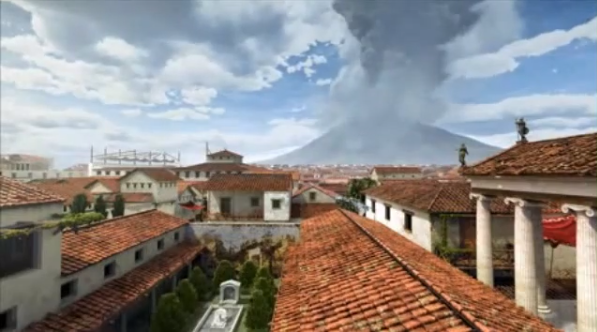
Animation still from “A Day in Pompeii,” You Tube video at http://youtu.be/w82yVDOMIa0
This may seem far-afield from the interests of most historic sites, but 1,933 years ago today, Mount Vesuvius erupted and buried the city of Pompeii (resulting in one of the world’s most popular historic sites about 1,700 years later). The Denver Museum of Nature and Science is marking the anniversary by tweeting the last day of Pompeii as it happened, starting at 10 a.m. today by @Elder_Pliny (formerly known as Pliny the Elder, who witnessed the events) in preparation for an exhibit on Pompeii opening on September 14. So far, he has more than 3,000 followers and he just tweeted that he’s preparing his boat to get a closer look (should I warn him?). Along with the tweets, the Museum has created a mashup with Google maps to follow Pliny around Pompeii, is hosting “Bacchus Raucous” (a fundraising gala dressed in a Roman toga) and is featuring a lecture on Ceren, a Mayan village that was also encased by a volcanic eruption centuries ago.
Thanks to Sandra Smith at the Heinz History Center sharing this clever approach in interpretation.