Q&A: Managing Collections at Historic Sites with Terri Anderson

Terri Anderson

Terri Anderson is swapping history collections for art when she joins the Corcoran Gallery of Art next week as a Contract Registrar to help them migrate their collections database from Filemaker to TMS (The Museum System).  For the past five years, she has focused her work on collections management at the 29 National Trust Historic Sites as the John and Neville Bryan Director of Collections at the National Trust for Historic Preservation, where she also taught collections management for George Washington University and became one of the national leaders on the challenges of deaccessioning collections at historic sites.  With this transition, I thought it would be a good time to capture some of her thoughts about managing collections at historic sites.

Max:  You’ve been managing the collections of the National Trust for the last five years–what have been the major successes?

Terri:  Our most visible successes were opening several Sites to the public for the first time, including the Philip Johnson Glass House in New Canaan, Connecticut; President Lincoln’s Cottage in Washington, DC; and Villa Finale in San Antonio, Texas. Each of these Site openings required many important decisions about collections stewardship and access, and each Site demanded a different approach: one size did not fit all.

At the same time, we had successes that, while less visible, were important to me and the parties involved.  We did a lot of great work with thoughtful, appropriate deaccessions at several of our Sites.  I wrote about our experiences in Continue reading
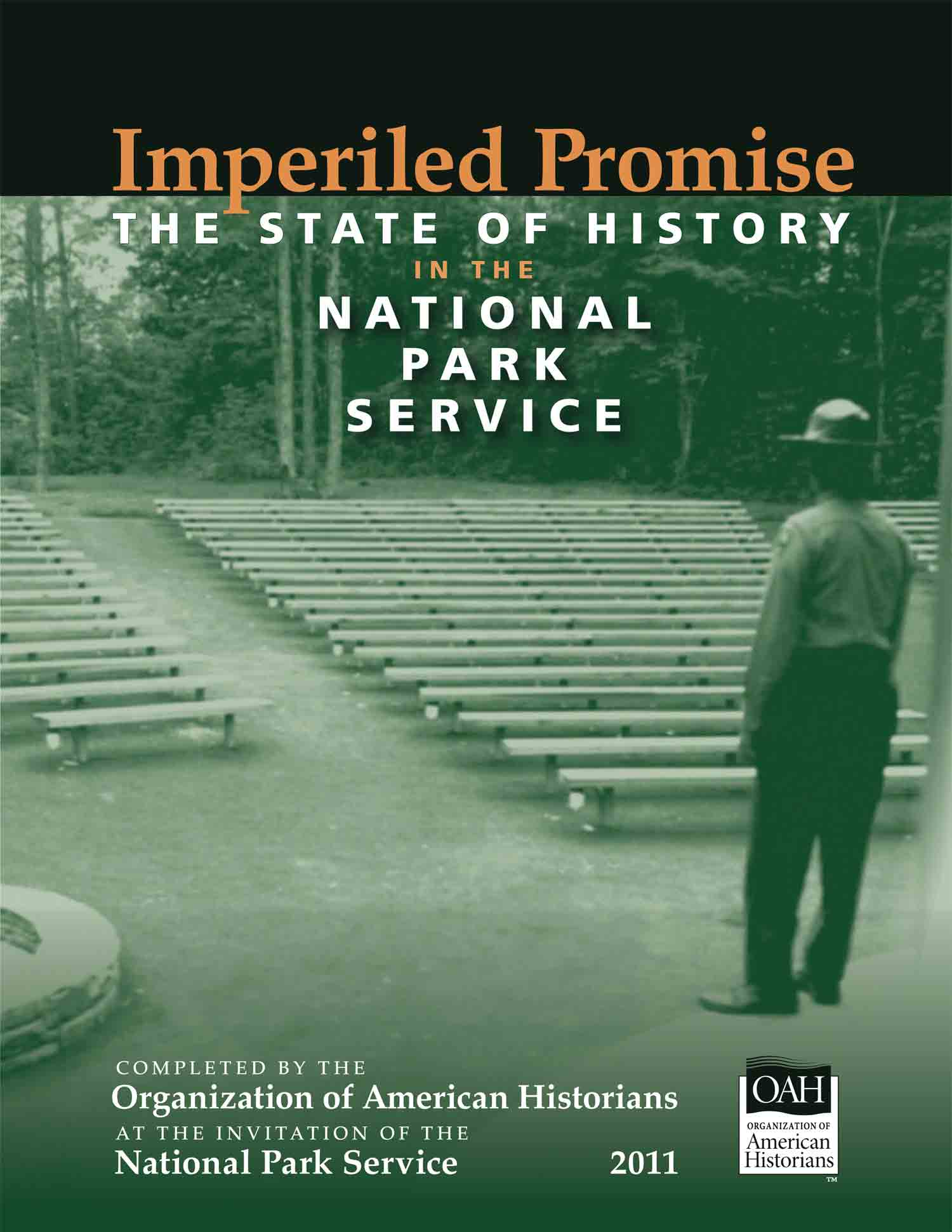
OAH Report Claims History is Imperiled at National Parks

The Organization of American Historians recently completed an evaluation of the “state of history” at the National Park Service.  Four prominent historians–Anne Mitchell Whisnant, Marla Miller, Gary Nash, and David Thelen–led the study, which was based on more than 500 staff responses to an online survey, interviews with current and former staff, site visits, discussions at national meetings, and a review of past studies and reports.

Their analysis revealed that much good work is going on in such areas as reinterpreting slavery and the Civil War, negotiating civic engagement, sharing authority, developing interdisciplinary partnerships, encouraging conversations about history through new media, and collaborating with historians in colleges and universities.  These are presented through a dozen profiles of projects at such National Parks as Manzanar, the Olmsted Center for Landscape Preservation, San Antonio Missions, Harpers Ferry, and the Martin Van Buren National Historic Site.

Although they discovered that good work is being done in a few places, it is not “flowering on the whole” due to several intertwined issues.  Most significant is the report’s contention that, “the agency as a whole needs to recommit to history as one of its core purposes, and to configure a top-flight program of historical research, preservation, education, and interpretation so as to foster effective and integrated stewardship of historic and cultural resources and places and to encourage robust, place-based visitor engagement with history.”  These concerns are presented as a dozen findings, and from my observations, many also reflect what’s happening at historic sites outside of the National Parks.  For example:

  1. The History/Interpretation Divide.  The intellectually artificial, yet bureaucratically real, divide between history and interpretation constrains NPS historians, compromises history practice in the agency, and hobbles effective history interpretation. The NPS should find and take every opportunity to reintegrate professional history practice and interpretation. [In museums, this is comparable to the tensions found between curators and educators, where those who conduct research are often separated from those who teach.]
  2. The Importance of Leadership for History.  Without visionary, visible, and respected leadership at the top, and Continue reading

Historic House Management Workshop in DC Reveals National Issues

This slideshow requires JavaScript.

For two days last week, about two dozen people gathered in Washington, DC for AASLH’s annual Historic House Management Workshop.  George McDaniel and I have been co-teaching this workshop for more than a decade around the country and while all the classes are fun and interesting, the one we recently completed was unusual because it was held in two incredibly significant historic houses designed by two of America’s pioneering architects.  Special thanks go to AIA Legacy for hosting the meeting at the Octagon and the White House Historical Association for hosting the meeting at Decatur House.  The workshop usually attracts a diverse group of participants but this one especially so with a mix of curators, educators, conservators, directors, boardmembers, college professors, and consultants–it would have been great to conduct a charrette with them!

Each year we ask the participants to identify one issue they’d like to address in the workshop and Continue reading

Failed Organizational Culture at Goldman Sachs Suggests Remedies for Non-Profits

Greg Smith’s public departure from Goldman Sachs after a dozen years is one of the hottest pages of the New York Times today and while I tend to ignore the personnel matters of Wall Street (oh, another tycoon getting/losing/complaining about a bonus that’s more than the value of my house), reading his statement startled me.  So many of his concerns about the organization’s culture are shared by me and many of my colleagues in the museum and historic preservation fields:

1.  The overriding pursuit of money that’s out of balance with mission or ethics.  Smith describes a staff meeting at Goldman Sachs:

Today, many of these leaders display a Goldman Sachs culture quotient of exactly zero percent. I attend derivatives sales meetings where not one single minute is spent asking questions about how we can help clients. It’s purely about how we can make the most possible money off of them. If you were an alien from Mars and sat in on one of these meetings, you would believe that a client’s success or progress was not part of the thought process at all.

Gosh, if this bothers someone at a financial investment firm, shouldn’t the lack of discussion about fulfilling mission and vision really bother the board and staff at a non-profit organization?  And yet most meetings Continue reading

Teaching History Without Textbooks? Stanford Proves It’s Possible.

In 2008, Stanford University introduced “Reading Like a Historian,” a non-traditional history curriculum to five schools in the San Francisco Unified School District.  According to Sam Wineburg, who directs the Stanford History Education Group and has been a longtime proponent of revising the teaching of history, “We need to break the stranglehold of the textbook by introducing students to the variety of voices they encounter in the past through primary sources.”  It seems this new curriculum is doing that and more, as recently reported in Futurity:

There are no orderly rows of desks in Valerie Ziegler’s 11th-grade history class—students sit in groups of three or four at small tables around the room. There also is no lectern because there are no lectures. And perhaps most striking, there are no textbooks.

These students at Abraham Lincoln High School in San Francisco learn about the Vietnam War, women’s suffrage, civil rights, the Great Depression, and other major events in U.S. history by analyzing journal writings, memoirs, speeches, songs, photographs, illustrations, and other documents of the era.

“I always tell my students they’re historians-in-training, so the work we do in here is that of a historian,” Ziegler says.

That sounds like fun, but does it have any impact? Continue reading

Collections Chat on NEH’s Preservation Assistance Grants

"Skeleton Room" at the Smithsonian Institution, ca. 1890.

On Monday, March 12 at 1 pm Eastern, the Connecting to Collections
Online Community
will host another live chat in their series. Join Elizabeth Joffrion, Senior Program Officer in the National Endowment for the Humanities’
Division of Preservation and Access
to learn about Preservation Assistance Grants. She will review what Preservation Assistance Grants fund, share tips on making a strong application, and answer your questions. No preregistration is required;
on Monday at 1 pm EDT just go to http://www.connectingtocollections.org/meeting and log in.

National Endowment for the Humanities’ Preservation Assistance Grants help small and mid-sized institutions—such as historic sites, museums, historical societies, cultural organizations, Continue reading

STEM needs a Bloom (and that’s the Arts and Humanities)

John Lithgow giving the keynote address for the National Arts and Humanities dinner in 2012.

Actor John Lithgow recently discussed the work of the Commission of the Humanities and Social Sciences (of which he is a member) and gave some thoughtful remarks about the value of the humanities as part of his keynote address at this year’s dinner honoring the fifteen recipients of the National Medal of Arts and the National Humanities Medal.  Among his observations were that,

civil discourse, self-knowledge, empathy, the habit of learning, and yes, the capacity for joy, are indeed learned skills and that they can be most effectively taught to young people through the arts and humanities, and I believe most fervently that the health of a democracy absolutely depends on these qualities.

He also criticized STEM–“the very word gives me Continue reading

Haas-Lilienthal House completes Sustainability Management Plan

Haas-Lilienthal House

The Haas-Lilienthal House in San Francisco has just completed a Sustainability Management Plan, which will help them meet energy and sustainability goals while preserving its character-defining and historically significant features.  Through this plan, they’ve established a goal of reaching LEED Gold, however, there’s a “stretch goal” to reach “net zero.”  Many people think that historic house museums are unable to meet any “green ratings” without compromising their preservation goals, however, recent achievements by President Lincoln’s Cottage and others show it’s possible.  The Haas-Lilienthal House is owned and operated by San Francisco Archiectural Heritage, a city-wide preservation organization, so plans like this not only provide a road map for greening the maintenance procedures and capital building improvements to save money and energy, but advance their position that historic preservation is relevant and historic buildings can perform as well as modern ones.

The plan was developed by Barbara Campagna, FAIA, LEEP AP, a former colleague of mine at the National Trust for Historic Preservation, where she was actively involved Continue reading

Historian Named One of the the Year’s Top Tech Innovators

The Chronicle of Higher Education just named Dr. Daniel Cohen one of academia’s top Tech Innovators for 2012 for his innovative approaches to employing digital tools in research and teaching.  Is he a computer scientist, business professor, or cognitive psychologist?  Nope, he’s an historian of 19th century science and religion, not a typical place where you’d expect to find someone on technology’s cutting edge. Nice to turn the tables on those who believe history is just about the past and has little to offer the future.  Think again.

Dan Cohen is an associate professor in the Department of History and Art History and director of Roy Rosenzweig Center for History and New Media at George Mason University in Virginia. He is the co-author of Digital History: A Guide to Gathering, Preserving, and Presenting the Past on the Web (University of Pennsylvania Press, 2005), author of Equations from God: Pure Mathematics and Victorian Faith (Johns Hopkins University Press, 2007), and has published articles and book chapters on the history of mathematics and religion, the teaching of history, and the future of history in a digital age in journals such as the Journal of American History, the Chronicle of Higher Education, and Rethinking History.  If that isn’t enough, he is an inaugural recipient of the American Council of Learned Societies’ Digital Innovation Fellowship.

To learn more about the work being done by Cohen and others at the center to preserve history through the use of digital media, read “Presenting and Preserving the Past Through Digital Media” in Mason Research and “A Digital Humanist Puts New Tools in the Hands of Scholars” in the Chronicle of Higher Education.

WebWise Attracts 400 Museums, Libraries, and Research Orgs

This slideshow requires JavaScript.

This week I was fortunate to spend two days in Baltimore with 400 persons representing museums, libraries, archives, and research organizations from 40 states at WebWise, the annual conference hosted by the Institute of Museum and Library Services.  This is always one of my favorite conferences and despite a rapid sell-out, I was able to snag a seat.

There seems to be a growing number of history museums and historic sites attending WebWise, and perhaps that’s due to increased recognition that digital technologies are no longer a fad but an essential part of a successful organization (indeed, one of the presenters remarked that staff with technology in their titles are rising up to senior levels with more frequency).  Among the history organizations represented this year are the American Continue reading