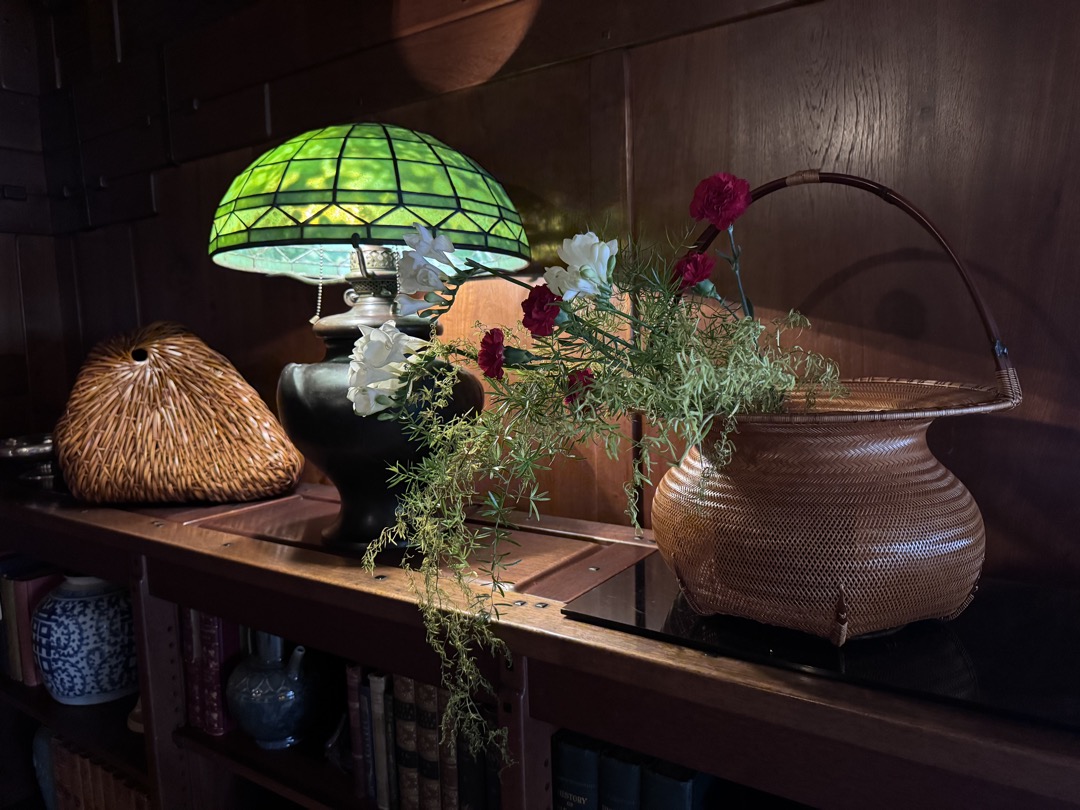
Japanese baskets from 20 years ago feel at home in a house that’s a century older.
A growing number of historic house museums are experimenting with contemporary art exhibitions to attract new—and especially younger—audiences. The logic is understandable: align with what feels current and visible, generate social media buzz, and compensate for the decline of traditional media coverage. But too often, these exhibitions feel short-lived and disconnected. The site becomes little more than a stage set, and the art—however compelling on its own—lands like what urban planners used to call “plop art.” It could be placed anywhere, anytime, with little meaningful connection to the place.
That’s why a recent visit to the Gamble House in California was so refreshing.
I had the chance to see From Strand to Sculpture, a temporary exhibition of contemporary Japanese bamboo basketry (February 5–April 12, 2026). The Gamble House, of course, is a textbook example—arguably a masterpiece—of the Arts and Crafts movement by Greene and Greene. Completed in 1908 as the winter home of the Gamble family of Cincinnati, the house is defined by its extraordinary attention to materials, craftsmanship, and the integration of architecture and decorative arts.
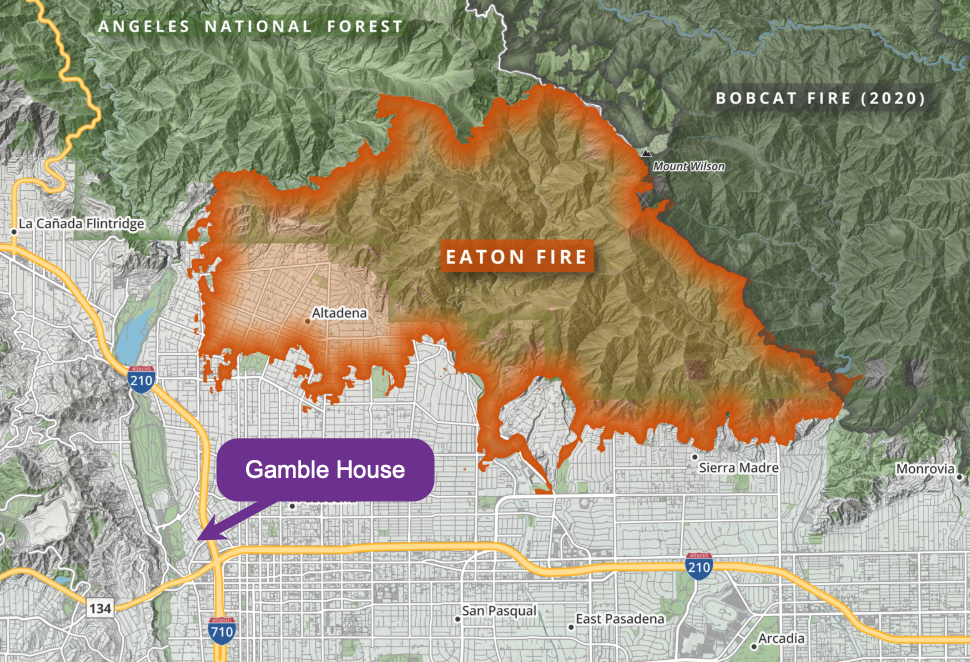
Extent of Eaton Fire, 2025. Courtesy Wikimedia Commons.
When disaster strikes, how should a museum approach fundraising? A recent appeal from the Gamble House Conservancy offers an excellent model.
Following the devastating Eaton Fire in January 2025, the Gamble House framed its appeal not simply around its own needs, but around its role in the community’s recovery. The letter powerfully connects the Gamble House to the larger regional tragedy, emphasizing the museum as a place of respite, inspiration, and service. Rather than focusing solely on damage or lost revenue, the appeal highlights how the museum has already acted: removing collections, supporting staff and volunteers, surveying visitors to guide future programs, and partnering with displaced nonprofits like the Pasadena Audubon Society.
The Conservancy also effectively maintained its core mission. Ongoing conservation efforts, such as addressing water intrusion and repairing the side yard gate, are presented alongside expanded community initiatives. This dual focus reassures donors that their gifts support both immediate public needs and long-term stewardship.
Finally, the letter makes giving easy. In addition to traditional mail-in donations, a QR code directs supporters to a secure online portal, meeting donors where they are.
The takeaway for museums and nonprofits? After a crisis, connect your organization’s needs to the broader recovery, demonstrate early action, and align core mission work with new community service roles. Fundraising after a disaster isn’t just about survival — it’s about showing how your institution remains essential to the life of the community it serves.
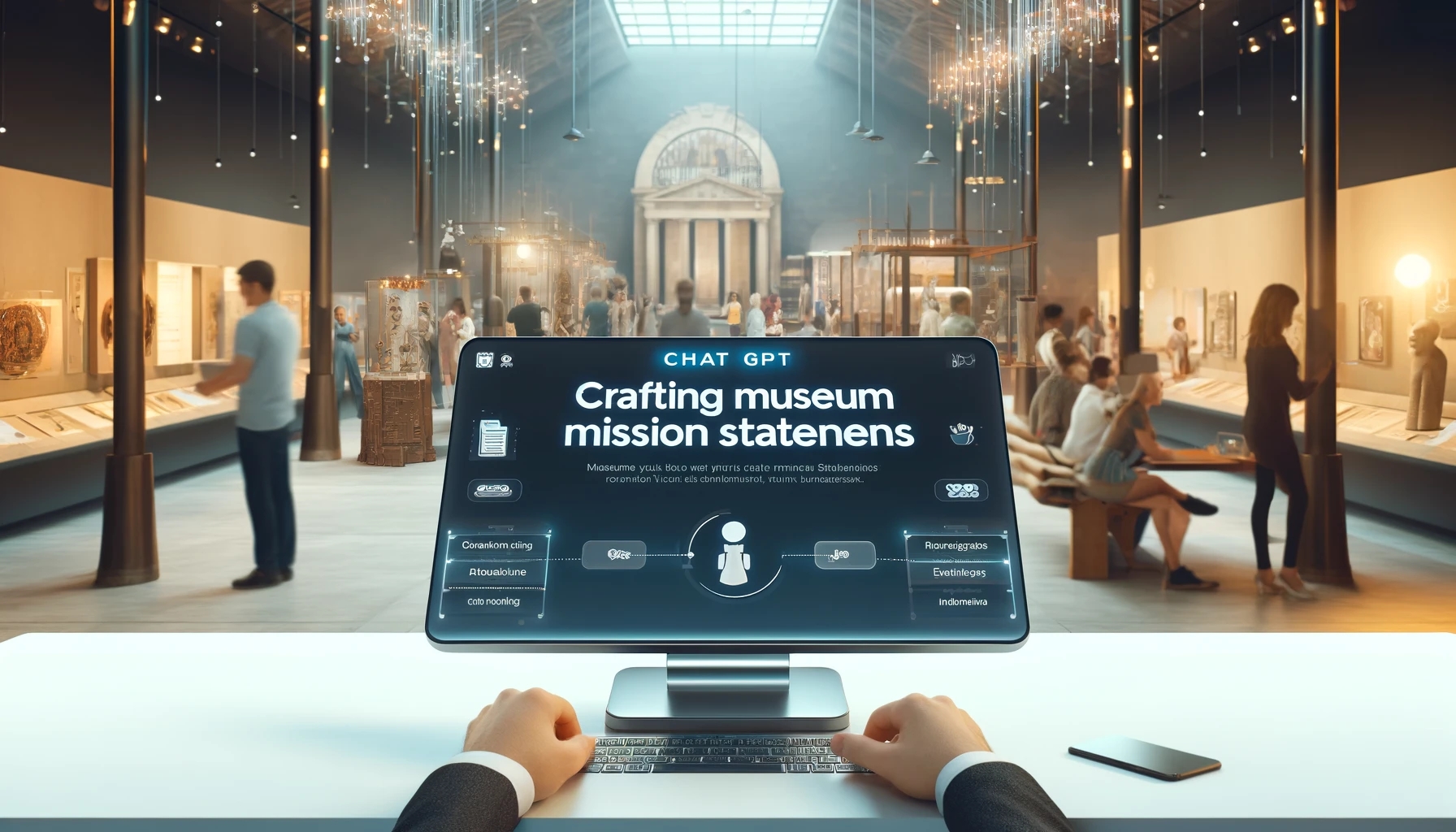
ChatGPT-4o created this image in less than a minute.
The highly anticipated release of ChatGPT-4o has once again thrust artificial intelligence (AI) into the spotlight. So how can historic sites and house museums harness the power of ChatGPT to craft thought-provoking mission statements, an essential element of effective management?
The American Alliance of Museums states that excellence requires that, “all aspects of the museum’s operations are integrated and focused on meeting its mission.” And yet, crafting mission statements is among the most difficult tasks for an organization. Writing and revising as a board or staff committee can result in circular arguments, the infinite parsing of words, or resignation to a milk-toast statement that offends no one. So how can you take a mission statement that’s weak or mild and turn it into something stronger and more meaningful?
My typical response is that a small committee of diverse leaders within the organization discuss the purpose and role of the museum in the community, and then appoint one person to draft a mission statement for approval. Although that’s much more effective than writing-by-committee, it can also result in a tremendous commitment of time and frustrations during the review as members defend their ideas. Instead, I’ve found ChatGPT to be much more efficient and less frustrating. You can revise frequently and quickly, try out variants and new ideas easily, and even better, criticize the “robot” and it won’t care.
The mission of The Gamble House is to inspire the public’s appreciation and understanding of architecture as a fine art through the example of The Gamble House, the most complete and best-preserved work of American Arts and Crafts architects Charles and Henry Greene.
Using a simple prompt, “Create a mission statement for the Gamble House in Pasadena, California,” ChatGPT-3’s version was:
Our mission at the Gamble House is to preserve and celebrate the legacy of this iconic American Arts and Crafts masterpiece. As a cultural destination and community resource, we aim to inspire and educate visitors about the significance of the Gamble House’s architecture and design, and its enduring influence on American culture.
The first sentence is the usual celebratory mission statement but notice that the next sentence goes further to explain why it matters today (“its enduring influence on American culture”). That’s a significant improvement that can improve the mission statement’s ability to guide decisions and establish priorities—which is the core function of a mission statement.
Going further, you can use ChatGPT to create mission statements inspired by the ideas of influential thinkers. English designer and writer William Morris inspired the Arts and Crafts Movement, so he’s an ideal choice for the Gamble House. By changing the prompt to, “Create a mission statement for the Gamble House in Pasadena, California in style of William Morris,” the result is:
“Our mission at the Gamble House is to preserve the beauty and integrity of this magnificent home, which is a masterpiece of American craftsmanship and design. Through our efforts to maintain the house and its surroundings in a state of harmony and balance, we seek to embody the principles of the Arts and Crafts movement, which holds that art and beauty should be an integral part of everyday life. By promoting the values of craftsmanship, simplicity, and authenticity, we aim to create a more just and equitable society, one in which the arts and culture are accessible to all, and the beauty of the natural world is cherished and protected.”
Far too long to be a modern mission statement for a museum, it does offer some intriguing ideas, particularly in the last sentence. By mentioning “craftsmanship,” “equitable society,” and “accessible to all,” it addresses values that could be meaningful to modern visitors and supporters of the Gamble House and inspire innovative programming.
In the year that followed, I’ve continued to explore how ChatGPT can help historic sites and house museum improve their mission statements, as well as create a vision and values. Lest anyone think that ChatGPT is a simple mindless hack to the usual hard work of crafting a mission statement, the use of AI requires a thoughtful human hand on the computer keyboard. ChatGPT can be biased, inaccurate, and hallucinate, so you need to know the organization and theories of management strategy. A weak or poor mission statement can harm a nonprofit organization, whether created by humans or AI.
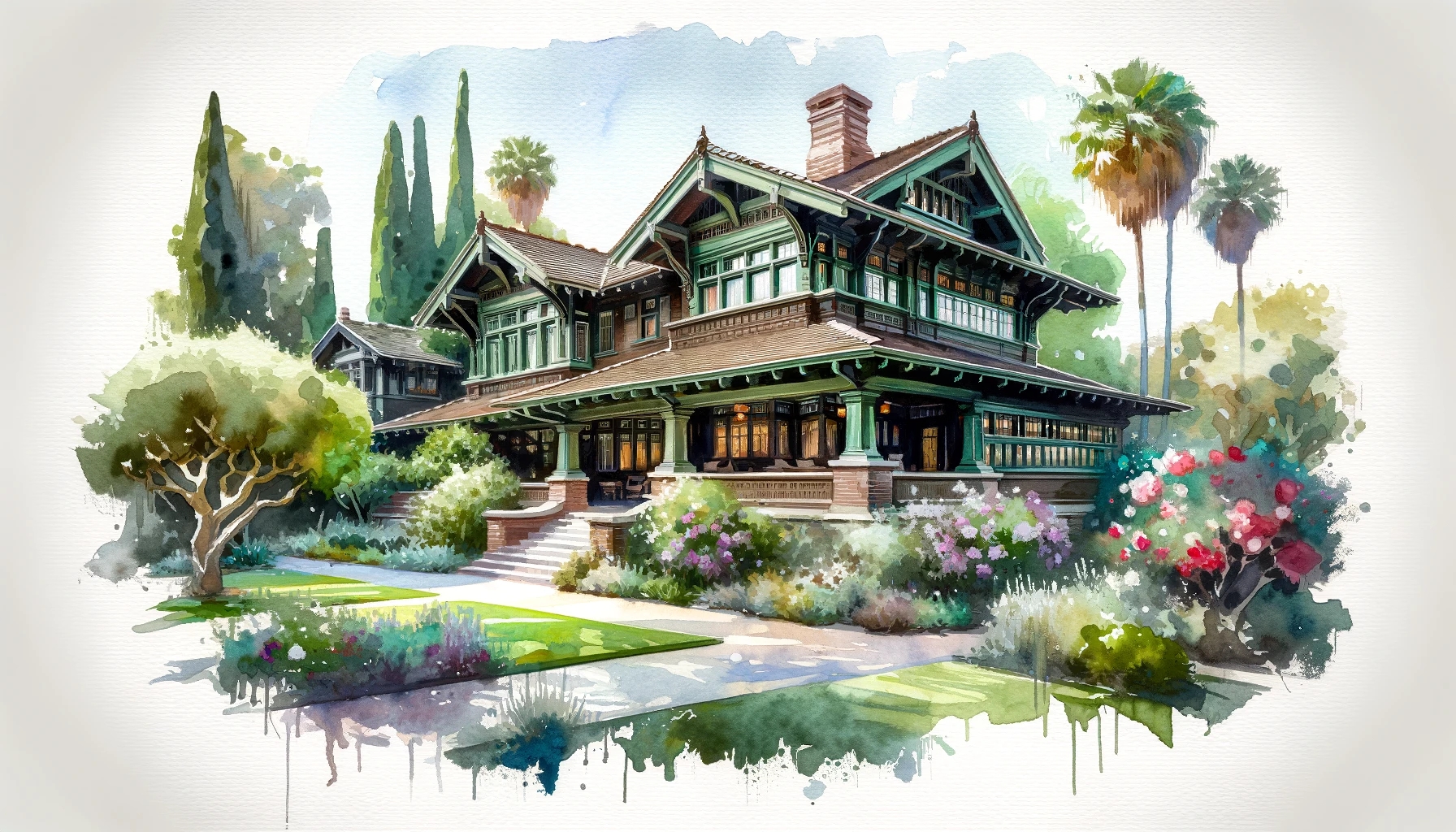
ChatGPT-4o created this image of the Gamble House, demonstrating the need for the human expert—there’s very little that is correct in this image.
Getting Started
If you’re interested in the best explanation and practices of AI and ChatCPT, read Ethan Mollick’s Co-Intelligence: Living and Working with AI (2024) or listen to an interview with him on the HBR IdeaCast, “Tech at Work: What GenAI Means for Companies Right Now.” If you’re interested in practical applications with lots of examples, read AI and the Future of Education (2023) by Priten Shah. AI is being incorporated into an increasing number of applications, including Microsoft Word, Evernote, Notion, and WordPress, but if you want to explore ChatGPT, it is available free with registration at OpenAI.
If you want to use ChatGPT to craft a mission statement, be aware that it relies on the information that is available to it. If your organization has a very small presence on the Internet or in publications (unlike the Gamble House), a simple prompt will be ineffective. You’ll need to take an additional step to provide it with information, such as the museum’s goals, primary audiences, collection strengths, historical background, and what makes it unique or distinctive. If you’re unsure how to do this in ChatGPT, start with the prompt, “I need help writing a mission statement for [your museum name]. Here are the details: [insert information].” You can follow up with additional instructions, such as “”Give me three different mission statement options,” “Can you make this mission statement more engaging for a younger audience?”, or “I like the direction of this mission statement, but can you make it shorter?”
If ChatGPT has helped your organization improve or rethink its mission statement, please share your experiences in the comments.
This small selection of historic sites operated by The National Society of The Colonial Dames reveals the enormous diversity of house museums and historic sites in the United States.
In 2007, I helped organize the Forum on Historic Site Stewardship in the 21st Century, which resulted in an influential issue of Forum Journal that laid out the major challenges and opportunities, including the need for financial sustainability, a willingness to change in response to the needs of the community, and a balance between the needs of buildings, landscapes, collections, and the visiting public. It also recognized that museum standards may not be the best practices for historic sites and that the profession “must develop new measures, beyond attendance, that document the quality of visitor engagement at sites and the extent of community outreach beyond the bounds of historic sites.”
So what has happened in the 16 years that followed? We’ll find out this week as the American Association for State and Local History hosts a virtual summit on the Sustainability, Relevance, and the Future of Historic House Museums on July 11-12. Sessions will address measuring the impact of house museums, broadening interpretation, care of buildings and landscapes, and the evolution of mission statements.
Our last Reimagining House Museums workshop was held at Dumbarton House in Washington, DC in June 2019!
Ken Turino and I will once again lead our workshops on reimagining historic house museums in 2023 after taking several years off due to the pandemic. Our first workshop will be held at the Gamble House in Pasadena, California on Friday, April 1 and our second will be held at the Decorative Arts Center of Ohio in Lancaster, Ohio on Thursday, June 22. AASLH is managing the workshop and registration is $325 but it’s $200 for AASLH members (and it’s $150 if you register by February 1!). Participation is limited to 25 people for the April workshop.
The workshop is closely related to the book, Reimagining Historic House Museums (2019), but we take a much deeper dive into the challenges facing house museums, assess current programs against a “double-bottom” line for a big-picture perspective, analyze the five forces that affect programs and events to find opportunities and obstacles, and highlight some of the ways that house museums have reinvented themselves. The day is packed with information and activities, but we take a good break in the middle of the day for lunch and we get to meet lots of other people who are working hard to make their historic site better. Plus it’s great fun!
Fans of the Gamble House, the Arts-and-Crafts masterpiece created by Greene and Greene in 1908, will either be thrilled or horrified this Halloween season. The Machine Project has transformed the House during the Pasadena Art Council’s two-week AxS Curiosity Festival to reveal the history and visual ideas behind the historic site in subtle and not-so-subtle ways. Called the “Field Guide to The Gamble House,” it includes experimental tours and dances, group naps, operatic bird beaks, seances, videos, architectural lawn furniture and a secret Swiss-Japanese fusion restaurant. Complementing those live events, they’ve installed contemporary paintings and sculptures throughout the house to juxtapose today’s artistic ideas with 1908′s architectural style. On-site, hands-on workshops offer lessons in topics ranging from soap-making (a tribute to the family’s business) to solar robotics, from Craftsman-style cat houses to basic electronics, bringing the Arts and Crafts movement in parallel with today’s Maker groups.
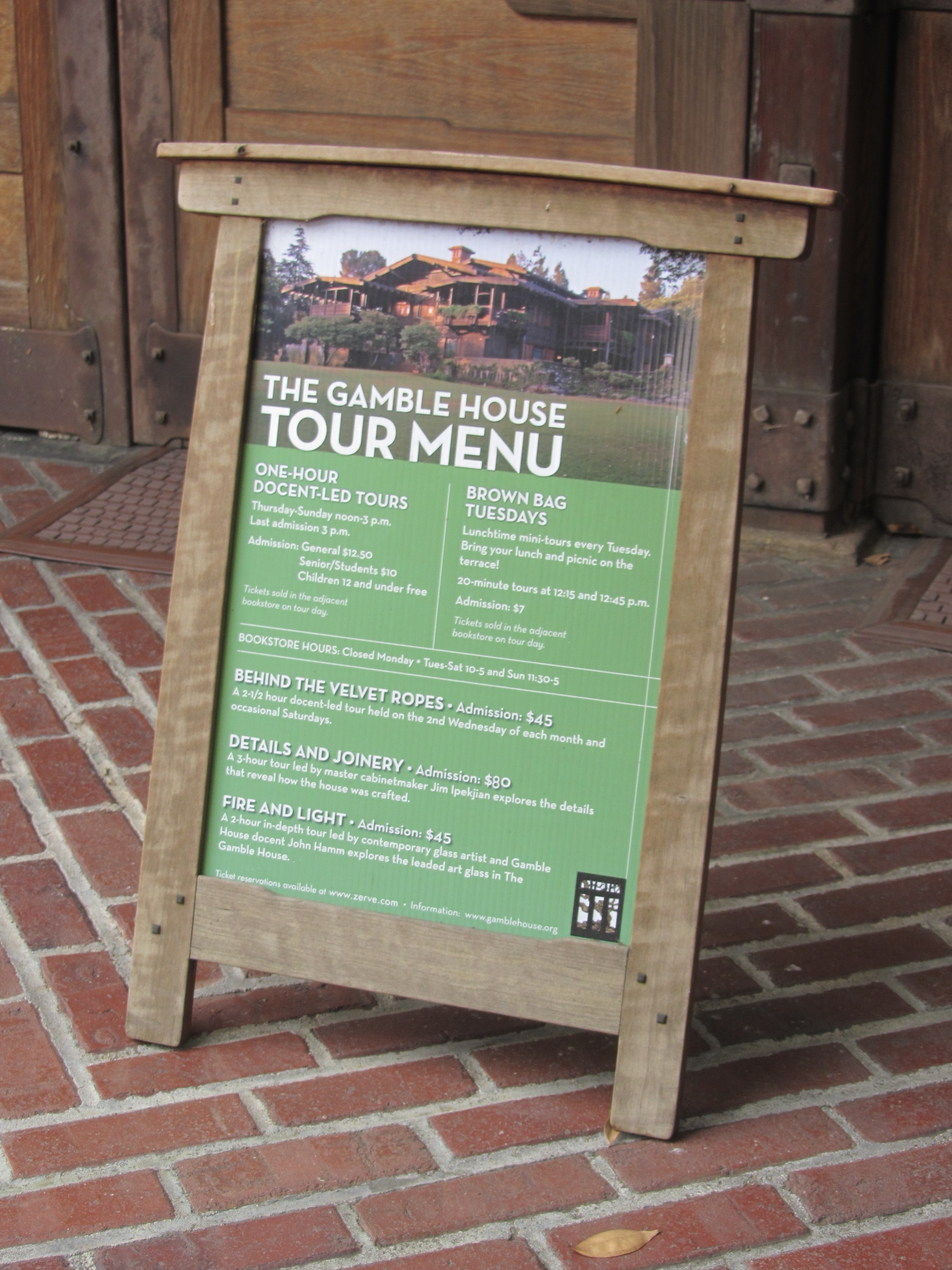
I have to admit that I’m the strange visitor at historic sites. I not only take photos of the architecture and landscape, but reception desks, walkway paving, light fixtures, wheelchair ramps, and signs. These are the things that make a visitor experience good, bad, or ugly, but they’re often overlooked and it’s hard to find good examples.
Gamble House Tour Menu Sign
Here’s one from the Gamble House in Pasadena, California. It’s a sandwich board placed on the driveway leading from the sidewalk to the garage, which now serves as the bookstore and admission desk. The sign isn’t big, but the bright color and location makes it easy to spot from the sidewalk. Visitors can comfortably learn about the options and then go inside the bookstore to buy their tickets. Notice it’s called a “tour menu,” using familiar terms so that visitors quickly grasp the purpose of the sign. The sign is placed outside in shady spot in front of the bookstore (those are the doors behind the sign). The store is small and often busy so encouraging people to make their selection outside is much more comfortable, especially because these types of decisions are typically Continue reading →
Los Angeles is hosting a four-day international conference on the care and interpretation of collections in historic house museums on November 6-9, 2012 called, The Artifact, its Context, and their Narrative: Multidisciplinary Conservation in Historic House Museums. A half dozen organizations are sponsoring and hosting the conference, including ICOM-DEMHIST (the international committee for historic house museums), three ICOM conservation working groups, the Getty Conservation Institute, Getty Research Institute, the University of Southern California’s School of Architecture/Heritage Conservation Program, and the Gamble House. Historic sites encounter some of the most challenging preservation issues in the museum field because it is often impossible to maintain environmental conditions that are ideal for the collections, building, and visitors. Indeed, some leaders in the field have wondered whether historic sites should be even considered museums because it establishes such an impossible standard.
The four-day conference consists of two days of site visits (such as the Gamble House, Huntington Library, Eames House, and Will Rogers Ranch) and two days of presentations and lectures. Sarah Staniforth (National Trust UK) and Linda Young (Deakin University) will be providing broad overview presentations on the challenges and opportunities facing collections in historic sites, but most of the presentations are Continue reading →
Arroyo Seco Parkway National Scenic Byway Interpretive Plan produced by Engaging Places for the Mountains Recreation and Conservation Authority in May 2012.
If you’re interpreting a group of sites or a heritage area, you might be interested in reviewing an interpretive plan I completed earlier this year for the Arroyo Seco Parkway National Scenic Byway. When the Parkway was completed in 1940, it connected Los Angeles and Pasadena and began southern California’s Freeway Age. It’s also a region that has a dense concentration of museums, historic sites, parks, historic Main Streets, architectural landmarks, and unique businesses, including the Gamble House, Huntington Library, Lummis Home, Heritage Square, and Olvera Street. To bring attention to these cultural riches, the Mountains Recreation and Conservation Authority commissioned me to develop this plan and work with a local stakeholders, build on an inventory of assets developed by the National Trust for Historic Preservation, and integrate audience research conducted by the Community Land Use and Economic Group and Decision Support Partners.
The planning process followed a traditional approach by collecting content to develop topics and themes; conducting visitor research to identify target audiences; and finally Continue reading →




 Engaging Places