Tag Archives: National Gallery of Art

Job Fairs: A New Public Program for Museums?

This fall, the Museum Studies Program at George Washington University is joining forces again with the History and Art History Departments to offer a Museums+ Internship Fair. Now in its second year, the fair connects undergraduate and graduate students with a wide range of museum and history internship opportunities in the DC area. For a couple of hours on a Friday afternoon, students will gather in the atrium of the Corcoran School of the Arts and Design to meet representatives from dozens of institutions—including the National Gallery of Art, Hillwood Estate, the National Museum of Women in the Arts, Supreme Court of the United States, White House Historical Association, and many more. The goal is simple: to help students discover just how much they can do with their degrees and to broaden their horizons by meeting professionals working across the museum and history fields.

As we’ve been preparing for the fair, I began to wonder—what if museums and historic sites flipped the concept and hosted a similar program for their own communities? Instead of being a service for students alone, imagine it as a public program, designed to connect local residents, businesses, and organizations with the museum itself.

Benefits to the Community

For many people working in business, technology, or traditional jobs, the idea of contributing their skills to a nonprofit or museum has never crossed their minds. They may not recognize that their expertise—whether in marketing, finance, customer service, or carpentry—has enormous value to cultural organizations. By connecting residents with organizations and ideas outside their usual circles, museums can help expand horizons and build confidence.
Benefits for the Museum

Continue reading

Reimagining the West Building: What’s Changing at the National Gallery of Art?

Over the past year, the National Gallery of Art has begun experimenting with how it presents art in the West Building—the museum’s original home, long known for its restrained elegance and traditional installations. While the building remains largely unchanged since it opened in the 1940s, these recent “interventions” offer a glimpse into how the museum is rethinking its interpretive and design strategies as it prepares for a broader transformation.

In a previous post, I discussed the National Gallery’s process of reimagining its West Building. Now we’re seeing that process move from discussion to experimentation. Here are three interventions currently on view, each testing new ways to engage visitors and reframe the collection:


1. Nature and Objects in Dutch Landscapes

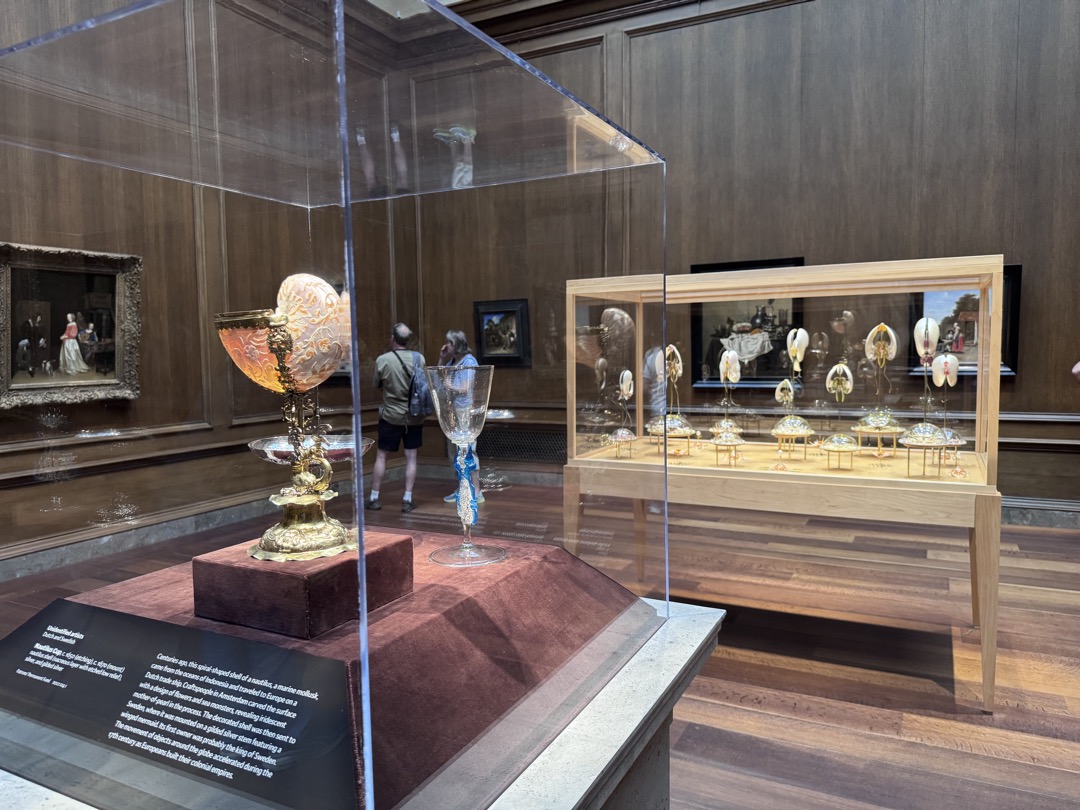
In the 17th-century Dutch landscape paintings gallery, two display cases offer a fresh angle on how nature shapes artistic imagination. One features three European decorative objects—a silver footed bowl, an elaborate stemmed glass, and a nautilus shell mounted on a gilt stand—designed to echo the forms and themes found in nearby paintings. The other case introduces a striking contemporary counterpart: Small Crafts on Sisyphean Seas by Dario Robleto, a mixed-media work combining natural materials like seashells, coral, urchin spines, and nautilus shells. These subtle interventions ask visitors to consider how objects, both functional and fantastic, reflect the human impulse to capture the natural world.

Continue reading

New Vision, Old Masterpieces: Transformation Ahead at the National Gallery of Art

The National Gallery of Art in Washington, DC has quietly launched an ambitious reimagining of its original West Building, a structure completed in the early 1940s and long known for its grand architecture and displays of masterpieces. For generations, galleries have been organized by geography and time period, with paintings neatly arranged on walls in a format familiar—and comforting—to many visitors. But as expectations change and audiences diversify, the NGA is reconsidering what a national art museum can and should be in the 21st century.

Project Goals: From Comfort to Connection

The West Building Reimagining Project is driven by a compelling vision: to make visible the profound links between art and our shared humanity. The project seeks to move beyond static displays and conventional categorizations to create exhibitions that are more resonant, inviting, and engaging—especially for multi-generational families and first-time visitors. The team aims to evoke a broader range of responses, from curiosity to awe, while incorporating a wider variety of objects and histories than traditionally seen in the West Building.

Listening, Learning, and Prototyping

The project began in earnest in 2023 with a series of listening sessions involving both staff and visitors. One key insight quickly emerged: diversity—of objects, perspectives, and people—matters. Since then, the Gallery has taken a human-centered design approach, engaging more than 100 participants across departments and partnering with faculty from the Corcoran School of Art at George Washington University (including me!).

Subcommittees were formed in 2024 to tackle specific challenges, and in 2025 the focus has shifted to testing experimental display strategies. These prototypes will be refined throughout the year, with recommendations to the NGA’s president and CEO slated for 2026. The process is intentionally iterative, emphasizing learning and responsiveness over rigid outcomes.

A Workshop on the Social Role of Art

Continue reading

Exploring Sustainability in Museums: A New Graduate Course at GWU

This spring, I’m excited to launch a new graduate course at George Washington University, Creating Sustainable Museums. Designed for those new to the topic, the course combines theory with practice to explore how museums can address sustainability through financial stability, social equity and access, and environmental responsibility.

At the heart of the course are three core texts that introduce students to sustainability’s principles, history, and practical applications. We begin with Jeremy Caradonna’s Sustainability: A History, a compelling exploration of sustainability’s roots in the 18th-century deforestation crises and the consumer revolution. Caradonna introduces key figures like John Muir and Gifford Pinchot and influential movements such as the Club of Rome. He also explains foundational terms like lifecycle analysis, greenwashing, carbon footprints, and B Corporations. By tracing sustainability’s evolution, the book helps students understand that this is not just a modern buzzword but a framework deeply embedded in our history and practices (although it becomes very dense in the second half of the 20th century).

Continue reading

Malaro Symposium Welcomes DC Museum Professionals

Kaywin Feldman, director, National Gallery of Art

This Friday, April 1 from 4-6 pm, the Museum Studies Program hosts the 24th Malaro Symposium in Hammer Auditorium at the Corcoran School of the Arts and Design, 500 17th Street, NW (enter from the side entrance on New York Avenue). Admission is free. The annual symposium is held in honor of Marie Malaro, the longtime chair of the Museum Studies Program and author of the landmark book, A Legal Primer on Managing Museum Collections. Kaywin Feldman, director of the National Gallery of Art, will discuss museums in uncompromising times, and we’ll have three students share highlights from their award-winning research papers:

  • Avery Barth, “New Archives, New Practices: Exploring the Digitial Transgender Archive”
  • Norman Storer Corrada, “Austerity and Access: The Ongoing Challenges of the Institute of Puerto Rican Culture National Collection”
  • Haley Higinbotham, “The Utilization of Technology to Show the Polychromy of Ancient Art”

Because the pandemic has reduced opportunities for museum professionals to get together to catch up, we’ll be hosting a special reception afterward for those who live and work in the DC region. It’ll be a nice chance to close out the week and celebrate spring. Admission is free and we’d appreciate registration in advance at https://www.eventbrite.com/e/24th-annual-marie-c-malaro-awards-symposium-tickets-294889611767

Corcoran Dismantlement Offers Lessons for Museums and Sites

Corcoran 2014The recent news that the Corcoran in Washington, DC, will be mostly dissolved and its parts distributed to the National Gallery of Art (NGA) and George Washington University (GWU) is generating lots of discussion on whether this is a good thing or not, and who should take the credit or blame.  For those unfamiliar with the Corcoran, it’s an unusual museum because it’s a combination of art gallery and art college.  Students use the art collection for study and inspiration, and the art gallery exhibits student and faculty artworks along with historic American paintings and sculpture, connecting past and present.  It’s a great approach for providing a rich environment for the study and appreciation of art for both students and the public.  Other museums have followed similar paths to create deeper places of learning, including the Henry Ford Museum with its charter school, the Academy of Natural Sciences in its merger with Drexel University, and the American Museum of Natural History offering a Masters of Arts in Teaching.  Yes, museums and historic sites can offer more than just an hour-long tour or a morning field trip.

The Corcoran was created in the Gilded Age, the era of the first major public museums.  Unlike its contemporaries such as the Boston Museum of Fine Arts and the Metropolitan Museum of Art, the Corcoran seems to have gone asleep in the mid-twentieth century and like Rip Van Winkle, it couldn’t wake up.  It made attempts to move out of its slumber, including Continue reading

Million Dollar Salaries at America’s Biggest Museums

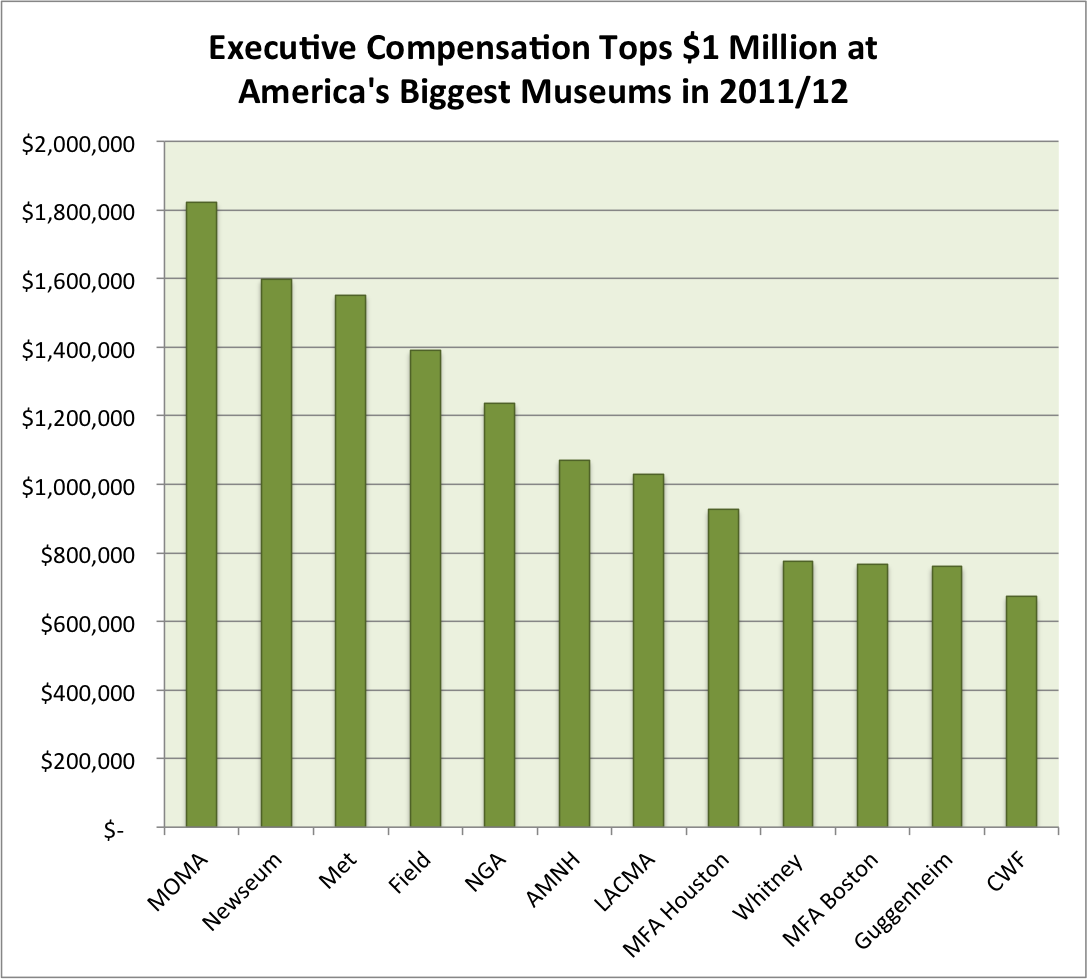
Exec Compensation 2011-12A review of the latest Forms 990 of more than two dozen of America’s biggest museums identified the most highly compensated executives in the field.  Among these museums, annual compensation ranged from $228,000 to $1,822,257 and the average was $727,000.  Seven directors earn more than one million dollars per year, as follows:

Responses to Government Shutdown Vary at Historic Sites and Museums

This slideshow requires JavaScript.

Washington, DC is one of the nation’s museum meccas with nearly 19 million annual visitors so with the partial shutdown of the federal government, tourists are frustrated and confused.  Closed are the most popular destinations such as the Smithsonian Institution, National Gallery of Art, Lincoln Memorial, US Holocaust Memorial Museum, National Archives, and Capitol Visitor Center (tours of the White House ended in March 2013 due to sequestration).  Although it is a federal city, many of its museums and historic sites are privately operated so places such as the Phillips Collection, Corcoran Gallery of Art, President Lincoln’s Cottage, Tudor Place, Woodrow Wilson House, and International Spy Museum, are open as usual.  “National” may be in its name, it doesn’t mean it’s affected by the shutdown, so the National Building Museum, National Geographic Museum, National Museum of Women in the Arts, National Museum of Health and Medicine, and National Museum of American Jewish Military History are open (as is the National Aquarium in Baltimore).  Adding to the confusion are parts of the federal government that remain open (hence its more precise definition as a “partial shutdown”), so historic sites such as the US Supreme Court and Arlington National Cemetery (but not Arlington House), continue to be open to tourists.

Washington DC is definitely a confusing places for tourists at the moment, but it’s also confusing at the Continue reading