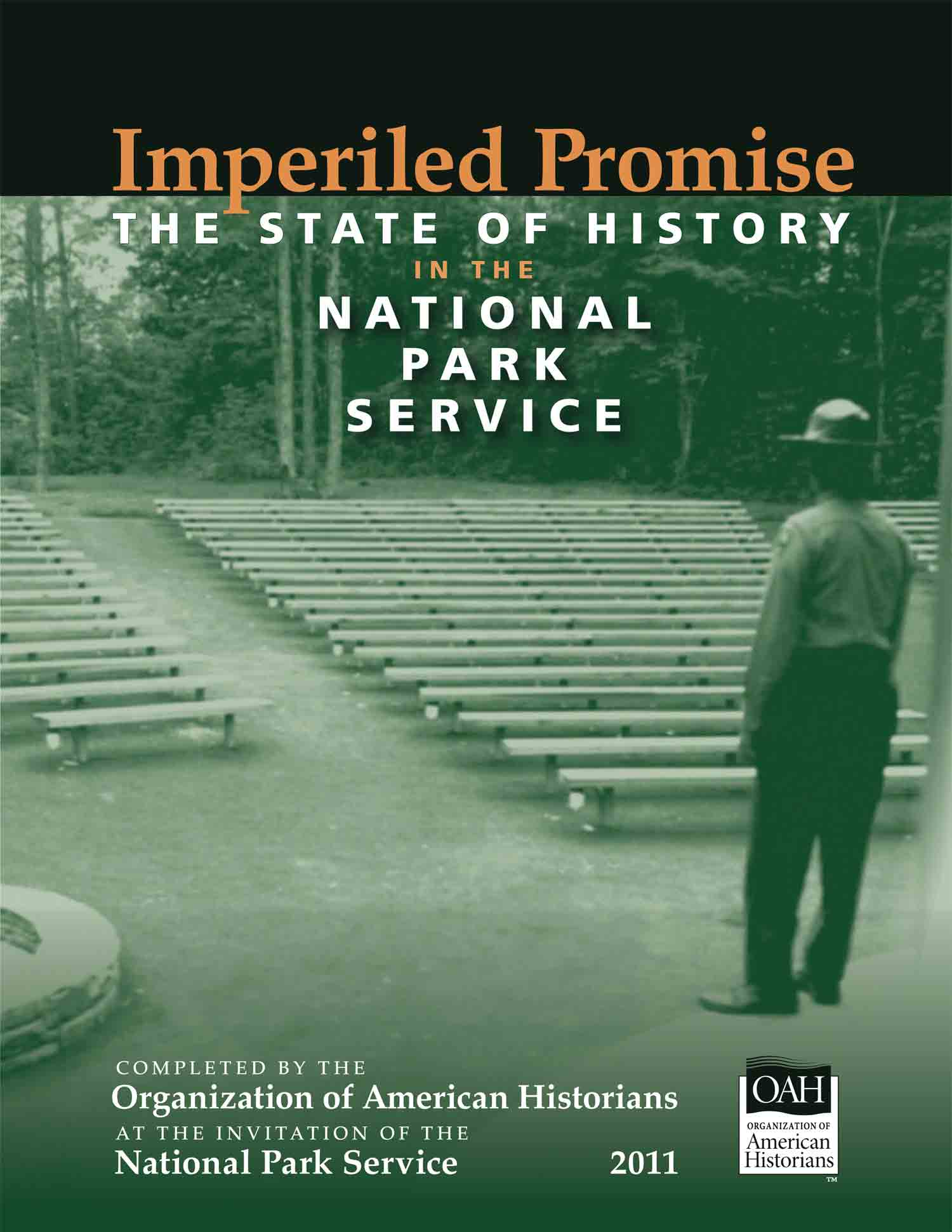
 The Organization of American Historians recently completed an evaluation of the “state of history” at the National Park Service. Four prominent historians–Anne Mitchell Whisnant, Marla Miller, Gary Nash, and David Thelen–led the study, which was based on more than 500 staff responses to an online survey, interviews with current and former staff, site visits, discussions at national meetings, and a review of past studies and reports.
Their analysis revealed that much good work is going on in such areas as reinterpreting slavery and the Civil War, negotiating civic engagement, sharing authority, developing interdisciplinary partnerships, encouraging conversations about history through new media, and collaborating with historians in colleges and universities. These are presented through a dozen profiles of projects at such National Parks as Manzanar, the Olmsted Center for Landscape Preservation, San Antonio Missions, Harpers Ferry, and the Martin Van Buren National Historic Site.
Although they discovered that good work is being done in a few places, it is not “flowering on the whole” due to several intertwined issues. Most significant is the report’s contention that, “the agency as a whole needs to recommit to history as one of its core purposes, and to configure a top-flight program of historical research, preservation, education, and interpretation so as to foster effective and integrated stewardship of historic and cultural resources and places and to encourage robust, place-based visitor engagement with history.” These concerns are presented as a dozen findings, and from my observations, many also reflect what’s happening at historic sites outside of the National Parks. For example:
- The History/Interpretation Divide. The intellectually artificial, yet bureaucratically real, divide between history and interpretation constrains NPS historians, compromises history practice in the agency, and hobbles effective history interpretation. The NPS should find and take every opportunity to reintegrate professional history practice and interpretation. [In museums, this is comparable to the tensions found between curators and educators, where those who conduct research are often separated from those who teach.]
- The Importance of Leadership for History. Without visionary, visible, and respected leadership at the top, and Continue reading →


 Engaging Places