Tag Archives: New England Museum Association

Sustainable Museums in Action: Key Takeaways from the NEMA Conference

This session on the sustainability initiatives at the Rhode Island School of Design Museum was among the first sessions at NEMA 2024.

Last week I attended the New England Museum Association 2024 Conference in Newport, Rhode Island. About 800 museum professionals attended over the three days of sessions, vendor displays, professional affiliation group meetings, and receptions. The weather was sunny and sixties, surprisingly warm for the first week of November. Without the crowds of summer, it made Newport much more pleasant.

The conference offered numerous sessions on sustainability, and I’m attending as many as possible in preparation for my upcoming course, “Creating Sustainable Museums,” at George Washington University this spring.

In the session “Climate Emergency and Sustainability Taskforce at RISD,” several staff members from the Rhode Island School of Design Museum shared insights on their in-house sustainability efforts. What began as informal conversations among a few staff members evolved into a formal task force that resulted in the “Take Care” exhibition. Staff from all areas of the museum—not only curators and educators—selected objects from the collection and created interpretive labels addressing sustainability themes. In addition to this curatorial approach, the museum implemented practical sustainable practices, including standardizing frame sizes, reusing exhibition cases, turning off cameras in virtual meetings, and eliminating admission stickers and vinyl lettering.

Continue reading
Interpreting Christmas Debuts to Enthusiastic Response at AASLH Conference

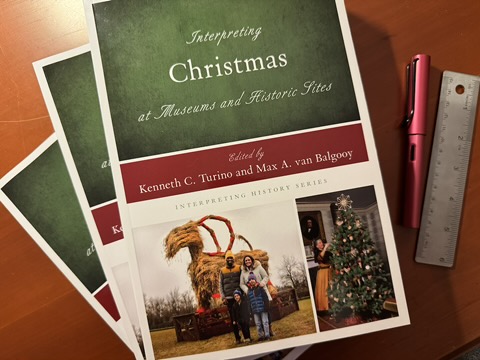
While I was traveling in England over the past few weeks, Interpreting Christmas at Museums and Historic Sites was released in print. The book made its debut at the American Association for State and Local History annual meeting in Alabama, where my co-editor, Ken Turino, was on hand to sign copies. We were thrilled to see the book sell out on the first day of the conference! It’s now listed on Amazon’s Hot New Releases for the “museum industry.” We are incredibly grateful for this positive reception. This project has been years in the making, and Ken and I (and the contributors!) are delighted to finally share this resource with you. A sneak peek at the table of contents and introduction is available.

If you missed out on purchasing a copy at the annual meeting or were unable to attend, you can order it online at Rowman.com or mail this order form. Use code RLFANDF30 at checkout to save 30%. This discount is available through September 2025. The book officially releases on September 20, so it should ship immediately when you order.

For those attending the New England Museum Association annual conference in Newport, Rhode Island, we’ll be presenting a panel discussion on Christmas on Thursday, November 7, from 11:00 am to 12:30 pm. Joining us will be Laurel A. Racine, Supervisory Historian and Program Manager for the National Park Service; Patricia West, recently retired Curator of Martin Van Buren National Historic Site and author of Domesticating History: The Political Origins of America’s House Museums; and David Rau, Curator of Visitor Engagement at the Florence Griswold Museum.

If you’ve had a chance to read Interpreting Christmas, we’d greatly appreciate a review on Amazon.com. Since history museums and historic sites are such a specialized field, your feedback can help others make more informed purchasing decisions.

Amazon’s Hot New Releases for the “museum industry for September 2024.

Should Local History and Historic Preservation Dominate the Museum Field?

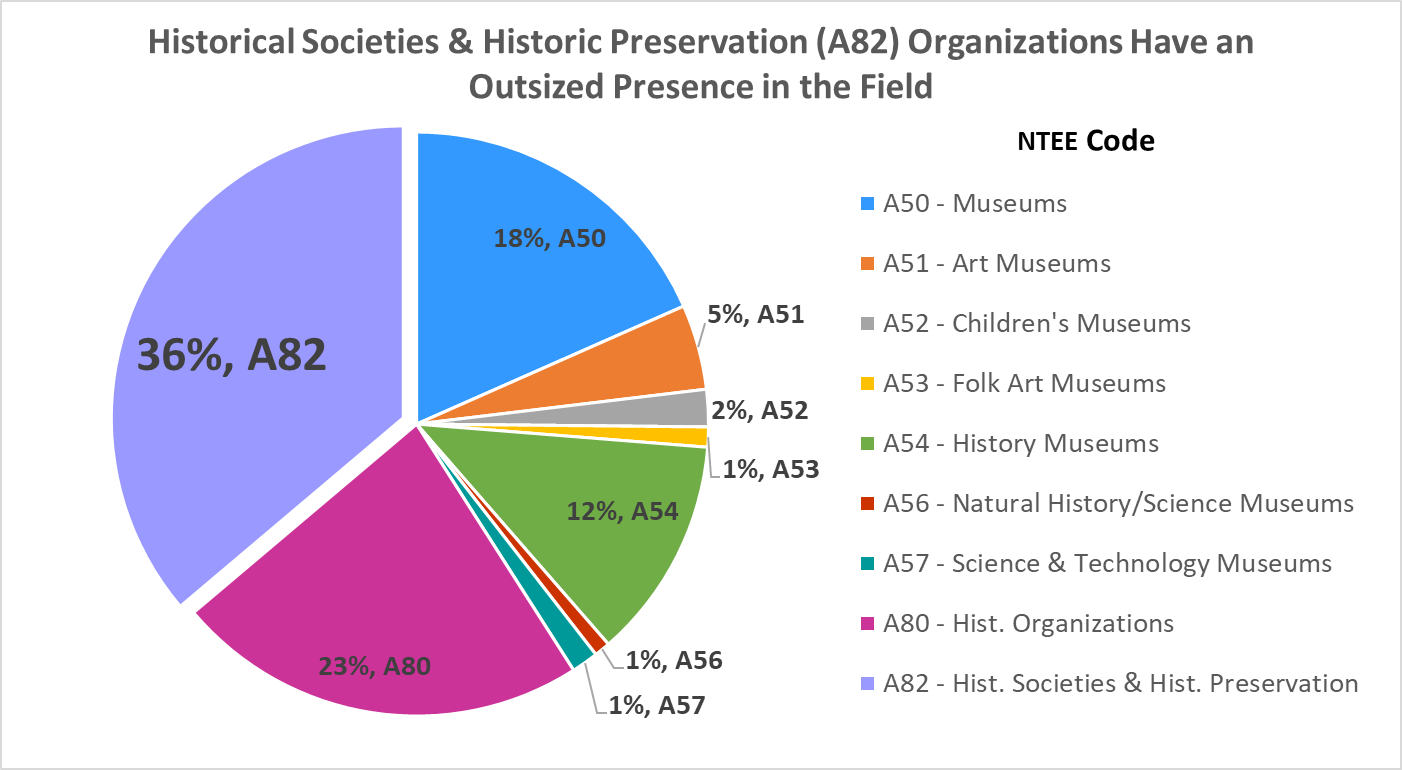
Figure 1. Historical Societies & Historic Preservation (A82) organizations have an outsized presence in the field. Source: Internal Revenue Service and National Center for Charitable Statistics.

Of all the organizations in the United States devoted to arts, culture, and humanities, Historical Societies & Historic Preservation (NTEE A82) organizations have an outsized presence.   More than a third of all organizations “sponsor activities which celebrate, memorialize and sometimes recreate important events in history such as battles, treaties, speeches, centennials, independence days, catastrophes that had an important impact or other similar occasions.” “Historical society,” “historical association,” “heritage society,” “preservation,” and “restoration” are in the name of nearly 80 percent of institutions in this category.  They are also focused on local history—only one in twenty institutions appear to have a geographic scope larger than the county level.

While preserving and interpreting local history is their primary interest, these organizations are the smallest by revenue.  More than 90 percent operate with less than $1 million in revenue annually and have a median revenue near $64,000 (yes, the median is $64,000 annually for all A82 organizations for 2011-2017—half of these organizations operate with less than this amount).  Only Historical Organizations (A80) produce similar financials, albeit with slightly higher figures.

Continue reading

A Mixed Prognosis for Regional Museum Associations

In the United States, museums are served by six regional museum associations that are associated (allied?) with the American Alliance of Museums (AAM):

While AAM is doing well with about $10 million in annual revenues and net assets of $2 million, the regional museum associations are much much smaller by comparison. Their annual revenues range from $70,000 to $600,000, which is 1-7% of AAM’s annual revenues (see Figure 1).

Figure 1. Chart of revenues for regional museum associations in the US, FY 2014-16.

That might be acceptable given these associations serve a few states rather than all 50, but a further analysis of their financial condition in fiscal years 2014-2016 suggests that their health is decidedly mixed: Continue reading

Reinventing the House Museum in Portsmouth

This slideshow requires JavaScript.

A sold-out crowd of history enthusiasts packed the auditorium at the Strawbery Banke Museum in Portsmouth, New Hampshire on April 21 to discuss ways to reinvent the house museum.  Sponsored by the American Association for State and Local History and the New England Museum Association, the one-day workshop explored ways that historic house museums can more successfully engage their community and improve their financial sustainability.

The morning featured several presentations and the afternoon was a hands-on workshop at a nearby historic house.  I opened the day with a process for developing a plan and then focused on Michael Porter’s Five Forces, a diagnostic tool that’s superior to SWOT for assessing a house museum’s strategic position.   Ken Turino of Historic New England provided a smorgasbord of ideas from house museums around the county to rethink existing conceptions.  Larry Yerdon, CEO of the Strawbery Banke Museum, discussed ways they are introducing new programs and activities to be both more engaging and financially sustainable.

After lunch, we gathered at the Governor John Langdon House, a property of Historic New England, where Joanne Flaherty and Linda Marshall led us on a quick inspection of the property and described its operations and recent efforts to use it for temporary exhibits.  Then the audience became temporary consultants using the Five Forces, analyzing existing and potential competition for exhibits, interests from visitors, and collaborating with exhibit providers.  The consensus seemed to be that an exhibit program could have a competitive advantage if it focused on the collections of Historic New England and may be better suited for rooms other than the parlor or dining room, which are architecturally significant.

This workshop will travel next to Atlanta, Georgia on June 12, where we’ll be using the Margaret Mitchell House as the case study.  To register and for more information, visit AASLH.org.


Resources for Historic Sites from the American Alliance of Museums

The American Alliance of Museums (formerly known as the American Association of Museums) is offering several resources and workshops that may be interest to historic sites, including:

TrendsWatch 2013: Upcoming Town Hall
This year’s edition of TrendsWatch, the annual report on key social, economic, technological and other trends that are shaping the future of museums, will be released next month.  You can also learn about it at the Alliance’s Web-based Town Hall on March 27 at 2 pm ET, which will be hosted by their Center for the Future of Museums.  Registration is free for Alliance members, and will open soon.  Meanwhile, read (or re-read) TrendsWatch 2012 for a taste of the future.

2012 National Comparative Museum Salary Study Available
A national salary study has long been a top request from Alliance members. Demonstrating that we’re stronger together, the 2012 study was prepared in collaboration with the Association of Midwest Museums (AMM), the Mountain-Plains Museums Association (MPMA), the New England Museum Association (NEMA) and the Southeastern Museums Conference (SEMC) and based on surveys conducted in their regions. Together, these associations represent 36 states, 64 percent of the American population and approximately two-thirds of all museums in the United States. Available free to Continue reading