Author Archives: Max van Balgooy

Unknown's avatar

About Max van Balgooy

President of Engaging Places LLC, a design and strategy firm that connects people to historic places.

Building Capacity with a Virtual Receptionist

One of the big challenges for small and medium-sized nonprofit organizations is building capacity. Staff salaries and wages are usually the largest expense and it’s hard to grow without a serious long-term hit to your budget. As a result, work tends to pile on the same people and threatening burnout. Thanks to the expansion of online technologies and the freelance economy there may be ways to build capacity as you need it.

I’m a big fan of Mac Power Users, a podcast that focuses on the hardware, software, and workflows that can make your business more productive. I’ve adopted their recommendations to use Evernote and the Fujitsu ScanSnap iX500 scanner with great success during the past few years. Although the podcast focuses Apple computers and applications, they can often be applied to other situations. For example, recent episode number 389 “The Mac-based Small Business” describes “virtual receptionists,” Continue reading

Greetings from New Orleans: SEMC

IMG_0984 copyI’m in back-to-back conferences—AASLH last week, SEMC this week—because I’m moderating sessions at both.  The Southeastern Museums Conference is in New Orleans, which is enjoying incredibly beautiful weather, making it easy to wander the streets to find the many museums that are in walking distance.  In the two days I’ve been here so far, I’ve visited the Southern Food and Wine Museum (which includes the Museum of the American Cocktail) and Historic New Orleans Collection, taken a guided tour of St. Louis Cemetery #1, and tonight I’ll be at the evening reception at the National World War II Museum.  New Orleans has some unusual museums tackling such unusual topics as tattoos, Mardi Gras, and death but I’m not sure I’ll have time to visit them as well.  Over the next few weeks, I’ll share what I’ve learned from the sessions that stood out for me but in the meantime, I’ll post my notes and observations on Twitter during the conference using #SEMC17.

Greetings from Austin: AASLH Annual Meeting

George McDaniel, Sandra Smith, and me at dinner at the LBJ Library.

This week I’m at the AASLH Annual Meeting in Austin, Texas where both the weather and friendships are warm.  We’re about halfway through the conference and I’ll have further postings about specific topics and sessions soon, but for now I wanted to share a few photos from my experiences at a couple workshops, a session I moderated on community engagement (also presented later as a webinar), the exhibit hall, dinner at the LBJ Presidential Library and the Briscoe Center on American History, and a reception for the Seminar for Historical Administration.


Analyzing Visitor Engagement Through Mapping

The July/August 2017 issue of Museum, the magazine of the American Alliance of Museums, features articles on engaging families, veterans, and LGBTQ audiences and my general article, “A Visitor’s Perspective on Visitor Engagement”. It introduces three major factors that influence visitor engagement at museums: convenience, novelty, and values. I had a limited space so I’d like to share a bit more information about the influence of convenience, the idea that the more convenient it is to visit a museum, the more likely that people will visit. It’s not just about living close by but also other effects, such as traffic, roadway patterns, museum hours of operation, finding a place to park, and ease of purchasing tickets. Nevertheless, distance is a major factor and you can see it through mapping.
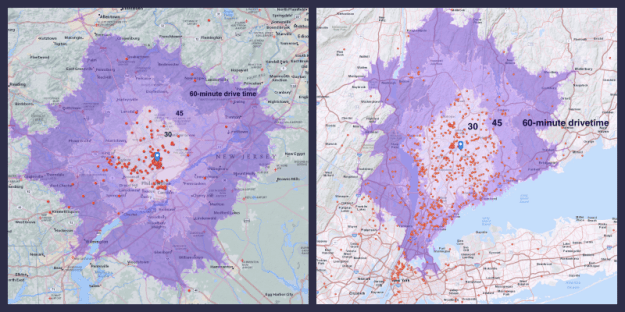
In my article I referenced a couple of my clients—Cliveden (Philadelphia) and Caramoor (Katonah, New York)—and described the differences in their program participants or supporters.  Below I’m showing these differences through maps created in ArcGIS. Each red dot represents a household and for Cliveden, the map shows that the majority of their supporters live within a 30-minute drive of the site. For Caramoor, the map shows that the majority also live within 30 minutes but there is a significant number who live within 45 minutes to the south (and very few to the north). As you can see, the distance of the audience varies (in other words, the meaning of “convenience” varies). Every place is different and you have to analyze your own data to fully understand it.  As I mention in my article, convenience is also affected by novelty and values, which might explain the clustering.

Drive times from Cliveden (left) and Caramoor (right) are shown in graduated drivetimes of 30, 45, and 60 minutes.

This type of mapping also pokes a big hole in one of the most common refrains I hear at museums: “we get visitors from every state in the nation.” Unless that’s your engagement goal, it’s a nonsensical recognition of success. First of all, it’s more likely that a site’s visitors are local, not national, so they’re overlooking the obvious audience for repeat visitation and support. By mapping your visitors and supporters, you can make better decisions about promotion, programming, and fundraising. Secondly, this statement creates a false sense of success. It’s been said numerous times that attendance shouldn’t be the only measure of success and yet it often is. More important is the impact that the history of your site has had on the people who visit. If the significance of your site is insignificant to the people who visit, perhaps it’s time to rethink your purpose and goals.

Fort Vancouver Has a Great Visitor Map (and a Lousy One, Too)

The simplest things impress me when I visit historic sites, like a good visitor map.  They’re hard to find so when I spot one, I’m thrilled.
I recently visited Fort Vancouver National Site in Vancouver, Washington, across the Columbia River from Portland, Oregon. In the Visitor Center, they provide a visitor map printed on 11 x 17″ paper that’s gathered in pads of 50 sheets. I’ve always loved these tear-off maps because they’re always neat and generously sized, and in this particular case, also well designed. Even though it’s simply printed with black ink on white paper, the designer carefully used tinting, serif and sans serif faces in different sizes, varied line weights, and symbols to help visitors easily find their way around this very large site. Most important, information that is not important to visitors is omitted. On the back side are Continue reading

Update: Standards for the Treatment of Historic Properties

The National Park Service has issued an updated version of the Secretary of the Interior’s Standards for the Treatment of Historic Properties with Guidelines for Preserving, Rehabilitating, Restoring, and Reconstructing Historic Buildings (whew!).  Last revised in 1992, it was recently updated as part of NPS’s “A Call to Action: Preparing for a Second Century of Stewardship and Engagement”.
The revised standards more fully develop topics in the previous editions, address the treatment of buildings of the last half of the twentieth century (which introduced new materials and systems, such as composites and curtain walls), include building code-required work, and eliminated energy efficiency (which is now addressed in 2011 in the Guidelines on Sustainability for Rehabilitating Historic Buildings).  The Standards provide guidance for the maintenance, care, or remodeling that might occur through an illustrated set of recommended or discouraged practices easily understood by architects, contractors, staff, and board members. A big thanks to NPS and Anne Grimmer for providing these new guidelines.  They’re free online and every house museum in America should adopt these Standards to help preserve and maintain their buildings and structures.

The Standards are designed to guide work on buildings listed on the National Register of Historic Places, but I’ve used them Continue reading

Low Tech Interactives at Boston’s Old State House

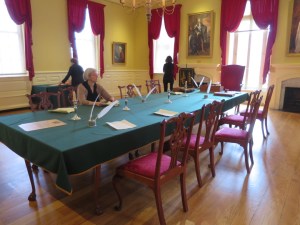
1760s Council Chamber in the Old State House in Boston. If the woman at the table looks familiar, it’s Dr. Jane Kamensky, professor of history and Pforzheimer Director of the Schlesinger Library at Harvard University.

The Old State House in Boston reconstructed its eighteenth century Council chamber several years ago but only recently was I able to visit as part of an advisory meeting.

The Council Chamber appears to be a typical period room from the 1760s, except that it’s actually an exhibition that requires visitors to get involved. When they sit at the Council table (yup, on those beautiful chairs), they need to handle the objects to discover the interpretive elements hidden inside.
It’s designed to provoke surprise and causes visitors, even teenagers, to look more closely.  Although the restoration of the room was expensive, the techniques used are not and can easily be adapted by others who want to create an interactive hands-on activity.

Here are several before-and-after images so you can see Continue reading

Engaging Programs = Engaging Communities?

Engaging_ProgramsEducators and interpreters are increasingly expected to engage the community to build support, attract audiences, and confront contemporary issues. So how do you get started? What does an effective community engagement project look like? How do you maintain it?

On Thursday, September 7, 11:00 am – 12:15 pm at the AASLH Annual Meeting in Austin, I’ll be moderating a session that will bring together three projects—Haymarket Project in Boston, James Madison’s Montpelier in Virginia, and El Pueblo History Museum in Colorado—to discover how they successfully engaged three different audiences in the local community—immigrants, African American descendants, and Latina teenage girls.  Joining me will be Ken Turino (Historic New England), Christian Cotz (James Madison’s Montpelier), and Dawn DiPrince (History Colorado).  Based on their experiences and with contributions from the audience, we will Continue reading

Engaging Places is Expanding its Vision

GWU-or-SHA.jpgThis year has been incredibly busy for me, so much so that I’ve been unable to share many of the ideas that I’ve discovered in my travels to historic sites across America through this blog. Along with my active consulting practice, I’ve recently agreed to become the director of Developing History Leaders @SHA and an assistant professor in the Museum Studies Program at George Washington University (GWU).  Both positions were announced at the same time at the beginning of the year and because they were both attractive opportunities, I applied for both, thinking it was like submitting an application to IMLS and NEH and assuming only one or none would be funded.  I hit the jackpot when both came my way and I’m thrilled about the opportunities.  I’m already at work with SHA in November and teaching at GWU starting in January 2018.

As my friends and colleagues learn about this big change in my career, Continue reading

Be the Early Bird to Catch a Deal on AASLH’s Annual Meeting

Friday, July 21 is the deadline to catch the early registration price of $328 ($253 for members); it jumps to $393 the next day.  AASLH offers the widest variety of sessions and workshops for house museums and historic sites at a national level and attracts some of the best minds in the field.  This year, the annual meeting will be held in Austin, Texas from September 6-9 and include:

  • Awaken the Historic House: A Fresh Look at the Traditional Model, an afternoon workshop led by Brett Lobello of Brucemore.
  • Current Issues Forum: What Role Should Historic Sites Play in Teacher Professional Development? moderated by Sarah Jencks at the Ford’s Theatre Society.
  • Engaging Programs = Engaging Communities?, a session I’ll be moderating on different ways to engage more effectively with your local community.
  • Preserving and Interpreting Contested Histories of Missions and Missionaries moderated by Barbara Franco, an independent scholar.
  • Historic Preservation Never Ends: Practical Maintenance for Your Historic Buildings moderated by Evelyn Montgomery of the Dallas Heritage Village.
  • From Millstone to Crown Jewel: Revitalization and Transition of a “Tired” Site moderated by Mike Follin of Ohio History Connection.
  • Parks and Prejudice: The Legacy of Segregation and State Parks moderated by Cynthia Brandimarte of Texas State Parks.
  • The Great Debate: Engaging Audiences vs. Protecting Dollhouses moderated by Brandie Ragghianti of the Charlotte Hawkins Brown Museum.
  • Lessons Learned: The Legal, Ethical, and Practical Issues Involved in Finding a New Steward for Upsala moderated by Carrie Villar of the National Trust for Historic Preservation.
  • Open the Door! Approaches to Interpreting Historic Landscapes moderated by Sean Sawyer of the Olana Partnership.
  • Historic House Museum Affinity Group Breakfast featuring Ken Turino of Historic New England.
  • Bucking the Trend: Energizing Historic Homes in Central Texas moderated by Oliver Franklin at the Elisabet Ney Museum.

Of course, these are just a small part of the 85 sessions, keynote presentations, field trips, evening events, and an exhibit hall happening over a few days in Austin.  There’s usually much much more available than you’ll ever have time to do and I’m often torn between 2-3 sessions at the same time.

To register or for more information, visit go.aaslh.org/AMreg.  Although registration fees for this national conference are very reasonable, especially at the early registration rate, AASLH offers several scholarships to reduce expenses (although their application deadlines have already passed).  If you can’t attend, there’s also an online version where you can hear six sessions that are especially presented as webinars, including my session on Engaging Programs = Engaging Communities? (they’re not simply a broadcast of the conference session).  They’ll be available for six months and can be viewed as many times as you like at rates starting at $60.