Author Archives: Max van Balgooy

Unknown's avatar

About Max van Balgooy

President of Engaging Places LLC, a design and strategy firm that connects people to historic places.

Creating a 21st Century House Museum in San Francisco

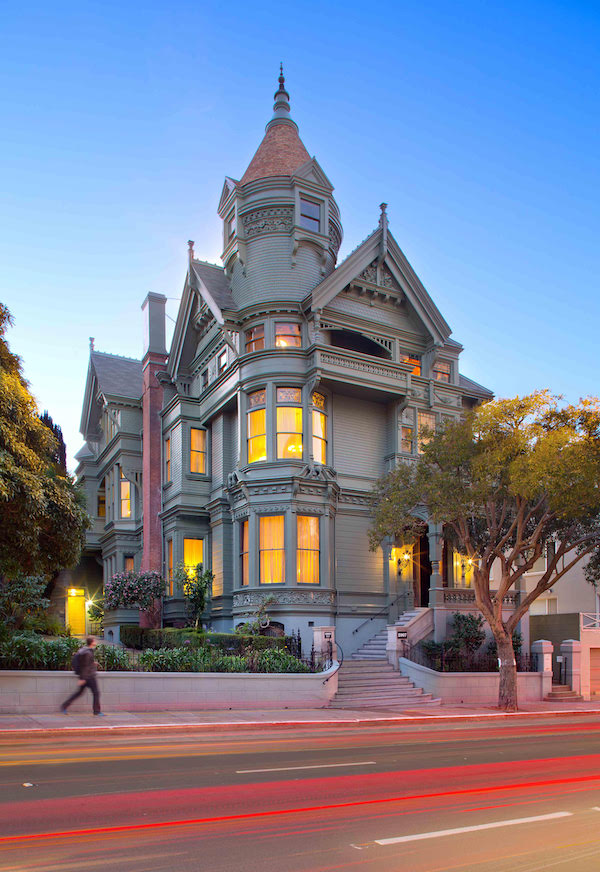
Haas-Lilienthal House, San Francisco.

Haas-Lilienthal House, San Francisco. Courtesy of San Francisco Heritage.

Over the past two years, I’ve been working with San Francisco Heritage to explore how the Haas-Lilienthal House, the 1887 Queen Anne house it owns and operates in the Pacific Heights neighborhood, can engage the public and advance its citywide mission in ways that are both environmentally and financially sustainable.

Just as the Haas-Lilienthal House was rocked by a tremendous earthquake in 1906, so are historic sites today, although in a different manner. The economic downturn that began in 2008 threatens many preservation organizations, house museums, and historic sites, even those that have large endowments and attendance. But the change is bigger than the latest economic recession. Surveys over the past thirty years by the National Endowment for the Arts show that visitation rates at historic sites have fallen from 37 percent in 1982 to 25 percent in 2008, and that rate of decline has only accelerated in the last decade. The Haas-Lilienthal House is experiencing a long and steady decline in attendance—it’s fallen by more than 50 percent over the past thirty years. Historic sites not alone, however: concerts, dance performances, craft fairs, and sporting events have all seen similar declines in attendance.

As a result, many historic preservation organizations around the country are questioning the value of owning historic property. Guided tours and public programs do not generate sufficient revenue to properly maintain historic sites, so unloading them seems to be the only solution. But there are also significant disadvantages.

When a preservation organization owns an historic building, it instantly conveys credibility. (Would you trust a surgeon who has never held a scalpel?) Secondly, by owning and caring for an historic property, Continue reading

Unconference in DC Poised to Transform Museums


Openlab is convening an unconference, talks, and a planning workshop in Washington, DC on December 1-2 to “to accelerate the speed and impact of transformational change in the GLAM (gallery, library, archive, and museum) sector” in order to “to increase and disseminate knowledge; to encourage civic dialogue and engagement; and to support individuals in their right to access and participate in culture.”  The brain child of Michael Peter Edson of the Smithsonian, much of OpenLab’s work seems to be focused on using digital technologies to solve age-old questions, such as “what needs to change in galleries, libraries, archives, and museums?” and “what is missing in the current funding and support landscape for GLAMs and the humanities?”  It’s all a bit nebulous and unclear, but that’s the core nature of an unconference. Nevertheless, it’s one of many concurrent efforts to increase the impact of museums in society (and yes, we’re still in the fragmented stage).

The first day on December 1 (today) is the unconference and a series of Ignite talks from 2-7 pm in Arlington, Virginia that’s free and open to the public.  The second day, however, Continue reading

President Lincoln’s Cottage Tackles Immigration

This slideshow requires JavaScript.

President Lincoln’s Cottage, the presidential summer retreat just a few miles north of the US Capitol, recently opened an exhibit in their visitor education center the compares immigration issues in the 19th century to the present day.  Titled, “American by Belief,” the introductory label reads:

The United States of America is, and always has been, a nation of immigrants. Abraham Lincoln recognized immigrants as one of America’s greatest resources and its best hope for the future. He believed America, in return, owed immigrants the full realization of its founding promises and a fair chance to succeed.

Our world is different than Lincoln’s. But what continues to bring immigrants here would look familiar to him: an opportunity to rise higher, improve themselves, live safely under the rule of law, become citizens, and count themselves as American by right of belief.

This is a small temporary exhibit, perhaps 200 square feet at most, and primarily consists of panels featuring text and images (no historic objects).  In the center of the room is a map of the world made of pegs, which visitors can use to link places associated with them using colored rubber bands (this looks cool but I’m not sure Continue reading

Taliesin West releases Preservation Master Plan

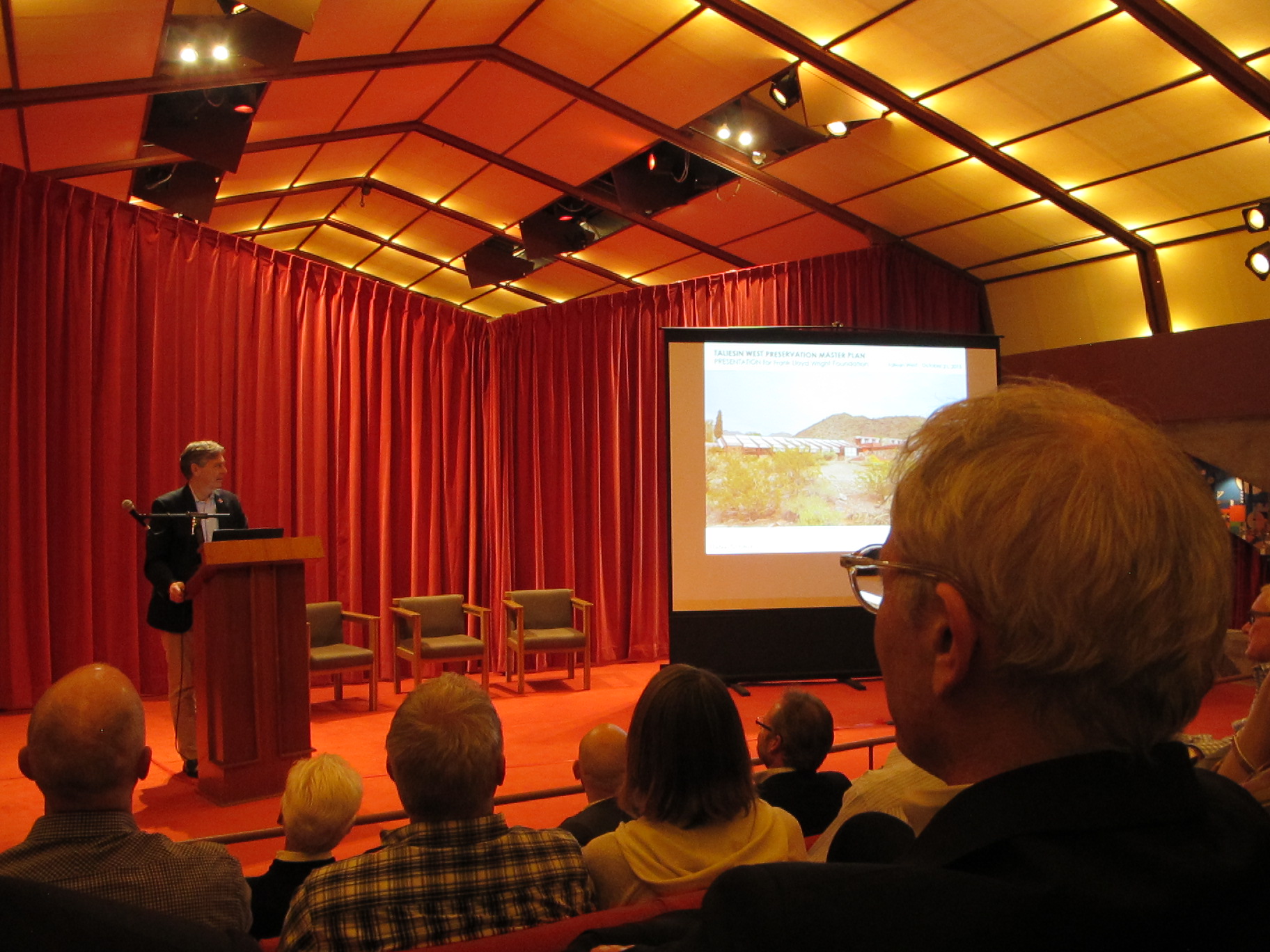
Gunny Harboe discussing the Preservation Master Plan for Taliesin West.

Gunny Harboe discussing the Preservation Master Plan for Taliesin West.

The Frank Lloyd Wright Foundation recently released the Preservation Master Plan for Taliesin West, a National Historic Landmark, which was established in 1937 as Frank Lloyd Wright’s winter home and studio, and the campus of the Frank Lloyd Wright School of Architecture. As part of the Bruce Brooks Pfeiffer lecture series, T. Gunny Harboe, preservation architect and founder of Chicago-based Harboe Architects, and the plan’s primary author, will present the major points of the Taliesin West plan on Monday, November 16 at 6:30 p.m. at the Museum of Modern Art in New York City.  The lecture is free and reservations are not required.

I had an opportunity to use with the Preservation Master Plan as part of the interpretive planning work I’m doing at Taliesin West and it was immensely helpful in clarifying the significance and integrity of the many buildings at the site through a set of tiered levels: Continue reading

AASLH Annual Meeting Provokes Historical Thinking

Tim Grove facilitating a lively conversation about historical thinking at the AASLH Annual Meeting in 2015.

Tim Grove facilitating a lively conversation about historical thinking at the AASLH Annual Meeting in 2015.

The annual meeting of the American Association for State and Local History always offers a good mix of educational sessions, social events, and opportunities to visit museums and historic sites around the country.  This year, Sam Wineburg, a Stanford University professor and author of Historical Thinking and Other Unnatural Acts (2001), prompted an ongoing discussion with his plenary address on the first day of the annual meeting.  Through his research on students and scholars, he showed that the analysis of historical documents is a sophisticated skill that isn’t apparent to most people (and I can confidently say this also applies to objects, buildings, and landscapes).  He went on to argue that teaching people to think historically isn’t about teaching history but making them better citizens.  John Dichtl, president of AASLH, discusses this further on the AASLH blog.

These ideas were pursued the next day at a packed session facilitated by Tim Grove of the National Air and Space Museum.  Using excerpts from Wineburg’s book, Tim encouraged a lively dialogue that allowed me to report out 15 Tweets, including:

  • Historical thinking: multiple perspectives; analysis of sources; context; and based on evidence.
  • Are we underestimating visitors if we don’t give them oppty to debate ideas & issues at museums/historic sites?
  • Debates always happen, but history gets flattened over time. Build multiple perspectives, uncertainty, & questions into exhibits.
  • Asking good provocative questions is a skill. Learn more at the Right Question Institute.
  • Challenge for marketing & communications staff about handling provocative topics in social media era.
  • Are museums & sites imposing their ideology on visitors? Have we become arrogant? Do we need to learn about visitor interests?

which resulted in 31 favorites and 20 retweets.  Just to be clear, these ideas didn’t come from me but from the persons gathered in the room.  I could have tweeted out many more but I couldn’t listen and type them out quickly at the same time.

If you weren’t able to attend, there’s next year in Detroit.  In the meantime, enjoy these snaps from the recent meeting in Louisville (and thanks to everyone at the Kentucky Historical Society for being such gracious hosts).

This slideshow requires JavaScript.

Designing Donor Recognition at Historic Sites

Plaque recognizing James Baxter, donor of the Portland Public Library, 1888.

Plaque recognizing James Baxter, donor of land and building of the Portland (Maine) Public Library, as well as the architect F. H. Fassett, 1888.

Major donors or supporters of a historic site are often recognized with a panel or plaque. Most traditional is a panel listing names of donors, often distinguished by the size of their gift, but it can often appear to be more like a somber memorial than a sincere and thoughtful appreciation. That’s the major reason for avoiding off-the-shelf recognition systems of wall plaques and engraved bricks, which have become so common they’ve lost their punch. For historic sites, this is especially important because they should be integrated and complementary to its design and significance, not merely plopped into place as an afterthought.

Donor recognition is typically installed near an entrance (either interior or exterior) so it can be readily seen by visitors on a wall, floor, or freestanding panel; made of durable materials that resist vandalism and years of cleaning; and can be easily corrected or updated in the future. Careful planning and consideration of alternatives will reveal methods that are most appropriate for your organization.

The Secretary of the Interior’s Standards for the Treatment of Historic Properties can guide decisions about Continue reading

Video: Avoiding Employee Theft

In this 2:22 video, this video by The Hartford, Gene Marks has two suggestions for reducing embezzlement and employee theft (yup, it happens at museums and historic sites).  When he discusses “inventory,” think “collections.”  And be sure that your staff takes vacations.

You’ll find more details at Five Signs Your Employees Are Tampering with Your Accounts.

Stanford Offers Webinars on Non-profit Management

Stanford Social Innovation Review Fall_2015Everyone knows that Harvard University has the Harvard Business Review, but did you know that on the opposite coast, Stanford University has an equivalent for non-profit organizations called the Stanford Social Innovation Review?  Both have been useful to me because along with the magazine, they offer webinars led by authors of their articles or who are leaders in the field.  Here are a couple coming up from the Stanford Social Innovation Review that you might find useful for your museum or historic site:

Overcoming the Overhead Myth

Presented by Jacob Harold, Ann Goggins Gregory, & Jan Masaoka
September 2, 11 a.m. – 12 noon PDT / 2 – 3 p.m. EDT

A dangerous myth prevails among funders that overhead can be used as a proxy for efficiency. In fact, research shows that under-investing in administrative overhead is often linked with poor performance by nonprofits. Ann Goggins Gregory and Don Howard dubbed this process “the nonprofit starvation cycle” in the eponymous Stanford Social Innovation Review article. In this webinar you will learn:

  • Why the nonprofit starvation cycle exists in the sector
  • How organizations that invested in administration subsequently improved their programmatic work
  • Strategies for explaining to funders the importance of overhead costs for future success
  • Tips for evaluating whether grantees are skimping on crucial investment areas in their budgeting

Price: $49, which includes access to the live webinar; unlimited access to the webinar as many times as you’d like for twelve months; and downloadable slides. Learn more about this webinar and register here.

Valuing Frontline Work

Presented by Lehn Benjamin, Katya Fels Smyth, Maria Peña, & Jesús Gerena
September 23, 11 a.m. – 12 noon PDT / 2 – 3 p.m. EDT

An increasing focus in the social sector on performance-driven frameworks can make it difficult for direct-service organizations to measure their impact. Some nonprofits are using creative strategies to measure and communicate their work’s value to funders. This webinar will:

  • Explain how some of the most popular performance models used in the nonprofit sector fail to measure the true impact of what nonprofit professionals do
  • Examine the reasons why it can be so difficult—yet so important—to recognize the value that on-the-ground work delivers to beneficiaries and their communities
  • Explore examples of nonprofits that have succeeded in capturing and conveying the full value of frontline work

Price: $49, which includes access to the live webinar; unlimited access to the webinar as many times as you’d like for twelve months; and downloadable slides. Learn more about this webinar and register here.

National Archives Should Allow Photography in Exhibits IMHO

No photography allowed in the exhibits at the National Archives?

No photography allowed in the exhibits at the National Archives?

Last weekend I went to see “Spirited Republic,” a temporary exhibit at the National Archives about the history of alcohol in the United States.  I’m interested in the history of food and knew the Archives would dig up some interesting materials. It was a worthwhile visit but ugh, right at the entrance is a sign declaring “no photography.”  This isn’t unusual for temporary exhibits because they may contain materials that are protected by copyright or have objects on loan.  In this exhibit, however, everything was drawn from the collections of the Archives or had fallen out of copyright.  If I went around the building to the Research Room, I could retrieve any of the items on display and make photographs without question.  Secondly, most of the items are historic governmental or administrative documents, which don’t encourage selfies or other distractions.  Photographs would most likely be taken by people who were really interested in the subject and wanted an image for reference.  If they’re worried about light damage, people can be warned not to take flash photos (and studies by conservators show that flash photography has to reach excessive levels to cause significant damage, so this is usually an unfounded concern).  If they’re worried about security, everyone has already been screened in the usual DC way and guards are posted throughout the exhibit.  Finally, photography is one of the only areas of creative activity that’s growing in the US (bucking the declines in sewing, painting, pottery, or music according to studies by the National Endowment for the Arts) and the Archives has a rich trove of content for inspiration (and it helps publicize their exhibits and collections). The “no photography” makes absolutely no sense at the National Archives.  Instead, the National Archives should assume that  photography will be allowed unless there are specific and legitimate reasons not to do so.  Just follow the same rules as in your Research Rooms.

Prohibitions on photography isn’t the only stumbling block to public access and historical interpretation at the National Archives–I’m sensing a growing use of Continue reading

International Museum Management Conference Coming to US

Screen Shot 2015-07-31 at 10.56.44 AM The International Committee of Museum Management (InterCom) of the the International Council of Museums (ICOM) with be holding its annual meeting in Washington, DC from October 28-31, 2015, the first time it has held its meeting in the United States. InterCom works toward the development of sound museum management throughout the world, including the managerial aspects of policy formulation, legislation, and resource management.  Registration is $350 ($150 for students) and early bird registration for $295 ends today (July 31).

This year’s conference focuses on three themes–The Sustainable Leader, The Enduring
Organization, and the Essential Museum–and plenary speakers include Lonnie Bunch, Founding Director, Smithsonian National Museum of African American History and CultureElaine Heumann Gurian, author and museum consultant; and Richard C. Harwood, Harwood Institute for Public Innovation. Sessions involve diverse topics from around the world and several caught my eye. I wonder what someone from Columbia has to say about museums as tourist attractions; how violence or civil unrest are affecting museums in Mexico, Denmark, and Minnesota (Minnesota??); or how the Research Center for Anatolian Civilizations in Turkey tackles the value of history and heritage in the contemporary world (how do you make thousands of years of history relevant?).

I’ll be there to expand my horizons and reporting out when I get a chance. It also looks like we’ll be having special tours of several museums in DC (it’s the behind-the-scenes experience at museums that lured me into this field) so that will be great fun. Hope to see you there!