Author Archives: Max van Balgooy

Unknown's avatar

About Max van Balgooy

President of Engaging Places LLC, a design and strategy firm that connects people to historic places.

Video: History Summer Camp in China

This 4:49 video is titled, “Dailian History Summer Camp” but I can’t figure out what’s going on.  The music is bubbly but the scenes make no sense:  children playing basketball in kimonos, performances of Korean traditional music, song and dance numbers, jumping rope, and a visit to a historic POW camp (including weapons and torture devices).  I can’t even figure out if the titles are written in Chinese, Japanese, or Korean, but it looks like they’re have a good time (the opening titling is a bit long, so you might want to skip to 0:30).      Can anyone translate this and share what’s going on?  Thank you all.

A Clever Model of Engagement for Your Desk or Office

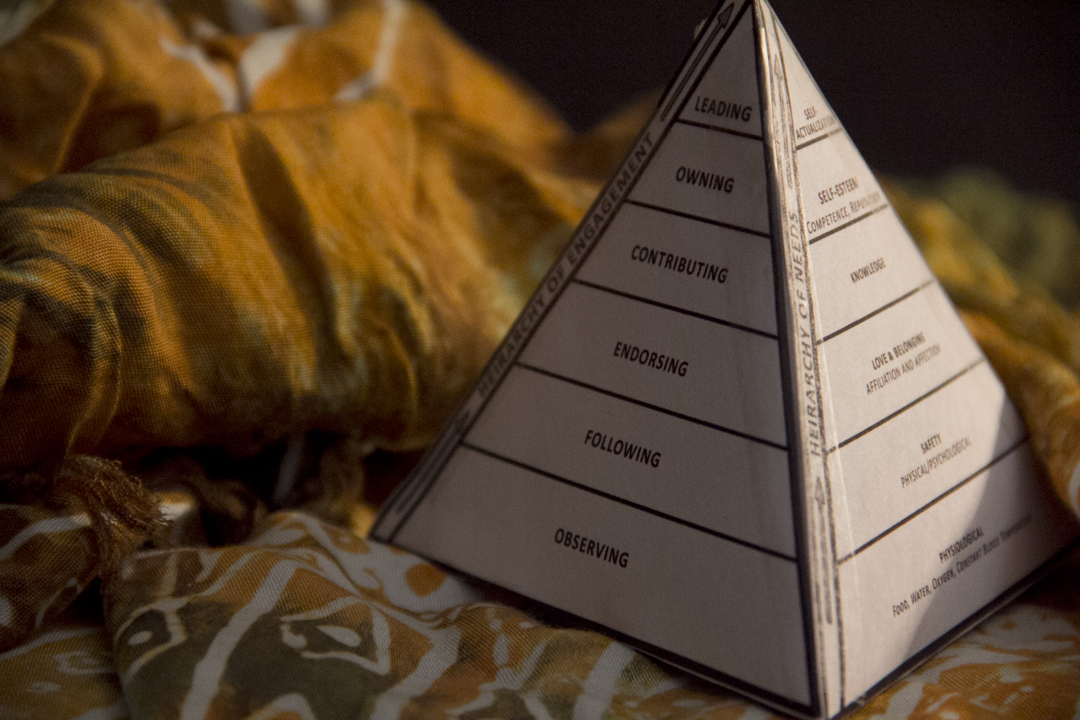
Travis Kirspel's Engagement PyramidI’ve been working on a strategic plan for the Division of Historical and Cultural Affairs for the State of Delaware for the past few months and after a recent meeting, I stopped by the office of Travis Kirspel, one of the planning team members and the Curator of Digital Assets.  A set of geometric solids in his bookcase caught my eye–I associate them with early science and cabinets of curiosity–and it turns out he created them.  He’s interested in community engagement, so he used his skills as a graduate of the Savannah College of Art and Design to develop a clever model that pulls together various theories into one object.  He graciously provided more details, as well as the blueprints so you can create a pyramid for your desk or office.

The Pyramid of Engagement:  A Psychological Model for Building Community Relationships by Travis Kirspel

It is said (albeit on Wikipedia) that the Egyptian pyramids were, well, pyramid-shaped as a nod to the “primordial mound” from which the earth was created. They have also been described as more like “resurrection machines” than “tombs” by design. Essentially, the deceased pharaohs’ souls became superhuman cannonballs launched through Continue reading

Early Bird Registration Discount on AASLH Meeting Ends this Week

The American Association for State and Local History just released its program for its annual meeting on September 18-21, 2013 in Birmingham, Alabama this year and it’s full of educational sessions, workshops, and field trips for people who work, volunteer, and love historic sites, including:

  • A tours of historic sites in Birmingham, Montgomery, and Florence
  • A visit to the Sixteenth Street Baptist Church on the week of the 50th anniversary of the bombing that killed four girls.
  • A workshop on interpreting slavery at historic sites and museums
  • A breakfast for professionals working  in historic house museums with the provocateurs who wrote The Anarchist Guide to Historic House Museums.
  • Sessions on interpreting women at historic sites, incorporating the arts, integrating African American voices into historic plantation tours, strategic planning through scenarios, and the creation of heritage trails.

Lots of events happen at the same time so it’s always hard choosing, but this year’s meeting is being held in partnership with the International Coalition of Sites of Conscience, so along with the sessions that focus around historic sites, there are also many sessions on community engagement, organizational leadership, interpretation of controversial topics, and the incorporation of new perspectives.   It’ll be a good meeting and I plan to be there, so I’m taking advantage of the early bird discount that ends this Friday, July 26. Registration is $325 for members, but this week it’s only $235 (staff of institutional partners get this same low price until August 16, so you have a few more weeks).  For more information, visit AASLH.org.

Video: A Virtual Summer Camp using Google+

Invention meets social media in a summer camp format.  In 2012, MAKE held a Maker Camp on Google+, introducing an online summer camp inspired by the creative and diverse maker culture.  It was a six-week program featuring 30 days of projects and activities for teens 13-18. Every day a different counselor posted how-to instructions and hosted a Hangout, giving campers a chance to ask questions and show off their projects. It was free and open to everyone with a Google+ profile.

How can new technologies transform or expand your programs?  Can Google+ or Hangout help you work with colleagues to complete projects?  Check out what the Henry Ford Museum is doing with Maker Faire Detroit.  Can your summer camps incorporate some ideas from Maker Faire®?

An Exhibit that Teases You For a Closer Look

This slideshow requires JavaScript.

I’ve just returned from Yellowstone National Park–the nation’s first–and while I have much to share on my experiences from my visit, I wanted to start with an exhibit that teases you to take a closer look.  In the new visitor education center at Old Faithful Geyser, you’ll find a diorama of a hot spring as the centerpiece of the exhibit gallery.  It would be easy to just point out the blue waters of the hot spring or the coyote nearby, but several flipbooks on the railing encourage you to “Look Closely” with the words, “Life abounds in Yellowstone’s hydrothermal areas.  How many things can you find here that are evidence of plants, animals, or other life?”  Rather than just put the answers on the next page, they first say, Continue reading

Video: Extreme Journey Camp

The Journey Through Hallowed Ground Partnership works with the Loudoun County Public Schools in Virginia to provide an unusual summer camp that visits historic sites to create vodcasts on leadership.   This 3:11 video describes the camp and includes interviews with students, teachers, and staff.  According to one 7th grader, “I would recommend it to kids that like history, computers, or sports.  If you don’t like one of those three, then some parts you won’t enjoy.”  This video is the first in a series of nine, and you’ll find them all on YouTube.

Pursuing an Aspirational Vision

1488056History organizations choose the impact they want to make.  Sometimes the choice is intentional and brought in by a visionary leader or strategic plan, but it can also come about through organizational confidence and maturity.  These transitions can occur quickly or over many years, and unlike puberty, there’s no guarantee that an organization won’t return to its previous condition.  In my work with dozens of history organizations over the past thirty years, I’ve witnessed three typical turning points that resulted in extraordinary activities and programs.  Two turning points–doing history with passion and making history meaningful–were discussed previously.

The third turning point for history organizations occurs when they adopt an aspirational vision for improving society.   Imagining a better America, museums, historic sites, and historical societies can follow examples set by such visionaries as Ann Pamela Cunningham.  She believed that George Washington’s exemplary service during the nation’s formation would urge a “bond of Union and political regeneration” during a period of increasing conflict in the 1850s and that the preservation of Mt. Vernon would Continue reading

AASLH Begins to Lead Itself Out of Challenges

The Council (board of trustees) of the American Association for State and Local History took a big step at its June meeting to lead itself out of its challenges, rather than just trying to manage them.  That’s one of the decisions we made in response to the impact of the 2008 economic downturn and the multi-year embezzlement by its chief financial officer.  We recognize that our governance needs to expand from merely enacting stronger policies and procedures to also include a clear direction for the future when we get through these pressing challenges.

So on Saturday, June 29, the entire Council and many of the staff members participated in an all-day retreat at the Museum Center in Cincinnati, Ohio, to identify its strengths and weaknesses, determine what makes AASLH distinctive, clarify Continue reading

History Organizations Gathering Awards

The American Alliance of Museums announced the winners of its 2013 Museum Publications Design Competition, which identifies the best in graphic design in fifteen different categories.  This is a juried competition and we send our congratulations to all, but especially to (given the bias of this blog):

  • Drake Well Museum for their journal, Oilfield
  • Kentucky Historical Society for educational resources.
  • US Holocaust Memorial Museum for their 2011-12 annual report
  • Museum of Flight (Seattle) for their 2011 annual report
  • Museum of the City of New York for the journal, City Courant
  • National Archives for their Girl Scout Welcome Activity Badge Cards
  • Peabody Essex Museum for their members magazine, Connections
  • Peabody Essex Museum for invitations to the Cultural Conversation and Ansel Adams events
  • Peabody Essex Museum for educational resources
  • Shaker Museum (Mount Lebanon) for the 2012/13 annual journal

I love good design and I applaud all the winners.  One thing about design contests, however, is that they’re only about design Continue reading

Making History Meaningful

2866208History organizations choose the impact they want to make.  Sometimes the choice is intentional and brought in by a visionary leader or strategic plan, but it can also come about through organizational confidence and maturity.  These transitions can occur quickly or over many years, and unlike puberty, there’s no guarantee that an organization won’t return to its previous condition.  In my work with dozens of history organizations over the past thirty years, I’ve witnessed three typical turning points that resulted in extraordinary activities and programs.  The first turning point–doing history with passion–was discussed last week.

The second turning point occurs when history organizations become more meaningful and relevant to their audiences.  Good writers always have the reader in mind and are continually asking, “will they turn the page?”  History organizations can ask similar questions such as, will they return?  Will they recommend us to their friends?  Will they be convinced to support your organization?  That means understanding your visitors, a knowledge that continually changes because visitors are continually changing.

Recording attendance is a good place to start, but that information often lacks sufficient detail to inform decisions.  It’s like a restaurant noticing that sales are down, but not knowing Continue reading