Author Archives: Max van Balgooy

Unknown's avatar

About Max van Balgooy

President of Engaging Places LLC, a design and strategy firm that connects people to historic places.

Stowe Center Launches Essay Contest to Promote Social Justice

Historic house museum workshop participants taking a tour of the Harriet Beecher Stowe House in 2003.

The Harriet Beecher Stowe Center in Connecticut has always impressed me ever since I taught a historic house museum workshop there nearly a decade ago.  It’s an unpretentious site with two Victorian-era houses somewhat overshadowed by the adjacent high school and Mark Twain House and Visitor Center.  Despite its modest appearance, it has a big ambitious mission:

The Harriet Beecher Stowe Center preserves and interprets Stowe’s Hartford home and the Center’s historic collections, promotes vibrant discussion of her life and work, and inspires commitment to social justice and positive change.

This mission infuses their programs and activities, connecting Stowe’s issues to the contemporary face of race relations, class and gender issues, economic justice and education equity.  They recognize they’re not a traditional historic house museum, indeed they call themselves, “a 21st-century museum and program center.”

It’s gutsy, but if you’ve ever met Katherine Kane, the executive director, you’ll know the source (there’s something about the name Katherine that inspires moxie:  Catherine Beecher, Katharine Hepburn, Catherine the Great of Russia. . .) and she’s pulling it off impressively.  Take a look at their website and you’ll see they offer Continue reading
New Guide for Historic Sites on the Scottsboro Boys Trials

This slideshow requires JavaScript.

Before I left the National Trust last October, I was the director of the Interpreting African American Historic Places Project, an experimental initiative funded by the Ford Foundation.  One of the elements was a grant program for collaborative projects between universities and historic sites to improve interpretation of African American history and culture through historic places and for a few years, the National Trust supported some amazing projects that are now just beginning to bear fruit.

One of the most interesting projects was the interpretation of the infamous Scottsboro Boys Trials of the 1930s by the New College at the University of Alabama and the Scottsboro Boys Museum and Cultural Center.  Ellen Griffith Spears and Shelia Washington initially sought to mark a few sites related to the trial in Scottsboro, but after some discussions with them, broadened their scope to look at all the places that were associated with this major civil rights event, providing a geographic context that’s often overlooked.  They’ve just shared with me Continue reading

Laurie Ossman Departs Woodlawn and Pope-Leighey House

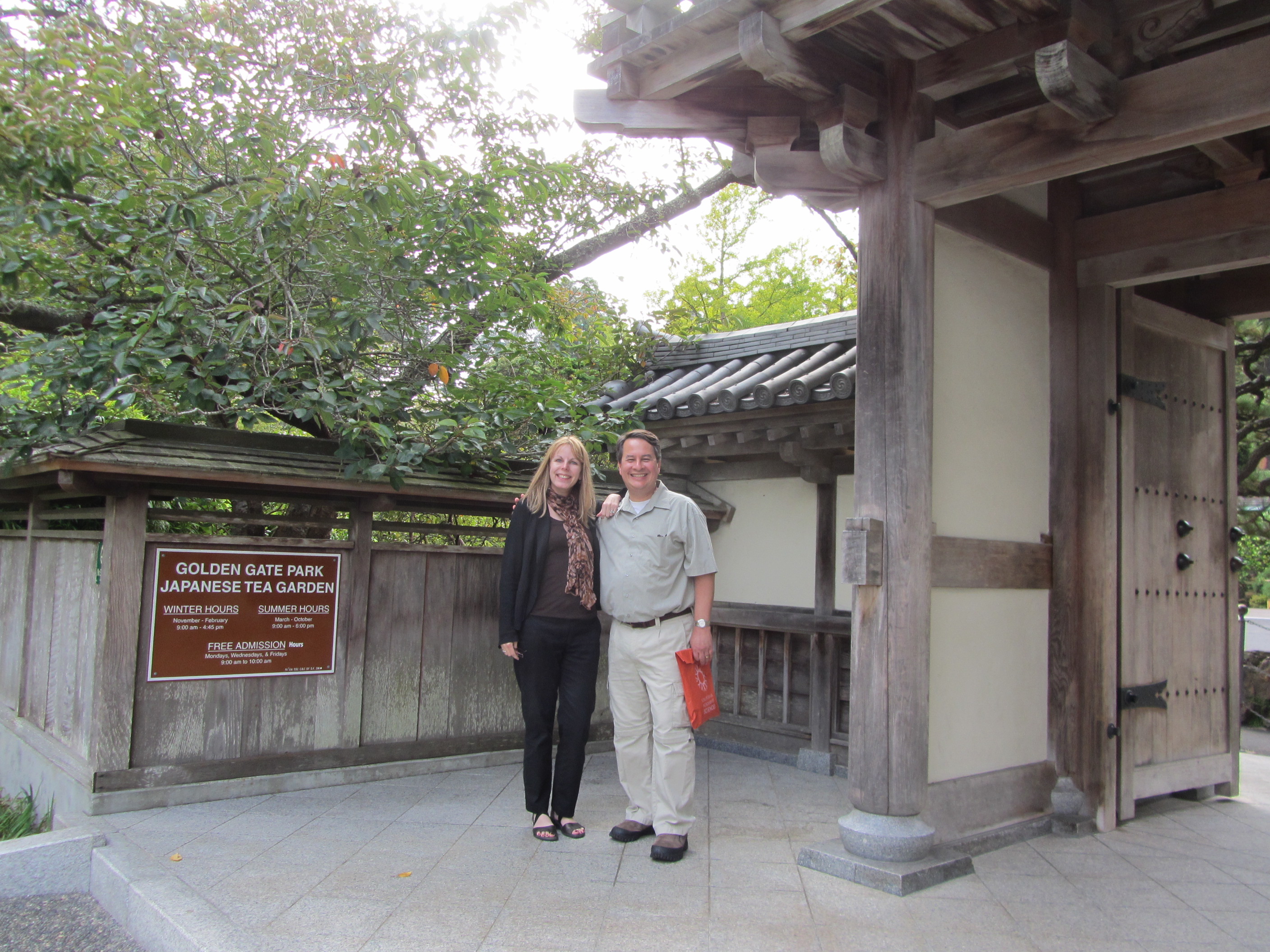
Laurie Ossman and Max van Balgooy meeting serendipitously in San Francisco in 2011.

Laurie Ossman has recently departed as director of Woodlawn and Pope-Leighey House, a National Trust Historic Site in Virginia, to advance her interest in re-imagining historic sites for today’s audiences through project-based endeavors and writing.  Her innovative work to reinterpret and reprogram the site has been featured by the American Association of Museums and the Washington Post, including the path-breaking Arcadia partnership with the Neighborhood Restaurant Group.  During her tenure, she also completed two major books with Rizzoli–a survey of Great Houses of the South and a study of the architectural firm of Carrere and Hastings (selected as the Washington Post‘s photo book of 2011)–which will be focus of several lectures in the coming month at Vizcaya, The Flagler, and the Sulgrave Club.  Laurie received her PhD. in architectural history from the University of Virginia and was previously responsible for the collections and scholarship at such nationally renowned historic sites as Vizcaya Museum and Gardens and Ca’ d’Zan at the Ringling Museum of Art.  She can now be reached at LaurieOssman@Comcast.net.

Susan Hellman has been promoted to Acting Director of Woodlawn and Pope-Leighey House and can be reached at Susan_Hellman@nthp.org.  Woodlawn and Pope-Leighey House are owned and operated by the National Trust for Historic Preservation and is one of 23 National Trust Historic Sites.

Exclusive Twitter Account Launched

If you use Twitter to keep up with what’s happening, you can follow this blog @MaxvanBalgooy.  Every blog post is automatically shared on Twitter, plus I often use Twitter to quickly report on immediate events at meetings and conferences as I encounter them, such as a speaker’s pithy quotes and breaking news.  If you’ve been following @MaxvanBalgooy, those tweets will now focus on my professional work in historic preservation, community engagement, and urban design (and I’ve moved my personal tweets about my hometown of Rockville, Maryland to @MaxforRockville).  Thanks to Scott Wands at the Connecticut Humanities Council for the suggestion (and alas @EngagingPlaces has already been taken).

Volatility Ends the Year

This will be the last post on EngagingPlaces.net for the year.  With the holidays, I typically take a two week break from blogging, unless some important news comes up that just can’t wait.  I’ll be posting again on Wednesday, January 4 with the goal to maintain 2-4 posts weekly for 2013.  Thanks to everyone who visited and commented in this inaugural year of the blog, and for your kind comments at conferences and via email.

Historic and cultural organizations are undergoing tremendous change, so you’ll be delighted to know that “volatility” has been named the Web of Language Word of the Year for 2011.  Were they thinking of us?  How did they know?   Dennis Baron, English professor at the University of Illinois and author of the Web of Language blog, shares his thoughts about volatility and other words of the year, including squeezed middle, truthiness, retweet, tergiversate, and bunga-bunga on the Visual Thesaurus blog (an online thesaurus that I find increasingly useful for my writing).  How many of those words did you recognize?

Best wishes for the holidays and 2012 (just remember, next year is a new year, thank goodness).

2012 Compact Calendar for Engaging Places Available

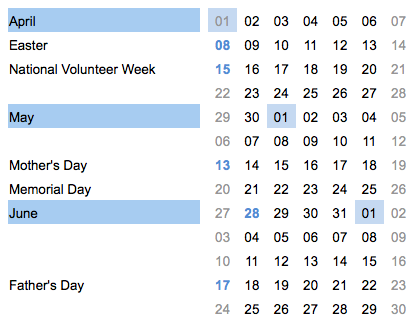
Detail from the Compact Calendar

Much of my work revolves around managing complex projects and programs, which requires checking in on a regular schedule, looking months ahead, or planning backwards from a deadline.  A typical monthly calendar doesn’t work very well–I need to see the entire year on one page so I can envision it all at one time, preferably as a single stream so I can more accurately see the distance between days (having been tripped up by months with five Mondays, for example).   I also need to know about major holidays and events so I don’t make the inadvertent mistake of scheduling a meeting on Memorial Day or Yom Kippur, dates that move around from year to year.

I’ve found a great solution from David Seah, an “investigative designer” who has this insatiable desire for Continue reading

Take Advantage of the Ten Cultural Trends for 2012

JWT Intelligence has just released its Ten Trends for 2012 based on surveys of Americans and Britons and interviews with experts and influencers.  If you can’t afford to buy copy of their full report for $250, here’s a summary plus some suggestions for taking advantage of them:

  1. Navigating the New Normal:  The economy won’t be back to the way it was for some time, so consumers are now becoming price conscious by habit.  Consider stripped down offerings (such as smaller sizes of products in your museum store) or some access at lower cost (such as a “grounds only” admission fee).
  2. Live a Little:  Although they don’t want to pay a lot, visitors are becoming anxious to splurge on a few good things responsibly.  Adjust your programs so they promote both the fun experience and extraordinary aspects of your site (and be sure you can deliver it–just saying your tours are fun and extraordinary doesn’t make it so).
  3. Generation Go:  20-somethings are struggling Continue reading

El Morro National Monument Damaged by Vandalism

In October, two international students from the University of New Mexico went behind a split rail fence and carved their nicknames on the sandstone walls of El Morro National Monument.  They knew enough English to write “Super Duper Dana” and “Gabriel” but claimed they didn’t know enough English to read the sign posted just a few feet away that said, “It is unlawful to mark or deface El Morro Rock.”  Now their graffiti joins “Pedro Romero 1758” and two thousand other signatures, dates, messages, and petroglyphs that have been left over hundreds of years by Puebloans, Spaniards, and Americans.  They were recently charged with damaging an archaeological resource on public land and face fines, prison, and repair costs of nearly $30,000.   For more details, see the Albuquerque Journal and Cibola Beacon. Continue reading

What do You do with Collections in a 21st Century House Museum?

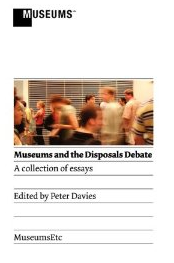
Museums and the Disposals Debate, 2011

One of the findings of the 2007 Kykuit Conference was that “undefined collecting coupled with a lack of professional standards and inconsistent practices regarding deaccessioning are an impediment to change and sustainability” and recommended that “selected sites should develop a pilot process to streamline deaccessioning and share their results with the field.”

Some of this work may have just been accomplished with the publication of Museums and the Disposal Debate, an anthology of essays edited by Peter Davies.  At a hefty 600 pages, it includes two dozen contributions from museums from around the English-speaking world but for those working at historic house museums, you’ll be most interested in “Too Much of a Good Thing: Lessons from Deaccessioning at National Trust Historic Sites” by Terri Anderson, the John and Neville Bryan Director of Museum Collections at the National Trust for Historic Preservation (she moderated the standing-room only session on deaccessioning for AAM a couple years ago).  I read an early version of her essay and it’s the best I’ve seen written on the particular challenges facing deaccessioning at historic sites, which are distinctly different from other museums.

The talk of becoming “21st century museums” is often coded language for Continue reading

Latest Trends in Mobile Computing

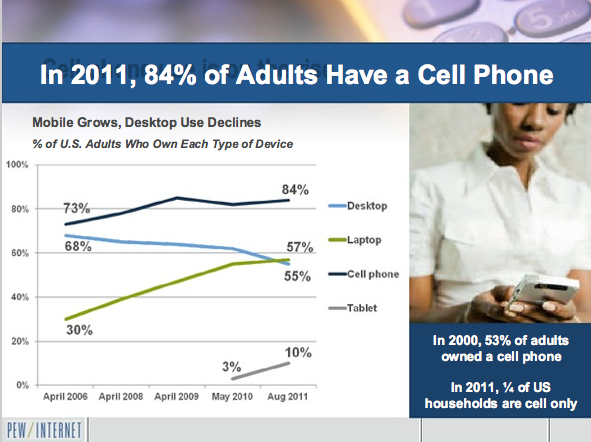
According to a recent survey by the Pew Internet and American Life Project, 84% of American adults have a cell phone and laptop and desktop use are about the same.

Aaron Smith, senior research specialist at the Pew Internet and American Life Project, recently released the key trends on Americans and mobile computing based on a nationwide telephone survey.  You can find the entire presentation online but some highlights for historic sites and historic house museums are:

  1. The use of mobile devices (cell phones, laptop computers, and tablets) is growing and desktop computer use is falling.  About 2/3rds of Americans connect to the internet wirelessly using a laptop or handheld device.  One quarter of US households only use cell phones.  [Soon everyone will be carrying an internet-connected computer with them–what will that mean for your organization?  How will that change your communications strategy, your programs and activities?]
  2. Smartphones (cell phones with internet access) are most popular with people ages 18-29, college graduates, households with an annual income $75,000 or more, and African Americans and Latinos.  [If you are trying to reach one of these audiences, Continue reading