Category Archives: Books and articles

Mapping Slavery in Amsterdam: Reflections on a Heritage Guidebook

During a recent trip to the Netherlands, I picked up a copy of Amsterdam Slavery Heritage Guide (Gids Slavernijverleden Amsterdam) , the second extended edition published in 2018. Although it’s been around for nearly a decade, this was my first encounter with it—and I’m glad I made the discovery. As someone interested in the interpretation of African American history and culture, as well as city guides, I found it to be a compelling model for documenting and acknowledging slavery’s legacy in public spaces.

The full-color Guide identifies over 100 locations throughout the city connected to slavery, from major institutions to architectural details that would be easy to overlook. Each site is presented with a bilingual (Dutch and English) description that varies in length, sometimes accompanied by historical context. The locations are not limited to traditional sites such as mansions and churches—many are ordinary houses or warehouses, gablestones, offices, or former homes of prominent individuals. A map at the beginning allows you to design your own exploration of the city’s slavery heritage.

The content is categorized among four topics:

  • Trade and Profit
  • Africans and Asians in Amsterdam
  • Resistance and Abolition
  • Museums and Archives
Continue reading

AASLH’s Interpreting History Series Now on Sale

If you’re looking to expand your bookshelf this summer, now’s a great time to explore the Interpreting History series from the American Association for State and Local History (AASLH). Bloomsbury is currently offering 10–15% off the entire series—an excellent opportunity to add fresh perspectives on interpretation to your library.

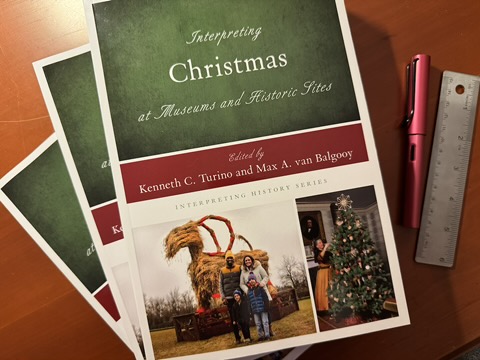
Among them is my newest title, Interpreting Christmas, co-authored with Ken Turino. We examine how museums and historic sites can thoughtfully interpret winter holidays in ways that are inclusive, community-centered, and grounded in historical research. If you’ve ever struggled with how (or whether) to “do” Christmas at your site, this book offers a framework—and lots of practical examples.

Even better: AASLH members always receive 20% off all titles in the series, including those not currently on sale. If you’re not already a member, it’s a great time to join.

This sale also comes at a turning point for AASLH’s publishing program. Earlier this year, Bloomsbury acquired Rowman & Littlefield’s academic publishing business, expanding the reach of the Interpreting History series to a much broader international audience.

Of course, most of us don’t write museum books for the royalties (we know we’re not Nora Ephron—or even Nora Roberts). The real reward is seeing our work spark ideas, inspire change, and shape the way history is shared with the public. So whether you’re an interpreter, educator, or site manager, pick up a volume or two—and join the conversation.

Webinar: Interpreting Winter Holidays with Your Community

The winter holidays are some of the most beloved and heavily attended times of year for museums and historic sites—but interpreting them can be a challenge. Whose stories are told? What traditions are represented? How can we ensure our programs are welcoming, accurate, and relevant to our communities?

If you’ve been asking these questions, join me at an upcoming webinar hosted by the American Association for State and Local History (AASLH):

  • “Interpreting Winter Holidays with Your Community”
  • Wednesday, June 12, 2025, 3:00–4:00 PM Eastern
  • $45 / $25 for AASLH members
  • Register here

I’ll be speaking alongside Ken Turino, Martha Katz-Hyman, and Morgan Lloyd, each of whom brings experience and insights into crafting more inclusive, community-centered holiday programs. We’ll explore ways that museums and historic sites can move beyond nostalgic or monolithic narratives and instead embrace a richer variety of traditions and histories—from Hanukkah to Kwanzaa, from secular seasonal festivals to the complexities of Christmas. Whether you’re revamping long-standing programs or launching something new, this session will offer fresh ideas, examples, and practical steps for engaging your community during the holiday season.

In my portion of the webinar, I’ll share strategies for refreshing an existing Christmas event by incorporating research on state and local history, helping organizations better connect with their communities and interpret traditions in a meaningful context.

The webinar is inspired in part by the recent book Interpreting Christmas at Museums and Historic Sites, which Ken and I co-edited and which features contributions from many practitioners grappling with these same questions. As a bonus, webinar attendees will receive a 30% discount on the book.

Job Hunting in Tough Times: Three Books for Museum Professionals

The museum field has always been a challenging place for job seekers. Even in the best of times, there are often more talented people than positions available, and salaries tend to lag behind comparable roles in business or government. But with the recent elimination of federal funding through IMLS and NEH, and with looming threats of layoffs at the Smithsonian Institution, National Park Service, and National Gallery of Art, the situation is becoming even more precarious. I’m deeply concerned about what lies ahead for our field, not just for those losing jobs, but for the ripple effects on institutions, communities, and careers.

Fifteen years ago, I faced a similar moment when the National Trust for Historic Preservation laid off about a third of its staff. I was fortunate: I had a generous severance package and a consulting project waiting (thank you, Jim Vaughan!). But not everyone will be so lucky this time. In that difficult season, a few books proved invaluable to me, and I strongly recommend them to anyone now facing an unexpected job search:

Continue reading

Video: Chicago Style Basics

Strong research and writing skills are essential for museum professionals, whether you’re publishing an article, preparing grant proposals, or mentoring new colleagues.
That’s why I created a new eight-minute video, Chicago Style Basics, to introduce the fundamentals of citation and documentation using the Chicago Manual of Style — just updated with its 18th edition ($75!).

The video walks through what a citation is, why citations matter, and the basic parts of a properly formatted citation. It also provides real examples of how to cite a book with one author, a chapter within a larger book, and a journal article — essential formats for anyone writing in our field. The video closes with a quick summary and a few resource suggestions for those who want to dig deeper.

At the Museum Studies Program at George Washington University, we require our graduate students to demonstrate professional-level research and writing, and this video was created to support those expectations. But it’s also a useful refresher for anyone preparing manuscripts for publication, developing course materials, or helping new professionals get their footing.

You can watch Chicago Style Basics at https://youtu.be/X9c1DQEcwhw.

I hope you’ll find it a handy reference — and please feel free to pass it along to anyone who might appreciate a refresher.

How to Turn Exploratory Visitors into Loyal Fans

Museums and historic sites face a persistent challenge: how to transform mildly interested visitors into deeply engaged patrons. These exploratory visitors—those who follow your social media accounts, visit the website, or attend an occasional event—represent a critical audience segment with untapped potential. How can museums help these visitors feel more connected and motivated to return?

Three recent studies offer actionable insights into addressing this challenge: one on the power of framing and emotional relevance, another on the role of clear wayfinding in reducing visitor anxiety, and a third on the holistic visitor experience at heritage attractions.

Lesson 1: Framing and Emotional Relevance Matter

In “The Role of Framing, Agency, and Uncertainty in a Focus-Divide Dilemma,” Justin Claydon et al highlight how contextual framing—presenting information in a familiar, relatable way—dramatically improves motivation and engagement. When tasks are abstract or unfamiliar, people struggle to prioritize and engage effectively. Conversely, framing a task with real-world relevance reduces uncertainty and increases interest.

Continue reading

Making Community Engagement Work: Fresh Ideas for Museums

Community engagement is essential to modern museum work—but let’s face it, it’s not always easy. Building authentic, long-term relationships with your community takes time, effort, and a willingness to rethink how your museum operates. Two recent studies in Curator: The Museum Journal offer practical tips and ideas to help you navigate the challenges and make a bigger impact.

Let the Community Lead

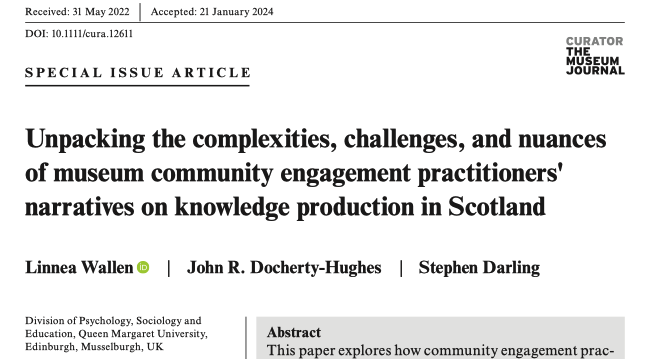
In “Unpacking the Complexities, Challenges, and Nuances of Museum Community Engagement Practitioners’ Narratives on Knowledge Production in Scotland” (Wallen et al., 2024) researchers explore how museums and communities can collaborate to co-create knowledge. The big takeaway? Museums need to value the lived experiences of their community partners as much as their own expertise. Smaller museums seem to do this best because their tight-knit teams often integrate community engagement into everything they do.

But it’s not always smooth sailing. Unequal power dynamics, emotional labor, and balancing community needs with organizational goals can make this work tricky. To address these challenges, the study suggests:

  • Making equity a priority from the start of any project.
  • Seeing relationship-building as an ongoing effort, not a one-time event.
  • Sharing decision-making power to let community voices shape museum projects.

This approach isn’t just about being inclusive—it can transform your museum into a space for authentic, diverse narratives.

Continue reading

Exploring Sustainability in Museums: A New Graduate Course at GWU

This spring, I’m excited to launch a new graduate course at George Washington University, Creating Sustainable Museums. Designed for those new to the topic, the course combines theory with practice to explore how museums can address sustainability through financial stability, social equity and access, and environmental responsibility.

At the heart of the course are three core texts that introduce students to sustainability’s principles, history, and practical applications. We begin with Jeremy Caradonna’s Sustainability: A History, a compelling exploration of sustainability’s roots in the 18th-century deforestation crises and the consumer revolution. Caradonna introduces key figures like John Muir and Gifford Pinchot and influential movements such as the Club of Rome. He also explains foundational terms like lifecycle analysis, greenwashing, carbon footprints, and B Corporations. By tracing sustainability’s evolution, the book helps students understand that this is not just a modern buzzword but a framework deeply embedded in our history and practices (although it becomes very dense in the second half of the 20th century).

Continue reading

Wrapping Up 2024 and Looking Ahead

As 2024 comes to a close, it’s time to reflect on what turned out to be a busy and productive year. The highlight was completing Interpreting Christmas at History Museums and Historic Sites, co-edited with Ken Turino, which released in September. This project was a labor of love for the two dozen contributors, and it’s been gratifying to see it resonate with so many museum professionals.

Another major milestone was taking a sabbatical from George Washington University in the fall. During this time, I attended two intense and inspiring programs: the Newport Summer School, which focused on Victorian architecture and decorative arts, and the Royal Collection Studies course, which explored the management and interpretation of royal palaces and their collections. These experiences gave me fresh insights into interpretive strategies and leadership in historic sites that I look forward to integrating into my work and teaching. I can easily recommend these two professional development programs (and a sabbatical)!

Continue reading

Join Today’s Museum People Call on Interpreting Christmas at Museums!

Are you ready to explore how the holiday season can transform your museum? Today at 12 pm Central Time (1 pm Eastern), the Illinois Association of Museums is hosting its monthly “Museum People Call”, and this month’s topic is Christmas at Museums and Historic Sites!

I’ll be joined by Ken Turino, my co-editor of the new AASLH book series Interpreting Christmas at Museums and Historic Sites, to discuss how your organization can leverage the holiday season to its fullest potential.

We’ll cover key topics to help you:

  • Leverage the holiday season to attract visitors and engage your community.
  • Increase financial stability through creative programming, gift shop sales, and end-of-year giving campaigns.
  • Enhance cultural sensitivity and inclusivity, ensuring your holiday interpretation is meaningful and welcoming to diverse audiences.

Whether your site has a long history of holiday programming or you’re just starting to explore the possibilities, this session will offer practical tips and inspiring ideas to align holiday traditions with your mission.

🎄 Join Us on Zoom 🎄
Click here to join the meeting
Meeting ID: 861 3328 4346

Let’s come together to make the holiday season brighter, more inclusive, and impactful for your museum and its visitors. We look forward to seeing you there!

PS. On Wednesday, December 25, the Gilded Age and Progressive Era podcast will release an interview about the Interpreting Christmas book with me, Ken, and Lenora Henson, formerly director of the Theodore Roosevelt Inaugural Historic Site in Buffalo, New York.