Category Archives: Design

Interpreting Bondage and Freedom in the Chesapeake

This slideshow requires JavaScript.

Visiting Annapolis a few weeks ago, I had a chance to see the nearly completed installation of Freedom Bound: Runaways of the Chesapeake, a year-long exhibit about the resistance to servitude and slavery in the Chesapeake Bay region from the colonial period to the Civil War.  Heather Ersts and Ariane Hofstedt of the Historic Annapolis Foundation graciously provided a personal tour of the exhibit, which is installed in several museums and historic sites around the city.  It’s an exhibit worth seeing not only for the content, but also the design, and several items jumped out at me:

1.  The exhibit looks at the varied experiences of people through nine persons.  Seven of these persons were enslaved Africans, but two are white–a convict servant and an indentured servant–which will surprise most visitors.  It complicates the usual narrative that only Africans were held in bondage (of course, being owned as a slave is very different from being incarcerated as a convict) and it’s by encountering the unexpected that people are more likely to learn.  The typical exhibit about slavery trots out the same 1850 drawing of the slave ship Brooks, a pair of iron shackles, and perhaps a tag from Charleston.  Yes, those are all authentic and true, but the constant repeat of these items renders them Continue reading

Vinyl Banners that Look Sharp, not Saggy

The other week I passed by Anderson House and was so struck by their full-color monument signs that I had to take a closer look.  They’re the common vinyl banners that can be made by nearly every sign and banner store, but they were incredibly neat and clean–none of the usual sagging, wrinkling, and rippling.  Mounted across the top and bottom with Velcro onto a metal frame, the bottom corners of banners are also secured with bolts to keep them from flying away in the wind or easily taken by admiring thief.  The frame is made of square tubing, whose legs slide onto a corresponding set of tubes set in the ground.   Emily Schulz, the deputy director and curator, generously provided more details:

“We installed the banners on the front lawn in mid April 2012, so they’ve been up pretty much exactly one year.  They replaced a small sandwich board sign that was put out every morning and Continue reading

The Many Flavors of Touring Historic Places

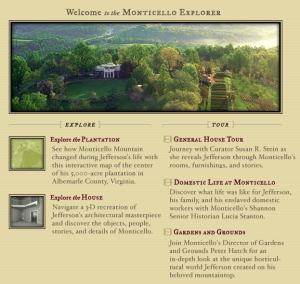
Monticello Explorer provides several virtual tours.

Monticello Explorer provides several virtual tours.

Although guided tours of period rooms is the most common form of interpretation at historic sites, audio tours, video tours, and virtual tours are growing in popularity thanks to technologies that are lowering the cost of production and increasing access to new audiences.  From a short list of examples, the students in my “historic site interpretation” class at George Washington University developed a list of ten best practices for different types of tours of historic sites.  You’ll discover that many of their suggestions emphasize the need for a plan, themes, and a focus–and projects that failed to have these elements were weaker and less effective.

A.  Guided Tours of Period Rooms

Reviewed by Johanna Bakmas, Melissa Dagenais, Emma Dailey
 

Suggested Best Practices

Do
  1. Develop an interpretive plan and themes
  2. Consult primary sources for the property
  3. Decide whether to have reproduction or original pieces Continue reading

Outdoor Interpretive Panel for Hot Humid Places

This slideshow requires JavaScript.

During a recent visit to Middleton Place, an historic site in Charleston, South Carolina, I spotted an outdoor interpretive sign that’s so nicely crafted that it’s withstood several years of weathering outdoors.  The wooden frame supports a one-inch thick plywood panel (two thinner panels secured together) whose edges are sealed and entire surface painted black (black is Middleton’s standard color for sign posts).  The interpretive sign is printed on a 1/16″ thick sheet of vinyl (or a similar synthetic material) and glued onto the face of the panel.  The top edge of the sign is protected from rain by a copper cap. One corner of the vinyl has turned up over time, but otherwise, the sign seems to be in perfect condition, despite the heat and humidity of summer in the Lowcountry.

Report from the 2012 AAAM Conference in Baltimore

This slideshow requires JavaScript.

Last week I attended the Association of African American Museums conference along with two hundred other people from across the country.  I’d never attended before but since it was close by in Baltimore, I decided to take a chance and it turned out to both educational and fun.  Although I only attended one day, I’d like to share some of the highlights from the sessions I observed.

In “Understanding Exhibition Design and Planning“, the panelists all stressed the importance of pre-design, which includes determining which spaces will be devoted to exhibits, visiting other exhibits to clarify what you like (and don’t like), conducting visitor research, identifying potential artifacts and images, roughing out a budget and schedule (is the exhibit feasible?), and determining the maintenance costs.  The Harpers Ferry Center of NPS offers an exhibit planning template for FileMaker Pro.  The panel also provided a rough estimates of exhibition costs for design and fabrication:

  • $150-250/sf: 2D items, graphics, pedestals for 3D objects, little to no media.
  • $250-350/sf: 3D object displays, more extensive use of graphics, some media elements
  • $350-500+/sf: custom cases, media, electromechanical interactives, theatrical lighting/projectors.

They stress that costs could be lower, but it will then rely heavily on reusing ideas or elements from earlier exhibits or projects.  The panelists also believed that better designs are the result of longer development schedules, not more money.  More time allows for more iterations of designs to refine ideas.  Finally, for new buildings, they suggest that exhibit designers be brought in early to the process because they help program the space because they tend to “design from the inside out”–but that will require that the architect is willing to collaborate.  For a copy of the PowerPoint presentation, contact Chris Danemeyer at Proun Design.

Claudine Brown, the Assistant Secretary for Education and Access at the Smithsonian Institution, was the luncheon speaker.  She laid out the new interpretive direction for the Smithsonian and why they matter to museums, especially those that focus on African American history and culture.  The challenges facing the Smithsonian is that they need to preserve the evidence of the past, be relevant in the present, and be prepared for the future [and these are ideas all museums and historic sites can follow].  The three big topics the Smithsonian will be interpreting are:

  • Americans All: a shared experience as immigrants, everyone came from somewhere else, but all share a common country.
  • Waterways:  Water is a serious problem and its estimated that 2/3rds of the world will suffer water shortages by 2025.
  • Creativity and Innovation:  With our current high unemployment rates, museums can be part of the solution by providing learning opportunities that simulate real life and helping the next generation learn how to organize, strategize, and act.

The session on developing mobile applications was led by the Digital Humanities Center at Michigan State University, which maintains an online clearinghouse of mobile museum applications.  The session provided some estimated costs for producing various applications, as follows:

  • $0-?: mobile-ready website (creating a website that can be easily viewed on a smartphone; most common solution)
  • $5,000-$60,000:  native application (self-contained program that’s downloaded and works without an internet connection)

The session stressed that mobile applications rarely generate revenue–the average return on investment is $688 and takes 51 years–so look for other benefits to the institution.  It may be possible to generate revenues from after-market sales, such as an app that promotes a book, photoprints, music, and attendance at an event.  When I asked about the effectiveness of applications, the person sitting next to me suggested I look at #SocialMedia Daily, a blog that aggregates news about social media and apps.

Boston MFA takes Flight with New American Wing

This slideshow requires JavaScript.

The Boston Museum of Fine Arts, one of the great public museums established just after the Civil War, has recently opened “Art of the Americas,” a new wing filled with its outstanding collections of American fine and decorative arts.  As some of you know, the Boston MFA underwent a controversial restructuring more than a decade ago, shifting from departments organized by media (e.g., paintings, ceramics, furniture) to geography (e.g., Europe, Asia, and America) and firing some longtime curators (including Jonathan Fairbanks, who created the American Decorative Arts and Sculpture department at the MFA).  I’m assuming one of the results of this restructuring is “Art of the Americas.”  This four-story exhibit consists of 53 galleries tracing the history of art from pre-Columbian to Modern periods for the continents of North and South America, so along with the expected Chippendale chairs and Copley portraits, there are Peruvian funerary urns and Acoma pots.  It’s so large that it took me nearly three hours just to cruise through it at a walking pace and I didn’t make it to the fourth floor, which explored the 20th century.

Unlike most art museums, the exhibit mixes Continue reading

Flexible Lobby Thanks to Furniture on Wheels

This slideshow requires JavaScript.

During a recent visit to the Abbe Museum in Bar Harbor, Maine, I spotted a clever way that allows them to easily remodel their lobby from a visitor reception area to an event space.  You don’t notice it at first because the furniture is so well designed and complements the appearance of the building.  The reception desk is busy selling tickets and greeting visitors, and next to it are panels explaining what to see and do.  But look below or behind, and you discover it’s not a panel but a moveable storage wall.  Clever!

2012 Webby Awards Point Out Models for Historic Sites

Historic sites are always looking for good models for online activities, such as websites and mobile applications, and one of the best places to look for inspiration is the annual Webby Awards, the leading international award honoring excellence on the Internet. Established in 1996 during the Web’s infancy, the Webbys are presented by the International Academy of Digital Arts and Sciences.

The 2012 Webby Awards received nearly 10,000 entries from over 60 countries and all 50 states and awards were given in over a hundred categories for website, interactive advertising and media, online film and video, and mobile and apps. As a result, there is a lot to cull through but here are several that seem to be most related to historic sites (and hang on, this is a long list):

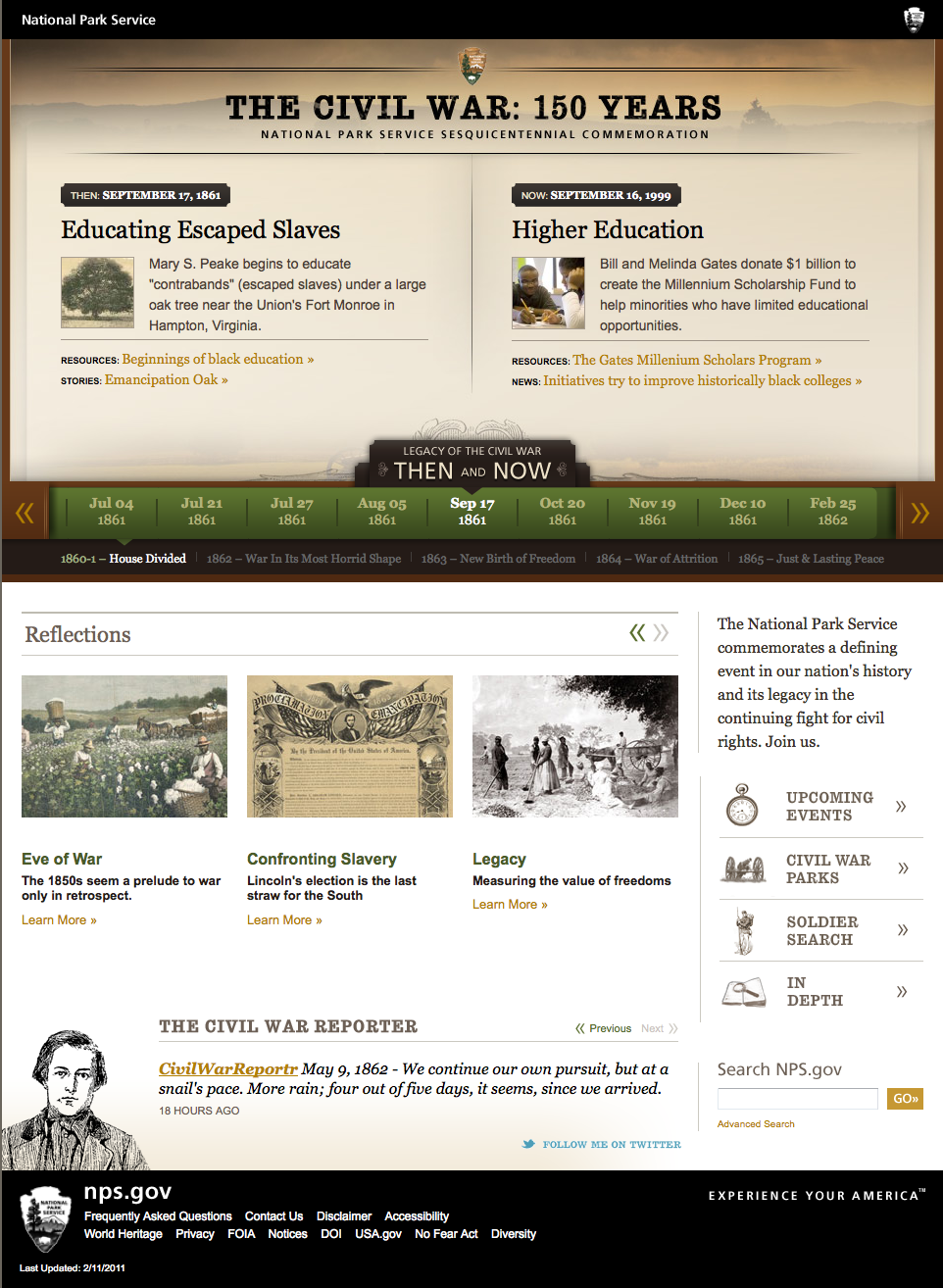
  • NPS’ Civil War: 150 Years features a Then and Now Timeline at the top and a Civil War Reporter sending tweets at the bottom.

    The Civil War: 150 Years has the form and content of websites that will be most familiar to historic sites, except that it commemorates “a defining event in our nation’s history and its legacy in the continuing fight for civil rights” rather than a specific place.  I like their use of Twitter to create a virtual “Civil War Reporter” whose tweets report on events from the 1860s but the major innovation is the featured Then and Now Timeline that compares similar events during the Civil War and today (although I was only able to jump months, not years).  Another way to compare the past and the present is demonstrated by Slavery Footprint, a website and mobile app that was launched on the 149th anniversary of the announcement of the Emancipation Proclamation.  It’s designed to raise awareness of modern-day slavery and can tell you approximately how many slaves have pitched in to make the goods you enjoy on a daily basis.

  • Timelines appeared in several other forms in the winning entries and along with the Then and Now version is Continue reading

Details on the new National Museum of African American History and Culture

This slideshow requires JavaScript.

Yesterday I joined a meeting of the curatorial and education staff at the National Museum of African American History and Culture to discuss a potential partnership with Drayton Hall, and it was great to see again Rex Ellis, Debbie Mack, Bill Pretzer, and Michele Gates Moresi as well as meet so many of the other staff who are working to make this new museum a reality.  The museum recently broke ground on the Mall in Washington, DC and is scheduled to open in 2015.

While I was there, I spied a three-dimensional model of the new museum in the lobby and it thought I’d share some photos to give you a close up of the design (and sorry for the reflections–it’s in a vitrine near a big window).  Freelon Adjaye Bond/SmithGroup, a consortium of four independent architectural firms that designed the building, laid out this vision: Continue reading