Category Archives: Social media

KCET Launches Online Neighborhood Field Guides

The Highland Park Field Guide by KCET.

KCET, a public television station based in Los Angeles, has been working for the last few years on Departures, a project designed to engage “community residents, non-profit organizations, schools and students, in the creation and procurement of relevant and relatable content.”  Included in this work are a series of online interactive field guides to various neighborhoods in their region, and most recently launched is one on the historic community of Highland Park (which features the Lummis House, Heritage Square, and the Southwest Museum).  Given that KCET is one of the major public tv stations in the nation, the field guides are beautifully produced and include lots of video.

According to Kelly Simpson, associate producer of the KCET Departures, “The Highland Park Field Guide was produced in partnership with the Highland Park Heritage Trust and the North Figueroa Association. In six categories (with two more coming soon) we feature fun, informative and adventurous activities for Continue reading
Free Webinar on the Hispanic Traveler on Feb. 10

If you are trying to reach an Hispanic or Latino audience, Laura Mandala of Mandala Research, LLC is leading a webinar on “Understanding the U. S. Hispanic Traveler” on February 10, 2012 at 2:00 pm Eastern. Produced in conjunction with Longwoods Travel USA, she’ll be providing comprehensive data and analysis on the U.S. Hispanic Traveler, including spending, activities, social media usage, mode of transport, trip purpose, trip planning, booking, destinations for both day and overnight stays, and much more.  Cost is $299 and pre-registration is required.  For more details, visit mandalaresearch.com.

If you’re not familiar with Laura Mandala, she  one of the leading research and analysis firms specializing in leisure travel (that includes those of us who work in museums and historic sites).  I became familiar with her study of heritage and cultural travelers at the National Trust.  Her website offers several free reports including the use of social media by travelers, behaviors of leisure travelers who drive, and culinary cultural travelers (foodies!).  If you’re a member of the American Association of Museums, you can receive the Cultural and Heritage Traveler Study for 50% off.

Responding to Public Complaints on Facebook

According to ComScore’s It’s A Social World report, “social networking sites now reach 82 percent of the world’s online population, representing 1.2 billion users around the world.”  Even if you don’t have a Facebook page or Twitter account, some of those users are talking about your organization and a few might be complaining.  How do you respond? Here are some actual postings taken from Yelp and TripAdvisor:

  • “This beautiful house was recently refurbished,and the amazing details of the woodwork just shine. The tour of the interior is well worth it, despite some rather fussy docents and lots of rules.”
  • “Rude pompous guides take you on way overpriced tour of Continue reading

2012 WebWise Conference Registration Is Open

Registration is now open for the Institute of Museum and Library Services’ (IMLS) WebWise Conference, which will take place February 29th-March 2nd at the Renaissance Baltimore Harborplace in Baltimore, MD. Today conference organizers announced that actor and literacy champion LeVar Burton has been chosen as one of the keynote speakers. Burton will speak on the morning of March 1.

A signature initiative of IMLS, the WebWise Conference annually brings together representatives of museums, libraries, archives, systems science, education, and other fields to explore the many opportunities made possible by digital technologies. George Mason University’s Roy Rosenzweig Center for History and New Media (CHNM), partnering with the Balboa Park Online Collaborative (BPOC), is helping to organize the conference.  Historic sites and historic house museums are rarely in attendance, but this is a great conference so I’ll share what I’ve learned on this blog. Continue reading

Latest Trends in Mobile Computing

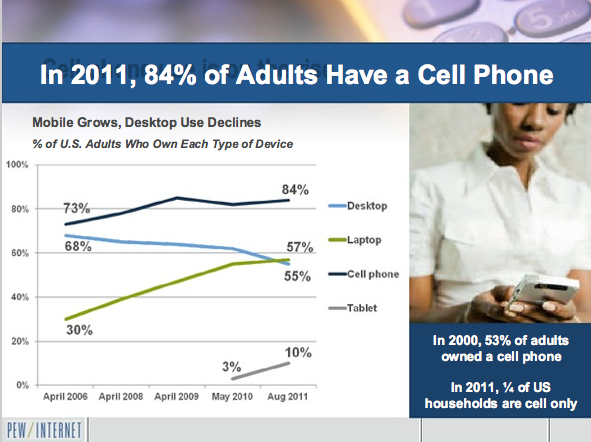
According to a recent survey by the Pew Internet and American Life Project, 84% of American adults have a cell phone and laptop and desktop use are about the same.

Aaron Smith, senior research specialist at the Pew Internet and American Life Project, recently released the key trends on Americans and mobile computing based on a nationwide telephone survey.  You can find the entire presentation online but some highlights for historic sites and historic house museums are:

  1. The use of mobile devices (cell phones, laptop computers, and tablets) is growing and desktop computer use is falling.  About 2/3rds of Americans connect to the internet wirelessly using a laptop or handheld device.  One quarter of US households only use cell phones.  [Soon everyone will be carrying an internet-connected computer with them–what will that mean for your organization?  How will that change your communications strategy, your programs and activities?]
  2. Smartphones (cell phones with internet access) are most popular with people ages 18-29, college graduates, households with an annual income $75,000 or more, and African Americans and Latinos.  [If you are trying to reach one of these audiences, Continue reading

Flat Stanley Goes Mobile; Will He Visit Your Site?

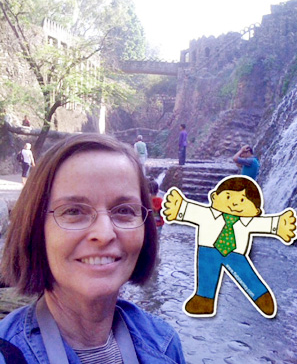
Flat Stanley with Suzie Boss in India. From Edutopia.org.

“Flat Stanley,” the elementary school activity that’s designed to get students to explore places around the world, has moved from a paper-cutout to a clever smartphone application.  He can now be integrated into a phone’s camera to be part of photos taken in places visited by children–the result of some clever computer programming and a legal agreement with the estate of the author.  Read more at Suzie Boss’ blog at Edutopia.org.

What’s Next in the Social Media Revolution?

"What's Next for Social Media" Forum at the National Archives.

The National Archives brought together a diverse panel of practitioners and critics of social media to discuss some of the challenges and opportunities for communication with the public in, “What’s Next in the Social Media Revolution?” at its Seventh Annual William G. McGowan Forum on Communications on Friday, November 4.  A really informative (and free!) evening and for historic sites there were these particularly useful insights and recommendations:

  • Social media is not just for socializing, but can inform and motivate. Alex Howard, the Government 2.0 Correspondent for O’Reilly Media, provided a quick history of social media noting that many of them are very new (Flickr, Facebook, LinkedIn, Digg launched in 2004; YouTube and Twitter in 2006) but the turning point was the Iran elections in 2009, which showed that the use of social media could have tremendous impacts on society.  My advice:  your organization may not have the capacity to use social media actively right now, but Continue reading

National Archives to Launch Dashboard to Engage Users

Pamela Wright of the National Archives describes the forthcoming Citizen Archivist Dashboard.

At the Seventh Annual William G. McGowan Forum on Communications on November 4, the National Archives previewed their Citizen Archivist Dashboard, a single place where users can actively participate in the work of the institution (the Archivist of the United States debuted it earlier in his blog). Pamela Wright, Chief Digital Access Strategist at the National Archives, stated that this would be a way to develop deeper levels of engagement with its users beyond the basic performance measures of “likes” and “followers”. Scheduled to launch in December, it will use crowd-sourcing strategies to improve access and understanding of its enormous collections by allowing visitors to: Continue reading

Claim Your Space on Google+ Pages

Yesterday, Google launched Google+ Pages worldwide, which expands their network from people to places.  Now historic sites, museums, galleries, organizations,  associations, and even advocacy campaigns can have a Page in Google+.  It’s similar to Facebook, but you have access to such Google+ features as:

  • email distribution lists (called Circles), which can help you build special interest groups around your collections or programs
  • group video chats (called Hangouts), which can help you hold meetings for up to 9 people
  • sending text messages as a group chat (called Messenger), handy if you’re coordinating a large event and need to communicate with everyone quickly.

Likewise, your members, users, and supporters will be able to more easily connect with you by adding you to their Circles, plus they can recommend your content on Google Search.

A number of pages are already available (Save the Children, Anderson Cooper 360, The All-American Rejects), but any organization will be able to join the community at plus.google.com/pages/create.  I’ve just created a Google+ Page for Engaging Places, but it’ll be fairly quiet until I better understand the possibilities (but I wanted to reserve my name before someone else takes it).

Taking Social Media to the Next Level of Engagement

Social media, such as Facebook, Twitter, and blogs, are now recognized as important tools in every communications strategy.  But these seem to only add to our workload, not reduce it, because there still is a need to maintain websites and mail newsletters to reach our traditional audiences and supporters.  And if you’re working with social media, how do you know it’s making a difference and really engaging your audience?  Who wants to go to the trouble of tweeting and posting if no one is listening? It’s going to take a bit more work to get to the next level, but it may be worth it.  Some of it is easy to adopt and just a matter of practice, others require learning a little technical jargon.  Here are a couple approaches:

1.  Use social media to show you are listening.  Remember, social media is supposed to be a two-way dialogue (that’s the “social” part), so respond to comments (even if it’s just a, “Thanks for your comment.  We’re glad you had a great time at the event.”).    On Facebook and blogs, that’s very easy (most have a “reply” feature for comments) but on Twitter Continue reading