
Category Archives: Uncategorized

AASLH Meets in Birmingham

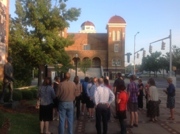
The American Association for State and Local History is holding its annual meeting in Birmingham, Alabama, attracting about 700 people from a variety of history organizations around the country.  The schedule is packed into three days and today started with an outstanding tour of the Civil Rights movement using historic sites around and the public art in Kelley Ingram Park.  We learned about the many people involved, the strategies and obstacles, using both local and national (sometimes even international) stories. A new sculpture was just installed to honor the children who were killed fifty years ago (four girls from a bombing of the church and two boys on the streets of Birmingham), now accompanying statues of Martin Luther King Jr., children facing fire hoses, and the famous walk-through sculpture of attacking police dogs.  I’ll be sharing more from the annual meeting in the following days, including a summary from the discussions on the relevance of history.  

Engaging Places blog on Vacation in August

One of the traditions in Washington, DC is a long vacation in August because it’s just too hot and humid to work.  Even though most offices, homes, and cars are now air conditioned, the tradition still holds (note that Congress recently adjourned until September) and we’ll be observing it here as well.  There won’t be any posts unless something incredibly interesting happens and we’ll focus on sweeping out spam, refreshing pages, and perhaps even get around to a little remodeling.  We’ll be back again after Labor Day with the usual 2-3 posts each week, so it’s a good time to subscribe so you don’t miss the news when it comes out again this fall.  Thanks for your continued support and interest this year and we look forward to seeing you in a few weeks.

Video: History Summer Camp in China

This 4:49 video is titled, “Dailian History Summer Camp” but I can’t figure out what’s going on.  The music is bubbly but the scenes make no sense:  children playing basketball in kimonos, performances of Korean traditional music, song and dance numbers, jumping rope, and a visit to a historic POW camp (including weapons and torture devices).  I can’t even figure out if the titles are written in Chinese, Japanese, or Korean, but it looks like they’re have a good time (the opening titling is a bit long, so you might want to skip to 0:30).      Can anyone translate this and share what’s going on?  Thank you all.

Video: Extreme Journey Camp

The Journey Through Hallowed Ground Partnership works with the Loudoun County Public Schools in Virginia to provide an unusual summer camp that visits historic sites to create vodcasts on leadership.   This 3:11 video describes the camp and includes interviews with students, teachers, and staff.  According to one 7th grader, “I would recommend it to kids that like history, computers, or sports.  If you don’t like one of those three, then some parts you won’t enjoy.”  This video is the first in a series of nine, and you’ll find them all on YouTube.

NEA Survey Reveals Patterns in Historic Site Visitation

On Monday, March 11, I’ll be a plenary speaker at the Virginia Association of Museums conference to discuss the trends, challenges, and opportunities facing historic house museums.  It will be followed by a forum with historic site managers, tourism experts, preservationists, and community leaders on the needs and opportunities for historic sites in Virginia, such as a statewide association for historic house museums.  It’s great timing for this topic:  Governor McDonnell declared 2013 as the Year of the Virginia Historic Home in recognition of the bicentennial of the Executive Mansion and Virginia’s more than 100 historic homes, most of which are open to the public as museums and historic sites.

Whenever I’m asked to give a presentation or write an article, it’s an opportunity to do some research and reading to gains some new or deeper perspectives on the issue.  For the VAM presentation, I’ve been looking closely at the Survey of Public Participation in the Arts by the National Endowment of the Arts.  For decades, NEA has interviewed thousands of people across the United States to learn about their involvement in music, art, theater, festivals, reading, and dance.   NEA conducted the last survey in 2008 and published a series of analytical reports in 2009-2011.

Looking back over 30 years, the survey confirms that attendance closely correlates with Continue reading

See You Next Year!

This will be the last post for this year as I close out 2012 with a couple weeks of vacation from posting on this blog (but I’ll probably be updating the design and layout).  Thanks to all my readers and especially those who shared their thoughts, comments, and recommendations via comments and emails.

I launched the EngagingPlaces blog on October 24, 2011, so I’m also celebrating a one-year+ anniversary with some statistics for those who like them:

Most viewed posts for 2012

  1. HBO CEO named Mt. Vernon CEO; A Step Backwards IMHO (9,043 views)
  2. Let’s Give SWOT a REST (2,327 views)
  3. Embezzlement: Is it Our Dirty Little Secret? (2,172 views)
  4. Take Advantage of the Ten Cultural Trends for 2012 (581 views)
  5. Best Practices (568 views)

The top referrers for 2012 (how readers find the blog)

  1. Google Search
  2. Facebook
  3. Twitter
  4. Linked In

Not so much through Bing, Yahoo, Pinterest, delicious, or StumbleUpon.  Although Google Reader and NetVibes weren’t among the top, their popularity surprised me so perhaps folks are becoming convinced of the benefits of news aggregators).

See you in 2013!

Contemporary Visitor Center opens at French Historic Site

MuséoParc Alésia in Burgundy, France. The new orientation center is on the right and reconstructed sections of Roman fortifications are on the left.

On the site in Burgundy, France where Julius Caesar laid siege to Gallic leader Vercingetorix, architect Bernard Tschumi of New York created a circular concrete orientation center wrapped in a wood lattice on the site occupied by the Roman army.  (Although Napoleon II erected a 22 foot tall statue of Vercingetorix in 1865, he doesn’t seem to have caught on as a celebrity and no one names their kids after him.)  Called MuseoParc Alesia, the design of the interpretation center echoes the ringed fortifications built by Julius Caesar in 52 BC.  The building not only interprets the site through the exhibits inside but emphasizes views out onto the historic landscape via the windows and balconies that circle the building.  After watching a film about the battle, visitors exit the auditorium onto the tree-shaded roof terrace to enjoy a panoramic view so that, “vous vivez une expérience au cours de laquelle vous allez comprendre l’histoire de ce site, apprendre à regarder les signes dans le paysage mais aussi partager un lieu, un moment, un récit.”  And it includes an innovation for French museums:  a “toy library” for children ages 3 to 8 where they can learn while having fun (I think we call this a discovery room in the U. S.).  Strangely, the architect wanted the lobby to be empty.  I wonder if visitors will find this a confusing and sterile experience after encountering this dramatic building outside?  Seems to me to be a bit jarring, but I guess I’ll have to go to Burgundy to find out for myself.  A second circular museum built in the brick Gaul style will be located about a half mile away.

You’ll find a slide show of images at Architectural Record and initial reviews on Trip Advisor look promising.  Thanks to Barbara Campagna for alerting me to this new building!

EngagingPlaces.net Celebrates Six Monthiversary

EngagingPlaces.net is entering its sixth month of operation and it’s doing well, thanks to all of you readers.  Each month has shown growth in the number of views and this past week saw a record of number of views in one day (432!).  Even more important measures are the number of subscribers/followers and quality of comments so this blog is providing a useful service to those who are working to preserve and interpret historic houses, sites, and places.  For those of you like data, most people are referred to this blog via search engines (such as Google, Bing, and Yahoo), Facebook, Twitter, and LinkedIn.  Most people come to the blog searching for specific people (e.g. Anthea Hartig, Barbara Carson, Laurie Ossman) or trends (e.g., 2012 Mobile Computing Trends).

I’ve also noticed that about the same number of people subscribe to the blog as follow me on Twitter, so I’ll experimenting with the type and frequency of posts in each media.  I’ve recently shifted to 2-3 posts weekly on the blog and 2-3 tweets daily on Twitter, taking Friday-Sunday off (views drop off significantly on those days–are you all taking three-day weekends or facing information overload by the end of the week?).  The blog posts will be mostly original or extended content whereas in the tweets, I will share stories produced by others and on occasion, breaking news.

The advantage of the two different media is that you can control how much and how frequently you wish to be engaged with EngagingPlaces.net: Continue reading

You Can’t Make This Stuff Up

Police at Lyndhurst following the discovery of a body on shore. Credit: Daily White Plains.

Adding to the ever-growing category of “you can’t make this stuff up” of unexpected things that happen at historic sites (and for which we’ve never been trained to handle in graduate school) is the discovery of a body that washed up at Lyndhurst, a National Trust Historic Site in Tarrytown, New York, last week.  According to the Daily White Plains:

The body was discovered Wednesday afternoon washed up on the rocks on the Hudson River shore of Lyndhurst, the National Trust Historic Site in Tarrytown, Scott Brown chief of the Tarrytown Police said.

Brown referred further questions to the New York State Police, saying that department would have jurisdiction over the body. A spokesman for the state police said that his department would normally take jurisdiction if the body recovered was thought to be someone who had jumped off the Tappan Zee Bridge.

It’s days like these that we begin wistfully thinking about a different career.