Two Ways to Easily Secure Student Lunches and Backpacks

If your historic site is visited by school groups, no doubt you’ve had to temporarily store dozens of lunches or backpacks while they’re exploring your buildings and grounds.  Perhaps they’re left on the bus or stashed in big boxes in an empty room, but if you’re looking for something more portable or secure, I encountered a couple ideas from museums I recently visited.

Basket trucks at the Asian Museum in San Francisco.

Basket trucks at the Asian Museum in San Francisco.

The Asian Art Museum in San Francisco uses “basket trucks” that you typically find in hotels for collecting laundry.  The carts easily roll around and hold lots of stuff, but some versions can collapse for storage and be cleaned by tossing the big cloth bag in the laundry.  The Museum attaches a big plastic sleeve on the frame to slip in a temporary label to identify the school so the cart can be easily retrieved for lunch time.
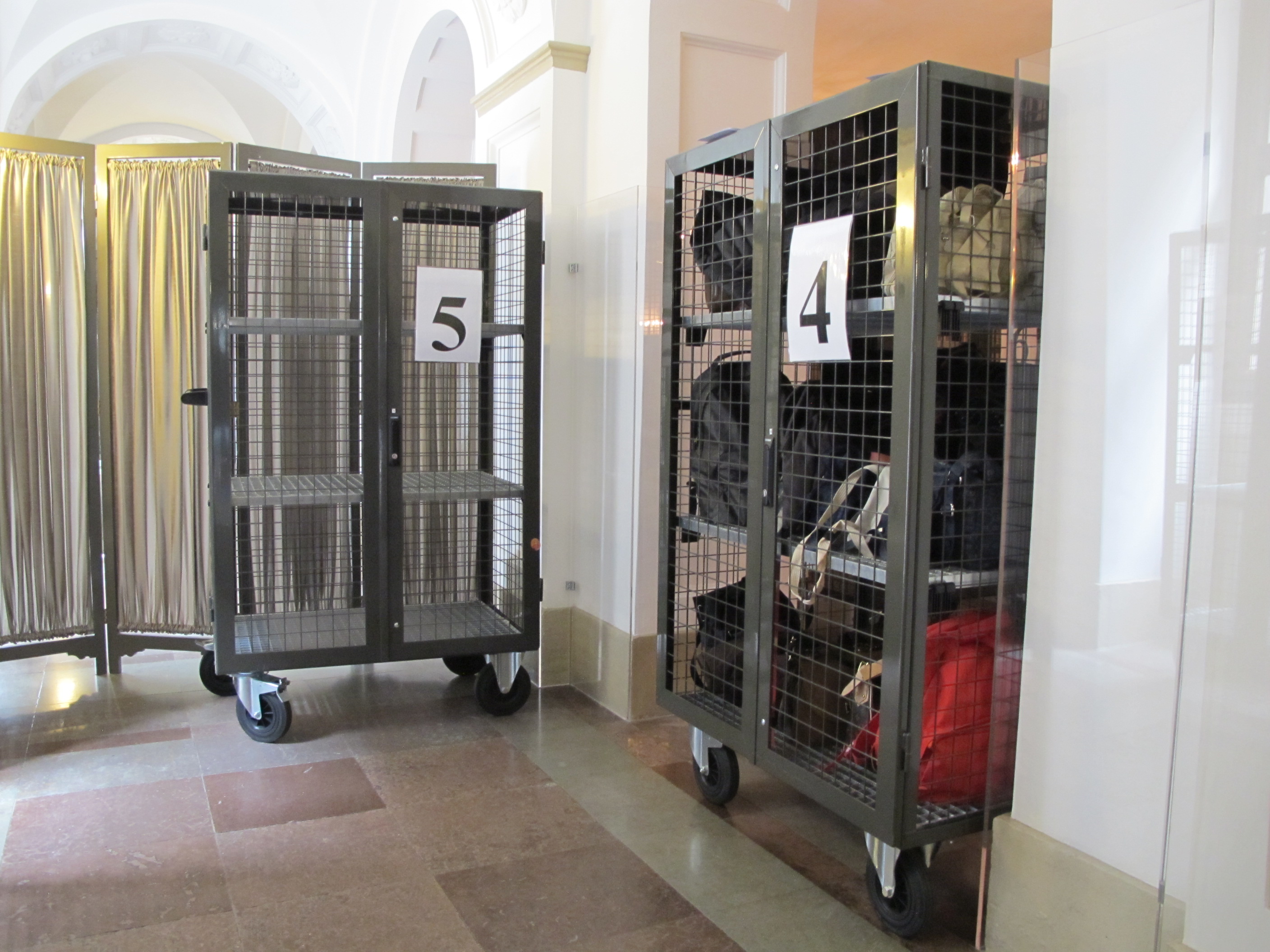
Security carts at the Dam, the royal palace in Amsterdam.

Security carts at the Dam, the royal palace in Amsterdam.

The Dam, the royal palace in Amsterdam, uses tall carts with steel shelves that are enclosed with steel mesh.  Not only can they be locked for security (nowadays, kids are carrying expensive electronics) but still allow for visibility inside.  They’re designed for moving valuable parts in warehouses and called “security carts”–many versions are available.

If you’ve found other clever way to handle student belongings during field trips, please share them in the comments below.


A Process for Rethinking the Historic House Museum

Mission-Sustainability Matrix Next week I’ll be at the Margaret Mitchell House in Atlanta, Georgia leading a workshop with Ken Turino of Historic New England on the rethinking the historic house museum.  We’re not the only ones who are working on this topic, indeed, Michelle Zupan at Hickory Hill  assembled a five-page bibliography of books, articles, and dissertations for the workshop, so long that I’m hesitant to distribute it because it could be discouraging (“what? I have to know all this to rethink my historic house?”).

And if we want to go beyond historic house museums, the list would be even longer. Businesses have been “rethinking” for decades in order to grow in size or increase their profits.  They have the resources to study this topic rigorously and there is a lot we can borrow for our field (and much that doesn’t apply and can Continue reading

Looking to Improve the Deaccessioning Process at Your Site?

collections avalancheThe Active Collections group is developing a new model to streamline the deaccessioning process, but they need information about current practices at house museums and historic sites to figure out how to best go about this.  If you’d like to share what’s happening at your institution as well as your thoughts on the process and impact of decessioning, please take their online survey.  This is part of a field-wide survey, so we really want to be sure historic sites and house museums are well represented.  To learn more, visit ActiveCollections.org.

If You Visit the Netherlands, Get a MuseumKaart

Museum KaartI’ve just returned from a week-long study trip to the Netherlands, a whirlwind visit that included nearly two dozen museums and historic sites, thanks to the MuseumKaart.  This card provides free (and sometimes discounted) admission at most museums in the Netherlands for a year.  It can be purchased at any participating museum for €55 and although it was a lot of money to pass over on my first day, I received it back quickly because admission fees range from €5 (Edam Museum) to €17.50 (Rijksmuseum).  As a museum geek, they definitely lost money with me. Even better, it’s good for a year, unlike the 1-3 day “I am Amsterdam” card, so there’s no rush.  The card not only saved me money, but encouraged me to see places I wouldn’t ordinarily visit, such as the Museum of Bags and Purses or the Willet-Holthuysen Museum.

My week in the Netherlands was provocative and I’ll be sharing some of the best and most interesting experiences in the coming weeks.  In general, museums and historic sites in the Netherlands seem to:

Continue reading

Using Windows for Interpretation

Every historic site (well, perhaps 98% of them) have windows but they are rarely used in the interpretation.  Here are several ways to use windows to set the stage, enhance the experience, or provoke thinking.

1.  Windows can set the stage for interpretation

Dayton Aviation Heritage National Historical Park in Dayton, Ohio.

Dayton Aviation Heritage National Historical Park in Dayton, Ohio.

The easiest way is to use windows is as an introduction to the site by using a bold image or intriguing message that prepares the visitor for what’s inside.  Perforated vinyl is ideal for this situation because it can display graphics while allowing light to flow inside and permitting views outside.  At the Dayton Aviation Heritage National Historical Park, perforated vinyl signs on the two-story windows of the visitor center feature enormous Continue reading

Knowledge of US History Unchanged Overall for 8th Graders, but Differences Are in the Details

Average score changes between 2010 and 2014 in NEEP at grade 8 by subject.

Average score changes between 2010 and 2014 in NEEP at grade 8 by subject. To view the full report, go to NationsReportCard.gov.

The National Center for Education Statistics, which administers National Assessment of Educational Progress (NAEP, also known as the Nation’s Report Card), recently announced that overall academic performance of eighth-graders in U.S. history, geography and civics has remained unchanged since 2010, though Hispanic students have made gains in U.S. history and geography.

NAEP reports performance using average scores and percentages of students performing at or above three achievement levels: Basic, Proficient and Advanced. The Basic level denotes partial mastery of the knowledge and skills needed for grade-appropriate work; Proficient denotes solid academic performance; and Advanced represents superior work. The assessment is based on nationally representative samples of more than 29,000 eighth-graders in total across the country.

The 2014 results for U. S. history show that 18 percent of eighth-grade students performed at or above Proficient, which is basically unchanged from 17 percent in 2010 and 2006. There are significant differences by ethnicity: Continue reading

Reinventing the House Museum in Portsmouth

This slideshow requires JavaScript.

A sold-out crowd of history enthusiasts packed the auditorium at the Strawbery Banke Museum in Portsmouth, New Hampshire on April 21 to discuss ways to reinvent the house museum.  Sponsored by the American Association for State and Local History and the New England Museum Association, the one-day workshop explored ways that historic house museums can more successfully engage their community and improve their financial sustainability.

The morning featured several presentations and the afternoon was a hands-on workshop at a nearby historic house.  I opened the day with a process for developing a plan and then focused on Michael Porter’s Five Forces, a diagnostic tool that’s superior to SWOT for assessing a house museum’s strategic position.   Ken Turino of Historic New England provided a smorgasbord of ideas from house museums around the county to rethink existing conceptions.  Larry Yerdon, CEO of the Strawbery Banke Museum, discussed ways they are introducing new programs and activities to be both more engaging and financially sustainable.

After lunch, we gathered at the Governor John Langdon House, a property of Historic New England, where Joanne Flaherty and Linda Marshall led us on a quick inspection of the property and described its operations and recent efforts to use it for temporary exhibits.  Then the audience became temporary consultants using the Five Forces, analyzing existing and potential competition for exhibits, interests from visitors, and collaborating with exhibit providers.  The consensus seemed to be that an exhibit program could have a competitive advantage if it focused on the collections of Historic New England and may be better suited for rooms other than the parlor or dining room, which are architecturally significant.

This workshop will travel next to Atlanta, Georgia on June 12, where we’ll be using the Margaret Mitchell House as the case study.  To register and for more information, visit AASLH.org.


Reconstructing a Lost “Field Quarter”

In this 34-second time-lapse video, James Madison’s Montpelier in Virginia constructs a log “field quarter” (a dwelling for enslaved field workers).  It’s first constructed in a building to cut and fit all the pieces in a protected place during winter, then re-assembled in the field on a beautiful spring day in 2015.  It’s now on the exact spot where the foundations for a house were uncovered through archaeology (if you look carefully to the horizon on the left, you’ll see the Visitor Center).

Montpelier is in the midst of reconstructing many of the lost buildings associated with the enslaved African community, using archaeological and documentary evidence assembled over the past decade.  Their major project is the South Yard, six buildings next to the Madison’s mansion, which will be completed in the next few years, thanks to a generous gift from David Rubenstein.

Introducing Amazon “Dash Button” for Historic Sites

Amazon-Dash-for-Historic-SitesIn an exclusive partnership with Engaging Places LLC, Amazon.com has introduced a “Dash Button” for historic sites and house museums. Dash Button is a simple one-touch button that can be placed in your kitchen, bath, and laundry where you store your favorite products.  When you’re running low, simply press the Dash Button and Amazon delivers your household favorites to you so you can skip a last-minute trip to the store.

This innovative technology can be used for a variety of services, not just products, and Amazon and Engaging Places is launching Dash Button specifically for house museums and historic sites.  In the last year, the Dash Button has been field-tested with Continue reading

Video: Smithsonian’s Museum Goes High Tech

In this 3:35 video, The Verge interviews Aaron Cope, the head of engineering, about the new high tech exhibits at the Cooper Hewitt Museum, which is in the former home of Andrew Carnegie and part of the Smithsonian Institution.  The Cooper Hewitt closed for the last three years for an extensive renovation to imagine a museum that was part of the Internet and served as a bridge to their huge 130-million-object collection.