How a Classic Business Matrix Can Help Museums and Historic Site

BCG MatrixIn the 1970s, Bruce Henderson at the Boston Consulting Group (BCG) introduced the “growth-share matrix” to help its clients better manage a portfolio of business units and products.  The matrix facilitates management decisions by rating each product according to their share of the market and their potential for growth.  Putting each product in one of the four quadrants of the matrix graphically showed which ones were the stars, cash cows, question marks, and pets (cute but worthless).  More importantly, it showed the overall position and health of the company and suggested next steps.  For example, “cash cows” should be maintained and used to invest in “stars” but “pets” should be abandoned (sorry for offending pet owners, but calling them “dogs” probably won’t make it any easier).

During the past 40 years, the BCG matrix has become a classic tool for business strategy and Harvard Business Review recently named it one of the frameworks that changed the world.  Yet it is rarely used by museums and historic sites, who seem to favor the much more limited SWOT exercise.  It may be because non-profits are unaware of the matrix but it’s more likely that “market share” and “market growth” are unfamiliar or impracticable concepts.  I do like the idea of assessing our work in ways other than attendance and income, so I’ve revised the framework to make it more useful to museums and historic sites.

Mission-Sustainability Matrix
In this “mission-sustainability matrix,” Continue reading
Delaware’s Strategic Plan Meets AAM Standards

AAM's "Continuum of Excellence."

AAM’s “Continuum of Excellence.”

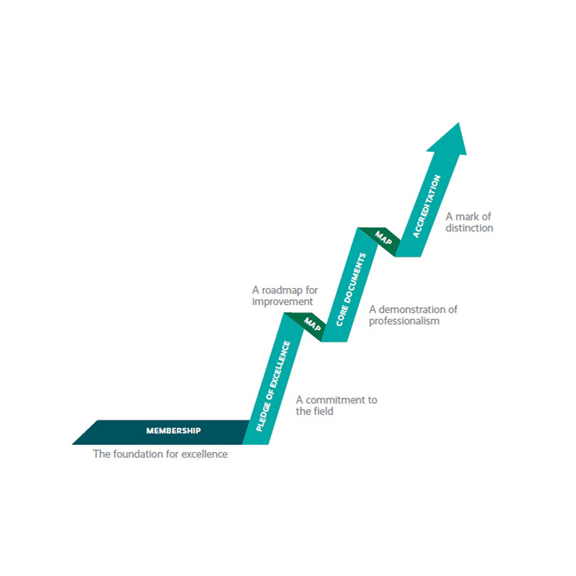
A couple years ago, the American Alliance of Museums introduced the Continuum of Excellence, a “multi-program structure [that] offers opportunities for various levels of assessment, feedback, and recognition that build on one another.”  It’s a significant expansion of the Museum Assessment Program and Accreditation process because it now includes additional intermediate steps, including verification of five core documents, including a strategic plan.

Delaware Strategic Plan FY15-FY19 coverLast year I worked with the Historical and Cultural Affairs Division of the State of Delaware to prepare a strategic plan that would meet or exceed AAM’s standards for professional museums.  The planning process was more complex than usual because it involved a state government agency that is responsible for over forty historic properties, five museums, a conference center, welcome center, historic preservation, and archaeology and has numerous local partners and affiliates. They also wanted a strong emphasis on team work and a heavy reliance on staff expertise, so the process included large and small group meetings, staff surveys, and community research to create a vision, core values, major audiences, goals, implementation, evaluation, and a budget within eight months.  Whew!

I facilitated the meetings and provided general direction, but the staff wrote, revised, and developed the strategic plan from beginning to end while still working their regular jobs.  I’m incredibly proud Continue reading

Video: Bens, the Legendary Deli

Cedric Conti produced this 2:00 video about “Bens, the Legendary Deli,” an exhibit currently on view at the McCord Museum in Montreal, Canada.  Includes French subtitles!  Bens Delicatessen, founded in 1908 by Benjamin Kravitz (1883-1956), closed in 2006 after nearly a century in business. The exhibition brings together some 100 objects, including posters, architectural plans, photos, counter stools, dishes, utensils, menus, recipes and testimonials that recount the history of this landmark, the very first of Montreal’s famous smoked meat restaurants.

Changing Attitudes About History one Grizzly at a Time

This slideshow requires JavaScript.

Politics and Prose, the famous independent bookstore in Washington DC, hosted a booksigning for Tim Grove, chief of museum learning at the Smithsonian Air and Space Museum, that attracted seventy-five listeners this past Saturday.  It’s not often that museum folks share a stage that recently included Patrick Buchanan, Timothy Geithner, Lynn Sherr, and Michelle Obama.  His talk will be aired on C-Span.

A self-professed history geek, Tim shares his love for history in A Grizzly in the Mail and Other Adventures in American History (University of Nebraska Press, 2014), a collection of stories from his years working at Colonial Williamsburg, Missouri Historical Society, National Portrait Gallery, and the National Museum of American History.   Tim wants to improve the public image of history by demonstrating the fun of history and “help history haters change their minds.” To do this requires provoking a deeper thinking about historical programs and activities to better link past and present  As he states in his book,

The staff at [Colonial] Williamsburg and other history sites wants visitors to “experience” history.  What does this mean?  One can visit Yosemite National Park and experience the beauty and grandeur of nature.  One can go whitewater rafting and experience the rush of the river and the cold wetness of the water as it splashes the face.  But experiencing history?  Do you experience history when you walk the hallowed ground of a battlefield or visit a historical house?  Experience in verb form implies action.  What action is actually taking place?

Tim demonstrates that “action” through a wide assortment of stories, from conquering a high wheel bicycle and questioning the significance of Eli Whitney’s cotton gin to navigating the legacy of Lewis and Clark, and yes, unpacking a grizzly bear Continue reading

Video: We Are Museums 2014 (Warsaw, Poland)

This 3:45 video gives a quick overview of We Are Museums, a two-day international conference on innovation and creativity within museums.  Hosted by the National Gallery of Art and the State Ethnographic Museum, it combines workshops, exhibitions, and presentations.  Presenters included Seb Chan of the Cooper-Hewitt National Design Museum and Sarah Hromack of the Whitney Museum of American Art.

Recent Articles on Historic Sites You May Have Missed

Stack of JournalsKnowing that most people working at historic sites don’t have access to an academic library, I thought I’d share a few articles around some major topics that caught my eye.  This is not a thorough review of the last 18 months, just a casual glance backward to highlight some studies that relate to the preservation, management, and interpretation of historic sites and house museums.

More Professors are Combining Local History and Service Learning to Engage Students

Henthorn, Thomas C. “Experiencing the City: Experiential Learning in Urban Environments.” Journal of Urban History 40, no. 3 (2014): 450-461.

Henthorn describes various student experiences to engage them in history, including a course on American urban history that combines an historical study of Flint, Michigan with an off-campus service learning project and a collections internship in automotive heritage at the Sloan Museum.

He concludes by finding that, “experience and place combine to prepare students for active citizenship.  This is arguably the most difficult to instill among students and in the same way one class will not change students understanding of a subject, one experience will not awaken in students a sense of civic responsibility.  At the very least, by linking the classroom with the community, students learn to respond creatively to critical issues confronting them.  But active citizenship requires Continue reading

Online Learning Opportunities for Historic Site Interpreters

The opportunities for sharpening your skills as an historic site interpreter continue to grow online, sometimes even for free.  Here are a sampling of a few non-degree granting organizations where you’ll find workshops and classes on the Internet to keep your thinking fresh and improve your technique.  All times are Eastern unless noted.

American Alliance of Museums

  • Embracing 360 Engagement, Widening the Circle.  September 2, 2014 at 2:00 pm Eastern.
  • Building Trust through High Performance, Becoming Essential.  December 3 at 2:00 pm.

American Association for State and Local History

  • Historic House Calls: Using Futures Thinking to Navigate Ongoing Change.  August 20, 2014 at 2:00 pm. Free for AASLH members.
  • Writing the Grant: What’s the Process Like?  August 27 at 3:00 pm.  $115; $40 members.

Coursera

Continue reading

Video: Museum of Water at Somerset House

This is a 2:38 amateur video documenting the “Museum of Water,” an unusual “live artwork” by Amy Sharrocks at the historic Somerset House, a new arts and culture center in London.

A melted snowman. Droplets from a baby’s bath. Sacred draughts from an Indian river. Just some of the items donated to London’s newest museum. In the atmospheric underground spaces of Somerset House, Amy Sharrocks invites you to consider our relationship with the most precious liquid the world has to offer.

Video: The Ragtrade: The Story of Flinders Lane

Melissa Rymer wrote, directed and produced this 14:50 video which was made in conjunction with an exhibition at the Jewish Museum of Australia. It is a small snapshot of some of the Jewish run businesses that operated out of Flinders Lane, the fashion district of Melbourne in the late 1940s through to the late 1980s.  It includes historic images intercut with oral histories of former employees and employers.

AASLH Annual Meeting in September Offers Lots for Historic Sites

Alexander Ramsey House in St. Paul, an historic site of the Minnesota Historical Society.

Alexander Ramsey House in St. Paul, an historic site of the Minnesota Historical Society.

Historic sites and house museums will find lots of educational sessions and workshops just for them at the upcoming annual meeting of the American Association for State and Local History on September 17-20 in St. Paul, Minnesota (the right half of the Twin Cities).  There are more than 70 sessions and workshops offered this year, so I’m only highlighting a few to show the diversity of topics on or about historic sites:

  • Putting the Native American Voice into Historic Sites
  • Saving the Charnley Norwood House
  • Interpreting Religion at Historic House Museums
  • Two Very Different Historic Houses Ask:  We Got the Money–Now What?
  • Telling a Whole History:  Methods of Interpreting Domestic Servants
  • Welcoming All Visitors:  Accessible Programs at History Museums and Sites
  • Diversity and Inclusion:  What Does that Really Mean for Museums and Historic Sites?
  • Diversity in Education:  Teaching About Slavery, Innovative Strategies, and Best Practices
  • Making the Invisible Visible:  Using Mobile Technology to Reach New Audiences, Improve Accessibility, and Breathe New Life into a Virginia Historic Site
  • Redefining Success:  Tips and Techniques for Training Interpreters to Talk About Slavery
  • They Can’t All be Museums
  • Pocket Change:  Moving a House Museum into the 21st Century on a Budget

Of course, there are many more sessions that address related topics, such as boards, fundraising, Continue reading