Tag Archives: American Association for State and Local History

Reimagining Historic House Museums Workshops Coming to Texas

Reimagining workshop in St. Louis, Missouri.

I’m excited to announce that I’ll be co-teaching two Reimagining the Historic House Museum workshops in Texas this November with Ken Turino, hosted by the American Association for State and Local History in collaboration with the Texas Historical Commission. It’s a big state, so we’re offering it twice! If you’re a museum professional, volunteer, or student interested in exploring fresh strategies for engaging visitors and revitalizing historic house museums, these workshops are a great opportunity to explore new ideas and connect with colleagues.

Why Attend?

Historic house museums are at a pivotal moment, navigating changes in visitor expectations, community needs, and funding models. These workshops are designed to help you tackle these challenges, offering practical solutions for making your house museum more accessible, sustainable, and relevant. By focusing on innovative interpretation, strategic planning, and community engagement, you’ll be empowered to breathe new life into your historic house museum.

What You’ll Learn

This one-day, hands-on workshop explores the most pressing challenges and rewarding opportunities facing historic sites in America today. We’ll delve into the latest social and economic research to help you identify how these trends impact your own house museum, sparking new ideas for growth and engagement.

Throughout the day, we’ll introduce a variety of field-tested tools and techniques drawn from diverse areas like non-profit management, business strategy, and even software development. You’ll hear about innovative historic sites that are successfully adopting new models to engage their communities, offering fresh interpretation and programming, and generating income to boost financial sustainability.

A key highlight of the workshop is our facilitated brainstorming session based on Michael Porter’s Five Forces framework, where you’ll work with fellow participants to reinvent an event or program for an actual house museum. This practical exercise not only puts theory into action but also showcases the power of collaborative thinking to drive change.

Details and Registration

  • Mesquite Workshop (near Dallas): November 12, 2024 – Heritage Plaza Visitor Center
  • Houston Workshop: November 14, 2024 – Bayou Bend Collection and Gardens
  • Cost: $350 for non-members, $225 for AASLH members
  • Registration: Visit AASLH’s website for more information and to sign up. Participation is limited.

I hope to see you there as we explore how to bring new life and relevance to historic house museums. Together, let’s make these vital cultural spaces vibrant, engaging, and sustainable for generations to come!

Interpreting Christmas Debuts to Enthusiastic Response at AASLH Conference

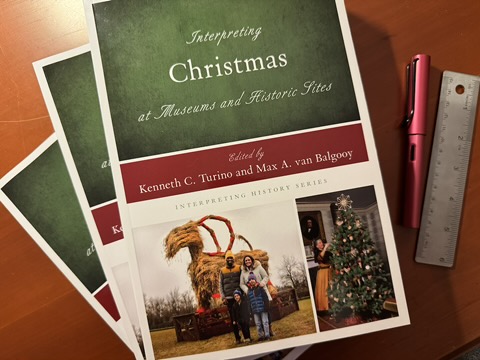
While I was traveling in England over the past few weeks, Interpreting Christmas at Museums and Historic Sites was released in print. The book made its debut at the American Association for State and Local History annual meeting in Alabama, where my co-editor, Ken Turino, was on hand to sign copies. We were thrilled to see the book sell out on the first day of the conference! It’s now listed on Amazon’s Hot New Releases for the “museum industry.” We are incredibly grateful for this positive reception. This project has been years in the making, and Ken and I (and the contributors!) are delighted to finally share this resource with you. A sneak peek at the table of contents and introduction is available.

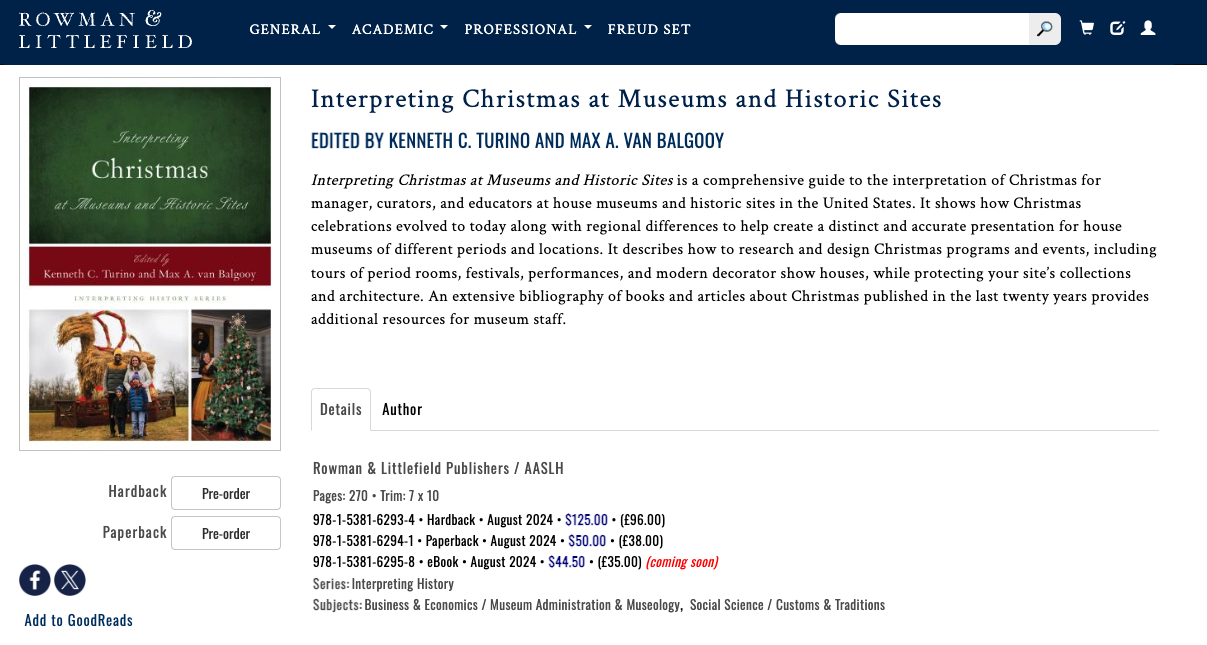
If you missed out on purchasing a copy at the annual meeting or were unable to attend, you can order it online at Rowman.com or mail this order form. Use code RLFANDF30 at checkout to save 30%. This discount is available through September 2025. The book officially releases on September 20, so it should ship immediately when you order.

For those attending the New England Museum Association annual conference in Newport, Rhode Island, we’ll be presenting a panel discussion on Christmas on Thursday, November 7, from 11:00 am to 12:30 pm. Joining us will be Laurel A. Racine, Supervisory Historian and Program Manager for the National Park Service; Patricia West, recently retired Curator of Martin Van Buren National Historic Site and author of Domesticating History: The Political Origins of America’s House Museums; and David Rau, Curator of Visitor Engagement at the Florence Griswold Museum.

If you’ve had a chance to read Interpreting Christmas, we’d greatly appreciate a review on Amazon.com. Since history museums and historic sites are such a specialized field, your feedback can help others make more informed purchasing decisions.

Amazon’s Hot New Releases for the “museum industry for September 2024.

Learning Outcomes for the Semiquincentennial

In a previous post, I offered a detailed guide on using the “Verbs for Significant Learning Outcomes” framework. However, I find that many people benefit from concrete examples, particularly when it comes to the deeper learning experiences—the “yellow” ones related to the human dimension, caring, and learning how to learn.

As a case study, let’s use the “Unfinished Revolutions” theme from the Making History at 250: The Field Guide for the Semiquincentennial:

In the United States, the fight for liberty, equality, and justice has a long and complex history. Through formal politics, grassroots organizing, boycott, protest, litigation, war, and a wide range of other mass and individual actions, people have continually challenged America to live up to our highest ideals—often drawing on ideas expressed in our founding documents. Before, during, and after the Revolution, people have fought for their rights to life, liberty, and the pursuit of happiness and worked tirelessly to secure the blessings of liberty for themselves and their posterity. This history is not a consistent march of progress, but a complex story full of both advancements and setbacks. These stories reveal the ways the Revolution began before 1776 and reverberates through to the present.

Examples of Outcomes

Some potential outcomes for adults during a two-hour visit to a history museum or historic site based on the Unfinished Revolutions theme are:

Foundational Knowledge

1. Visitors will identify three key figures and three pivotal events in U.S. history that significantly contributed to the fight for liberty, equality, and justice.

2. Visitors will describe two core principles from the U.S. founding documents and their influence on major social justice movements.

3. Visitors will define and contextualize three essential terms related to equality and fairness, such as civil rights, freedom, and suffrage.

Application

Continue reading

A Sneak Peek at “Interpreting Christmas”

Ken Turino, Sara Bhatia, and I are currently compiling the index for our book Interpreting Christmas at Museums and Historic Sites, while the other authors are meticulously reviewing the proofs for any final corrections. But we are much more excited to announce that we have a colorful cover featuring images from Old World Wisconsin and Strawbery Banke, and that Rowman and Littlefield have made the 270-page book available for pre-orders at this link.

To get a start on the holidays, join us in July when we’ll be hosting a live AASLH webinar, “Jingle All the Way: Maximizing Your Museum’s Holiday Potential.” Drawing from some of the insights in the book, we’ll discuss how your historic house or history museum can leverage December’s holiday season to enhance community engagement.  Mark your calendar for July 23 at 3 p.m. Eastern and secure your spot by registering here for $45 ($25 for AASLH members).

For a preliminary glimpse inside Interpreting Christmas, I’m sharing the proofs for the table of contents and introduction. Just remember, they’re publisher’s proofs so they are subject to change!

Reimagining the Historic House Museum coming to Maryland in April

The Reimagining the Historic House Museum workshop at the Decorative Arts Center of Ohio in June 2023.

“Reimagining the Historic House Museum,” the one-day workshop co-led by me and Ken Turino (Historic New England) will be held on Friday, April 19, 2024, from 8:30 am to 5:00 pm at Montpelier, a 1780s house museum in Laurel, Maryland (between DC and Baltimore). This workshop is part of the professional development series produced by AASLH. Registration is $325 but it’s $200 for AASLH members (and you receive an additional $50 discount if you register by March 22!). Participation is limited to 35 people.

Our workshop, while inspired by the book Reimagining Historic House Museums (2019), provides a more comprehensive hands-on exploration of house museums’ challenges. We assess current programs using a “double-bottom” line for a holistic view, analyze influencing forces to pinpoint opportunities and hurdles, and spotlight how house museums have successfully reinvented themselves. While the day is rich with information and activities, we ensure a well-deserved lunch break and networking time. You’ll leave with new tools and ideas to enhance your historic site and have an enjoyable experience.

Back to AASLH in 2024: Proposing Sessions, Supporting Colleagues, and Visiting the Clotilda

It’s been several years since I attended an AASLH annual meeting due to the pandemic and conflicts with my teaching schedule, but I plan to be in Mobile, Alabama in September 2024 (I’m hoping to see the Clotilda–National Geographic called it the best museum that opened in 2023!). Professional conferences are one of the best ways to mentally stand above your daily work and compare what you’re doing with the rest of the field. You can compare experiences, solve problems, share solutions, and be inspired. Plus I can share meals with some of my colleagues (and meet new ones!).

I’ll not only be attending but hope to lead a session or two to support the good work happening at history organizations around the country. It’s a terrific way to work with others to address a hot topic, provide different perspectives on a common issue, and yes, shape the future of the field–so I hope you’ll join me in proposing a session to support your colleagues.

AASLH has moved beyond the traditional three-panelists-and-a-moderator format to include roundtable discussions, in-depth workshops, debates, and a series of quick presentations to allow more variety, so if you have an idea for an educational session, there’s probably an interesting way to present it. I’m having a hard time choosing!

Like most conferences, a committee reviews proposals to assemble the program. Because this is a national conference, they’re looking for sessions that address issues that are affecting history organizations nationally, offer a national perspective on a topic through a geographically diverse session, or relate to the conference theme. Avoid “show and tell” sessions about a program or event that’s unique to your organization and can’t be easily duplicated by others (plus they tend to be really boring self-congratulatory panels). Finally, the attendees want results to justify the time and money they’ve spent at the conference. What will they learn? It’s got to be more than “understand” and “appreciate”–that’s far too vague. By the end of the session, what will they specifically know, what will they be able to do, and how will they feel (e.g., more confident, less confused)?

AASLH is accepting proposals until December 20, 2023. Because proposals are prepared online, it may be difficult to know what information they are seeking, so I’ve attached a one-page summary of the core questions to answer.

Historic House Museum Summit This Week

This small selection of historic sites operated by The National Society of The Colonial Dames reveals the enormous diversity of house museums and historic sites in the United States.

In 2007, I helped organize the Forum on Historic Site Stewardship in the 21st Century, which resulted in an influential issue of Forum Journal that laid out the major challenges and opportunities, including the need for financial sustainability, a willingness to change in response to the needs of the community, and a balance between the needs of buildings, landscapes, collections, and the visiting public. It also recognized that museum standards may not be the best practices for historic sites and that the profession “must develop new measures, beyond attendance, that document the quality of visitor engagement at sites and the extent of community outreach beyond the bounds of historic sites.”

So what has happened in the 16 years that followed? We’ll find out this week as the American Association for State and Local History hosts a virtual summit on the Sustainability, Relevance, and the Future of Historic House Museums on July 11-12. Sessions will address measuring the impact of house museums, broadening interpretation, care of buildings and landscapes, and the evolution of mission statements.

Continue reading

Planning for the 250? This Webinar Will Help You Get Started

Join Conny Graft and Max van Balgooy on May 24 at 3:00 pm Eastern for a ninety-minute webinar on interpretive planning as we prepare for the U.S. 250th anniversary in 2026. To help you feel more confident in this specialized topic, we will discuss the basic process of interpretive planning, provide a simple rubric to develop goals, and distinguish topics and themes (and why themes are more valuable). As a bonus, we’ll briefly mention ways to identify target audiences and expand your thinking about methods and formats. Registration is $20; $10 for AASLH members.

It’s the start of a three-part series on interpreting the 250th at historic sites and house museums. Other sessions will dive into the field-wide themes for the 250th with Ashley Jordan (African American Museum in Philadelphia) and Steve Murray (Alabama Department of Archives and History) and offer an interactive platform to workshop ideas with fellow practitioners with Sarah Pharaon (Dialogic Consulting). Whether you have a clear tie to the Revolution or not, this webinar series will help you make history relevant and captivating for your audience. Attend all three webinars for $55; $25 for AASLH members.

The American Association for State and Local History is hosting these webinars. Scholarships to attend all three webinars are available on a first come, first served basis, thanks to support from the Classical American Homes Preservation Trust.

The Field of Local History at Your Fingertips—Free!

The third edition of the Encyclopedia of Local History, edited by Amy Wilson, is now available for free to members of the American Association for State and Local History. The print version is a nearly two-inch thick, 814-page resource to a wide range of topics related to the issues and practices in local history, but now available digitally as a pdf to AASLH members. This edition includes my contributions on mission, vision, values and house museums in the 21st century, plus a photo of the Gamble House—but there are dozens of experts who share their knowledge of the field in one place.

For more details, visit the AASLH Resource Center or you’re not a member, you can purchase it for $161.50 (hmm, membership is less than half that cost).

Reimagining Historic House Museums Workshops Returning in 2023

Our last Reimagining House Museums workshop was held at Dumbarton House in Washington, DC in June 2019!

Ken Turino and I will once again lead our workshops on reimagining historic house museums in 2023 after taking several years off due to the pandemic. Our first workshop will be held at the Gamble House in Pasadena, California on Friday, April 1 and our second will be held at the Decorative Arts Center of Ohio in Lancaster, Ohio on Thursday, June 22. AASLH is managing the workshop and registration is $325 but it’s $200 for AASLH members (and it’s $150 if you register by February 1!). Participation is limited to 25 people for the April workshop.

The workshop is closely related to the book, Reimagining Historic House Museums (2019), but we take a much deeper dive into the challenges facing house museums, assess current programs against a “double-bottom” line for a big-picture perspective, analyze the five forces that affect programs and events to find opportunities and obstacles, and highlight some of the ways that house museums have reinvented themselves. The day is packed with information and activities, but we take a good break in the middle of the day for lunch and we get to meet lots of other people who are working hard to make their historic site better. Plus it’s great fun!