Author Archives: Max van Balgooy

Unknown's avatar

About Max van Balgooy

President of Engaging Places LLC, a design and strategy firm that connects people to historic places.

Can You Tackle Today’s Tough Topics in a Garden?

200731_Longwood_Graduate_Program_Symposium_Fochs_Mackenzie-2_0This year’s Longwood Graduate Program Symposium will examine that issue with a top-notch series of nationally-recognized speakers on Friday, March 4, 2016 at Longwood Gardens in Kennett Square, Pennsylvania.  They’ve laid out a challenging agenda for dealing with topics such as environmental action, civic responsibility, and the evolution of public gardens as community assets. Here’s their description:

Public gardens and cultural institutions are centers of community, science, and art. Today’s society is often overwhelmed with debates in all of these areas. In a world where misspoken words amplify in a matter of minutes, how can institutions tactfully open discussion on today’s difficult topics? When and where do they provide research, resources, and opportunities to interact with new or contested ideas?

Sessions include: Continue reading

Visits to Historic Sites are a Humanities Indicator, says AAAS

Percentage of Americans Who Visited a Historic Park or Monument* in the Previous 12 Months, by Age, 1982–2012. Humanities Indicators, 2012.

Percentage of Americans Who Visited a Historic Park or Monument in the Previous 12 Months, by Age, 1982–2012. Humanities Indicators, 2016.

As part of their Humanities Indicators project, the American Academy of Arts and Sciences just released their analysis of visits to historic sites.  It shows that, “the percentage of people reporting at least one such visit in the previous year fell by more than a third from 1982 to 2012, with declines across most age groups.” At first, I saw this as a corroboration of the widely reported Survey of Public Participation in the Arts (SPPA), which the National Endowment for the Arts has conducted since 1982, but when I looked more carefully at the data, I realized it was based on the SPPA. So while there’s no news here, it does provide a useful summary:    Continue reading

New Deputy Director for Museum Services Appointed at IMLS

Paula Gangopadhyay, deputy director of museum services, IMLS

Paula Gangopadhyay, deputy director of museum services, IMLS

At Museums Advocacy Day, Kathryn Matthew, director of the Institute of Museum and Library Services, introduced the new deputy director for museum services, Paula Gangopadhyay.

I didn’t get a chance to meet her but she’s familiar with the challenges and opportunities that are faced by history museums and historic sites on a daily basis.  She was appointed last month and according to the IMLS web site:

She has worked in small, medium and large museums and cultural organizations, as well as government, business and education sectors, where she led systemic change and positive community impact at local, state and national levels. Ms. Gangopadhyay is a respected thought-leader on innovation in education and has been the recipient of several state and national awards and recognitions. Ms. Gangopadhyay has held a variety of positions including, serving as the Chief Learning Officer at The Henry Ford museums from 2008 to 2015; Executive Director of the Plymouth Community Arts Council from 2006 to 2008; Curator of Education, Public Programs, Visitor Services and Volunteers at the Public Museum of Grand Rapids from 2002 to 2006; and Executive Director of the Great Lakes Center for Education, Research and Practice from 2000 to 2001. She was Executive Director of the Commission for Lansing Schools Success (CLASS) from 1998 to 2000 and Executive Director of Meridian Historical Village from 1995 to 1998.  As an independent evaluation consultant for over seven years, she has led formative and summative evaluation directed at producing measurable outcomes. Gangopadhyay received her B.A. and M.A. in history from Indore University (India), her post-graduate certification in archival, museum, and editing studies from Duquesne University, Pittsburg, PA, and an education policy fellowship from the Institute for Educational Leadership (IEL).

She’ll probably be visiting national and regional museum conferences this year, so be sure to welcome her!

A Wet but Successful Museums Advocacy Day

This slideshow requires JavaScript.

Washington DC was cold and grim yesterday as hundreds of museum advocates visited the offices of senators and congressmen to encourage their support for the Institute of Museum and Library Services and the charitable tax deduction.  I had a short but very productive meeting with the staff in Congressman Van Hollen’s office, who has been a long-standing supporter of museums, libraries, and historic preservation, so despite the wet weather, my day felt great. I was also reminded how many other people are also promoting their causes and how easy it is for the value of museums and historic sites to get drowned out by others.

On Monday, we prepared for our visits with several solid briefings on IMLS and education policy, hearing some good news (the American Institute for Conservation will manage the Conservation Assessment Program, following the dissolution of Heritage Preservation) and some frustrating news (the recently adopted Every Student Succeeds Act restores history and civics to the curriculum but President Obama’s recently submitted budget eliminated the funding).  Of course, it was really fun seeing colleagues from around the country and hearing about the interesting work they’re doing (l discovered Building Public Will for Arts and Culture, which is surprisingly similar to the History Relevance Campaign).

Thanks to the American Alliance of Museums for coordinating this event!

Should Tour Guides be Tested and Certified?

tour-guide-antwerpAt the end of last month, the California Tour Guide Act (AB 836) died in committee in the California State Capitol. If it had passed, it would have established a “tour guide certification program” through the California Travel and Tourism Commission to test and certify persons who “practice tour guiding for compensation” (it would exempt guides who work at museums and amusement parks). The bill’s authors wanted to ensure that tourists “get the most of their visit and return to the Golden State.” It’s also a big business. According to the California Travel Association, the travel industry generated $106.4 billion in revenue from visitors and contributed $6.6 billion in state and local taxes in 2012. In 2013, California hosted nearly 16 million international visitors and is expected to grow at over 5 percent annually through 2016. To support this volume of visitors, nearly one million people work in the travel and tourism industry, including 3,000 tour guides.

We can debate various aspects of the proposed law, such as the $700,000 annual cost to manage the program or the need for a criminal background check, but I was more intrigued by the requirement that tour guides must have completed a “curriculum in California tour guiding and related subjects,” including “tour guide safety and California geography, history, and culture.”  How is that defined?  How is that evaluated?  The proposed law left the standards to Continue reading

Researching the Interpretation of Slavery in Louisiana

Research Trip 2015 MapJames Madison’s Montpelier is in the midst of expanding its interpretation of slavery thanks to a generous gift from David Rubenstein.  To explore potential interpretive techniques and content that could be adopted, we conducted a three-day research trip to visit a wide range of sites in Louisiana. Staff had visited most of the sites in Virginia, and so we sought a location that most of us had not visited but had a large concentration of historic sites that interpreted African American history before emancipation. Because the experience helped us question assumptions, think more deeply about outcomes, and expand our catalog of ideas, I’m sharing our itinerary with you to encourage you to visit. Our research trip started with two days to make a big loop through Baton Rouge and New Iberia to visit several historic sites and finished with a day in New Orleans. In future blog posts, I hope to discuss some of the sites in more detail.

Day 1: Whitney Plantation, Laura Plantation, and Oak Alley.  Our initial plans also included Evergreen Plantation but the timing didn’t work out, even though these sites are within ten miles of each other.

Day 2: West Baton Rouge Museum in Port Allen (near Baton Rouge) and Continue reading

How a Kitchen Timer Makes Me More Productive

My work has always involved a lot of writing, whether it’s historical research, a grant application, a project proposal, a newsletter article, or a report to the board. But writing is hard work, especially if it has to be a good product, which means several revisions.  I’m rereading On Writing Well (the 30th Anniversary Edition–yikes! have that many years passed) and William Zinnser reminds us that, “the professional writer [that’s nearly anyone in our business] must establish a daily schedule and stick to it.”  Over the years, I’ve kept track of the habits of prolific writers and they seem to write in the mornings, which is the schedule I’ve adopted.  Nevertheless, I’m still challenged by “sticking to it.”

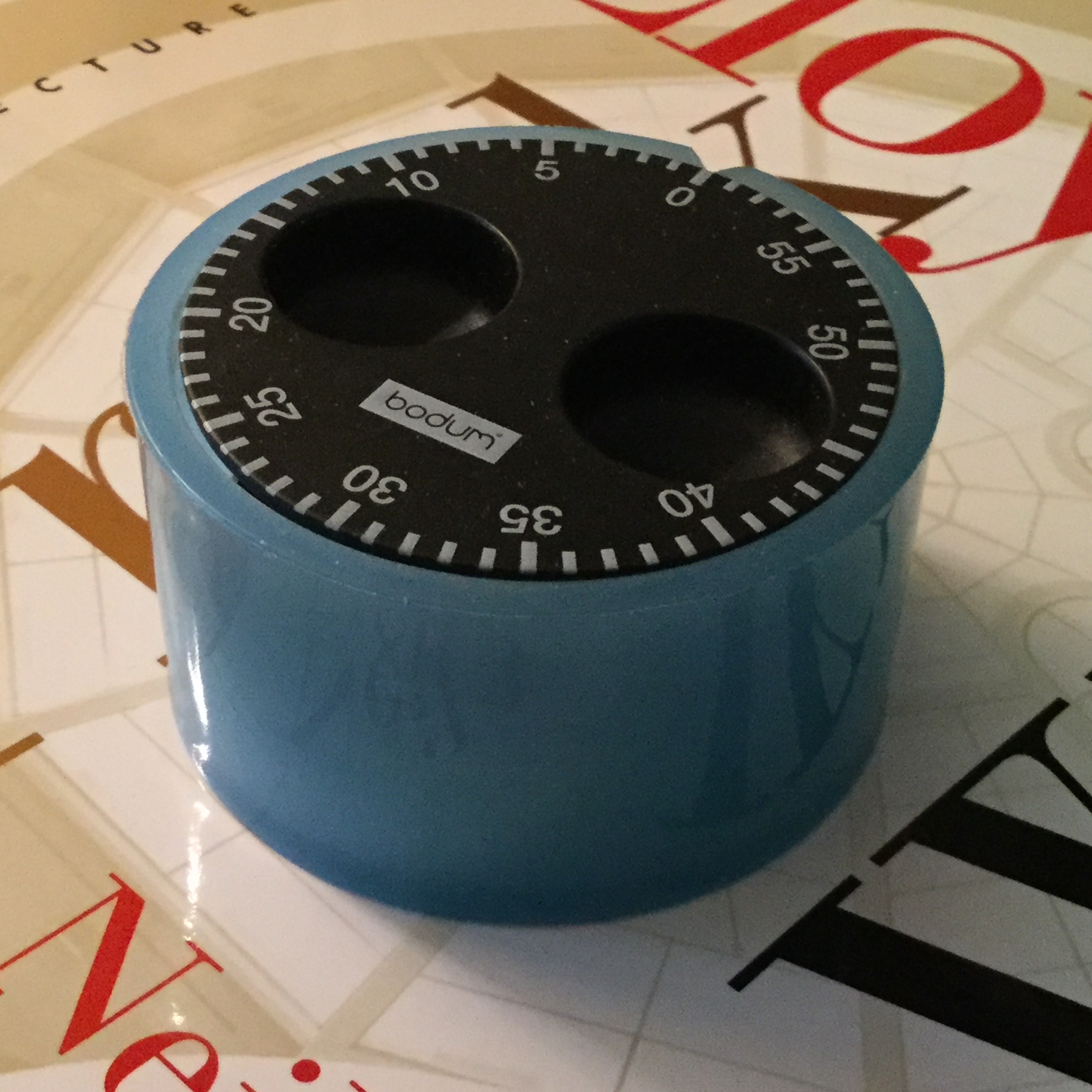
The kitchen timer that's on my office desk.

The kitchen timer that’s on my office desk.

To my rescue came the Pomodoro Technique developed by Francesco Cirillo, a time-management method that relies on an ordinary kitchen timer (which are sometimes designed to look like a tomato or pomodoro in Italian).  Set the timer for 25 minutes and while the clock is ticking, stay focused on your work. When the time is up, take a five-minute break and then return for another 25-minute session. It’s designed so that the sessions are short enough to encourage you to stay at the task at hand (“I can write for 25 minutes!”) while including routine breaks to be sure you don’t burn out (and really get discouraged).  It’s been the primary way that I stay productive and thought it might be useful for others who are also trying to stay disciplined.

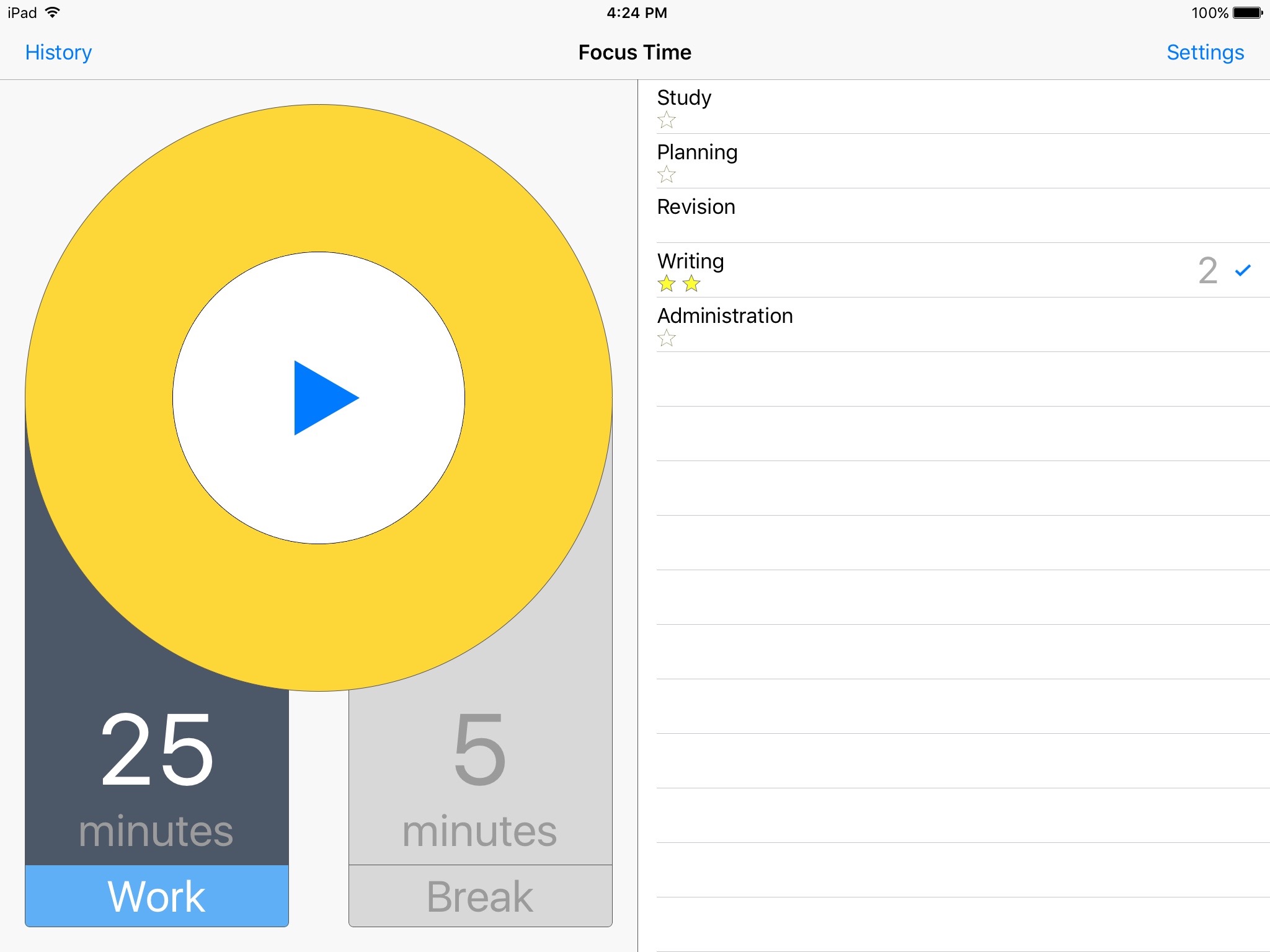
Focus Time app for OS and iOS.

Focus Time app for OS and iOS.

And while the kitchen timer is still on my office desk, I now use Focus Time, an app on my iPad, because it allows me to categorize my work as well as provide a timer that’s visual, not just auditory (plus I can choose the sounds for the ticking and ending). This year I’m also expanding my writing toolbox by using Evernote and a Fujitsu ScanSnap iX500 along with Scrivener, all unusual tools that take time to learn but once mastered, can be immensely helpful.  I’ll share my experiences in future posts.

Video: Non-Profit? Most Museum Visitors Don’t Know

In this 1:51 video, Colleen Dilenschneider of Know Your Own Bone explains that nearly 60 percent of Americans don’t know that history museums operate as non-profit organizations.  It doesn’t get much better for those who visit history museums—53 percent are unaware.  That may be alarming because we often distinguish ourselves by our non-profit status.  Dilenschneider, on the other hand, suggests reframing the issue:

Our key differentiator is not our tax status, but that our dedication to making a difference is embedded in the very structure of how we operate. There’s a thought that we need to run “more like for-profit companies” (and in some ways we do, but the blanket directive is an ignorant miss). But look around. For-profit companies are actually trying to be more like us in the sense that they want audiences to know that they stand for something that makes the world a better place.

The video is a quick overview but you’ll find more details in “Nonprofit Recognition: What Matters More to Visitors Than Your Tax Status“.

Data source: National Awareness, Attitudes and Usage Study, a partnership project of IMPACTS Research and the Monterey Bay Aquarium.

Video: Keep the Smartphone, Ditch Bad Management

In this 3:42 video, Jennifer Deal, a senior research scientist at the Center for Creative Leadership in San Diego, California, discusses recent studies that suggest that staying connected to work after hours isn’t the problem, but how organizations respect their people’s time. According to her research,

We found that although a majority of our participants were connected to work for 13.5 or more hours a day, five days a week, and for about five hours total on weekends, they didn’t resent their smartphones. Instead, 60 percent said they appreciated the increased flexibility: Many explained they didn’t mind the additional hours connected with work, if that meant their work time was flexible and they could better fulfill their personal obligations. What did they resent? Having to stay connected because of bad management practices that tied their hands, forcing them to spend business hours waiting instead of working.

She provides some suggestions for improving meetings and office practices, but you’ll find more in “Stop Wasting Your Employees’ Time” at Strategy + Business.

Historic House Workshops for the New Year

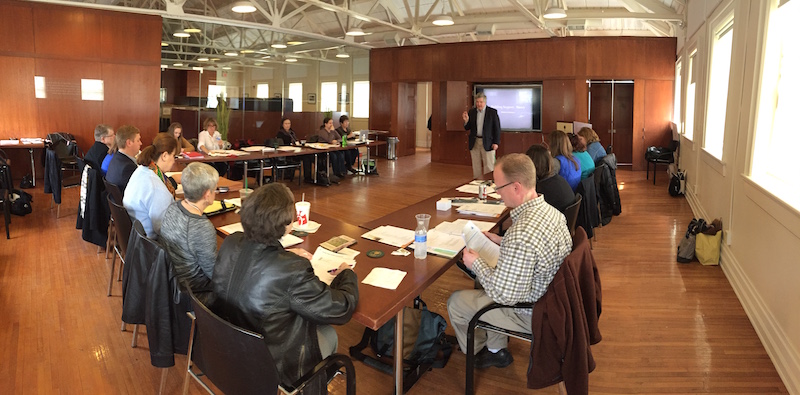
Historic House Museum Workshop, Charleston, South Carolina, 2015

Historic House Museum Workshop, Charleston, South Carolina, 2015

If want some time to plan and evaluate what’s happening at your historic site or house museum, one of the best ways is through a workshop. Of course, a long weekend of reflection in the Rockies or Virgin Islands might be more relaxing, but a workshop with colleagues discussing the potential solutions to the challenges facing historic sites will be more effective.

AASLH is offering two workshops this year just for house museums and historic sites, and I’ll be part of both of them:

April 4: Reinventing the Historic House Museum at the Campbell House in St. Louis, Missouri

This one-day symposium is designed to offer current thinking, practical information, and solutions to the challenges facing historic sites. The historic house museum in America is not dead nor are most of them dying. The field, however, needs to take time to reflect and renew as the world around our historic sites continues to change. The symposium will include presentations, discussion, a boxed lunch, historic site visit, and a brainstorming workshop at the historic house museum to try out the new ideas proposed during the symposium. Workshop led by Ken Turino (Historic New England) and Max van Balgooy (Engaging Places). (There may be a second Reinventing workshop offered this year.)

April 28: Historic House Museum Issues and Operations at Brucemore in Cedar Rapids, Iowa

Why are historic houses necessary to their communities? How are historic house museums unique? This workshop focuses on the special needs, management, and interpretation of historic houses. With a focus on historic house museums, topics covered include collections care, types of research appropriate for historic house museums, exhibition development, interpretive tours, volunteers, and building and landscape maintenance. Workshop led by George McDaniel (Drayton Hall) and Max van Balgooy (Engaging Places).

Can’t attend these workshops but are still looking for a shot in the arm? Join one of the quarterly Historic House Calls. Every call explores a different topic with an expert, and they’ve previously discussed deaccessioning, tours, interpreting race, and environmental sustainability.

AASLH has nearly two dozens way to sharpen your skills with some of your smartest colleagues in the history field and you’ll find a continually updated list on their calendar of events.