
I recently had an opportunity to visit the Occoquan Workhouse Prison, an early 20th century federal prison in northern Virginia, which was transformed by Fairfax County in 2008 into the Workhouse Arts Center, a collection of 100 artist studios and galleries. Once regarded as a model for reform-minded incarceration with open dormitory-style residences accompanied by honest work on the surrounding country farm, its image was soon tarnished by the imprisonment and force-feeding of the women who were picketing the White House for suffrage–which helped turn public opinion against the Wilson Administration. I had long known about this infamous event and wanted to get a better sense of the conditions. At the small museum on site, I learned much about the prison’s history and the struggle for woman’s suffrage, however, I also learned that Continue reading
Author Archives: Max van Balgooy

Compact Calendar for 2013
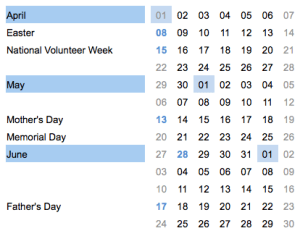
Detail from the Compact Calendar
Happy New Year!
For those who plan events, programs, and activities months ahead of time, I’ve updated my Compact Calendar for 2013 based on a design by David Seah. The entire year is listed on one page as a continuous series rather than broken out by months so you can quickly calculate time between dates and avoid getting messed up by months with five Mondays. In addition, it includes major holidays to schedule towards or around them, as needed. I’ll use the Compact Calendar to plot out all my events and deadlines for the year to ensure they don’t pile up too much in one place, and I’ll place a copy in a project file to have a handy calendar to determine milestones and coordinate tasks. If the last three sentences didn’t make any sense, you probably don’t need this calendar (and if they do, this calendar will make your year happier!).
For more time and project organization ideas, visit David Seah’s blog (I use his emergent task planner as well).
See You Next Year!
This will be the last post for this year as I close out 2012 with a couple weeks of vacation from posting on this blog (but I’ll probably be updating the design and layout). Thanks to all my readers and especially those who shared their thoughts, comments, and recommendations via comments and emails.
I launched the EngagingPlaces blog on October 24, 2011, so I’m also celebrating a one-year+ anniversary with some statistics for those who like them:
Most viewed posts for 2012
- HBO CEO named Mt. Vernon CEO; A Step Backwards IMHO (9,043 views)
- Let’s Give SWOT a REST (2,327 views)
- Embezzlement: Is it Our Dirty Little Secret? (2,172 views)
- Take Advantage of the Ten Cultural Trends for 2012 (581 views)
- Best Practices (568 views)
The top referrers for 2012 (how readers find the blog)
- Google Search
- Linked In
Not so much through Bing, Yahoo, Pinterest, delicious, or StumbleUpon. Although Google Reader and NetVibes weren’t among the top, their popularity surprised me so perhaps folks are becoming convinced of the benefits of news aggregators).
See you in 2013!
Donations Aren’t Keeping Pace with NPO Growth
 In its December 6, 2012 issue, the Chronicle of Philanthropy reported that, “the nonprofit world continues to grow both in number of organizations and in its share of the U. S. work force” but “fundraising isn’t keeping pace”–and the gap is especially wide for those working in arts, culture, and humanities (that includes historic sites and house museums). If you felt that you’ve been spinning your wheels in the last few years, you can now confirm it with some national statistics.
In the last decade (2000-2010), the number of charities that focused on arts, culture, and humanities grew at 45% but the rise in revenue was only 26%–the bottom of the eight fields studied. Compare that to health-related charities, whose number grew at 22.4% but their revenues rose by 96.6%. At the top of the revenue growth for the decade were Continue reading
An Interactive Holiday Calendar for Historic Sites
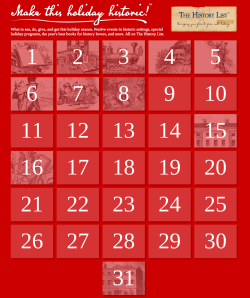
Make Your Holidays Historic at The History List.
Lee Wright at The History List has developed a clever interactive calendar for the holidays which highlights events at historic sites around the country with changing images and sounds wrapped in an attractive bright red package. It’s fun to play with it to find what’s hidden underneath each date and the best part is that any historic site or history organization can participate. So far, it includes a Victorian Christmas at the Ramsey House, a whiskey tasting at Jefferd’s Tavern, and a holiday masquerade at Tryon Palace. If you’d like to include your event, Lee provides instructions for participating via History List or Facebook.
December’s calendar is part of The History List’s, “Make this Holiday Historic” campaign, however, you can include events from the rest of the year as well. The History List is Lee Wright’s effort to create a one-stop place for history lovers to find places and events happening near them, whether at home or on the road, as well as provide a convenient, easy-to-use online calendar for Continue reading
The Many Flavors of Touring Historic Places
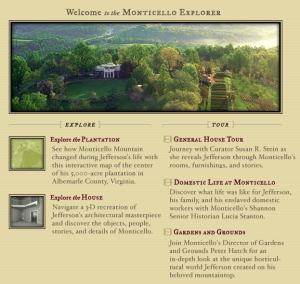
Monticello Explorer provides several virtual tours.
Although guided tours of period rooms is the most common form of interpretation at historic sites, audio tours, video tours, and virtual tours are growing in popularity thanks to technologies that are lowering the cost of production and increasing access to new audiences. From a short list of examples, the students in my “historic site interpretation” class at George Washington University developed a list of ten best practices for different types of tours of historic sites. You’ll discover that many of their suggestions emphasize the need for a plan, themes, and a focus–and projects that failed to have these elements were weaker and less effective.
A. Guided Tours of Period Rooms
Reviewed by Johanna Bakmas, Melissa Dagenais, Emma Dailey
- “Historic House Furnishings Plans” by Bradley Brooks in Jessica Donnelly’s Interpretation of Historic Sites (2002)
- “I Wish You Could Take a Peek at Us” by Nancy Bryk in Donnelly (2002)
- “Guidelines for Preparing Historic Furnishings Reports: an Annotated Sample of Contents” by the National Park Service (retrieved September 2, 2012)
- “When Values Collide: Furnishing Historic Interiors” by Carol Petravage in Preservation of What, for Whom? edited by Michael Tomlan (National Council for Preservation Education, 1999), pp. 151-158.
- “Historic Furnishings Report: William Johnson House” (NPS, 2004).
Suggested Best Practices
Do
- Develop an interpretive plan and themes
- Consult primary sources for the property
- Decide whether to have reproduction or original pieces Continue reading
Interpretive Planning at Historic Sites is a Three-Part Harmony
Historic sites and house museums probably represent the largest type of museum in the United States, and yet less than a handful of books or articles have been written about the interpretation of historic sites in the last fifty years. Part of this weakness can be attributed to the usual “last place” position that historic sites hold in terms of funding, staffing, and other resources, but it can also be due to the additional complexity of historic sites compared to other educational and cultural institutions. If you imagine interpretation as a melody, most museums can choose from all the keys on a piano and play the notes as desired, whereas historic sites have to play specific notes, such as the buildings and landscapes, and often in a certain order. Nevertheless, all museums have to address three primary areas to effectively teach and educate: content, audience, and method.

- Content: This comprises all the potential and unique Continue reading
A Second Helping of Local History from A to Z
 Local history lovers, rejoice–the second edition of the Encyclopedia of Local History has just been published by AltaMira Press. Under revision for the past few years by editors Carol Kammen and Amy H. Wilson, it’s a significant update from the 2000 edition and comes in at 655 pages as a result of 200 contributors and a gazillion entries (okay, I’m exaggerating a bit). Encyclopedias are for quick reference, not reading from A to Z , however, if you’re a local history buff, you would enjoy dipping in at random and learning about a topic (copyright or culinary history), organization (Cambridge Group or History News Network), or source (maps or inventories) from some of the best minds in the field including Stuart Blumin, John Bodnar, Simon Bronner, Michael Kammen, David Kyvig, Brown Morton, Mary Beth Norton, Sandra Oliver, Philip Scarpino, and Carol Shull. This encyclopedia also includes entries on every state of the union and Canada (and some other English-speaking nations), providing a Continue reading
Strategies for Year-End Fundraising Appeals
 Another post this week inspired by the Chronicle of Philanthropy, with the article, “Charities Unveil Bold Year-End Appeals in Storm’s Big Shadow” in the November 15, 2012 issue prompting several ideas that might be useful for historic sites as they come to the end of the calendar year with its year-end fundraising appeals. Hurricane Sandy and the 2012 federal election results are both affecting donations, with much attention given to disaster relief and to the possible limitation on charitable deductions. Can your year-end appeals:
- Emphasize your needs for storm-damage recovery or for disaster preparedness (e.g., roof replacement or repair, tree trimming, repairing gutters and downspouts, preparing a disaster plan).
- Encourage major donors to give big gifts now, rather than Continue reading
What We Can Learn from America’s Biggest Non-profits?
Philanthropy 400 is the Chronicle of Philanthropy‘s annual list of the 400 groups that raised the most funds from private sources. For 2011, these groups achieved a median 7.5-percent increase from last year, the third straight year of median gains for non-profits in the Chronicle‘s rankings. That’s amazing considering the depths of the recession that affected most charities. “Giving USA” said that charitable giving overall grew less than one percent last year. About $1 out of every $4 donated by individuals, corporations, and foundations goes to these top 400, so what can we learn from them?
The lessons are a bit hard to uncover given the wide diversity of organizations represented on the list, primarily universities, social services, and health/medical,, followed closely by religious, youth, and education. Topping the list are: Continue reading
 Engaging Places