Author Archives: Max van Balgooy

Unknown's avatar

About Max van Balgooy

President of Engaging Places LLC, a design and strategy firm that connects people to historic places.

Cooking Gene Project Raising Funds Online

Michael Twitty at the Sandy Spring Museum in Maryland.

A couple weeks ago I attended a lecture on the “world of a slave” at the Sandy Spring Museum in Maryland.  Kym Rice spoke about her recently published two-volume work, The World of a Slave: Encyclopedia of the Material Life of Slaves in the United States, which she co-edited with Martha Katz-Hyman of Colonial Williamsburg.  Many of you know Kym as the director of the museum studies program at George Washington University, but you may not know she is also working towards her Ph.D. in American Studies, focusing on African American history and culture.

Joining her was Michael Twitty, one of the contributors to the encyclopedia.  He gave a fascinating lecture on African American foodways but also discussed an upcoming research trip as part of his Cooking Gene Project:

From May to September, Michael will be going with a team of friends on several expeditions into the Old South searching for his own connections to his ancestors through food and cooking. The Southern Discomfort Tour–May to July–will form the bulk of these explorations and will incorporate diverse Continue reading

WebWise 2012: Learning and Participation on the Move

WebWise 2012 in Baltimore.

It’s been a couple weeks since the WebWise conference in Baltimore, but the information hasn’t gone stale yet.  It’s still cutting edge and thought-provoking because most of the projects discussed are still underdevelopment and it’s unclear if they’ll succeed or not.  However, they do provide a glimpse of current and potentially future practices in the use of technology for historic sites. The webcast videos are now available except for LeVar Burton’s presentation, which is waiting for broadcast permission. Heritage Preservation will be using portions of the webcasts to create webinars that will be available later this summer including, “Crowdsourcing in Public History” and “Oral History in the Digital Age.”

The first panel session, History Places and Spaces:  Learning and Participation on the Move, was moderated by Nancy Proctor and looked at the ways that mobile technologies (that is, technologies that are aware of your location) can provide new and better experiences for visitors.

Rob Stein at the Indianapolis Museum of Art opened the session by stating that the field already recognizes that location should be a required element in basic content but the challenge is the proliferation of software and hardware platforms.  Every digital device (website, cellphone, tablet) seems to be in a unique format and requires special treatment.  To overcome this, Stein suggested we rethink Continue reading

NEH Announces Recent Awards

The National Endowment for the Humanities recently announced the awards for the applications submitted in August 2011 (yes, 2011) for the “America’s Historical and Cultural Organizations” grant program.  Out of the 25 major grants awards (I’m not including the small NEH on the Road grants), about a third are related to historic places including:

El Presidio de Santa Barbara State Historic Park Visitor Center Plan

  • Santa Barbara Trust for Historic Preservation, Santa Barbara, CA
  • Award: Outright; $40,000
  • Planning for interpretive exhibitions and programs in a newly constructed visitor center about the history of Santa Barbara.

Impressions of a Lost World

  • Pocumtuck Valley Memorial Association, Deerfield, MA
  • Award: Outright; $40,000
  • Planning for a website, mobile applications, hand-held digital and print tours, public programs, and educational materials about the early nineteenth-century discovery of dinosaur tracks in the Connecticut River Valley and the impact of this discovery on American thought and culture.

Continue reading

Interpreting African American History if You’re NOT African American

Session on Interpreting African American history and culture, AASLH annual meeting, 2012

Last September, I had the privilege of moderating a session on interpreting African American history at historic sites in a room filled with some of the smartest people in the field during the annual meeting of the American Association for State and Local History.  The panelists–George McDaniel, Pam Green, David Young, and Tanya Bowers–gave outstanding opening remarks but even more engaging was the discussion that followed with the audience.  Because African American history can be a sensitive topic and to demonstrate a way to confront these issues among a group of strangers, I used a technique drawn from Great Tours (page 117).  Each person in the audience was given a 3×5 card and was asked to anonymously complete the sentence, “I would feel more comfortable talking about African American culture and history if…”  Among the responses I received were: Continue reading

EngagingPlaces.net Celebrates Six Monthiversary

EngagingPlaces.net is entering its sixth month of operation and it’s doing well, thanks to all of you readers.  Each month has shown growth in the number of views and this past week saw a record of number of views in one day (432!).  Even more important measures are the number of subscribers/followers and quality of comments so this blog is providing a useful service to those who are working to preserve and interpret historic houses, sites, and places.  For those of you like data, most people are referred to this blog via search engines (such as Google, Bing, and Yahoo), Facebook, Twitter, and LinkedIn.  Most people come to the blog searching for specific people (e.g. Anthea Hartig, Barbara Carson, Laurie Ossman) or trends (e.g., 2012 Mobile Computing Trends).

I’ve also noticed that about the same number of people subscribe to the blog as follow me on Twitter, so I’ll experimenting with the type and frequency of posts in each media.  I’ve recently shifted to 2-3 posts weekly on the blog and 2-3 tweets daily on Twitter, taking Friday-Sunday off (views drop off significantly on those days–are you all taking three-day weekends or facing information overload by the end of the week?).  The blog posts will be mostly original or extended content whereas in the tweets, I will share stories produced by others and on occasion, breaking news.

The advantage of the two different media is that you can control how much and how frequently you wish to be engaged with EngagingPlaces.net: Continue reading

Nonprofit Benchmarks for Online Communications

Email Messaging Benchmark infographic

Online communications–electronic newsletters, Facebook, e-fundraising, Twitter–have become a standard for non-profit organizations but often we’re unsure if they’re effective.  We can track the number of Facebook Fans or times an email has been opened, but those numbers mean little by themselves.  Benchmarking is one way to measure effectiveness and progress, and one of the easiest ways to do this is by comparing your results consistently over time (for example, number of Facebook Fans on December 31, 2012 compared to December 31, 2011).

But to really see how you’re doing, you need to compare yourself to similar organizations.  The American Association of Museums has developed an online benchmarking tool for comparisons across the museum field, however, it doesn’t include e-communications at this time (they’re collecting lots of data in other areas, though, so please participate).  M+R Strategic Services and the Nonprofit Technology Network just released its 2012 eNonprofit Benchmarks Study as an infographic to show the highlights.   These results are based on a study of 44 leading nonprofits in 2011 and among the many benchmarks are:

  • 12-15% of email messages are opened, with a response rate for advocacy around 4% and for fundraising at less than 1%.
  • The average one-time online gift is $62.
  • For every 1,000 email subscribers, nonprofits have an average of 103 Facebook Fans and 29 Twitter Followers.

The full study will be released on April 5 at the Nonprofit Technology Conference (although you can attend in-person free in Washington DC) and will be presented as a webinar on April 18.

Q&A: Managing Collections at Historic Sites with Terri Anderson

Terri Anderson

Terri Anderson is swapping history collections for art when she joins the Corcoran Gallery of Art next week as a Contract Registrar to help them migrate their collections database from Filemaker to TMS (The Museum System).  For the past five years, she has focused her work on collections management at the 29 National Trust Historic Sites as the John and Neville Bryan Director of Collections at the National Trust for Historic Preservation, where she also taught collections management for George Washington University and became one of the national leaders on the challenges of deaccessioning collections at historic sites.  With this transition, I thought it would be a good time to capture some of her thoughts about managing collections at historic sites.

Max:  You’ve been managing the collections of the National Trust for the last five years–what have been the major successes?

Terri:  Our most visible successes were opening several Sites to the public for the first time, including the Philip Johnson Glass House in New Canaan, Connecticut; President Lincoln’s Cottage in Washington, DC; and Villa Finale in San Antonio, Texas. Each of these Site openings required many important decisions about collections stewardship and access, and each Site demanded a different approach: one size did not fit all.

At the same time, we had successes that, while less visible, were important to me and the parties involved.  We did a lot of great work with thoughtful, appropriate deaccessions at several of our Sites.  I wrote about our experiences in Continue reading

OAH Report Claims History is Imperiled at National Parks

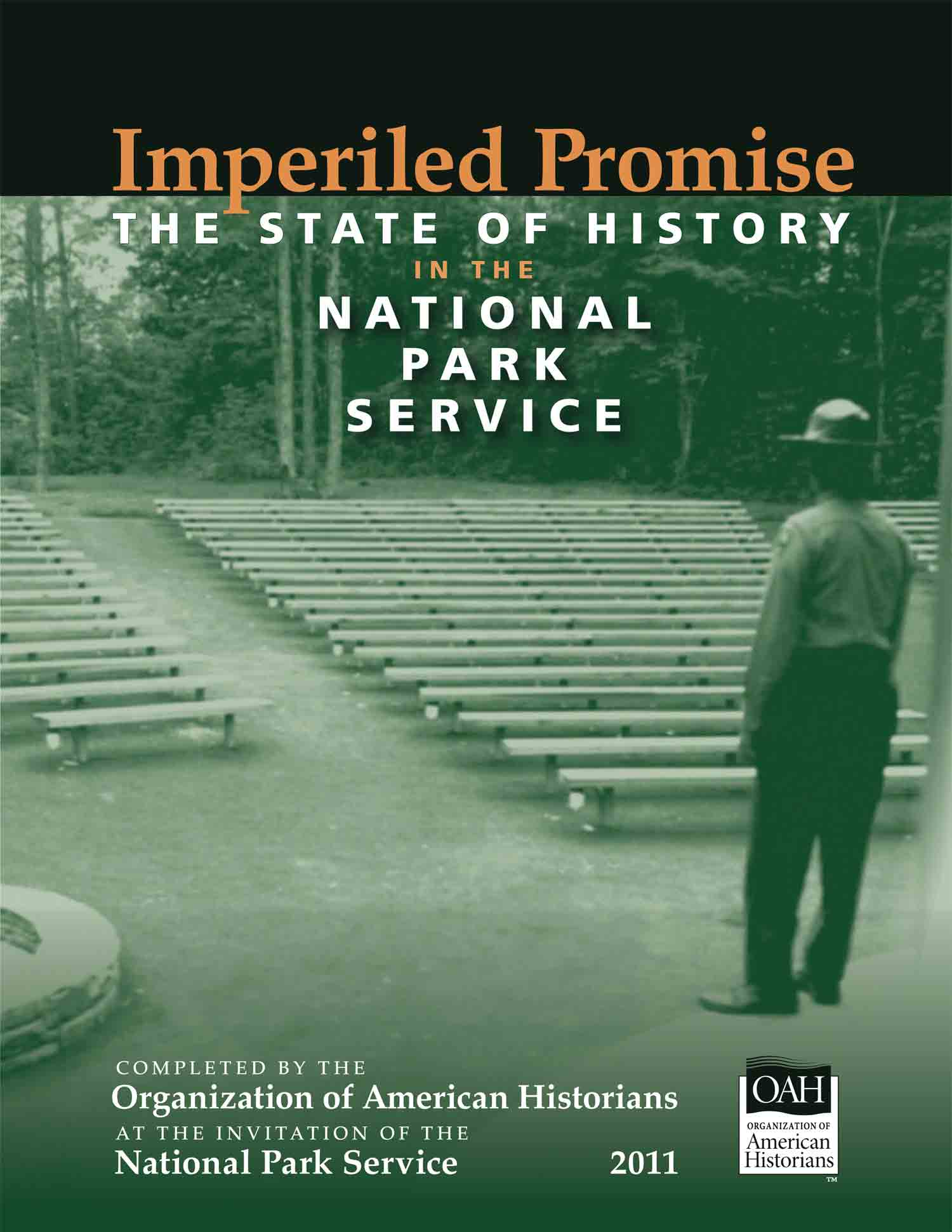
The Organization of American Historians recently completed an evaluation of the “state of history” at the National Park Service.  Four prominent historians–Anne Mitchell Whisnant, Marla Miller, Gary Nash, and David Thelen–led the study, which was based on more than 500 staff responses to an online survey, interviews with current and former staff, site visits, discussions at national meetings, and a review of past studies and reports.

Their analysis revealed that much good work is going on in such areas as reinterpreting slavery and the Civil War, negotiating civic engagement, sharing authority, developing interdisciplinary partnerships, encouraging conversations about history through new media, and collaborating with historians in colleges and universities.  These are presented through a dozen profiles of projects at such National Parks as Manzanar, the Olmsted Center for Landscape Preservation, San Antonio Missions, Harpers Ferry, and the Martin Van Buren National Historic Site.

Although they discovered that good work is being done in a few places, it is not “flowering on the whole” due to several intertwined issues.  Most significant is the report’s contention that, “the agency as a whole needs to recommit to history as one of its core purposes, and to configure a top-flight program of historical research, preservation, education, and interpretation so as to foster effective and integrated stewardship of historic and cultural resources and places and to encourage robust, place-based visitor engagement with history.”  These concerns are presented as a dozen findings, and from my observations, many also reflect what’s happening at historic sites outside of the National Parks.  For example:

  1. The History/Interpretation Divide.  The intellectually artificial, yet bureaucratically real, divide between history and interpretation constrains NPS historians, compromises history practice in the agency, and hobbles effective history interpretation. The NPS should find and take every opportunity to reintegrate professional history practice and interpretation. [In museums, this is comparable to the tensions found between curators and educators, where those who conduct research are often separated from those who teach.]
  2. The Importance of Leadership for History.  Without visionary, visible, and respected leadership at the top, and Continue reading

Historic House Management Workshop in DC Reveals National Issues

This slideshow requires JavaScript.

For two days last week, about two dozen people gathered in Washington, DC for AASLH’s annual Historic House Management Workshop.  George McDaniel and I have been co-teaching this workshop for more than a decade around the country and while all the classes are fun and interesting, the one we recently completed was unusual because it was held in two incredibly significant historic houses designed by two of America’s pioneering architects.  Special thanks go to AIA Legacy for hosting the meeting at the Octagon and the White House Historical Association for hosting the meeting at Decatur House.  The workshop usually attracts a diverse group of participants but this one especially so with a mix of curators, educators, conservators, directors, boardmembers, college professors, and consultants–it would have been great to conduct a charrette with them!

Each year we ask the participants to identify one issue they’d like to address in the workshop and Continue reading

Failed Organizational Culture at Goldman Sachs Suggests Remedies for Non-Profits

Greg Smith’s public departure from Goldman Sachs after a dozen years is one of the hottest pages of the New York Times today and while I tend to ignore the personnel matters of Wall Street (oh, another tycoon getting/losing/complaining about a bonus that’s more than the value of my house), reading his statement startled me.  So many of his concerns about the organization’s culture are shared by me and many of my colleagues in the museum and historic preservation fields:

1.  The overriding pursuit of money that’s out of balance with mission or ethics.  Smith describes a staff meeting at Goldman Sachs:

Today, many of these leaders display a Goldman Sachs culture quotient of exactly zero percent. I attend derivatives sales meetings where not one single minute is spent asking questions about how we can help clients. It’s purely about how we can make the most possible money off of them. If you were an alien from Mars and sat in on one of these meetings, you would believe that a client’s success or progress was not part of the thought process at all.

Gosh, if this bothers someone at a financial investment firm, shouldn’t the lack of discussion about fulfilling mission and vision really bother the board and staff at a non-profit organization?  And yet most meetings Continue reading