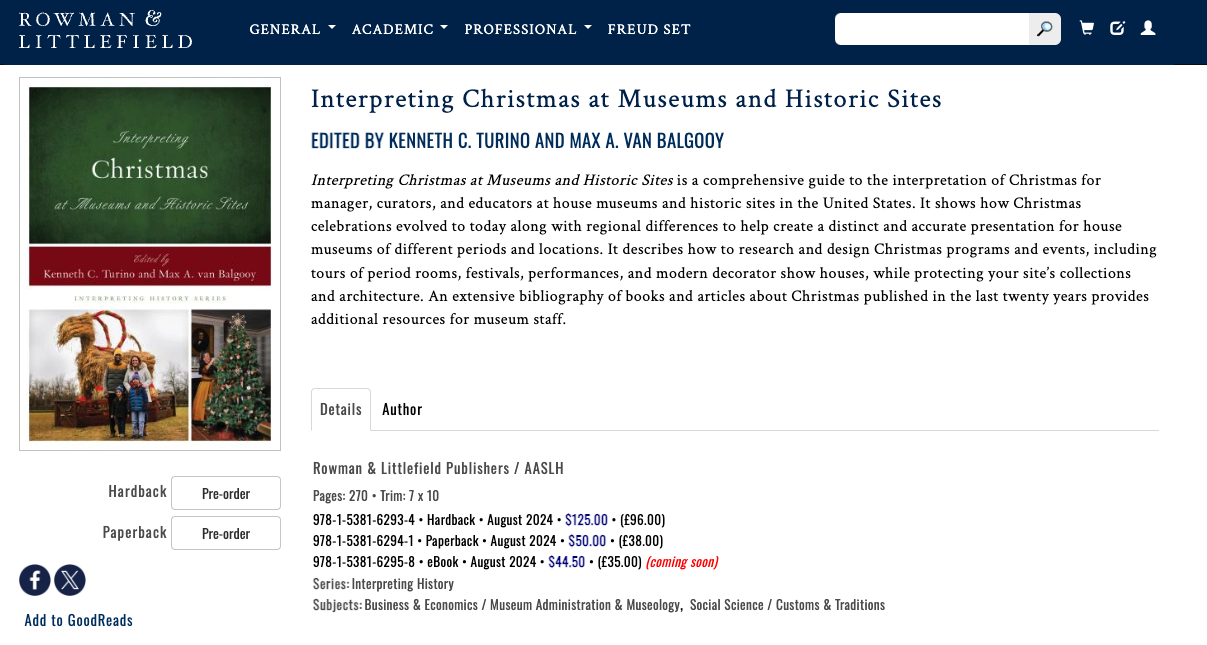
Ken Turino, Sara Bhatia, and I are currently compiling the index for our book Interpreting Christmas at Museums and Historic Sites, while the other authors are meticulously reviewing the proofs for any final corrections. But we are much more excited to announce that we have a colorful cover featuring images from Old World Wisconsin and Strawbery Banke, and that Rowman and Littlefield have made the 270-page book available for pre-orders at this link.
To get a start on the holidays, join us in July when we’ll be hosting a live AASLH webinar, “Jingle All the Way: Maximizing Your Museum’s Holiday Potential.” Drawing from some of the insights in the book, we’ll discuss how your historic house or history museum can leverage December’s holiday season to enhance community engagement. Mark your calendar for July 23 at 3 p.m. Eastern and secure your spot by registering here for $45 ($25 for AASLH members).
For a preliminary glimpse inside Interpreting Christmas, I’m sharing the proofs for the table of contents and introduction. Just remember, they’re publisher’s proofs so they are subject to change!
The Newport Summer School visiting one of the many historic houses in Newport, Rhode Island. Source: Victorian Society of America.
George Washington University recently awarded me a semester-long sabbatical for fall 2024, which will give me a break from teaching in the museum studies program and allow me to more actively pursue my interests in:
the early history of house museums to better understand their formation and evolution of interpretive practices;
the interpretation of house museums; and
the management of historic sites, especially in strategy and leadership to move performance up to the next level or respond to an ever-changing environment.
For a deep dive into these topics, I’m delighted that I’ve been selected for two prestigious programs:
In June, I will be in Newport, Rhode Island attending the Victorian Society’s Summer School. Over ten days, our class will explore four centuries of American architecture, art, culture, and landscape guided by renowned architectural historian Dr. Richard Guy Wilson. The program will delve into Newport’s rich history, often referred to as the “Queen” of American resorts, and includes exclusive tours of private homes, behind-the-scenes access to America’s grandest mansions, and insightful presentations by leading scholars.
In September, I will be in England for Royal Collection Studies, organized by The Attingham Trust for the Study of Historic Houses and Collections. This ten-day residential course in Windsor provides extraordinary access to one of the world’s leading collections of fine and decorative art, all housed within the grand architecture of the royal palaces. The course combines lectures and tutorials, visits to both occupied and unoccupied palaces in and around London, and close-up object study, aiming to give heritage sector professionals a deeper understanding of this remarkable collection.
If you’re working in a house museum or historic site, these specialized residential mid-career courses are both incredibly educational and refreshing. Participating in the Attingham Summer School in 2008 significantly enriched my scholarship, and fifteen years later I continue to draw upon the principles and practices learned during our site visits and insightful discussions. You’ll find a professional development experience for nearly any interest or length of time, and many offer scholarships. For example, if you’re seeking a course more focused on management, consider the History Leadership Seminar or the SEMC Leadership Institute (it appears that the [Getty] Museum Leadership Institute is no longer operating).
And alas, this schedule also means that my plans for attending the AASLH Annual Meeting in September will be postponed to 2025 in Cincinnati, Ohio. And if I don’t see you there, I hope it’s because you’ll be participating in an incredible professional development opportunity (remember to apply 6-8 months in advance!).
The Bethesda Historical Society, established in 2020 in Maryland, has made a commendable stride by crafting a collections management policy ahead of their growing collection of 400 artifacts and documents. Thanks to a local foundation grant, the Historical Society enlisted Mary van Balgooy from Engaging Places to develop a policy that aligns with professional standards and is manageable by a small organization using PastPerfect.
We’re thrilled to share this policy as a benchmark for small museums and historical societies. It succinctly addresses mission; roles of board, staff, and volunteers; ethical and legal aspects; collection scope, definitions, acquisitions, loans, documentation, appraisals, intellectual property, and policy reviews—all within a concise 15 pages!
Ken Turino and I started on Interpreting Christmas at Museums and Historic Sites three years ago and I’m delighted that it is now in production at Rowman and Littlefield. Our goal is to have the book available for the AASLH annual conference in September 2024, but that’s a very tight deadline, so no promises.
As part of the publication process, two colleagues reviewed the manuscript anonymously (thank you, whoever you are!) and provided lots of helpful suggestions along with the overall evaluation that, “With a superstar group of contributors, the editors have assembled a handy and engaging collection that offers abundant practical advice and interpretive guidance for public historians who are developing and running holiday programs. Museum educators, curators, interpreters, and managers will be thrilled to have such a helpful collection as a reference and guide.”
With the hope for publication in fall 2024, Ken is proposing a session for the NEMA annual meeting in Newport, Rhode Island, and for an AASLH webinar. If the book is out in time for the AASLH annual conference in September, the publisher will host a book signing. We also have a standing invitation for an interview on the NPS blog. If you have other suggestions for regional conferences or other presentations, please let Ken or me know. We are happy to consider any potential sessions or presentations about the book as a whole or a focused topic around research, diverse traditions, planning, and public programming.
The Reimagining the Historic House Museum workshop at the Decorative Arts Center of Ohio in June 2023.
“Reimagining the Historic House Museum,” the one-day workshop co-led by me and Ken Turino (Historic New England) will be held on Friday, April 19, 2024, from 8:30 am to 5:00 pm at Montpelier, a 1780s house museum in Laurel, Maryland (between DC and Baltimore). This workshop is part of the professional development series produced by AASLH. Registration is $325 but it’s $200 for AASLH members (and you receive an additional $50 discount if you register by March 22!). Participation is limited to 35 people.
Our workshop, while inspired by the book Reimagining Historic House Museums (2019), provides a more comprehensive hands-on exploration of house museums’ challenges. We assess current programs using a “double-bottom” line for a holistic view, analyze influencing forces to pinpoint opportunities and hurdles, and spotlight how house museums have successfully reinvented themselves. While the day is rich with information and activities, we ensure a well-deserved lunch break and networking time. You’ll leave with new tools and ideas to enhance your historic site and have an enjoyable experience.
Regular posts by me have been infrequent this year (and even last year!) due to an incredible amount of projects that have come across my desk, as well as travels here in the US and abroad.
Thankfully, Colin Gliniecki has helped with several posts on the financial condition of history organizations, which is part of a bigger personal project on strengthing the financial sustainability of historic sites and house museums. Colin received an MA in Museum Studies from George Washington University four years ago and with his undergraduate degree in business, I’ve relied on his extraordinary skills with Excel to analyze enormous sets of Form 990 data. (If anyone needs a museum data analyst, I’m happy to make an introduction.) We’ve finished the foundational series of posts around revenues and expenses and are now taking a step back to reflect on the work and determine next steps.
So next on the blog are more regular posts from me (weekly?), but they may take a variety of forms such as:
“reports from the field,” where I describe clever ideas from the museums and historic sites I encounter in my travels.
“reports from my garden,” describing what’s happening in my GW courses and commissioned projects.
books that are affecting my thinking about the management and interpretation of historic sites
personal projects (such as the Interpreting Christmas book)
I may be late to the game, but I believe video is the next big format that museums and historic sites need to embrace for interpretation and promotion. I’ve been testing the waters with a few videos, being pushed into the deep end by the pandemic when teaching went online:
The challenge is that video production is sloooooow but I’m determined to master it–and the only way to do it is by doing a lot of it. I’ve produced three in 2020, seven in 2023, so I definitely need to ramp up. Warning: the videos will be rough and drafty this year, so I’ll appreciate comments and suggestions!
It’s been several years since I attended an AASLH annual meeting due to the pandemic and conflicts with my teaching schedule, but I plan to be in Mobile, Alabama in September 2024 (I’m hoping to see the Clotilda–National Geographic called it the best museum that opened in 2023!). Professional conferences are one of the best ways to mentally stand above your daily work and compare what you’re doing with the rest of the field. You can compare experiences, solve problems, share solutions, and be inspired. Plus I can share meals with some of my colleagues (and meet new ones!).
I’ll not only be attending but hope to lead a session or two to support the good work happening at history organizations around the country. It’s a terrific way to work with others to address a hot topic, provide different perspectives on a common issue, and yes, shape the future of the field–so I hope you’ll join me in proposing a session to support your colleagues.
AASLH has moved beyond the traditional three-panelists-and-a-moderator format to include roundtable discussions, in-depth workshops, debates, and a series of quick presentations to allow more variety, so if you have an idea for an educational session, there’s probably an interesting way to present it. I’m having a hard time choosing!
Like most conferences, a committee reviews proposals to assemble the program. Because this is a national conference, they’re looking for sessions that address issues that are affecting history organizations nationally, offer a national perspective on a topic through a geographically diverse session, or relate to the conference theme. Avoid “show and tell” sessions about a program or event that’s unique to your organization and can’t be easily duplicated by others (plus they tend to be really boring self-congratulatory panels). Finally, the attendees want results to justify the time and money they’ve spent at the conference. What will they learn? It’s got to be more than “understand” and “appreciate”–that’s far too vague. By the end of the session, what will they specifically know, what will they be able to do, and how will they feel (e.g., more confident, less confused)?
AASLH is accepting proposals until December 20, 2023. Because proposals are prepared online, it may be difficult to know what information they are seeking, so I’ve attached a one-page summary of the core questions to answer.
Students assessing mission statements in a museum management course at George Washington University, fall 2022.
Today I’m teaching my third class of the semester on museum management and we are discussing mission, vision, and values. I assign each student a museum as their case study for the topics we explore through the course, which is brought together in an organizational assessment based on MAP as the final project.
Because mission, vision, and values are the foundations for managerial decision-making in non-profit organizations, they are a good place to start the semester because it will affect their thinking throughout the course. As part of our readings, we draw from chapters in Reinventing the Museum: The Evolving Conversation on the Paradigm Shift, Second Edition edited by Gail Anderson; What Management Is by Joan Magretta; Mission Matters: Relevance and Museums in the 21st Century by Gail Anderson; and the AAM’s Standards. Erin Carlson Mast, president and CEO of the Lincoln Presidential Foundation, joined us last week to discuss how the Foundation and President Lincoln’s Cottage developed their mission statements and how they affected their thinking.
This small selection of historic sites operated by The National Society of The Colonial Dames reveals the enormous diversity of house museums and historic sites in the United States.
In 2007, I helped organize the Forum on Historic Site Stewardship in the 21st Century, which resulted in an influential issue of Forum Journal that laid out the major challenges and opportunities, including the need for financial sustainability, a willingness to change in response to the needs of the community, and a balance between the needs of buildings, landscapes, collections, and the visiting public. It also recognized that museum standards may not be the best practices for historic sites and that the profession “must develop new measures, beyond attendance, that document the quality of visitor engagement at sites and the extent of community outreach beyond the bounds of historic sites.”
So what has happened in the 16 years that followed? We’ll find out this week as the American Association for State and Local History hosts a virtual summit on the Sustainability, Relevance, and the Future of Historic House Museums on July 11-12. Sessions will address measuring the impact of house museums, broadening interpretation, care of buildings and landscapes, and the evolution of mission statements.
Scholars reviewing the archives at the Haas-Lilienthal House.
The National Endowment for the Humanities, a federal granting agency, recently announced a special grant program to support interpretive planning at small organizations for up to $25,000, no match required.
What does “small” mean? You need to meet at least two of the following:
Annual operating expenses of less than $1,000,000
Located in a community with less than 300,000 residents
A staff of less than 50 people
Rely primarily on volunteers or part-time staff.
A mission to interpret under-told stories or serving a non-traditional audience
Hmm…that describes most history organizations in the US, so if you’re reading this post, you’re probably eligible.
Now, what will it support? Nearly anything that improves or enhances the interpretation of your collection, site, or community, such as:
help you think creatively about the hidden strengths of your collections or historic site
generate new ideas for engaging with the community
train staff and volunteers on interpretive methods and techniques
develop a framework for developing public programs
creating interpretive plans for exhibitions, tours, or school programs
visiting other historic sites or museums to sharpen skills and knowledge
evaluating existing tours or exhibitions
testing new programs for their ability to engage new audiences
conducting historical research to support new interpretive themes
Projects must include at least one scholar from a humanities discipline (e.g., history) or one consultant specializing in interpretation to the public (Engaging Places can help you with this), as well as at least one expert on your local community.
Applications are due June 28, 2023 for one to two year projects beginning between March 1 and May 1, 2024. You will need all of that time to prepare an application and NEH will read draft applications submitted by May 24. Remember to register in advance with the System for Award Management (SAM) and Grants.gov—those are steps you cannot do at the last minute.



 Engaging Places