Category Archives: Community engagement

Using Windows for Interpretation

Every historic site (well, perhaps 98% of them) have windows but they are rarely used in the interpretation.  Here are several ways to use windows to set the stage, enhance the experience, or provoke thinking.

1.  Windows can set the stage for interpretation

Dayton Aviation Heritage National Historical Park in Dayton, Ohio.

Dayton Aviation Heritage National Historical Park in Dayton, Ohio.

The easiest way is to use windows is as an introduction to the site by using a bold image or intriguing message that prepares the visitor for what’s inside.  Perforated vinyl is ideal for this situation because it can display graphics while allowing light to flow inside and permitting views outside.  At the Dayton Aviation Heritage National Historical Park, perforated vinyl signs on the two-story windows of the visitor center feature enormous Continue reading

Reinventing the House Museum in Portsmouth

This slideshow requires JavaScript.

A sold-out crowd of history enthusiasts packed the auditorium at the Strawbery Banke Museum in Portsmouth, New Hampshire on April 21 to discuss ways to reinvent the house museum.  Sponsored by the American Association for State and Local History and the New England Museum Association, the one-day workshop explored ways that historic house museums can more successfully engage their community and improve their financial sustainability.

The morning featured several presentations and the afternoon was a hands-on workshop at a nearby historic house.  I opened the day with a process for developing a plan and then focused on Michael Porter’s Five Forces, a diagnostic tool that’s superior to SWOT for assessing a house museum’s strategic position.   Ken Turino of Historic New England provided a smorgasbord of ideas from house museums around the county to rethink existing conceptions.  Larry Yerdon, CEO of the Strawbery Banke Museum, discussed ways they are introducing new programs and activities to be both more engaging and financially sustainable.

After lunch, we gathered at the Governor John Langdon House, a property of Historic New England, where Joanne Flaherty and Linda Marshall led us on a quick inspection of the property and described its operations and recent efforts to use it for temporary exhibits.  Then the audience became temporary consultants using the Five Forces, analyzing existing and potential competition for exhibits, interests from visitors, and collaborating with exhibit providers.  The consensus seemed to be that an exhibit program could have a competitive advantage if it focused on the collections of Historic New England and may be better suited for rooms other than the parlor or dining room, which are architecturally significant.

This workshop will travel next to Atlanta, Georgia on June 12, where we’ll be using the Margaret Mitchell House as the case study.  To register and for more information, visit AASLH.org.


Introducing Amazon “Dash Button” for Historic Sites

Amazon-Dash-for-Historic-SitesIn an exclusive partnership with Engaging Places LLC, Amazon.com has introduced a “Dash Button” for historic sites and house museums. Dash Button is a simple one-touch button that can be placed in your kitchen, bath, and laundry where you store your favorite products.  When you’re running low, simply press the Dash Button and Amazon delivers your household favorites to you so you can skip a last-minute trip to the store.

This innovative technology can be used for a variety of services, not just products, and Amazon and Engaging Places is launching Dash Button specifically for house museums and historic sites.  In the last year, the Dash Button has been field-tested with Continue reading

SlideShare: Promoting Teen Night Out Using Social Media

In this 17 slide deck, the Lukens Company explains how they promoted Teen Night Out at the Seattle Art Museum using social media.  Since 2007, the museum has held thirteen Teen Night Outs with over 8,000 attendees.   You’ll find that it’s a well-rounded campaign that carefully defined the target audience and used several measures of success.  If you want to reach teenagers, you’ll want to check this out.

Museums Responding to Mosul and Nimrud

According to reports received by the New York Times, ISIS has “destroyed parts of two of northern Iraq’s most prized ancient cities, Nimrud and Hatra. On Sunday, residents said militants destroyed parts of Dur Sharrukin, a 2,800-year-old Assyrian site near the village of Khorsabad.”  The extent of the destruction is shown in this video (not for the faint of heart):

It’s a reminder of the important role that museums and historic sites play in preserving heritage and culture–and how easy it is for it to be destroyed and lost. It’s also a reminder that places far away from America can affect us, both politically, economically, and culturally. Some museums have found a way to make this connection through temporary exhibits, including this vacant vitrine at the Field Museum:

Exhibit case at the Field Museum noting destruction at the Mosul Museum in Iraq.

Exhibit case at the Field Museum noting destruction at the Mosul Museum in Iraq.

If your organization is also responding to the destruction of museum collections and historic sites in Iraq, please share your ideas in the comments below.

On Ferguson and Related Events: How Should Historic Sites Respond?

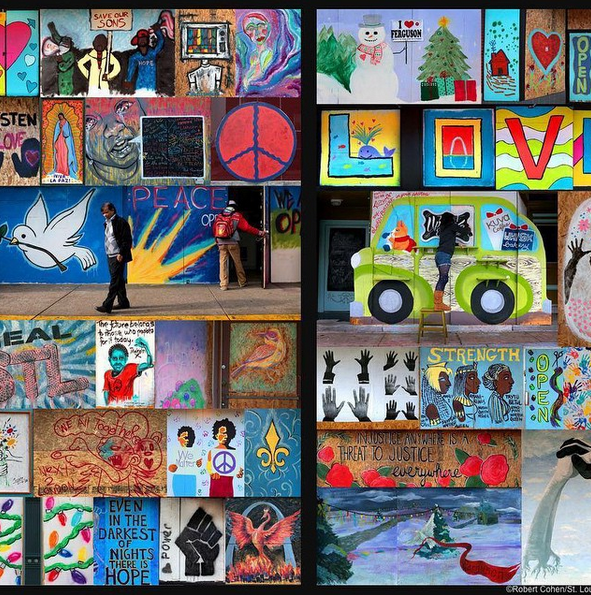
Storefronts that were covered with plywood during the protests in Ferguson were painted by local artists and collected by the Missouri History Museum.

Ferguson and related events are sparking broad protests over the treatment of African Americans by the police and the courts.  Should museums and historic sites be involved?  Should they be collecting, preserving, or interpreting these present-day events? Should they provide a place for protest or response?  Or are these beyond their roles and responsibilities?  There are no easy answers because every site and every community is different, but ultimately, people engage with historic places because there’s a personal connection–historic sites are collecting, preserving, or interpreting topics that are relevant and meaningful to the visitor.

Identifying what is relevant and meaningful isn’t always easy but contemporary events offer a glimpse.  People discuss, explore, study, question, react to, and protest about issues that matter to them, and the more people that are involved around the same issue, the more significant it is.

Museums and historic sites inhabit a special “third space” in society that allows us to do things that can’t happen at home or work. They allow diverse people to discuss, explore, study, question, react to, and protest about issues in a safe place.  As Presence of the Past has shown, we are Continue reading

Plenty for Historic Sites at 2015 NCPH Meeting

National Council on Public History annual meeting 2015The National Council on Public History will be holding its 2015 conference in Nashville from April 15-18 and there are lots of sessions that will interest house museums and historic sites, including:

  • Best Practices for Interpreting Slavery at Historic Sites and Museums
  • Re-imagining Historic House Museums for the 21st Century with President Lincoln’s Cottage, Roger Brown Study Collection, and others
  • On the Cutting Edge of American Historic Preservation:  The Role of the Mount Vernon Ladies’ Association
  • Religion, Historic Sites, and Museums with Gettysburg Seminary Ridge Museum, Ephrata Cloister, and others
  • Historic Sites, Racialized Geographies, and the Responsibilities of Public Historians with the Lower East Side Tenement Museum and Weeksville Heritage Center
  • The Woodrow Wilson Family Home: Our Story of a Radical Makeover
  • Pulling Back the Curtain: Displaying the History-Making Process in Museums and Sites
  • Hidden Histories:  Cultural Amnesia, Interpretive Challenges, and Educational Opportunities
  • Haunted Histories: Ghost Lore Interpretation at Historical Sites

Nashville also has many historic sites and NCPH will be offering walking tours and field trips on musical heritage, the state capitol, crime, Civil War, civil rights, and Fisk University.  Nearby are several notable historic house museums, including the Hermitage, Belle Meade Plantation, and Belmont Mansion.

Registration is $240 and for members it’s $192.  Sign up before March 4 as a member, and it’s only $167.  For a copy of the preliminary program, visit http://bit.ly/NCPH2015prog.

Is Historic Preservation Ready to Preserve Culture as well as Architecture?

Sustaining San Francisco's Living History by San Francisco Heritage

Sustaining San Francisco’s Living History by San Francisco Heritage

The fundamental boundaries of historic preservation have been significantly expanded by San Francisco Heritage, one of the country’s leading historic preservation organizations. In Sustaining San Francisco’s Living History: Strategies for Conserving Cultural Heritage Assets, they state that, “Despite their effectiveness in conserving architectural resources, traditional historic preservation protections are often ill-suited to address the challenges facing cultural heritage assets. . . Historic designation is not always feasible or appropriate, nor does it protect against rent increases, evictions, challenges with leadership succession, and other factors that threaten longtime institutions.”   In an effort to conserve San Francisco’s non-architectural heritage, historic preservation must consider “both tangible and intangible [elements] that help define the beliefs, customs, and practices of a particular community.” Did you notice the expanded definition?  Here it is again:  “Tangible elements may include a community’s land, buildings, public spaces, or artwork [the traditional domain of historic preservation], while intangible elements may include organizations and institutions, businesses, cultural activities and events, and even people [the unexplored territory].”

With many historic preservation organizations, it’s all about the architecture so protecting landscapes, public spaces, and artwork is already a stretch.  They’re often not aware that Continue reading

Know a Museum or Site Making an Impact with History?

Discussing the History Relevance Campaign at a packed session at AASLH in St. Paul.

Discussing the History Relevance Campaign at a packed session at AASLH in St. Paul. Photo by Lee Wright.

At the American Association for State and Local History annual meeting in St. Paul, the History Relevance Campaign presented an update on their work to a packed audience. During the session, we presented the Impact Project, a year-long process for identifying and studying historic sites and history museums that are making history relevant in their community. The goals of the Impact Project are to:

  • Increase the use of history as a way to understand and address critical community issues.
  • Help board members and staff make an impact in their communities by integrating best practices into their strategic and interpretive plans
  • Encourage AASLH and other professional associations to include standards on community relevance and impact
  • Encourage academic programs in history, public history, and museum studies to include community relevance and impact in their curriculum
  • Encourage elected officials, funders, and communities to provide more support for history organizations that are making an impact
  • Provide every Governor with at least one example of history organizations that are making an impact in their state

We Need Your Help

We are looking for history museums, historic sites, and similar organizations that are Continue reading