This 5:45 video provides a behind-the-scenes view with staff and residents about a 2014 collaborative exhibition between the Hackney Museum and a local neighborhood. This film documents what the museum staff and community partners learned together, both successes and failures, when they created the “Side by Side: Living in Cazenove” exhibition at the Hackney Museum, located in a suburb northeast of London.
Category Archives: Community engagement
Tackling Challenges for Historic Sites in St. Louis
Last week, Ken Turino of Historic New England and I gave a one-day workshop on reinventing historic house museum in St. Louis, Missouri for the American Association for State and Local History. It was a sold-out workshop with more than 50 people participating, mostly from the St. Louis region, so it was a great opportunity to meet so many of our colleagues, including a couple places who were starting new house museums (glad to have people learning about this specialized field before they open the doors!). A big thanks to Andy Hahn at the Campbell House for hosting the workshop and to the St. Louis Public Library for allowing us to meet at the historic Central Library.
Ken and I continue to refine the workshop based on the evaluations we receive from the participants, and one of the elements we added to the beginning of the workshop is asking, “What is the biggest challenge facing your house museum?” and “What needs to be reinvented at your historic site?” Here are some of the responses we received: Continue reading
Interpreting Race: Challenges and Solutions from NCPH
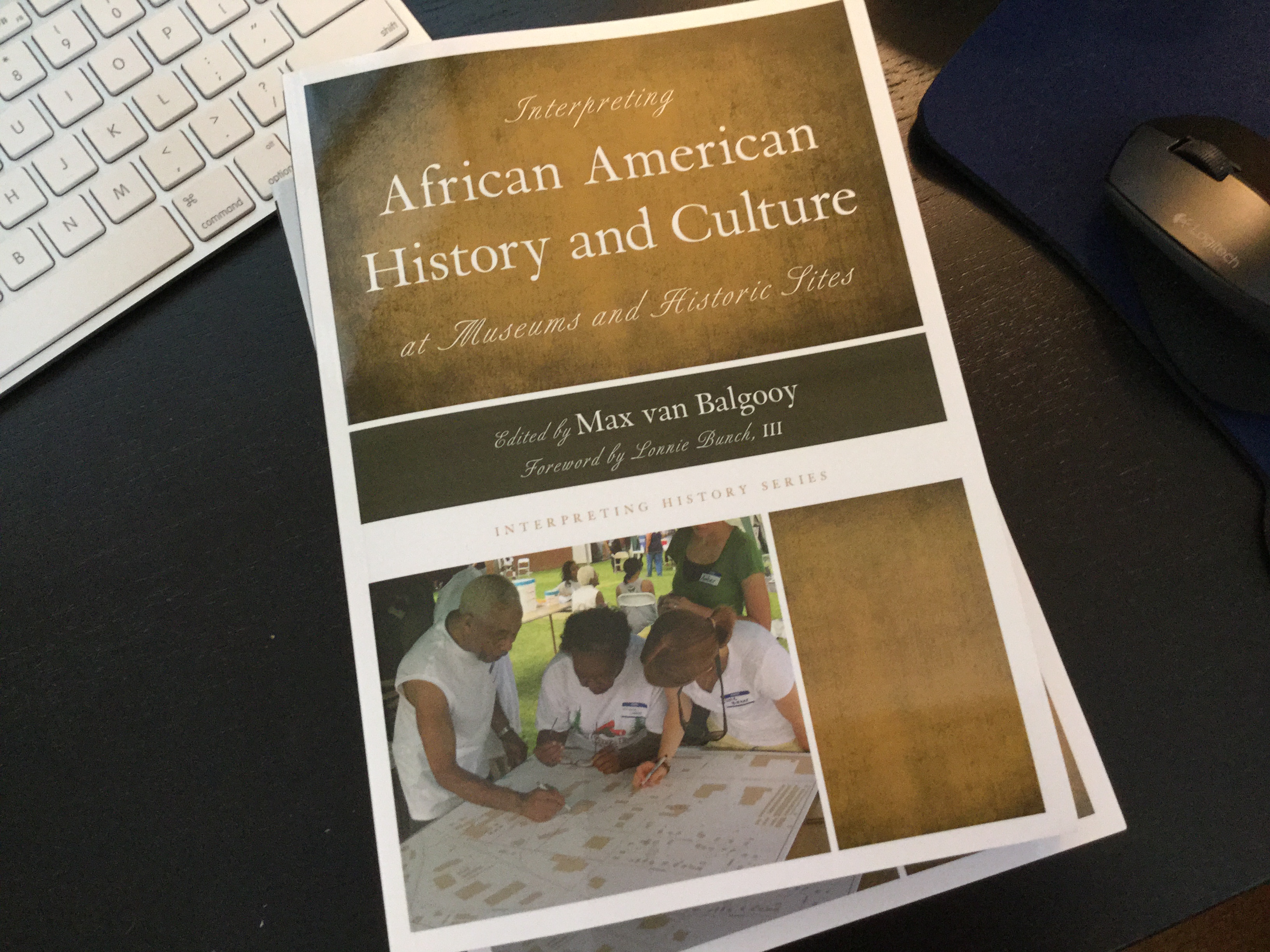 Last year when I was preparing Interpreting African American History and Culture at Museums and Historic Sites, it seemed that the obvious had been overlooked: race. Although we all advocated for the integration of African American history in interpretation in part to overcome racism, I wondered if instead we are inadvertently promoting the idea that races exist and we simply need to find ways to get along, just like dogs and cats in our homes. We never questioned or uncovered the assumptions about race that visitors may carry with them into museums and historic sites. Our bigger concern was that African American history was sufficiently significant to merit preservation and integration into the interpretation.
We know that races do not exist and it was a theory developed by scientists in the 18th and 19th century as a way to explain human differences. Race has long been disproven, but certainly race and racism continues, probably in the minds of many of our visitors. So if more of our visitors could understand that race is socially constructed and artificial, it may go a long way towards Continue reading
An App That Easily Merges Oral History and Images
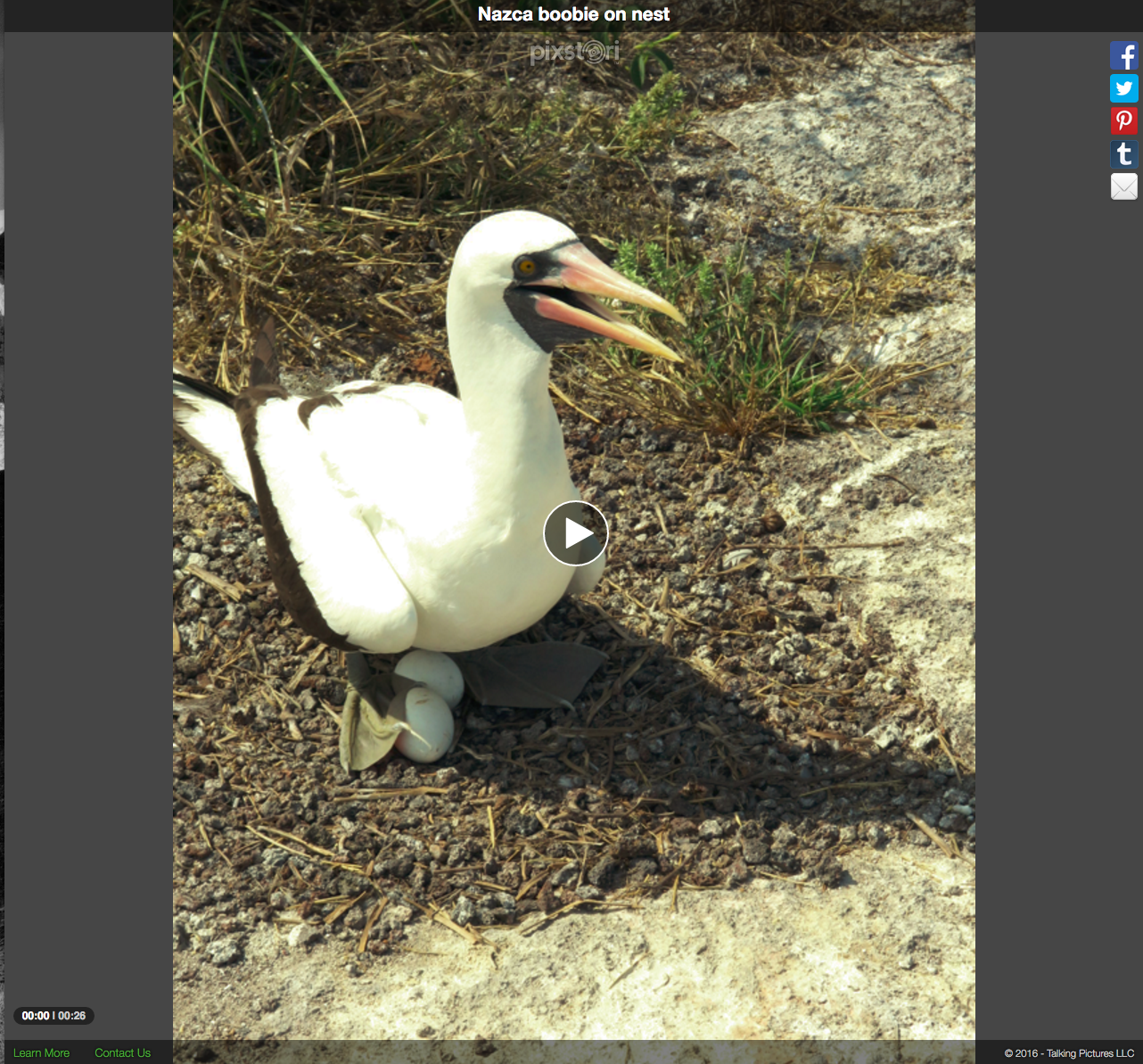
My recording about a bird nest on the Galapagos Islands using PixStori.
At the National Council on Public History conference last week in Baltimore, Michael Frisch of the University of Buffalo introduced PixStori, a iOS app that he helped develop that easily shares photographs with audio recordings. Frisch is a leader among oral history practitioners and he developed the app as a way for people to record short oral histories to accompany photographs.
Users pull up a photo from their iPhone or iPad and then record a short message (up to 20 minutes), which can then be shared via email, Twitter, or Facebook. I experimented with a photo of a bird and it’s remarkably easy to use. It’s definitely fun for sharing photos, but I can easily see museums and archives using it to share historic images or documents with a comment by an historian or help promote an upcoming event. But I can also see how it might be used in-house to record visitor reaction to proposed exhibit or to send a message to your staff about a site emergency. It appears that the recordings are stored at PixStori, so recipients don’t need to have the app installed but do need an internet connection to see and hear the file. The app is available free for iOS devices and an Android version is underway.
Webinar: How can Historic Sites Make History More Relevant?
 On Monday, March 21 at 3:00 pm Eastern/12 pm Pacific, Tim Grove and I will be discussing the History Relevance Campaign during AASLH’s monthly Historic House Call. For the past few years, a dozen people from various history organizations have studied the challenges and opportunities for changing the common attitude that history is nice, but not essential. We won’t have overnight solutions and there’s lots of work to do, but we’ll share what we’ve learned, discuss how it impacts historic house museums, and provide a tool that organizations have found very helpful. The webinar is free but preregistration is required.
If you’re not familiar with the Historic House Call, they are webinars offered through out the year by the Historic House Museum Community of the American Association for State and Local History (AASLH). Upcoming webinars include religion and historic house interpretation and using futures thinking to navigate ongoing change, and a recording of an earlier webinar, “creating engaging and memorable tours” is available. They also have a very active listserv on Yahoo Groups, a growing blog called “Views from the Porch,” and free resources, such as the Technical Leaflet, “How Sustainable is Your Historic House Museum?“
Can the Folger Library Figure Out Its Schizophrenic Photo Policy?
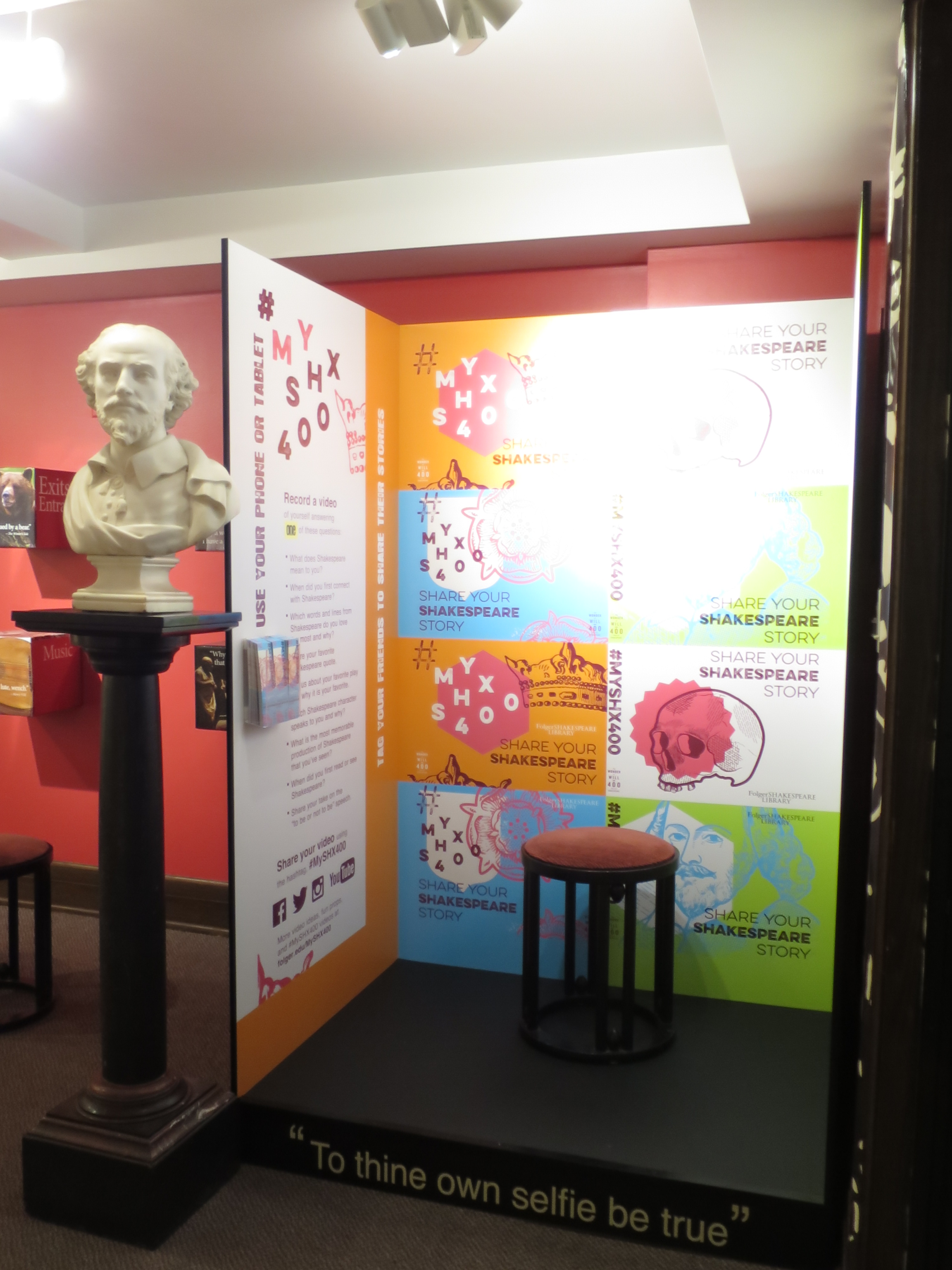
Photo booth at the exhibit that prohibits photography at the Folger Library.
The Folger Library in Washington, DC is one of my favorite places because it’s about books and Elizabethan England, two things that fascinate me. As an historian, books are not an unusual passion but as an American historian, I’m interested in the Elizabethan period because of the comparisons to our Colonial era. So every time the Folger mounts an exhibit in their gallery, I go no matter the topic and want to document what I’ve seen and learned through photos (and share them with you!). And yet, while copyright protects none of the material on exhibit, the guards frequently stop me from taking photos and one time I even had to prove I deleted the images from my camera. The latest exhibit on Shakespeare was photo-prohibited because it was on loan, but again, none of the materials were protected by copyright (all pre-dated 1700). Ironically, at the entrance to the exhibit is a special booth where visitors were asked to share videos or photos of themselves talking about Shakespeare on Twitter, Instagram, and Facebook. Huh? To thine own selfie be true, as long as it doesn’t include any actual historic objects on exhibit.
 That’s such a contrast to other museums in DC which encourage photography. The “Wonder” exhibit at the Renwick Gallery of Art in Washington, DC, is filled with contemporary art, which is typically tied up in a particularly rabid form of copyright protection, encourages photography with signs mounted in nearly every gallery. Somehow they’ve figured out how to allow photography by the public without jeopardizing their collections, reputation, or loan agreements.
Museums and libraries have to figure out how to embrace photography.* While overall attendance has dropped for the past thirty years, interest in photography has grown by leaps in bounds.** Indeed, it’s the only cultural or artistic activity that’s growing in the US and by prohibiting it unconditionally, museums and libraries are only further distancing themselves from the rest of America.
*The Rauschenberg Foundation recently developed a radical but thoughtful photography policy, which is described in the New York Times.
**National Endowment for the Arts, “Survey of Public Participation in the Arts,” 2012.
Can You Tackle Today’s Tough Topics in a Garden?
 This year’s Longwood Graduate Program Symposium will examine that issue with a top-notch series of nationally-recognized speakers on Friday, March 4, 2016 at Longwood Gardens in Kennett Square, Pennsylvania. They’ve laid out a challenging agenda for dealing with topics such as environmental action, civic responsibility, and the evolution of public gardens as community assets. Here’s their description:
Public gardens and cultural institutions are centers of community, science, and art. Today’s society is often overwhelmed with debates in all of these areas. In a world where misspoken words amplify in a matter of minutes, how can institutions tactfully open discussion on today’s difficult topics? When and where do they provide research, resources, and opportunities to interact with new or contested ideas?
Sessions include: Continue reading
Video: Non-Profit? Most Museum Visitors Don’t Know
In this 1:51 video, Colleen Dilenschneider of Know Your Own Bone explains that nearly 60 percent of Americans don’t know that history museums operate as non-profit organizations. It doesn’t get much better for those who visit history museums—53 percent are unaware. That may be alarming because we often distinguish ourselves by our non-profit status. Dilenschneider, on the other hand, suggests reframing the issue:
Our key differentiator is not our tax status, but that our dedication to making a difference is embedded in the very structure of how we operate. There’s a thought that we need to run “more like for-profit companies” (and in some ways we do, but the blanket directive is an ignorant miss). But look around. For-profit companies are actually trying to be more like us in the sense that they want audiences to know that they stand for something that makes the world a better place.
The video is a quick overview but you’ll find more details in “Nonprofit Recognition: What Matters More to Visitors Than Your Tax Status“.
Data source: National Awareness, Attitudes and Usage Study, a partnership project of IMPACTS Research and the Monterey Bay Aquarium.
Historic House Workshops for the New Year
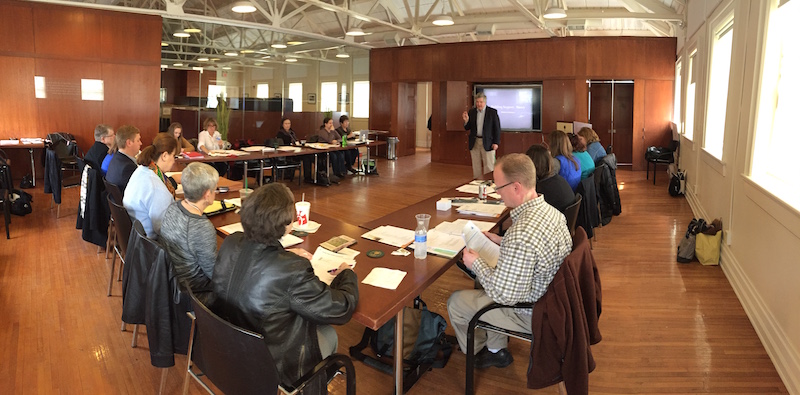
Historic House Museum Workshop, Charleston, South Carolina, 2015
If want some time to plan and evaluate what’s happening at your historic site or house museum, one of the best ways is through a workshop. Of course, a long weekend of reflection in the Rockies or Virgin Islands might be more relaxing, but a workshop with colleagues discussing the potential solutions to the challenges facing historic sites will be more effective.
AASLH is offering two workshops this year just for house museums and historic sites, and I’ll be part of both of them:
April 4: Reinventing the Historic House Museum at the Campbell House in St. Louis, Missouri
This one-day symposium is designed to offer current thinking, practical information, and solutions to the challenges facing historic sites. The historic house museum in America is not dead nor are most of them dying. The field, however, needs to take time to reflect and renew as the world around our historic sites continues to change. The symposium will include presentations, discussion, a boxed lunch, historic site visit, and a brainstorming workshop at the historic house museum to try out the new ideas proposed during the symposium. Workshop led by Ken Turino (Historic New England) and Max van Balgooy (Engaging Places). (There may be a second Reinventing workshop offered this year.)
April 28: Historic House Museum Issues and Operations at Brucemore in Cedar Rapids, Iowa
Why are historic houses necessary to their communities? How are historic house museums unique? This workshop focuses on the special needs, management, and interpretation of historic houses. With a focus on historic house museums, topics covered include collections care, types of research appropriate for historic house museums, exhibition development, interpretive tours, volunteers, and building and landscape maintenance. Workshop led by George McDaniel (Drayton Hall) and Max van Balgooy (Engaging Places).
Can’t attend these workshops but are still looking for a shot in the arm? Join one of the quarterly Historic House Calls. Every call explores a different topic with an expert, and they’ve previously discussed deaccessioning, tours, interpreting race, and environmental sustainability.
AASLH has nearly two dozens way to sharpen your skills with some of your smartest colleagues in the history field and you’ll find a continually updated list on their calendar of events.
Reinventing Historic Houses in National Parks
Earlier this week I led a workshop on reinventing historic house museums at two great National Parks—Marsh-Billings-Rockefeller in Vermont and Saint-Gaudens in New Hampshire—with Ken Turino of Historic New England. The National Park Service and the American Association for State and Local History co-sponsored this workshop to help their staff rethink the tours of the historic houses at these two sites, especially for visitors under 35 years of age. Using such tools as the Five Forces and a Double-Bottom Line Matrix along with a smorgasbord of ideas from other sites, we explored possible processes and projects that could improve and enhance their tours. Our goal wasn’t to provide solutions but to raise many useful questions, including: Continue reading
 Engaging Places