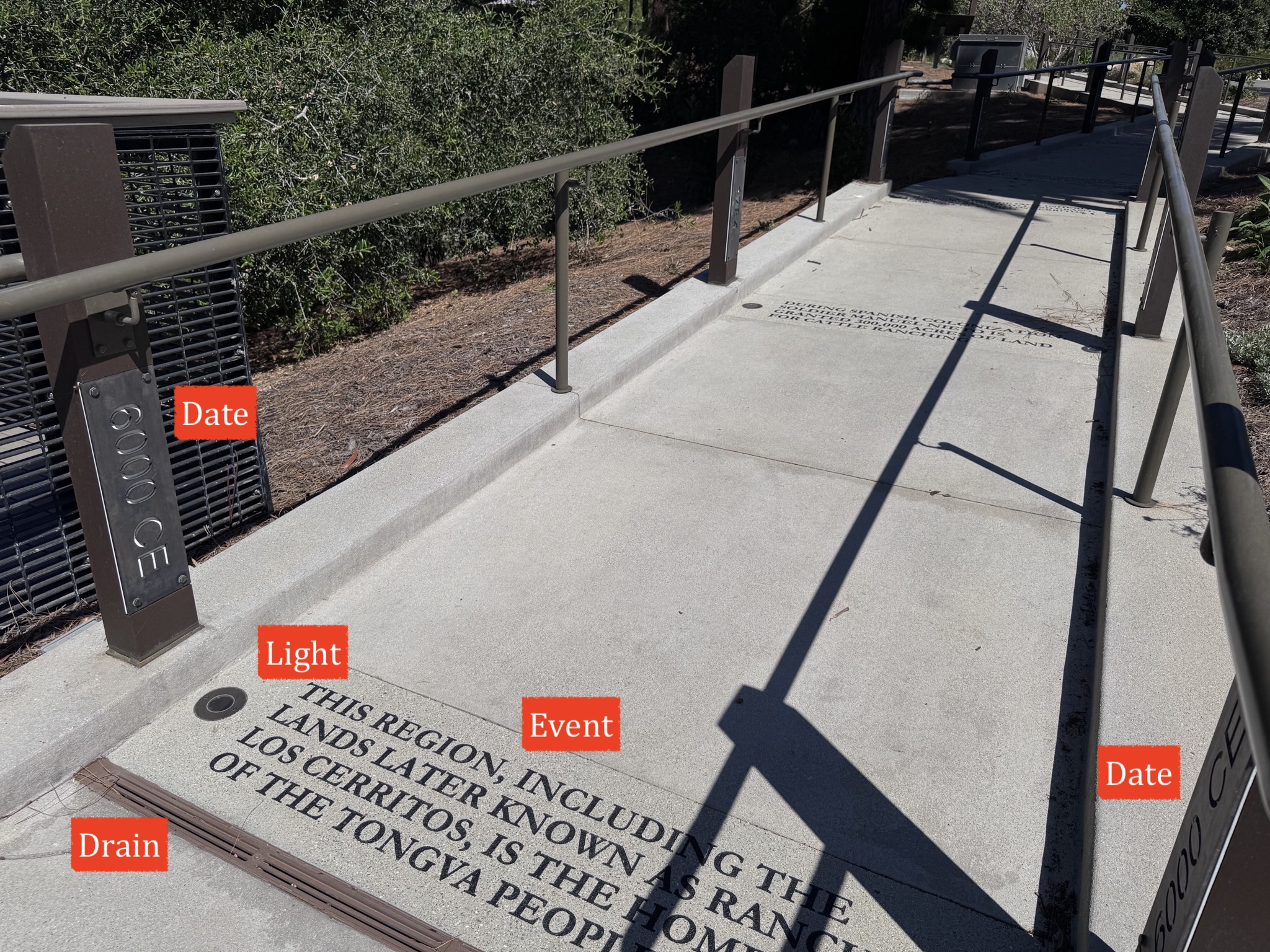
A breakdown of the key elements in the timeline walkway at Rancho Los Cerritos in Long Beach.
A couple of weeks ago, Engaging Places spent two days at Rancho Los Cerritos in California as part of an interpretation and visitor experience assessment. Before I even reached the house, something caught my attention—and it’s stayed with me since.
Walking in from the parking lot, I encountered a pathway that integrates a timeline from past to present. It was developed as part of a stormwater and groundwater reclamation project designed by Studio One Eleven, but what struck me wasn’t just the infrastructure—it was the interpretive opportunity. The walkway quietly does something many historic sites struggle to achieve: it begins interpretation before the visitor even arrives.
I’ve long been interested in how entrance sequences can frame a visitor’s experience, and this is a particularly effective example. As you move along the path, you’re also moving through time. Each step becomes a kind of measurement—an embodied sense of duration and change. It’s intuitive, familiar, and requires almost no instruction. In a matter of moments, visitors gain a basic orientation to the site’s history and significance.
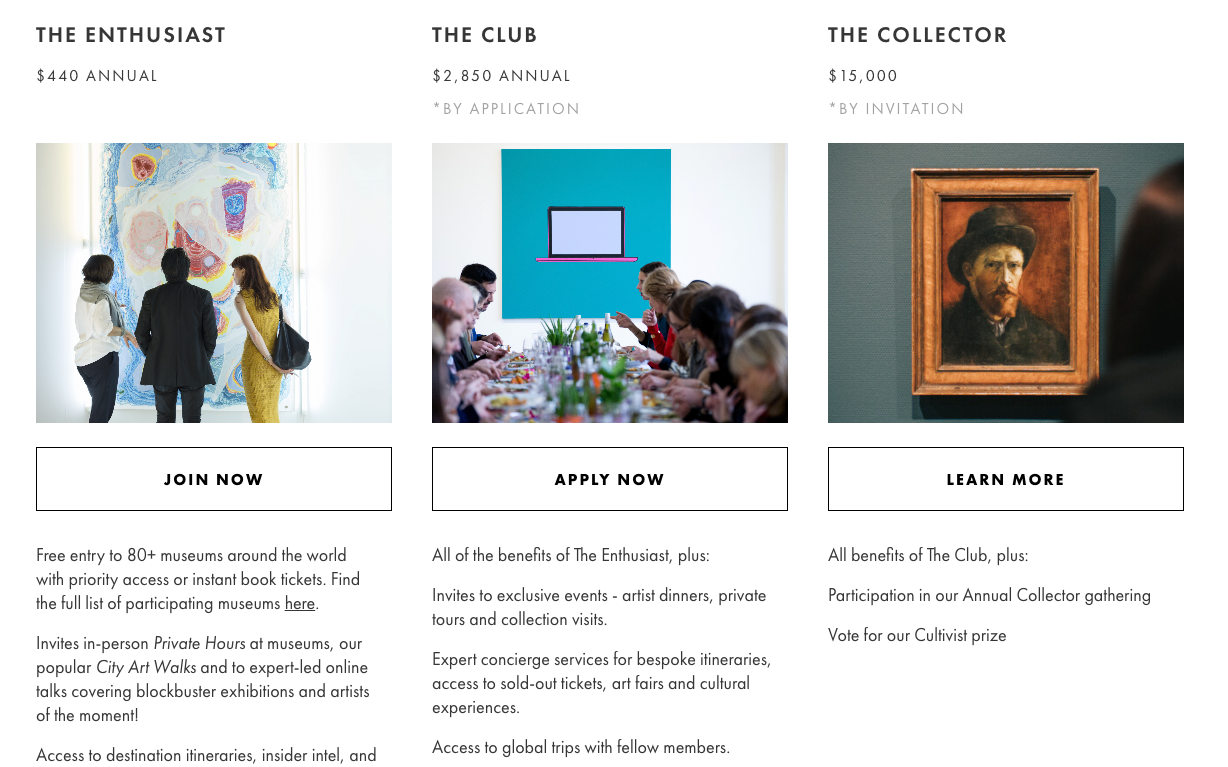
Membership levels for The Cultivist start at $440 per year and by invitation, you can join at the $15,000 level.
A few weeks ago I came across The Cultivist, a private membership program that promises art lovers “insider access” to the global art world. The club offers members free or priority admission to dozens of museums, invitations to special events, tailored trips to art fairs and biennials, and behind-the-scenes experiences with artists, collectors, and curators.
At first glance, I was skeptical. Is this simply the commodification of art and culture for wealthy travelers?
Perhaps. But it’s also worth taking a closer look, because The Cultivist reveals something important about how cultural tourists and heritage travelers—especially affluent ones—may want to experience museums and historic sites.
The organization was founded by Marlies Verhoeven and Daisy Peat, both of whom previously worked at Sotheby’s developing VIP loyalty programs for collectors. Their backgrounds are not in museums, curatorial practice, art history, or education. Instead, they specialize in relationship marketing, high-net-worth client services, and luxury experiences. That background explains the business model perfectly.
The Cultivist is not a museum membership program in the traditional sense. It is closer to a global concierge service for the art world. Members pay an annual fee starting at $440 to access a network of museums, exhibitions, artists’ studios, and art fairs, combined with customized travel and social events. Participating US museums include the Museum of Fine Arts Boston, Art Institute of Chicago, Museum of Modern Art, Jewish Museum NY, and the Huntington Library. In effect, the organization packages the art world into a kind of cultural lifestyle club.
From one perspective, this can feel uncomfortable. Museums have historically framed themselves as institutions devoted to public education, access, and engagement that contribute to society. A private club that sells privileged access to museums risks reinforcing the perception that the arts are primarily a playground for wealthy insiders. But before dismissing the model entirely, it’s worth asking why a service like this exists—and why it appears to be successful.
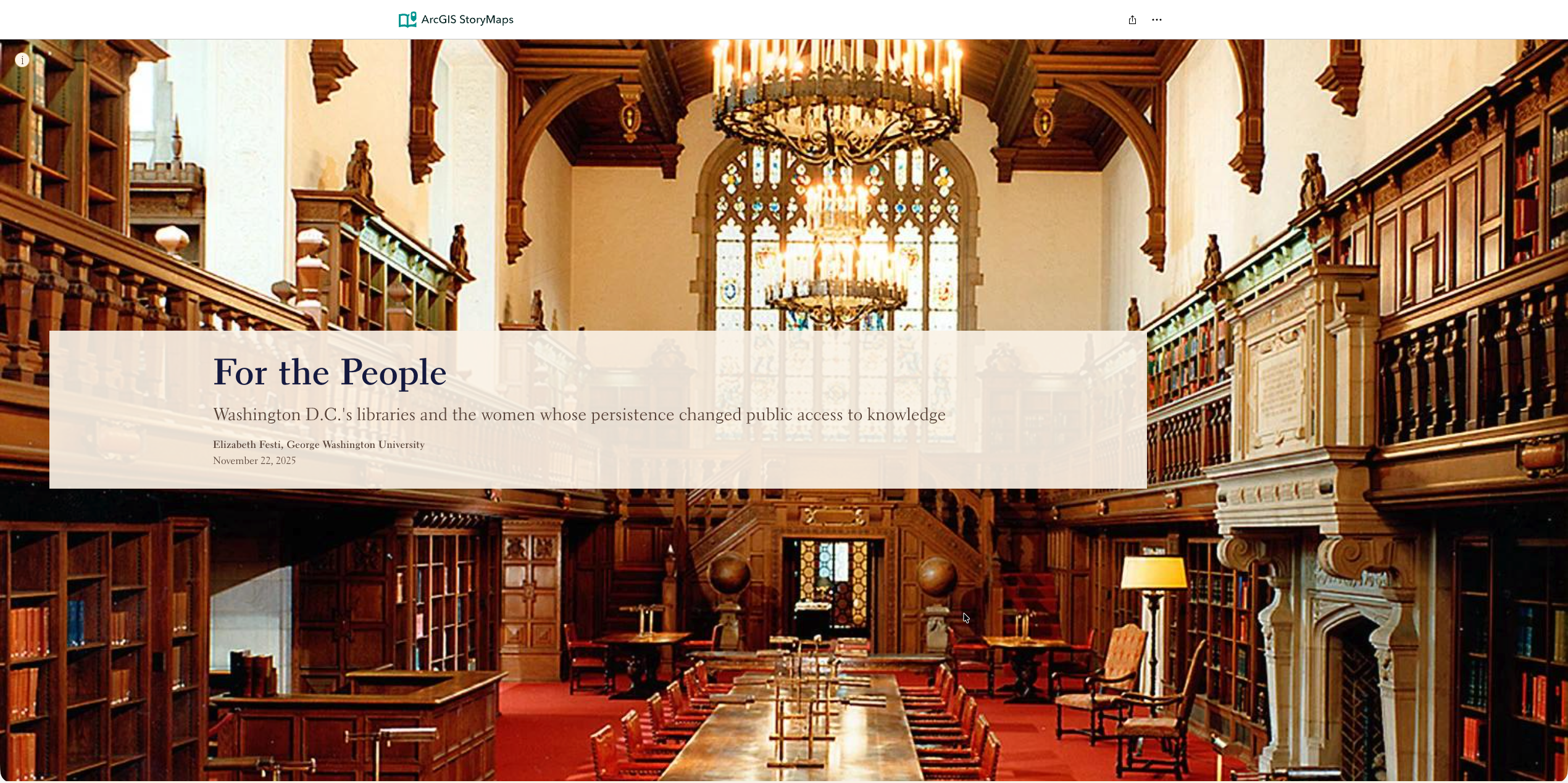
Digital tools do not automatically produce meaningful interpretation. What they can do—when used with discipline—is force clarity about audience, theme, and purpose. This is why I have begun using ESRI ArcGIS StoryMaps as a core interpretive platform in my graduate course CMST6307: Interpretation of Historic Sites at George Washington University.
This fall, students were commissioned—within a realistic professional scenario—to create StoryMaps interpreting the history of women in Washington, DC. Each project connected five or six historic sites through a coherent theme, tailored to a specific public audience. The results demonstrate how StoryMaps can function not as digital scrapbooks, but as public-facing interpretive products grounded in professional standards.
I’m incredibly proud of what they accomplished, but this isn’t a showcase of student work for its own sake. It’s a case study in how digital storytelling platforms can support the interpretation of historic sites and house museums.
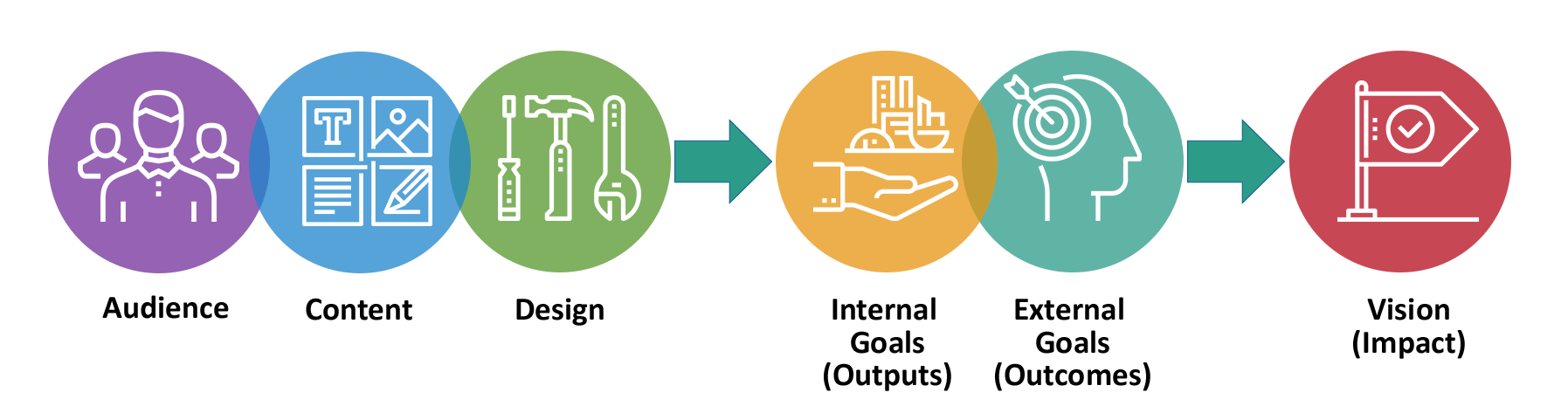
Interpretive framework used in my interpretation course (and with my clients).
A Professional Product, Not a Classroom Exercise
The assignment was framed as a hypothetical consulting project for the White House Historical Association. Students were told: “The StoryMap should connect 5–6 historic sites through a coherent theme, tailored to a specific audience. It should demonstrate professional standards in historical research, interpretive writing, and digital design.”
From the beginning, the emphasis was not on technology, but on interpretation. Each student had to demonstrate the integration of three core elements: audience, content, and design.
At the recent Mid-Atlantic Association of Museums (MAAM) conference in Pittsburgh, I attended “Headwinds and Tailwinds: A Panel Discussion about the Financial and Operational Impacts on the Museum and Arts Management Field.” One of the panelists, Hayley Haldeman of the Pittsburgh Cultural Trust, offered particularly insightful observations about board governance in the post-COVID landscape. Her comments confirmed what many of us have observed firsthand—museum boards are facing more challenges and opportunities than ever before.
A Changing Landscape—But Familiar Structures
Despite the upheavals of recent years, Haldeman noted that few organizations have made major changes to their board structures. Most boards remain large, and many governance documents have yet to be updated. The notable exception has been a growing emphasis on board diversity—though progress toward real inclusion varies widely.
At the same time, museums are experiencing significant leadership transitions. Many long-serving executive directors have retired, while others are navigating the aftermath of the “Great Resignation,” which has affected both staff and board leadership. These changes can be destabilizing, but they also open the door for renewal.
New Pressures on Museums and Nonprofit Organizations
Board service today comes with new (and sometimes unexpected) responsibilities. Museums and other nonprofit organizations are grappling with a range of threats, both real and perceived:
Drops in individual giving and shifts in foundation priorities
Greater community expectations for accountability and transparency
Political and legal questions (e.g., DEAI initiatives, exhibition content)
Cybersecurity and AI-related risks
Meanwhile, board members are harder to recruit and retain. COVID-19 reshaped personal and professional priorities, making time an even scarcer resource. For organizations, that means it’s harder than ever to fill board seats, onboard new members, and keep them engaged—especially when board work happens virtually.
Move beyond what we tell visitors to what they actually do—and discover how eight types of experiences can deepen learning and meaning.
When we think about interpretation in museums and historic sites, we often focus on what we want to say—the stories, facts, and insights that bring history to life. But what if we focused instead on what visitors do?
That simple shift—from content to experience—changes how we design tours, exhibitions, and programs. It encourages us to move beyond “telling” and toward engaging, offering visitors a range of ways to learn, reflect, and connect.
Recently, I’ve been revisiting an idea from educational research called the Eight Learning Events Model, developed at the University of Liège in Belgium. It identifies eight ways people learn: receiving, imitating, practicing, experimenting, exploring, creating, debating, and reflecting. Although the language in their articles is academic (and a bit European in tone), the concept translates beautifully into the world of museums. With a little adaptation, I’ve reimagined these eight learning events as the “Eight Ways to Engage Visitors.”
A Spectrum of Engagement
At one end of the spectrum, visitors receive information. They listen, read, or watch as museums provide structure and context—through a guided tour, an introductory panel, or a short video.
The next few experiences—observing, practicing, and experimenting—invite more active participation. Visitors watch a demonstration, try out a skill, or test how something works. These steps increase a visitor’s sense of agency. The museum moves from telling to showing to inviting.
I attended a timely and thought-provoking session at this year’s AASLH Annual Meeting called Bridging Divides: Navigating Challenging Histories Through Community Engagement on September 13. It gathered five panelists—Angela O’Neal, Columbus Metropolitan Library, Columbus, OH; Rebecca Asmo, Ohio Humanities, Columbus, OH; Jason Crabill, Decorative Arts Center of Ohio, Lancaster, OH; Kaitlyn Donaldson, Lorain Historical Society, Lorain, OH; Doreen Uhas-Sauer, Rickenbacker Woods Foundation, Columbus, OH—who shared practical advice for how museums and historic sites can continue doing meaningful work in an era of heightened scrutiny, political pressure, and declining trust. I want to share my notes here, not as a verbatim report, but as highlights of ideas that struck me as especially useful for our field.
Protecting Institutions While Advancing Mission
The panel emphasized that today’s environment did not emerge overnight, so institutions can look to history and the humanities for guidance. Two watchwords were don’t obey in advance and don’t over-comply. When regulations restrict action—such as a requirement to remove feminine hygiene products from restrooms—organizations can comply while still serving their audiences by relocating them to staffed areas. Institutions should avoid inviting unnecessary trouble, ensuring content is evidence-based, factual, and defensible. Even the naming of grants matters: choose descriptive, straightforward titles rather than attention-grabbing language that might provoke critics.
Building Credibility Through Storytelling and Relationships
Telling concrete, factual stories is essential. Because American history is often taught as headlines rather than complex narratives, museums must provide depth while remaining accessible. Community review of working drafts helps ensure relevance and reduces backlash. Listening for common ground creates ownership and fosters support. In some cases, reframing exhibits as art rather than history opens doors to difficult conversations. Festivals, events, and everyday relationship-building are as important as the exhibits themselves.
This fall, the Museum Studies Program at George Washington University is joining forces again with the History and Art History Departments to offer a Museums+ Internship Fair. Now in its second year, the fair connects undergraduate and graduate students with a wide range of museum and history internship opportunities in the DC area. For a couple of hours on a Friday afternoon, students will gather in the atrium of the Corcoran School of the Arts and Design to meet representatives from dozens of institutions—including the National Gallery of Art, Hillwood Estate, the National Museum of Women in the Arts, Supreme Court of the United States, White House Historical Association, and many more. The goal is simple: to help students discover just how much they can do with their degrees and to broaden their horizons by meeting professionals working across the museum and history fields.
As we’ve been preparing for the fair, I began to wonder—what if museums and historic sites flipped the concept and hosted a similar program for their own communities? Instead of being a service for students alone, imagine it as a public program, designed to connect local residents, businesses, and organizations with the museum itself.
Benefits to the Community
For many people working in business, technology, or traditional jobs, the idea of contributing their skills to a nonprofit or museum has never crossed their minds. They may not recognize that their expertise—whether in marketing, finance, customer service, or carpentry—has enormous value to cultural organizations. By connecting residents with organizations and ideas outside their usual circles, museums can help expand horizons and build confidence.
House museums across the country are confronting difficult questions about relevance, sustainability, and meaning in the 21st century. What worked twenty years ago—traditional tours, decorative arts displays, and carefully preserved interiors—often isn’t enough today to engage visitors or generate financial stability. Communities are changing, audiences have new expectations, and historic sites are under increasing pressure to demonstrate their value.
That’s why Ken Turino (formerly at Historic New England) and I developed Reimagining the Historic House Museum, an intensive one-day workshop that helps professionals and volunteers tackle these challenges head-on. Over the past decade, we’ve led this program at sites across the United States, working with hundreds of staff, board members, and volunteers to think creatively about interpretation, audience engagement, and business models. Each workshop is highly interactive, blending case studies, small-group activities, and practical exercises. Participants leave not only with new ideas, but with concrete tools to implement change at their own sites.
This fall and next spring, we’ll be offering two opportunities to join us in person:
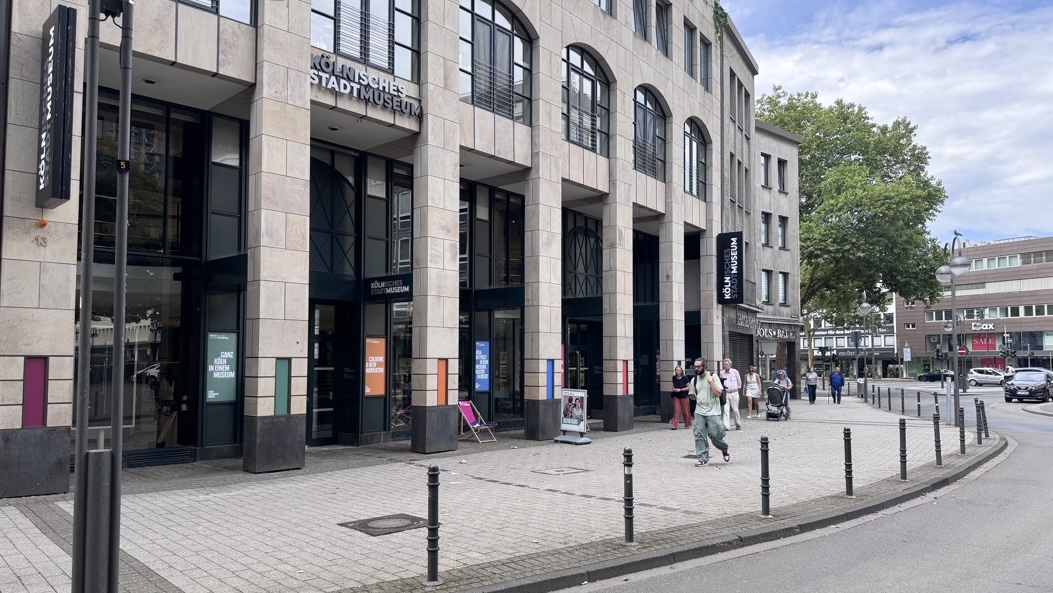
In March 2024, the Cologne City Museum (Kölnisches Stadt Museum) in Germany reopened in an unexpected setting: a former luxury department store in the heart of the city’s shopping district. The museum has been around since 1888, but a 2017 water leak forced it out of its former location. Its latest incarnation takes a bold new approach to presenting the city’s history, promoting itself with “Cologne: A New Narrative.”
Rather than organizing its permanent exhibition chronologically or thematically, the museum focuses on emotions using eight big questions to explore both the past and present of Cologne for residents and tourists. Throughout they incorporated responses and personal objects from their “Cologne Experts,” fifteen diverse residents who represented different perspectives.
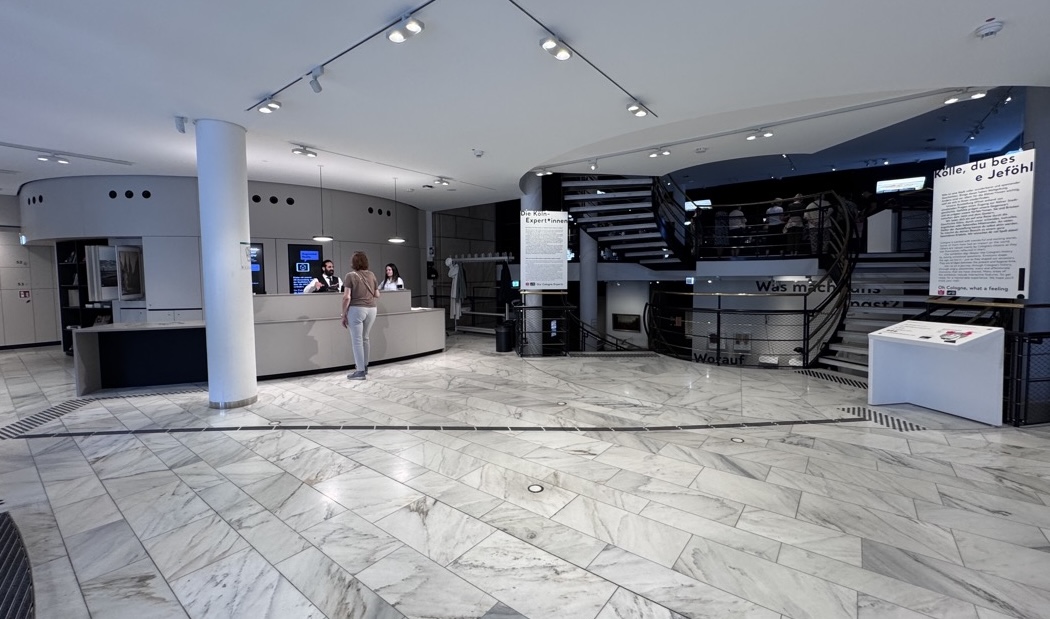
From the moment you enter, the museum signals something different. The large black-and-white lobby features a central stairway leading both a half-story up and a half-story down, offering a tantalizing glimpse of what’s to come. The introductory label in the lobby reads:
In today’s fast-moving, attention-fragmented world, museums are under pressure to do more than just deliver content–they need to make it stick. Whether it’s an online program, a guided tour, or an immersive performance, professionals are increasingly asking: How do we create experiences that matter? Three recent studies point to a clear answer: if you want to deepen impact, design for reflection.
Reflection Creates Meaningful Museum Visits
A recent study by Pieter de Rooij and colleagues at the Dutch Open Air Museum in Arnhem investigated what factors contribute to a memorable, meaningful, or transformative museum experience. Using surveys from over 500 visitors, they found that reflection was the strongest predictor of all three outcomes, while sociability and joy had a smaller yet significant effect. Visitors who were prompted to think about new ideas or connect the experience to their own lives were significantly more likely to report lasting impact.
Interestingly, traditional design features—such as beautiful displays, freedom to roam, or relaxing environments—were not strong predictors of impact. While those elements may support comfort and enjoyment, they don’t on their own foster deeper engagement.




 Engaging Places