
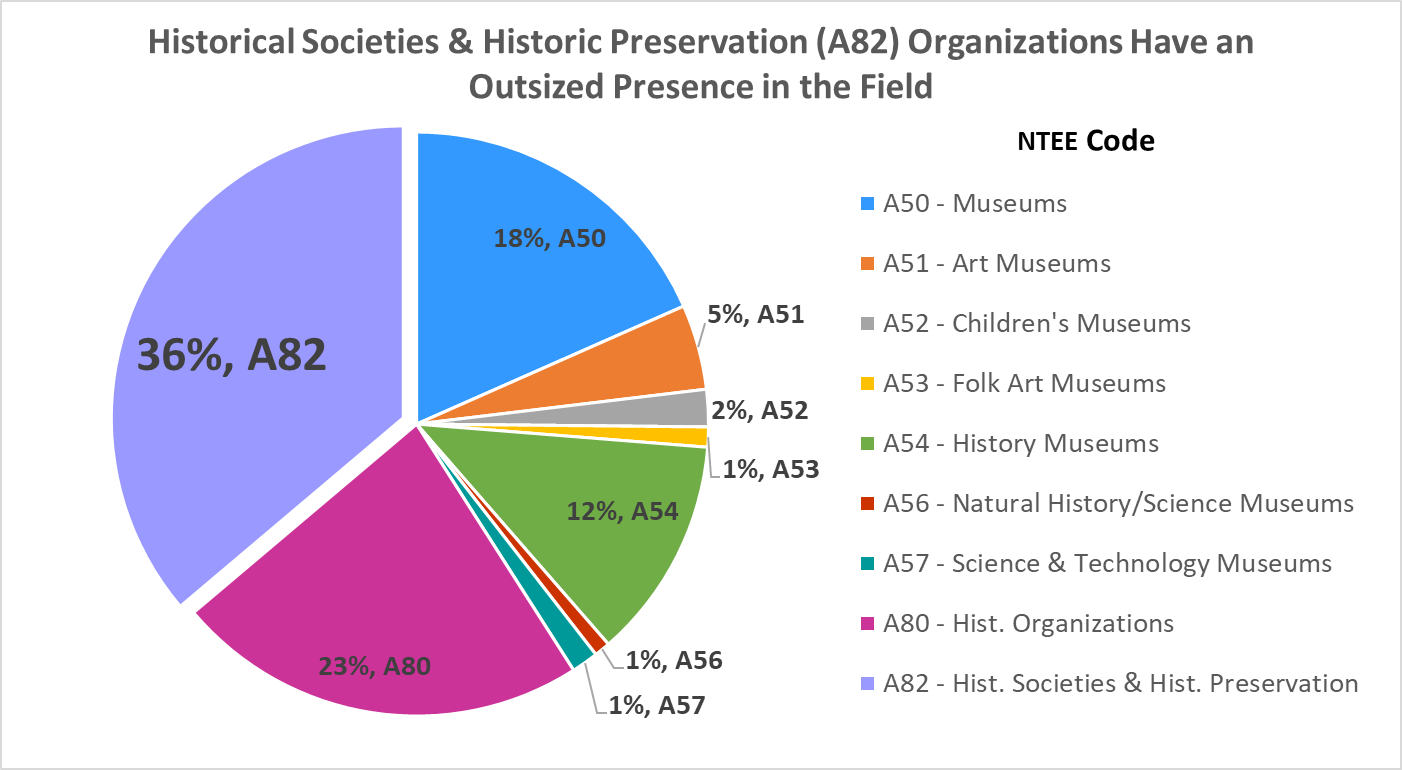
Of all the organizations in the United States devoted to arts, culture, and humanities, Historical Societies & Historic Preservation (NTEE A82) organizations have an outsized presence. More than a third of all organizations “sponsor activities which celebrate, memorialize and sometimes recreate important events in history such as battles, treaties, speeches, centennials, independence days, catastrophes that had an important impact or other similar occasions.” “Historical society,” “historical association,” “heritage society,” “preservation,” and “restoration” are in the name of nearly 80 percent of institutions in this category. They are also focused on local history—only one in twenty institutions appear to have a geographic scope larger than the county level.
While preserving and interpreting local history is their primary interest, these organizations are the smallest by revenue. More than 90 percent operate with less than $1 million in revenue annually and have a median revenue near $64,000 (yes, the median is $64,000 annually for all A82 organizations for 2011-2017—half of these organizations operate with less than this amount). Only Historical Organizations (A80) produce similar financials, albeit with slightly higher figures.
Continue reading an Diego’s
  Historic House Museums in the United States and the United Kingdom: A History by Linda Young. Lanham, MD: Rowman & Littlefield, 2017. v + 299 pp.; bibliography, index; clothbound, $85.00; eBook, $80.00.
 The National Park Service has issued an updated version of the
  Friday, July 21 is the deadline to catch the early registration price of $328 ($253 for members); it jumps to $393 the next day. AASLH offers the widest variety of sessions and workshops for house museums and historic sites at a national level and attracts some of the best minds in the field. This year, the annual meeting will be held in Austin, Texas from September 6-9 and include:
 Donald J. Trump’s election to the U. S. presidency is a shock to many pundits and career politicians because he never held elected office and didn’t seem to care about politics or government, except as it might benefit his businesses. His interest is business, following his father into real estate and receiving his bachelor’s degree in economics from the Wharton School, and then pursuing real estate development, professional sports, beauty pageants, for-profit education, branding and licensing, and entertainment. While the 2016 campaign will be heavily analyzed for years to understand its unfolding, my sense is that it’s not just about “change,” but a change in the skills and qualifications required for effective leadership. It’s no longer about mission, vision, or values, but the expertise and perspective of independent business entrepreneurs. And it’s a trend I’ve been witnessing in house museums and historic sites as well.
 Engaging Places