Indiana Landmarks‘ “Moveable Feasts” are three summer evening events that each feature a different place in Indiana through a multi-course progressive dinner at several historic sites, along with walking tours, presentations, and films. This 2:00 video provides an overview of the June 13, 2014 Moveable Feast in Aurora, Indiana on the banks of the Ohio River. Cost is $50; $45 for members.
Category Archives: Historic preservation
Video: The Fairbanks House
This 2:20 video by Nick Papps provides a contemplative introduction to the 1637 Fairbanks House in Dedham, Massachusetts, believed to be the oldest surviving timber frame house in North America and now an historic house museum. The video blends contemporary and historic images accompanied by the reading of a 1937 poem by Elizabeth Fairbank Rock.
Brown University and National Trust Provide Recommendations for Historic House Museums
The financial sustainability and social relevance of historic house museums continue to intrigue scholars, preservationists, organizations, and even pundits on National Public Radio (I was recently interviewed by them about this topic) and adding to the conversation are two recent publications by the John Nicholas Brown Center at Brown University and the National Trust for Historic Preservation.

Bedroom at Liberty Hall Museum, Kean University, New Jersey.
If historic house museums are historic sites that primarily educational (not commercial) in purpose, how would they be different if they were managed by educational institutions? “University-Affiliated Historic House Museums,” a report by the John Nicholas Brown Center at Brown University may provide some answers. Prepared for the 1772 Foundation by Hillary Brady, Steven Lubar, and Rebecca Soules, the report examines the issues facing historic house museums that are owned or operated by colleges and universities based on a survey of existing practices at ten sites. Offering recommendations for “new ways to make these museums more useful to the university community,” it concludes with a half dozen alternatives for the Liberty Hall Museum at Kean University, which might be applicable to sites that are not affiliated with universities (swap “campus” and “students” with “community” and “residents”). By the way, the Center is hosting an intriguing colloquium in May 2015 on “lost museums“.
 In 1949, Congress created the National Trust for Historic Preservation to Continue reading
Recent Articles on Historic Sites You May Have Missed
 Knowing that most people working at historic sites don’t have access to an academic library, I thought I’d share a few articles around some major topics that caught my eye. This is not a thorough review of the last 18 months, just a casual glance backward to highlight some studies that relate to the preservation, management, and interpretation of historic sites and house museums.
More Professors are Combining Local History and Service Learning to Engage Students
Henthorn, Thomas C. “Experiencing the City: Experiential Learning in Urban Environments.” Journal of Urban History 40, no. 3 (2014): 450-461.
Henthorn describes various student experiences to engage them in history, including a course on American urban history that combines an historical study of Flint, Michigan with an off-campus service learning project and a collections internship in automotive heritage at the Sloan Museum.
He concludes by finding that, “experience and place combine to prepare students for active citizenship. This is arguably the most difficult to instill among students and in the same way one class will not change students understanding of a subject, one experience will not awaken in students a sense of civic responsibility. At the very least, by linking the classroom with the community, students learn to respond creatively to critical issues confronting them. But active citizenship requires Continue reading
AASLH Annual Meeting in September Offers Lots for Historic Sites

Alexander Ramsey House in St. Paul, an historic site of the Minnesota Historical Society.
Historic sites and house museums will find lots of educational sessions and workshops just for them at the upcoming annual meeting of the American Association for State and Local History on September 17-20 in St. Paul, Minnesota (the right half of the Twin Cities). There are more than 70 sessions and workshops offered this year, so I’m only highlighting a few to show the diversity of topics on or about historic sites:
- Putting the Native American Voice into Historic Sites
- Saving the Charnley Norwood House
- Interpreting Religion at Historic House Museums
- Two Very Different Historic Houses Ask: We Got the Money–Now What?
- Telling a Whole History: Methods of Interpreting Domestic Servants
- Welcoming All Visitors: Accessible Programs at History Museums and Sites
- Diversity and Inclusion: What Does that Really Mean for Museums and Historic Sites?
- Diversity in Education: Teaching About Slavery, Innovative Strategies, and Best Practices
- Making the Invisible Visible: Using Mobile Technology to Reach New Audiences, Improve Accessibility, and Breathe New Life into a Virginia Historic Site
- Redefining Success: Tips and Techniques for Training Interpreters to Talk About Slavery
- They Can’t All be Museums
- Pocket Change: Moving a House Museum into the 21st Century on a Budget
Of course, there are many more sessions that address related topics, such as boards, fundraising, Continue reading
Video: Vacant Not Blighted: Revitalizing Detroit
This 4:12 video by the Michigan Historic Preservation Network shows that preservation and rehabilitation are much more effective than demolition to address “blight” in Detroit. The video was created in Mindfield and features a host of interesting people across the city working on rehab projects from firehouses to garages, homes to schools. Thanks to Jay Vogt for telling me about this video.
Video: 2014 NCPH Conference Recap
The Institute of Oral History at the University of Texas at El Paso just produced a 2:49 video covering the 2014 annual conference of the National Council Public History in Monterey, California. Using video from the conference and Monterey along with interviews, it highlights the value of the conference. This was created by Karina Arroyo and Jesus Genaro Limon, who I believe are students at UTEP. Perhaps your site could create something like this for your events or conferences with the help of a local college or university.
Webinar: Making Heritage Tourism Work for Your Community
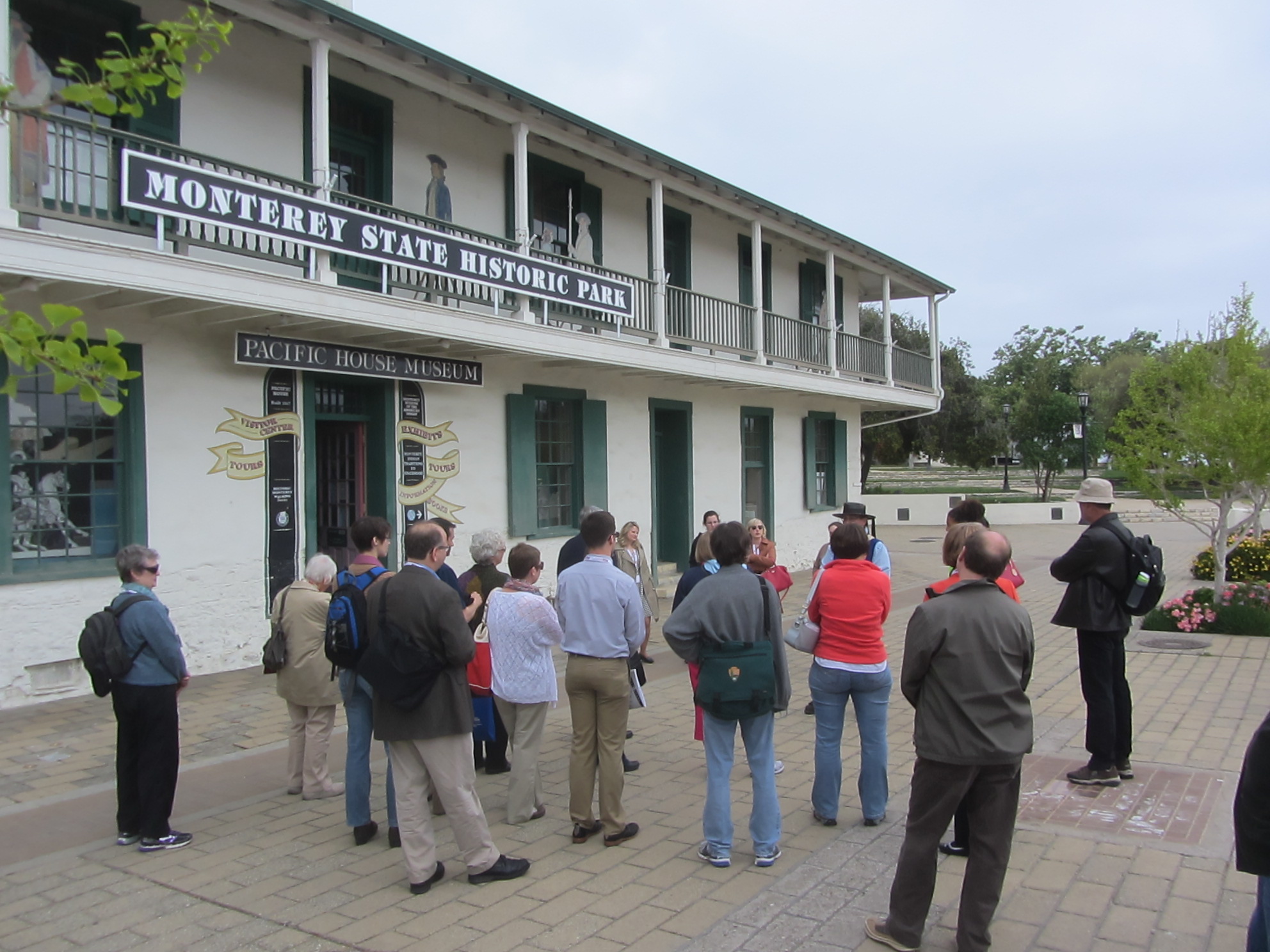
Walking tour of historic Monterey, California.
Heritage tourism is a growing industry that can improve community engagement, economic revitalization, and preservation advocacy. People want authentic and meaningful experiences—and are willing to pay for them. On May 13, 2014 from 12 noon to 1:30 pm Pacific Time, I’ll be presenting a webinar for the California Preservation Foundation exploring the benefits of heritage tourism and how it may (or may not) benefit your community or region. We will examine the latest research on the motivations and interests of tourists (they’re not all alike), how to identify or create destinations that will attract tourists, and how to build support and attract funding for a heritage tourism program. You’ll learn the overall elements of a heritage tourism program and leave with a list of the next steps to take in your community. Although much of the webinar will be focused on California, the principles and process for developing a heritage tourism program will be same for other places. Cost is $45 for CPF members ($60 for non-members) and advance registration is required.
It’s part of a three-part webinar series on economic development using historic preservation from the California Preservation Foundation. For those interested in continuing education credit, it’s available for AIA, AICP, and ASLA.
Program in New England Studies Offering Diversity Scholarships
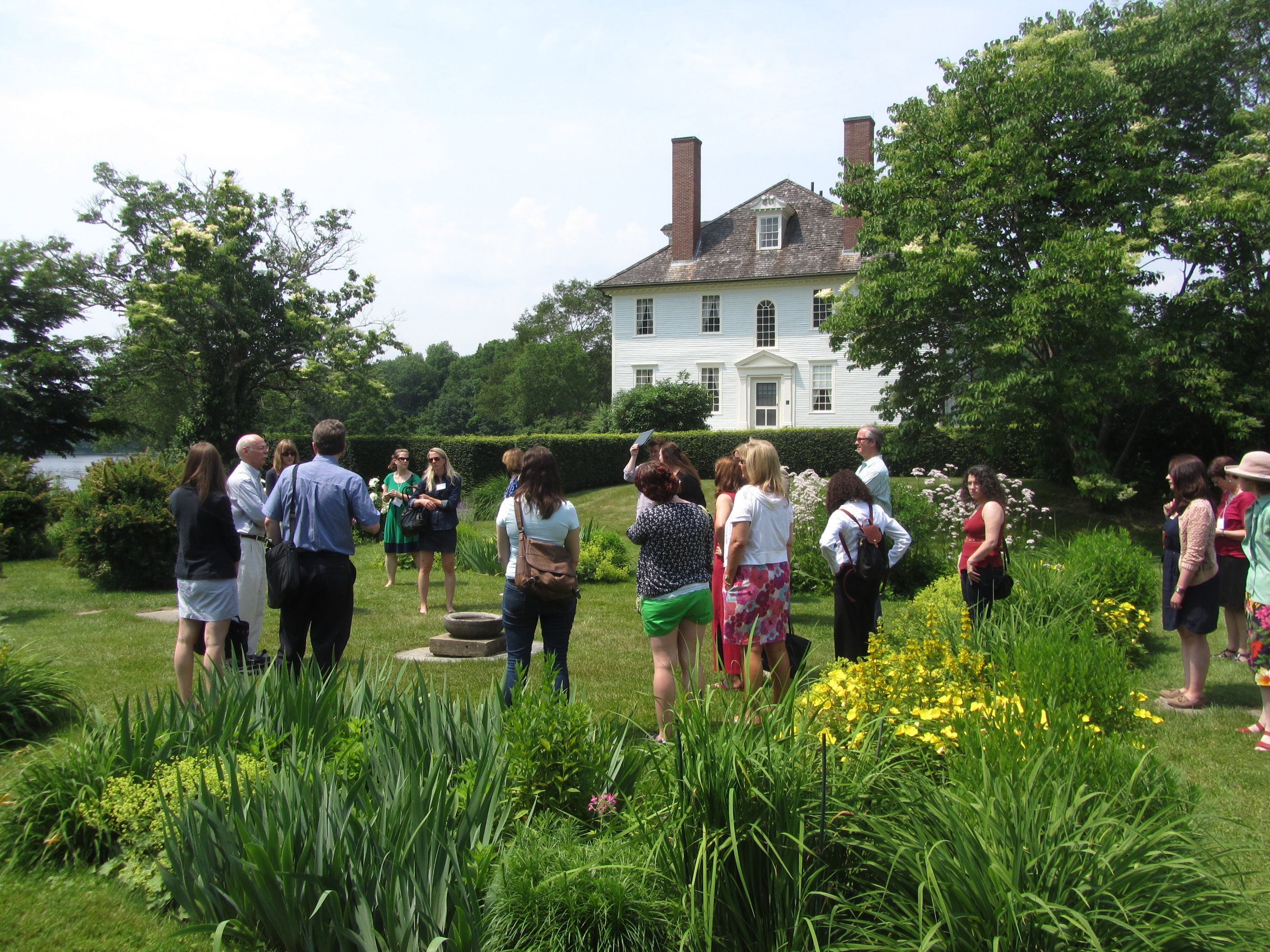
Program in New England Studies at Hamilton House, 2013.
Historic New England presents its Program in New England Studies, an intensive week-long exploration of New England from Monday, June 16 to Saturday, June 21, 2014. Now entering its second decade, the Program in New England Studies features lectures by noted curators and architectural historians, workshops, behind-the-scenes tours, and special access to historic house museums and collections. Last year I had a chance to talk with some of the participants and they said they were attracted by the chance to see the houses and collections, but found that they really loved the expert lectures.
This year, Historic New England launches a diversity scholarship to support a mid-career museum professional or graduate student. Applicants must represent a racial or ethnic minority group in the U.S. The scholarship covers the full registration fee of Continue reading
Period Rooms at a Modern University
During a recent visit to Pittsburgh, I visited the Cathedral of Learning at the University of Pittsburgh. At 535 feet, it’s the tallest university building in the nation and dominates the skyline east of downtown. Despite its name, it’s more skyscraper than cathedral. It’s also an historical and architectural landmark, built between 1926 and 1937 as an Art Deco “cake” with Gothic Revival “frosting.” For those of us working at historic house museums, what’s most interesting are the Nationality Rooms, a series of 29 classrooms on the first and third floors designed and furnished to represent different nations and ethnicities.
The classrooms vary in size but each have Continue reading
 Engaging Places