Category Archives: Marketing

The VRIO Framework: Looking Inward, Thinking Forward

When I was chatting with John Wetenhall, director of the GW Museum, he mentioned a business analysis tool I had never heard of: VRIO. It was a surprisingly lively conversation about whether this corporate framework could apply to museums and historic sites—and it piqued my curiosity. Developed by Birger Wernerfelt in his landmark 1984 article “A Resource-Based View of the Firm,” and later refined by Jay Barney in “Firm Resources and Sustained Competitive Advantage” (1991), VRIO offers a way to evaluate whether an organization’s internal assets truly contribute to long-term success. The acronym stands for Value (does it help the organization exploit opportunities or neutralize threats?), Rarity (is it scarce among competitors?), Imitability (is it difficult to duplicate or substitute?), and Organization (is the organization structured to fully leverage it?).

What began as a theoretical framework for corporations turns out to have practical potential for cultural institutions as well. Tools like logic models and Porter’s Five Forces are helpful, but what about the museum’s internal capabilities? How do we know if our collections, staff, or community ties are truly strategic advantages? Two articles by Paul Knott at the University of Christ Church (New Zealand) offer guidance by critically examining the popular VRIO framework—and how it can work better for cultural institutions.


Insight #1: Strengthening Strategy with an Expanded VRIO Model

In “Integrating Resource-Based Theory in a Practice-Relevant Form” (2009), Knott builds on the traditional VRIO model—Value, Rarity, Imitability, Organization—to create a more actionable and dynamic approach. He emphasizes that internal resources (like a museum’s brand, reputation, or community partnerships) are only strategic if they are used under the right conditions. Critically, he introduces a matrix that shows how the same resource can be a strength, weakness, missed opportunity, or rigidity depending on how it’s managed. This is a significant improvement over the traditional SWOT exercise because it requires you to evaluate each asset or resource with specific questions.

Continue reading

Is Free Admission Really the Key to Unlocking Museum Doors?

Imagine walking into a museum for the first time. The sunlight filters through glass atriums, the smell of polished wood and history greets you, and the quiet hum of curiosity fills the air. For some, this is an everyday experience. For others, it’s a world they’ve never dared to enter. Free admission promises to change that, throwing open the doors to anyone, regardless of their pocketbook. But does it really work? I scanned the journals to see what researchers had discovered.

What Free Admission Gets Right

Let’s face it—free admission has a magnetic pull. People are more likely to take a chance when the price barrier vanishes. Lin (2008) notes that museums offering free access often see surges in attendance. Suddenly, a day at the museum isn’t competing with groceries or a new pair of shoes—it’s a possibility.

In France, Gall-Ely et al. (2007) found that free admission felt like a gift. Visitors talked about how it gave them permission to explore without guilt or second-guessing. Think of it as a universal invitation: “Come in, look around. This is your space, too.” Similarly, Barbosa and Brito (2012) found that open-day events broke the ice, especially for hesitant first-timers. Those who’d never considered a museum visit were finally stepping inside.

Continue reading

Beyond the Mill: Clarke County Historical Association’s Model for Modern Historical Programming

The Burwell-Morgan Mill in Berryville, Virginia, which hosts the Art in the Mill shows in fall and spring.

On a recent road trip through the Shenandoah Valley, we passed through the small but charming village of Millwood (south of Berryville, Virginia). With its historic church, a corner gas station turned into a post office, a hip country store, and an 18th-century stone grist mill, it feels like you’ve stepped back into mid-century America. The mill, dating back to the 1780s, ceased operations in 1943, but thankfully the Clarke County Historical Association (CCHA) stepped in to preserve this important piece of local history. They restored and reopened the mill as a museum, offering milling demonstrations that continue to connect the community with its past—a business that, while no longer economically viable, resonates deeply with those of us who value local landmarks.

Fast forward 80 years, and the CCHA not only continues to produce flour at the mill but has expanded its offerings in creative and impactful ways for a county with 15,000 residents. Today, their mission—”to help preserve the historic resources and records of Clarke County and to foster their use, understanding, and enjoyment through stewardship and education”—may sound familiar, but their approach is anything but ordinary. Their programming stands out as a model for how historical societies can evolve, attract diverse audiences, and ensure long-term sustainability. Here’s a preview of some of the exciting events and initiatives they have planned for this fall:

Continue reading

Reimagining Historic House Museums Workshops Coming to Texas

Reimagining workshop in St. Louis, Missouri.

I’m excited to announce that I’ll be co-teaching two Reimagining the Historic House Museum workshops in Texas this November with Ken Turino, hosted by the American Association for State and Local History in collaboration with the Texas Historical Commission. It’s a big state, so we’re offering it twice! If you’re a museum professional, volunteer, or student interested in exploring fresh strategies for engaging visitors and revitalizing historic house museums, these workshops are a great opportunity to explore new ideas and connect with colleagues.

Why Attend?

Historic house museums are at a pivotal moment, navigating changes in visitor expectations, community needs, and funding models. These workshops are designed to help you tackle these challenges, offering practical solutions for making your house museum more accessible, sustainable, and relevant. By focusing on innovative interpretation, strategic planning, and community engagement, you’ll be empowered to breathe new life into your historic house museum.

What You’ll Learn

This one-day, hands-on workshop explores the most pressing challenges and rewarding opportunities facing historic sites in America today. We’ll delve into the latest social and economic research to help you identify how these trends impact your own house museum, sparking new ideas for growth and engagement.

Throughout the day, we’ll introduce a variety of field-tested tools and techniques drawn from diverse areas like non-profit management, business strategy, and even software development. You’ll hear about innovative historic sites that are successfully adopting new models to engage their communities, offering fresh interpretation and programming, and generating income to boost financial sustainability.

A key highlight of the workshop is our facilitated brainstorming session based on Michael Porter’s Five Forces framework, where you’ll work with fellow participants to reinvent an event or program for an actual house museum. This practical exercise not only puts theory into action but also showcases the power of collaborative thinking to drive change.

Details and Registration

  • Mesquite Workshop (near Dallas): November 12, 2024 – Heritage Plaza Visitor Center
  • Houston Workshop: November 14, 2024 – Bayou Bend Collection and Gardens
  • Cost: $350 for non-members, $225 for AASLH members
  • Registration: Visit AASLH’s website for more information and to sign up. Participation is limited.

I hope to see you there as we explore how to bring new life and relevance to historic house museums. Together, let’s make these vital cultural spaces vibrant, engaging, and sustainable for generations to come!

Demystifying Spending Patterns in Small Museums

In the world of small museums, location and audience significantly influence expenses, rendering a one-size-fits-all approach ineffective. However, gaining insight into the various types of expenses museums incur can shed light on common challenges and their causes. The non-profit financial Form 990 categorizes expenses into five areas, providing a framework for understanding spending patterns. Our goal is to simplify the concept of museum spending and guide museums toward prudent budget management by exploring these key expense categories.

Continue reading

On the Road: Hitting Triples with a Single Artwork

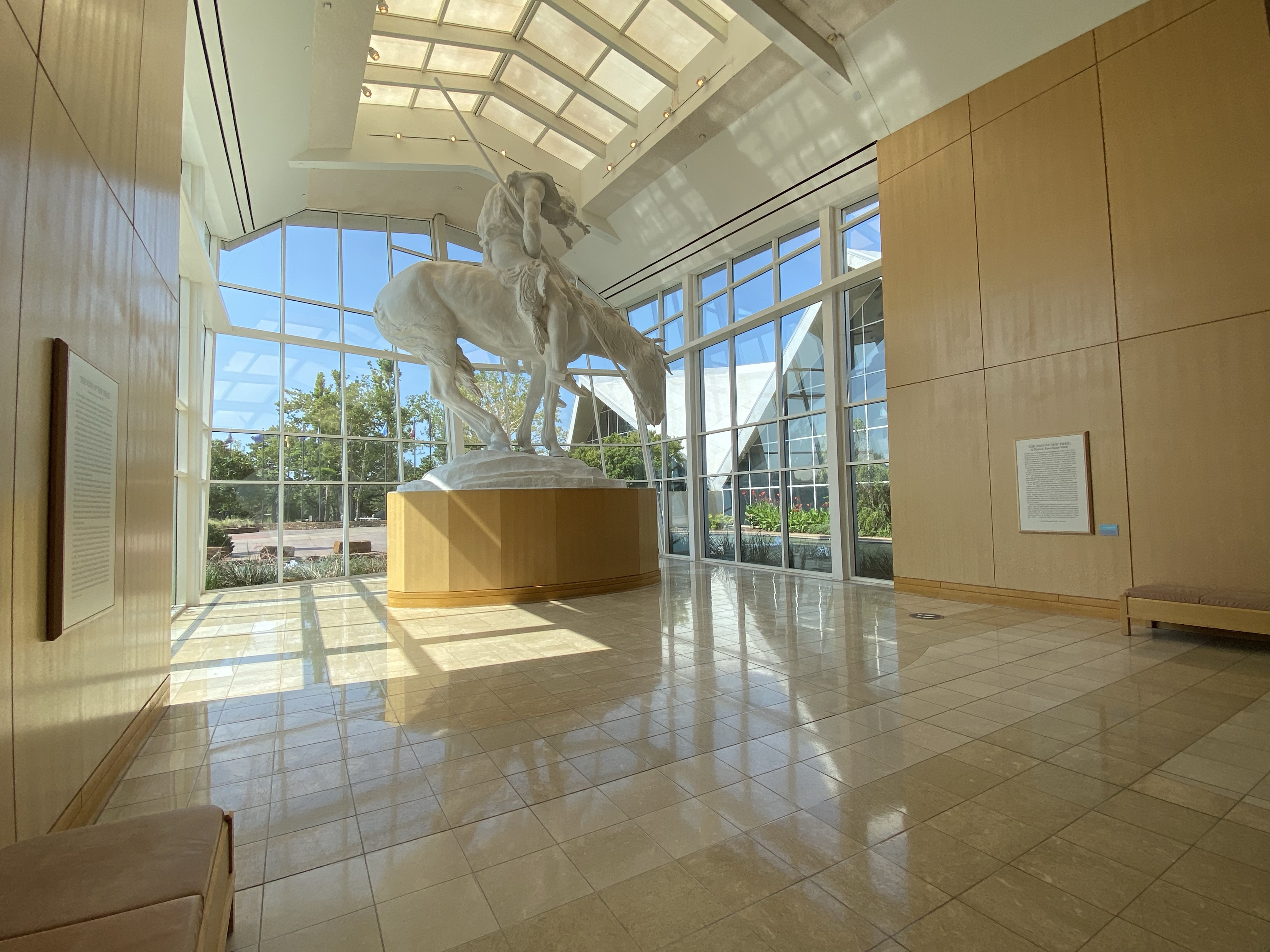
Entrance hall, National Cowboy and Western Heritage Museum, Oklahoma City.

At the National Cowboy and Western Heritage Museum in Oklahoma City, a monumental bright white sculpture of an Indian slouched on a horse fills the end of the entrance hall. James Earle Fraser created “The End of the Trail” for the 1915 Panama-Pacific International Exposition in San Francisco, earning him a Gold Medal. It also became a popular image that signaled the end of a free people.

The Museum acquired the plaster statue from Tulare County (California) Historical Society, where it sat outside in a city park deteriorating for nearly 50 years. Now the restored statue is the centerpiece of this large museum and they’ve used this one object to hit a triple with visitors, to borrow a phrase from baseball.

Along with a typical label describing the sculpture’s creation, acquisition, and significance, it includes a Native American View in a second label of equal length by Dr. R. David Edmunds, a Cherokee. He states that the sculpture represents the popular view of “a nineteenth century Indian warrior defeated and bound for oblivion—frozen in time. By the 1890s, Native Americans knew their trail had become steep and rocky, but they believed it would continue.” The label continues to discuss the challenges and opportunities faced by Native Americans in the 20th century and that “being Indian has never been cast in stone. Today, Native Americans proudly ride forward on a trail into the future.”

The use of labels to provide multiple perspectives is not uncommon in art museums, but I haven’t seen it used enough in history museums. They are ideal places to show that events, places, and eras are experienced differently by different people. It’s an easy way to enrich interpretation without the need to create entirely new exhibitions or special events on women, African Americans, or Native Americans.

Continue reading

Why There? Figuring Out the Presence of America’s History Organizations

As part of a project to develop a new framework for AASLH‘s professional development/continuing education program, I plotted history organizations onto a map of the United States using a subset of IMLS’s database of museums. That’s a big category that includes history museums, historical societies, historic preservation organizations, historic house museums, and general museums that include history as a major topic and while there is some discussion about the comprehensiveness of the IMLS database, it’s the best information we have available and for my project, more than sufficient to get a sense of the big picture.

As you’ll see in the map below, history organizations are mostly located in the eastern half of the US.  Start at the southern tip of Texas and draw an imaginary line due north and the lion’s share is on the right side of the map.

History organizations in the United States. Red is the location of historical societies and historic preservation organizations; green is history museums and house museums; and blue is general museums. Data source: IMLS, 2018. Map: Engaging Places.

That’s probably something we all suspected but now can visualize it better. When I’ve shown this map to a few people, they concluded that it’s because there’s much more history in the East. But take a look at the heat map below while recalling the US history timeline, and you’ll come to a different conclusion. Continue reading

Recent Research on Common Target Audiences for Museums

Students in “Museums and Community Engagement” develop engagement plans through a wide variety of tools and techniques, including crowdsourcing research on target audiences.

This semester my course on museums and community engagement at George Washington University prepared an annotated bibliography of research published in the last decade on audiences that are a common focus for museums in the United States:  students in grades 3-5, families with children under 12 years, and adults over 50 years.  Because most museums don’t have access to academic research libraries, the class has agreed to share their bibliography with the field (link to pdf below).  While the thirty-six articles provide a useful picture of the research for these audiences, please recognize it is not complete nor comprehensive—with twelve students in the course in a fast-moving semester, this is just to get them started on a community engagement plan for the Alexander Ramsey House, Joel Lane House Museum, and Van Cortland House.

Highlights of Recent Research on Common Target Audiences for Museums 2019

Reimagining House Museums: Fall 2019 Release

collage book contents.pngThis blog has been fairly sparse this past year because Ken Turino and I were editing and assembling two dozens essays for Reimagining Historic House Museums: New Approaches and Proven Solutions, an anthology to be published by Rowman and Littlefield as part of the AASLH series. I’m delighted to announce that it is now off my desk and in the hands of the publisher; we expect it will be released in fall 2019.

One of the biggest consequences of the under-resourced and over-stretched community of house museums is that it is difficult for them to share their successes with others—they just don’t have time. The field doesn’t learn about them except through publications, blog posts, or conference sessions—that’s one of the major reasons we assembled this anthology. There’s lots of good work happening in house museums but we’re simply not aware of it. Our hope is that this book is a good place to grab a hold of the current thinking about reinventing house museums so that they are more relevant, sustainable, diverse, inclusive, equitable, and accessible, hopefully broadening and deepening the current conversations in the field.

The book is a result of a 2014 conference, How are Historic House Museums Adapting for the Future? sponsored by the Historic House Museum Consortium of Washington, DC and the Virginia Association of Museums at Gunston Hall Plantation in Virginia. They invited to give presentations to the 120 participants and noticed that while historic site practitioners and their boards recognized that the world of historic houses has changed dramatically, they weren’t sure how to go about reimagining or reinventing themselves.

With the support of the American Association for State and Local History and local funders, we embarked on a series of workshops in subsequent years to lay out a “reinventing process” that has taken us to Missouri, New Hampshire, Vermont, Kansas, Pennsylvania, Wisconsin, and Illinois with more to come (Washington, DC in June; New York City in October). The one-day workshop, Reinventing the Historic House Museum includes an analysis of the most important opportunities and threats facing historic sites in America based on the latest Continue reading

Met Museum Segmenting Visitors to Improve Its Online Collections

The Metropolitan Museum of Art recently shared the results of its research on the users of its online collections, which approach about 600,000 visitors per month.  Digital analyst Elena Villaespesa collected information on motivations and knowledge through Google Analytics, heat maps, and an online survey to develop six core user segments: professional researchers, student researchers, personal-interest information seekers, inspiration seekers, casual browsers, and visit planners.  This typology will help the museum “plan new content and prioritize production of new features for the online collection” and is a finer version of the “stroller/streaker/scholar” categories that are often used by museum educators.

Using visitor research to plan and design the online collection is good application, but the article also points out several other ideas that will be useful to history museums and historic sites: Continue reading