Category Archives: Objects

Boston MFA takes Flight with New American Wing

This slideshow requires JavaScript.

The Boston Museum of Fine Arts, one of the great public museums established just after the Civil War, has recently opened “Art of the Americas,” a new wing filled with its outstanding collections of American fine and decorative arts.  As some of you know, the Boston MFA underwent a controversial restructuring more than a decade ago, shifting from departments organized by media (e.g., paintings, ceramics, furniture) to geography (e.g., Europe, Asia, and America) and firing some longtime curators (including Jonathan Fairbanks, who created the American Decorative Arts and Sculpture department at the MFA).  I’m assuming one of the results of this restructuring is “Art of the Americas.”  This four-story exhibit consists of 53 galleries tracing the history of art from pre-Columbian to Modern periods for the continents of North and South America, so along with the expected Chippendale chairs and Copley portraits, there are Peruvian funerary urns and Acoma pots.  It’s so large that it took me nearly three hours just to cruise through it at a walking pace and I didn’t make it to the fourth floor, which explored the 20th century.

Unlike most art museums, the exhibit mixes Continue reading

IMLS’ Revised Grant Guidelines Need Revision

In May, the Institute of Museum and Library Services (IMLS)–the national agency devoted to museums and libraries–released a new set of proposed guidelines that would significantly revise their grant programs for museums (and that includes historic sites, historical societies, house museums, and preservation organizations).  Initially, these changes were proposed to go into effect without comment from the field, but fortunately enough museums spoke up that director Susan Hildreth changed her mind and announced she would welcome comments–but the comment period ends on Friday, July 6, 2012.

According to IMLS, the guidelines affect the Museums for America and National Leadership Grants for Museums programs, however, the impact is much larger because these programs are proposed to consume two other grant programs: Conservation Project Support and 21st Century Museum Professionals.  Claudia French, deputy director for museums, proposed the changes so that the grant programs would align better with the IMLS strategic plan and make it easier for grantees and IMLS staff.

Here are the major changes that caught my eye:

1.  One deadline to rule them all:  January 15.  Currently, the deadlines for Continue reading

Earthquake in Northern Italy destroys Historic Sites

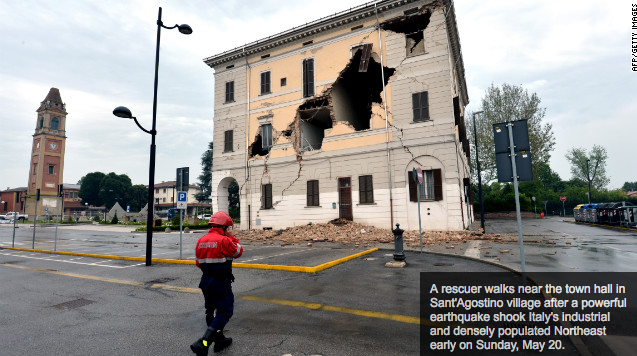
The Town Hall in Sant’Agostino, Italy, damaged by Sunday’s earthquake.

On Sunday morning, the area near Bologna in northern Italy was struck by a major earthquake with aftershocks occurring today.  Damage to historic buildings is significant and about seven people have died.  Information is still coming in but the latest on CNN (with many photos) is:

Northern Italy was shaken by an aftershock Monday morning, a day after a magnitude-6.0 quake killed at least seven people and left thousands of survivors huddling in tents or cars overnight. Continue reading

A Collections Loan that Would Prompt a Career Change

The Farm by Joan Miro (1921-2).

The National Gallery of Art in Washington, DC, holds “The Farm,” one of Joan Miro’s masterpieces and its provenance makes for a great story as told by Jim Conaway in “Getting the Picture” in the May 2012 issue of Washingtonian.  Here’s a glimpse into its complex history when the painting was owned by Ernest Hemingway and slated for an exhibition loan:

Alcohol–and his own vituperation–was catching up to Hemingway by 1959, when, then on his fourth and final wife, Mary, he agreed to loan “The Farm” to the Museum of Modern Art.  Hemingway was nervous about exposing the painting to the hostilities stirred by Fidel Castro’s revolution while trying to get it out of the country [Cuba].  He insisted that the museum insure “The Farm” and send an emissary to squire it back to New York, but no company would issue such a policy.

Hemingway finally agreed to let the museum’s emissary, David Vance, take the painting, but he ran into roadblocks:  Continue reading

Q&A: Managing Collections at Historic Sites with Terri Anderson

Terri Anderson

Terri Anderson is swapping history collections for art when she joins the Corcoran Gallery of Art next week as a Contract Registrar to help them migrate their collections database from Filemaker to TMS (The Museum System).  For the past five years, she has focused her work on collections management at the 29 National Trust Historic Sites as the John and Neville Bryan Director of Collections at the National Trust for Historic Preservation, where she also taught collections management for George Washington University and became one of the national leaders on the challenges of deaccessioning collections at historic sites.  With this transition, I thought it would be a good time to capture some of her thoughts about managing collections at historic sites.

Max:  You’ve been managing the collections of the National Trust for the last five years–what have been the major successes?

Terri:  Our most visible successes were opening several Sites to the public for the first time, including the Philip Johnson Glass House in New Canaan, Connecticut; President Lincoln’s Cottage in Washington, DC; and Villa Finale in San Antonio, Texas. Each of these Site openings required many important decisions about collections stewardship and access, and each Site demanded a different approach: one size did not fit all.

At the same time, we had successes that, while less visible, were important to me and the parties involved.  We did a lot of great work with thoughtful, appropriate deaccessions at several of our Sites.  I wrote about our experiences in Continue reading

Why We Have Curators and Collections Managers

Times are tough and many museums and historic sites wonder about the value of keeping curators and collections managers on the payroll.  What do they do besides sit in their offices all day?  Well, boardmembers and CEOs, they keep an eye on your most valuable assets.  The University of California Berkeley, that fine institution of learning, provides a useful lesson on what happens when you don’t have curators or collections managers involved in managing your artifacts.  According to the New York Times:

Everybody misplaces something sometime. But it is not easy for the University of California, Berkeley, to explain how it lost a 22-foot-long carved panel by a celebrated African-American sculptor, or how, three years ago, it mistakenly sold this work, valued at more than a million dollars, for $150 plus tax. The university’s embarrassing loss eventually enabled the Huntington Library, Art Collections and Botanical Gardens, a large museum and research center in San Marino, Calif., to acquire its first major work by an African-American artist.

Fortunately, there’s a happy ending to this tale for the object, the artist, and the museum–but the university has egg on its face. First, for not recognizing and properly caring for a significant work of art and secondly for disposing of it for so little money. I’m not surprised. Most colleges and universities are notorious for treating their historic sites and museum collections poorly (have we forgotten about the University of Southern California’s long mistreatment of Frank Lloyd Wright’s Freeman House or Cal Poly Pomona’s neglect of Richard Neutra’s VDL House?).

For the complete story, see “Berkeley’s Artwork Loss Is a Museum’s Gain” by Carol Pogash in the New York Times (February 20, 2012) and Huntington Library Acquires Sargent Johnson Monumental Depression-Era Sculpture in Black Artist News (June 22, 2011).

For Lovers of New England: A Week on the Road in June

Discover the rich history of the region with Historic New England’s Program in New England Studies, an intensive week-long exploration of New England from Monday, June 18 to Saturday, June 23, 2012.  The Program in New England Studies includes lectures by noted curators and architectural historians, hands-on workshops, behind-the-scenes tours, and special access to historic house museums and museum collections. The program examines New England history and material culture from the seventeenth century through the Colonial Revival. Curators lecture on furniture, textiles, ceramics, art, and wallpaper and cover their history, craftsmanship, and changing methods of production. Architectural historians explore a timeline of regional architecture starting with the Massachusetts Bay styles of the seventeenth century through the Federal and Georgian eras, to Gothic Revival and the Colonial Revival. Participants visit historic sites and museums with curators and enjoy special receptions.

Expert lecturers include:

  • Richard Candee, professor emeritus, Boston University
  • Cary Carson, retired vice president of the research division at Colonial Williamsburg
  • Abbott Lowell Cummings, former director, Historic New England Continue reading

Field Trip: Homestead Museum in California

This slideshow requires JavaScript.

Last week I had a chance to visit with my colleagues at the Workman and Temple Family Homestead Museum in the City of Industry, California.  I was the assistant director there a decade ago and it continues to be a special place to me (if you haven’t visited, it has great architecture and a great story).  After a generous lunch with the staff, director Karen Graham Wade and some of her staff took me to see the Workman House, the earliest house on the site.  It’s undergoing extensive interior rehabilitation to make it more suitable and attractive as an exhibit gallery.  It’s part of a major effort to respond to the changing interests of their visitors by increasing the self-guided experiences.  They are also reducing the number of days per week the Homestead Museum will be open for walk-in public tours and  increasing the number of days they’ll be open for tours by appointment and for other activities.  At La Casa Nueva, the second house on site, they are Continue reading

Pine Point: Interpreting a Vanished Town

Pine Point, an interactive Web documentary by The Goggles.

Last week I had a chance to visit Bill Adair, director of the Heritage Philadelphia Program and one of the co-authors of the new book, Letting Go?:  Sharing Historical Authority in a User-Generated World.  As usual, we had a wide ranging discussion which included his interest in the work of The Goggles, an award-winning Canadian design group headed by Paul Shoebridge and Michael Simons.  He was particularly taken by “Pine Point,” an interactive web documentary about a northern mining town that closed in 1988 and was demolished.  Through oral histories, documents, video, and artifacts, the story of this ghost town is told in a mesmerizing scrapbook style.  If you’re looking for a way to interpret a place in a new way on the Web, this might provide some inspiration.

Take Advantage of the Ten Cultural Trends for 2012

JWT Intelligence has just released its Ten Trends for 2012 based on surveys of Americans and Britons and interviews with experts and influencers.  If you can’t afford to buy copy of their full report for $250, here’s a summary plus some suggestions for taking advantage of them:

  1. Navigating the New Normal:  The economy won’t be back to the way it was for some time, so consumers are now becoming price conscious by habit.  Consider stripped down offerings (such as smaller sizes of products in your museum store) or some access at lower cost (such as a “grounds only” admission fee).
  2. Live a Little:  Although they don’t want to pay a lot, visitors are becoming anxious to splurge on a few good things responsibly.  Adjust your programs so they promote both the fun experience and extraordinary aspects of your site (and be sure you can deliver it–just saying your tours are fun and extraordinary doesn’t make it so).
  3. Generation Go:  20-somethings are struggling Continue reading