
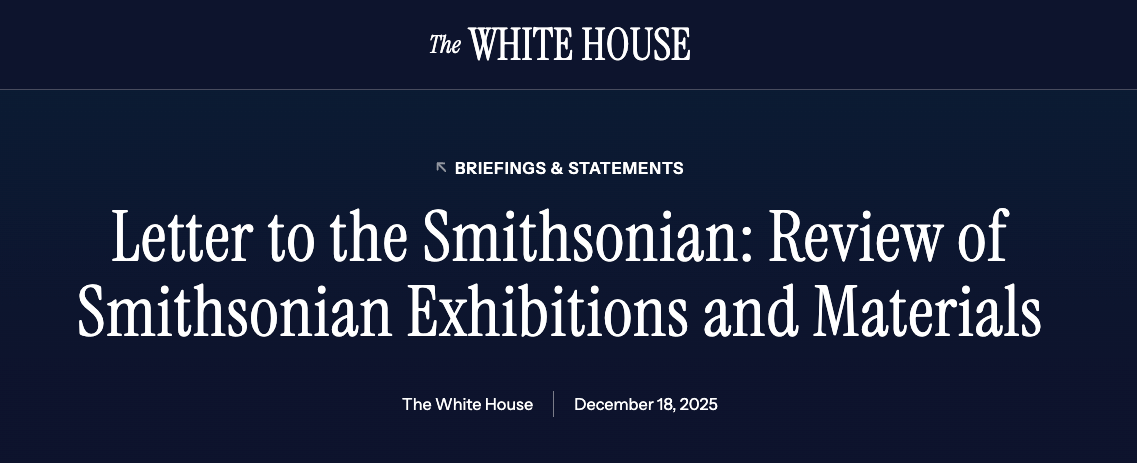
In December 2025, the White House sent a letter to the Smithsonian Institution requesting extensive documentation related to exhibitions, educational materials, internal processes, and collections. The request followed an earlier directive tied to an executive order and was framed as part of federal oversight.
In principle, this kind of oversight is not only appropriate—it is necessary. The President and senior staff have a responsibility to ensure that federally-funded institutions are operating effectively and that public resources are protected from waste, fraud, or abuse. Museums, like any other organizations that receive public funds or tax exemptions, should expect scrutiny and be prepared to demonstrate sound management and professional standards.
What concerns me is not the idea of oversight, but the scale, scope, and apparent purpose of this particular request. From a museum management and governance perspective, much of what is being asked for would require significant staff time to assemble, while providing little information that would actually inform decisions about efficiency, risk, misuse of funds, or as they phrased it, “Americanism.”

As someone who has worked with museum boards, executive directors, and city councils for more than three decades, I see troubling patterns here—patterns I have seen before, much closer to home.
First, I’ll share my open letter to Vince Haley, Director of the Domestic Policy Council, and Russell Vought, Director of the Office of Management and Budget, then I’ll relate this to museums and historic sites.
Continue reading
 Donald J. Trump’s election to the U. S. presidency is a shock to many pundits and career politicians because he never held elected office and didn’t seem to care about politics or government, except as it might benefit his businesses. His interest is business, following his father into real estate and receiving his bachelor’s degree in economics from the Wharton School, and then pursuing real estate development, professional sports, beauty pageants, for-profit education, branding and licensing, and entertainment. While the 2016 campaign will be heavily analyzed for years to understand its unfolding, my sense is that it’s not just about “change,” but a change in the skills and qualifications required for effective leadership. It’s no longer about mission, vision, or values, but the expertise and perspective of independent business entrepreneurs. And it’s a trend I’ve been witnessing in house museums and historic sites as well.


 Engaging Places