Category Archives: Resources

New Guide: Writing Professional Memos for Museum Work

Over the years, I’ve noticed something consistent in my museum management courses: graduate students are well-prepared to write academic papers, but many struggle when asked to write professional memos—the format that museum directors, CEOs, and board members actually read.

This isn’t a flaw in their abilities; it’s a mismatch between what universities traditionally teach and what museums need. Academic writing is designed to demonstrate thinking. Managerial writing is designed to support decisions.

In the museum field, we write memos all the time—to recommend actions, summarize findings, or prepare leaders for decisions. That’s why many of the assignments in my courses require students to write to a real audience: a museum director, board chair, or CEO. Students practice being clear, concise, and actionable—skills that will serve them throughout their careers.

At recent professional conferences, I’ve also heard colleagues say that emerging professionals often struggle with executive communication. They know their subject matter, but don’t always know how to structure recommendations for decision-makers. Supervisors want to help, but explaining “how to write a memo” can be surprisingly difficult without concrete models.

For years, I’ve used the FranklinCovey Style Guide for Business and Technical Communication as the foundation (available free online). It offers excellent standards and a managerial memo structure that aligns beautifully with museum leadership needs.

Still, many students found it challenging because executive writing feels so different from college writing. So I created a new two-page memo about memos: “Writing Professional Memos in Managerial Format” (available as a free download at the end).

Continue reading

Eight Ways to Engage Visitors at Museums and Historic Sites

Move beyond what we tell visitors to what they actually do—and discover how eight types of experiences can deepen learning and meaning.

When we think about interpretation in museums and historic sites, we often focus on what we want to say—the stories, facts, and insights that bring history to life. But what if we focused instead on what visitors do?

That simple shift—from content to experience—changes how we design tours, exhibitions, and programs. It encourages us to move beyond “telling” and toward engaging, offering visitors a range of ways to learn, reflect, and connect.

Recently, I’ve been revisiting an idea from educational research called the Eight Learning Events Model, developed at the University of Liège in Belgium. It identifies eight ways people learn: receiving, imitating, practicing, experimenting, exploring, creating, debating, and reflecting. Although the language in their articles is academic (and a bit European in tone), the concept translates beautifully into the world of museums. With a little adaptation, I’ve reimagined these eight learning events as the Eight Ways to Engage Visitors.”

A Spectrum of Engagement

At one end of the spectrum, visitors receive information. They listen, read, or watch as museums provide structure and context—through a guided tour, an introductory panel, or a short video.

The next few experiences—observing, practicing, and experimenting—invite more active participation. Visitors watch a demonstration, try out a skill, or test how something works. These steps increase a visitor’s sense of agency. The museum moves from telling to showing to inviting.

Continue reading

What Should Stay, Grow, or Go? Let the Impact–Sustainability Matrix Help

Back in 2014, I shared a classic business matrix as a tool to help museums and historic sites think more strategically about their programs and activities. It plotted mission alignment on one axis and financial sustainability on the other, providing a quick visual way to categorize whether something was worth continuing, needed revision, or should be reconsidered altogether, using metaphors of stars, hearts, cash cows, and bunnies.

The response was strong—many found it useful for internal discussions, staff retreats, and board meetings. But since then, my thinking has evolved.

Over the last decade, I’ve come to see that we need a broader lens. It’s not enough to think about money and mission alone. Sustainability today must account for more than just dollars, and impact is shaped not only by mission statements, but also by vision and values.

A Matrix for Today

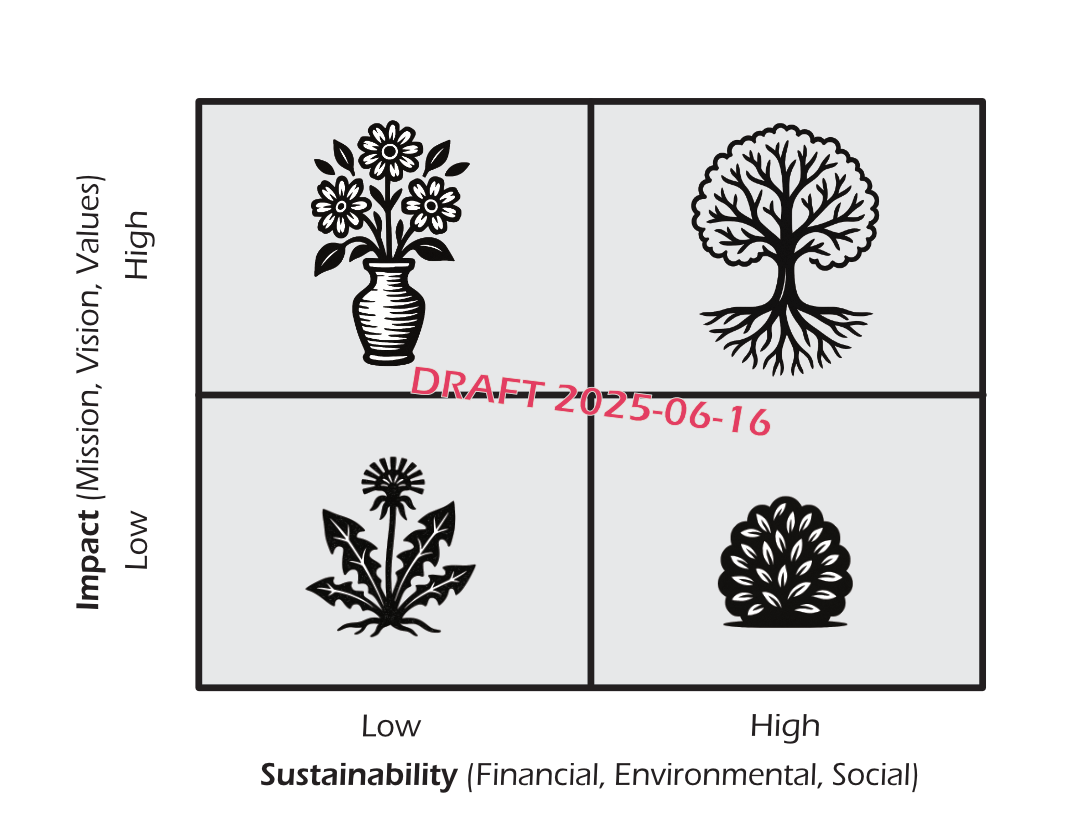
Here’s the updated version:

  • The vertical axis is now Impact, encompassing not just your mission but also your vision and values—your full organizational purpose.
  • The horizontal axis is now Sustainability, which considers financial, social, and environmental dimensions.

This updated Impact-Sustainability Matrix helps museum professionals assess whether a program or initiative is aligned with what matters most and whether it can endure in a resource-constrained world.

A Living Metaphor: From Bloom to Root

To make the matrix easier to understand and more memorable, I’m using a botanical metaphor. Every program or initiative can be thought of as a kind of plant—some deeply rooted and thriving, others beautiful but short-lived, and a few that are sadly distractions.  I’m not sure if the metaphor is as clear and apt as my previous star/heart/cash cow/bunny matrix, so I’d love your thoughts and suggestions in the comments below. 

Below are descriptions of each quadrant using this metaphor:

Continue reading

Job Hunting in Tough Times: Three Books for Museum Professionals

The museum field has always been a challenging place for job seekers. Even in the best of times, there are often more talented people than positions available, and salaries tend to lag behind comparable roles in business or government. But with the recent elimination of federal funding through IMLS and NEH, and with looming threats of layoffs at the Smithsonian Institution, National Park Service, and National Gallery of Art, the situation is becoming even more precarious. I’m deeply concerned about what lies ahead for our field, not just for those losing jobs, but for the ripple effects on institutions, communities, and careers.

Fifteen years ago, I faced a similar moment when the National Trust for Historic Preservation laid off about a third of its staff. I was fortunate: I had a generous severance package and a consulting project waiting (thank you, Jim Vaughan!). But not everyone will be so lucky this time. In that difficult season, a few books proved invaluable to me, and I strongly recommend them to anyone now facing an unexpected job search:

Continue reading

Video: Chicago Style Basics

Strong research and writing skills are essential for museum professionals, whether you’re publishing an article, preparing grant proposals, or mentoring new colleagues.
That’s why I created a new eight-minute video, Chicago Style Basics, to introduce the fundamentals of citation and documentation using the Chicago Manual of Style — just updated with its 18th edition ($75!).

The video walks through what a citation is, why citations matter, and the basic parts of a properly formatted citation. It also provides real examples of how to cite a book with one author, a chapter within a larger book, and a journal article — essential formats for anyone writing in our field. The video closes with a quick summary and a few resource suggestions for those who want to dig deeper.

At the Museum Studies Program at George Washington University, we require our graduate students to demonstrate professional-level research and writing, and this video was created to support those expectations. But it’s also a useful refresher for anyone preparing manuscripts for publication, developing course materials, or helping new professionals get their footing.

You can watch Chicago Style Basics at https://youtu.be/X9c1DQEcwhw.

I hope you’ll find it a handy reference — and please feel free to pass it along to anyone who might appreciate a refresher.

History Redacted? What Museums Can Do About Censorship and Content Restrictions

Across the United States, museums and historic sites are feeling the pressure of growing efforts to limit how history is interpreted and shared with the public. Whether it’s school boards restricting curricula, exhibitions removing stories about women or African Americans, or state legislatures targeting specific narratives, the landscape for public history is shifting. Two recent statements—one from national associations of professional historians and another from a leading association of history organizations—offer timely guidance for navigating this challenge.

Upholding Academic Freedom and Public Access to History

In their joint statement, the American Historical Association (AHA) and the Organization of American Historians (OAH) raise alarm over federal directives aimed at censoring public-facing historical content. Specifically, they object to restrictions on the use of terms like “diversity,” “equity,” and “inclusion,” as well as efforts to remove access to resources about gender, race, and immigration history across government platforms. These actions, the associations argue, “deny the American public access to the complex, nuanced, and evidence-based historical knowledge that is essential to democratic society.”

For museum professionals, this serves as a reminder that we are not only stewards of collections but also of public understanding and trust. AHA and OAH call on historians–including those in museums and historic sites–to resist these pressures by reaffirming their commitment to historical accuracy, critical inquiry, and public service. The practical takeaway? Review interpretive plans, online content, and programs to ensure they are grounded in evidence-based scholarship, even–and especially–when the topics are politically charged.

Standing with the National Park Service: A Sector-Wide Response

Continue reading

IMLS Targeted for Elimination—How Museums Can Prepare and Advocate

On March 14, 2025, President Trump issued an Executive Order directing the elimination of the Institute of Museum and Library Services (IMLS) and the Woodrow Wilson Center at the Smithsonian Institution “to the maximum extent consistent with applicable law.” While the full impact of this order is still unfolding, museums that rely on IMLS resources should take immediate steps to safeguard critical information. IMLS websites and databases may be taken down soon, limiting access to funding guidelines, research reports, and professional development materials. If your institution depends on these resources, now is the time to download and archive what you need.

If your museum has an active IMLS grant, there’s reason to believe that existing awards will be honored, but based on past experience with federal grant funding disruptions, delays are highly likely. Be proactive in communicating with your IMLS program officer, tracking your grant-related expenses, and preparing contingency plans for potential funding interruptions.

This Executive Order may also signal broader cuts to federal cultural funding. It wouldn’t be surprising to see similar threats to the National Endowment for the Humanities (NEH), National Endowment for the Arts (NEA), National Gallery of Art, and even the Smithsonian Institution. If these agencies are reduced or eliminated, the impact on museums, historic sites, and cultural organizations nationwide will be profound.

If your museum is affected by these potential cuts, now is the time to act. Inform your board, staff, members, and community stakeholders about what this means for your institution. Contact your elected representatives in Congress and urge them to protect federal support for museums, libraries, and cultural heritage. Without direct advocacy from the field, lawmakers may assume these cuts will go unnoticed.

For more details, see the full Executive Order here: White House Executive Orders.

Continue to speak up! Museums, historic sites, historical societies, and libraries matter—let’s make sure Congress knows it.

Building Lasting Museum Connections: The Four Levels of Audience Engagement

Imagine this: you’ve spent weeks planning a concert at your local history museum. You’ve arranged every detail, from booking a fantastic band to setting up the stage. The chairs are perfectly aligned, the lighting is just right, and the atmosphere feels full of possibility. But as the start time approaches, your excitement gives way to nervous glances at the clock. The parking lot remains empty. You keep hoping someone will arrive late, but after ten minutes, the seats are still vacant. The band—thankfully understanding—decides to use the time to practice, and while their music fills the room, you’re left grappling with embarrassment and frustration. Just a week earlier, a similar concert you organized thirty miles away had a packed house. What went wrong this time? How could the results be so different?

That happened to me early in my museum career and it was a humbling lesson. Perhaps you’ve faced similar moments—community events that fell flat, partnerships that fizzled, or publicity that didn’t attract attention. It’s easy to feel defeated when a community group declines to collaborate because their priorities don’t align, or when a business association’s objectives clash with the mission of interpreting artifacts rather than hosting public events. Sometimes, the problem is simply bandwidth—not enough staff to attend community meetings or follow up with volunteers. Community engagement can feel like a puzzle with a lot of missing pieces. But with the right tools, those challenges can transform into opportunities.

Continue reading

Sustainable Museums in Action: Key Takeaways from the NEMA Conference

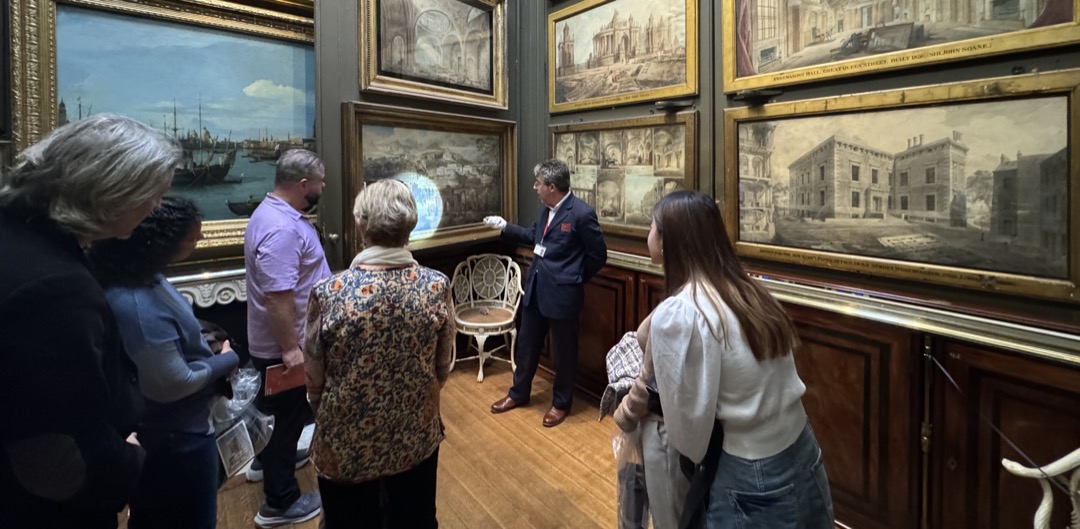
This session on the sustainability initiatives at the Rhode Island School of Design Museum was among the first sessions at NEMA 2024.

Last week I attended the New England Museum Association 2024 Conference in Newport, Rhode Island. About 800 museum professionals attended over the three days of sessions, vendor displays, professional affiliation group meetings, and receptions. The weather was sunny and sixties, surprisingly warm for the first week of November. Without the crowds of summer, it made Newport much more pleasant.

The conference offered numerous sessions on sustainability, and I’m attending as many as possible in preparation for my upcoming course, “Creating Sustainable Museums,” at George Washington University this spring.

In the session “Climate Emergency and Sustainability Taskforce at RISD,” several staff members from the Rhode Island School of Design Museum shared insights on their in-house sustainability efforts. What began as informal conversations among a few staff members evolved into a formal task force that resulted in the “Take Care” exhibition. Staff from all areas of the museum—not only curators and educators—selected objects from the collection and created interpretive labels addressing sustainability themes. In addition to this curatorial approach, the museum implemented practical sustainable practices, including standardizing frame sizes, reusing exhibition cases, turning off cameras in virtual meetings, and eliminating admission stickers and vinyl lettering.

Continue reading

Learning Outcomes for the Semiquincentennial

In a previous post, I offered a detailed guide on using the “Verbs for Significant Learning Outcomes” framework. However, I find that many people benefit from concrete examples, particularly when it comes to the deeper learning experiences—the “yellow” ones related to the human dimension, caring, and learning how to learn.

As a case study, let’s use the “Unfinished Revolutions” theme from the Making History at 250: The Field Guide for the Semiquincentennial:

In the United States, the fight for liberty, equality, and justice has a long and complex history. Through formal politics, grassroots organizing, boycott, protest, litigation, war, and a wide range of other mass and individual actions, people have continually challenged America to live up to our highest ideals—often drawing on ideas expressed in our founding documents. Before, during, and after the Revolution, people have fought for their rights to life, liberty, and the pursuit of happiness and worked tirelessly to secure the blessings of liberty for themselves and their posterity. This history is not a consistent march of progress, but a complex story full of both advancements and setbacks. These stories reveal the ways the Revolution began before 1776 and reverberates through to the present.

Examples of Outcomes

Some potential outcomes for adults during a two-hour visit to a history museum or historic site based on the Unfinished Revolutions theme are:

Foundational Knowledge

1. Visitors will identify three key figures and three pivotal events in U.S. history that significantly contributed to the fight for liberty, equality, and justice.

2. Visitors will describe two core principles from the U.S. founding documents and their influence on major social justice movements.

3. Visitors will define and contextualize three essential terms related to equality and fairness, such as civil rights, freedom, and suffrage.

Application

Continue reading